The Doctrine of Simony
A Theological Retrieval and Appraisal
Conley Owens



A Theological Retrieval and Appraisal
Simony is an earnest desire to buy or sell something spiritual or something annexed to a spiritual thing.
—Thomas Aquinas
The prohibition of simony filled canon law from the patristic period, occupied the schoolmen, and entered the confessional standards of the Reformation. Today, most Christians have never heard the word.
The Doctrine of Simony brings that scattered inheritance into a single account, expounding simony’s definition clause by clause and recovering the tradition’s answers to the standard questions that accompanied it. What does Scripture say of the sin? How severely should it be regarded? How may a minister receive support without committing it?
The book then addresses the practices of our own day that run afoul of that doctrine. The Protestant Reformation itself began in a dispute over the sale of spiritual things. What new reformation awaits a church that learns again to discern the sin of simony?
non ut pretium operis vel laboris, sed ut sustentationem ministri
Ministry should be supported, not sold.
Conley Owens is a pastor at Silicon Valley Reformed Baptist Church. He lives with his wife and ten children in Sunnyvale, California.
The Doctrine of Simony
A Theological Retrieval and Appraisal
Conley Owens
The Doctrine of Simony: A Theological Retrieval and Appraisal
Copyright © waived 2026 by Conley Owens
Published by Dorean Press
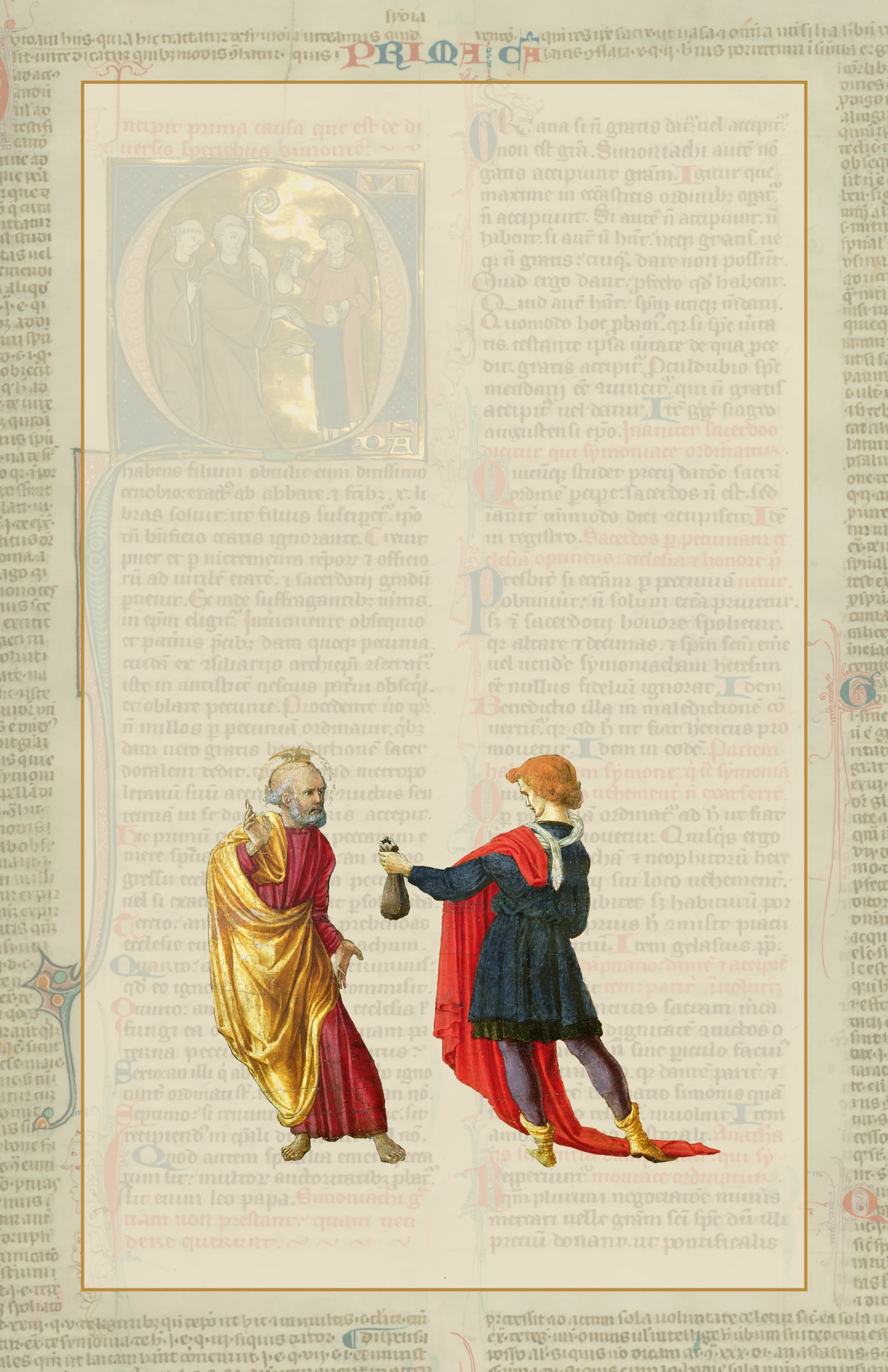
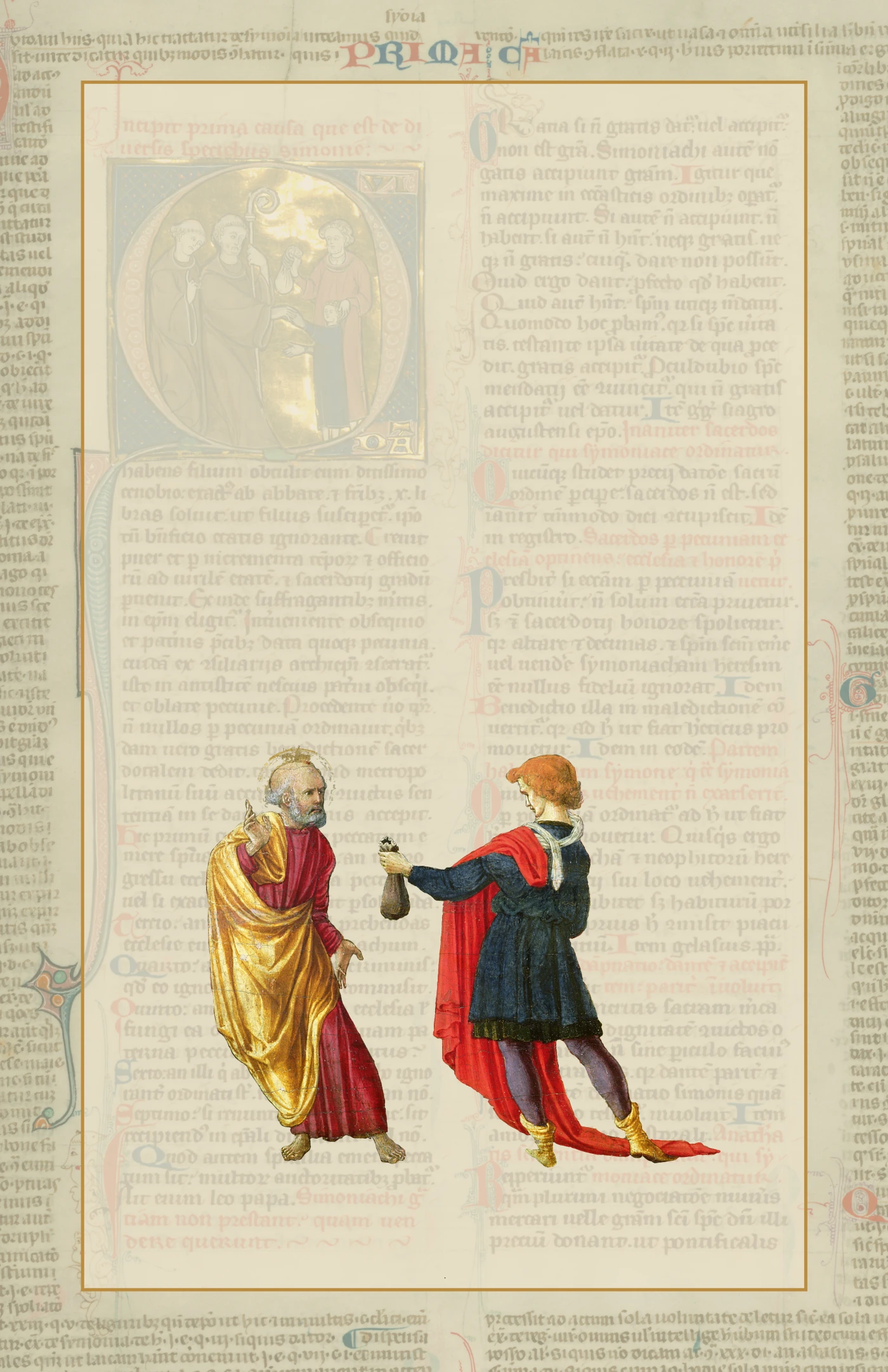
Cover, background: Gratian, Decretum, Hainaut, ca. 1280–90; Walters Art Museum, Baltimore, Ms. W.133, foll. 86v–87r—the historiated initial on 87r opening Causa 1, on simony.
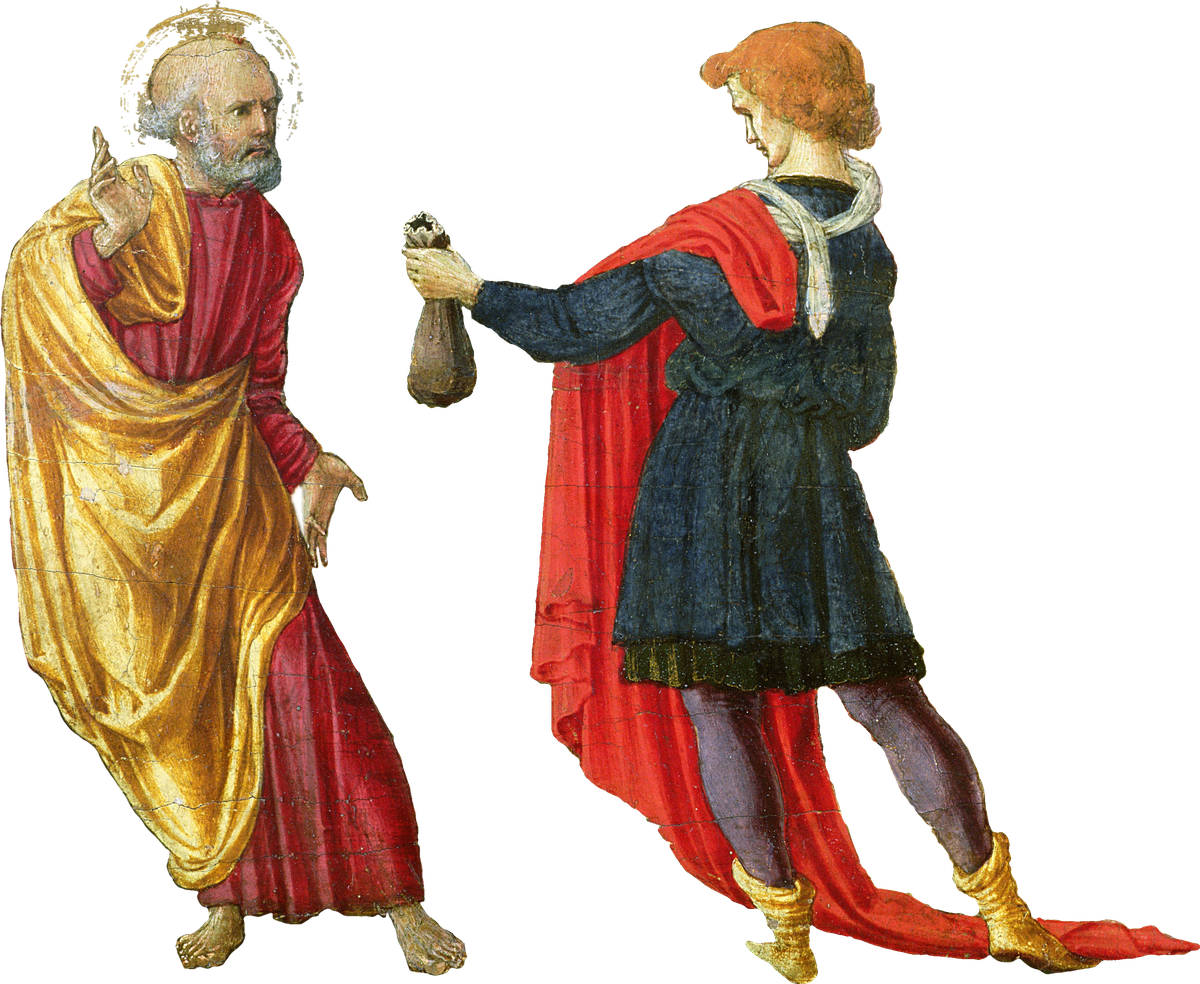
Cover, foreground: Liberale da Verona (attributed), Simon Magus offering St Peter money for the power of conferring the Holy Spirit, ca. 1470–75, egg tempera on panel; Fitzwilliam Museum, Cambridge, PD.21-1961.
 To the extent possible under law, Conley Owens has waived all copyright and related or neighboring rights to The Doctrine of Simony: A Theological Retrieval and Appraisal. This work is published from the United States.
https://creativecommons.org/publicdomain/zero/1.0/
Unless otherwise indicated, translations, including those of Scripture, are the author’s own.
ISBN 979-8-1749-3028-5 (paperback)
ISBN 979-8-237-53534-1 (EPUB)
Online edition: https://simony.info
For Andrew and Jon,
without whom my arms would have fallen long before the sun.
Þou þat sellest þe worde of God,Be þou berfot, be þou schod,Cum nomore here.Inprincipio erat verbumIs þe worde of God, all and sum,Þat þou sellest, lewed frere.
Hit is cursed symonieEþer to selle or to byeOny gostly þinge;Þerfore, frere, go as þou come,And hold þe in þi hows at homeTil we þe almis brynge.
Goddis lawe ȝe reuerson,And mennes howsis ȝe persen,As Poul beriþ wittnes.As mydday deuelis goynge abowteFor money lowle ȝe lowte,Flatteringe boyþe more and lesse.
—Anonymous, fifteenth century
Providence carries our lives, liberties and concernments in its hand every moment. Your bread is in its cupboard, your money in its purse, your safety in its enfolding arms; and sure it is the least part of what you owe, to record the favours you receive at its hands.1Flavel, Divine Conduct, pp. [210–11].
—John Flavel
The providence that has brought this work into being is remarkable. I owe it to the Lord to recount his mercies, and perhaps in some measure I owe this to the reader as well.
I was born into a Christian family that emphasized generosity, and multiple sermons from my childhood on the topic of heavenly treasures left an indelible mark on me. In high school and college, a larger philosophy about the ownership of ideas reinforced this posture toward possessions when I encountered the free and open source software movement, where I interacted personally with some of the more notable thinkers in the field of free licensing, including Richard Stallman and Lawrence Lessig. Completing my higher education, I continued in that world professionally, working on the Android Open Source Project, on Chromium, and in Google’s Open Source Programs Office.
I was introduced to Reformed theology during an internship in 2006 and came to affirm the doctrines of grace the following year. I did not immediately make a diligent study of the matter, but upon xivmoving to California, I found a church—the same one I now pastor—that challenged me to grow in that tradition. Studying through the Log College and Seminary, I was required to write a thesis but given the freedom to take the time needed since the school operates without a semester schedule. This presented me with the opportunity to answer questions that had formed at the intersection of my interests in theology and intellectual property law. From this was born my thesis on the dorean principle,2The dorean principle: in the context of gospel proclamation, accepting support as anything other than an act of co-labor compromises the sincerity of ministry. which I rewrote as a book of the same name and published in 2021.3Owens, Dorean Principle.
Of the responses it received, the one that most resonated with me was the concern to see this principle echoed by theologians of former generations. I also wanted much more than the scattering of quotations I had managed to produce from the pages of historical writings. However, as I followed the trail of citations, it became evident that what I sought was largely inaccessible, hidden away in Latin theology under the title of simonia (simony). Technology soon bridged that gap. Not only have online archives of historical works grown immensely, but the recent availability of large language models to the public has enabled sourcing, transcribing, and translating worthwhile works on the subject at a scale previously unimaginable. What is more, this study has become possible at the very time that interest in retrieval is growing.
In all this, the hand of God is evident. I have neglected countless details in this brief chronology, but even the few recorded here show a discernibly divine influence that has prepared me for the present task. Calls to labor in untilled soil often come out of season so that another would enjoy the harvest, and so it may be in my own case. But in the unfathomable kindness of God, I sense that the church is ripe for this moment as well.
Sunnyvale, California
September 2026
2LBCF. Second London Baptist Confession of Faith, cited by chapter and section.
ACO. Eduard Schwartz and Johannes Straub, eds. Acta conciliorum oecumenicorum. Berlin: Walter de Gruyter, 1914–1974.
C. Gratian, Decretum, cited by causa, quaestio, and canon. Text in Friedberg, vol. 1.
Clem. Clementinae, cited by book, title, and chapter. Text in Friedberg, vol. 2.
CO. G. Baum, E. Cunitz, and E. Reuss, eds. Ioannis Calvini opera quae supersunt omnia. 59 vols. Brunswick: C. A. Schwetschke, 1863–1900. Volumes 29–87 of the Corpus Reformatorum.
CSEL. Corpus Scriptorum Ecclesiasticorum Latinorum. Vienna, 1866–.
Extravag. comm. Extravagantes communes. Text in Friedberg, vol. 2.
Friedberg. Emil Friedberg, ed. Corpus iuris canonici. 2 vols. Leipzig: Bernhard Tauchnitz, 1879–1881.
GCS. Die griechischen christlichen Schriftsteller. Leipzig and Berlin, 1897–.
JL. Philipp Jaffé. Regesta pontificum Romanorum. 2nd ed., revised by S. Löwenfeld and others. Leipzig: Veit, 1885–1888.
Mansi. Giovanni Domenico Mansi, ed. Sacrorum conciliorum nova et amplissima collectio. 31 vols. Florence and Venice: Antonio Zatta, 1759–1798.
xviMGH. Monumenta Germaniae Historica. Hanover, Berlin, and Munich, 1826–.
PG. J.-P. Migne, ed. Patrologia Graeca. 161 vols. Paris, 1857–1866.
PL. J.-P. Migne, ed. Patrologia Latina. 221 vols. Paris, 1844–1864.
PS. René Graffin, ed. Patrologia Syriaca. 3 vols. Paris: Firmin-Didot, 1894–1926.
SHC. Second Helvetic Confession, cited by chapter.
ST. Thomas Aquinas, Summa theologiae, cited by part, question, and article.
WA. D. Martin Luthers Werke: Kritische Gesamtausgabe. 127 vols. Weimar: Hermann Böhlaus Nachfolger, 1883–2009. The Tischreden and Briefwechsel, cited as WA TR and WA Br.
WCF. Westminster Confession of Faith, cited by chapter and section.
WLC. Westminster Larger Catechism, cited by question.
X. Liber extra (Decretalium Gregorii IX compilatio), cited by book, title, and chapter. Text in Friedberg, vol. 2.
a. Articulus, the article of a question.
A, B, C… A segment the edition itself marks off: a band of a Migne or Mansi column, a section within a chapter in Hus. E.g., PL 76:1091B, 9.A–D.
ad. The reply to a numbered objection—ad 3 answers arg. 3. Before a decretal it points instead at the chapter a commentator is glossing. E.g., ad X 5.3.24.
arg. Argumentum, an objection standing at the head of a question.
c., cc. Canon, the chapter of a canonical collection.
can. Canon, of a council.
cap. Caput, a chapter.
col., cols. Column, in an edition that numbers columns rather than pages.
xviiconcl. Conclusio, the master’s determination, or one of the numbered theses into which he divides it. E.g., concl. 2.
corp. The corpus, the body of an article, where the master answers in his own voice.
d., D. Distinctio.
d.a.c., d.p.c. Dictum ante canonem, dictum post canonem—Gratian’s own comment, standing before or after the canon by which it is numbered.
disp. Disputatio, a disputed question.
dub. Dubium, a doubt appended to a question.
fol., foll. Folio, cited by leaf, side, and column. E.g., fol. 147rb is leaf 147, recto, second column; v is the verso.
hom. Homilia, a homily.
lect. Lectio.
lib. Liber, a book within a larger work.
Mand. Mandatum, a mandate of the Shepherd of Hermas.
n., nn. Following a coordinate, the edition’s own note rather than its text. E.g., PL 76:1091n3, 8:24n.
no., nos. The number an edition gives its pieces: a letter in a register, an entry in the Tischreden. In a printed commentary, the numbered nota of the lecture. E.g., ad X 5.3.34, no. 5.
p., pp. Page.
P., Inq., Tract., S., Q., T., C., A., probl. The chain of divisions in the Summa Halensis—pars, inquisitio, tractatus, sectio, quaestio, titulus, caput, articulus, problema.
prol. Prologus, the prologue.
q. Quaestio.
qc. Quaestiuncula, a question within an article.
quaest. Quaestio, marked off by an edition as a division of its own.
rat. Rationes—the arguments of a question taken together: ad rat. replies to them as a set, where ad 3 answers one of them.
s.c. Sed contra, the argument set against the objections.
xviiis.v. Sub voce, under the word—the entry or lemma being glossed.
serm. Sermo, a numbered sermon.
sess. Sessio, the session of a council.
sig., sigs. The printer’s signature, by which a book with no foliation is cited. E.g., sig. q5vb.
sign. Signum, a numbered “Sign” of false apostles in William of Saint-Amour’s De periculis and Collectiones.
sol. Solutio, the part of an article in a Sentences commentary where the master answers in his own voice.
tit. Titulus.
tr. Tractatus, a treatise within a summa.
un. Unicus, -a, -um—the sole member of a division, where there is only one. E.g., q. un. is the one question of that distinction.
§, §§ A numbered paragraph inside a canon or a chapter. E.g., C. 1, q. 1, d.p.c. 24, § 1.
“There is hardly one sin in the world, whose nature is less known, and whose heinousness is less considered, than the sin of simony.”1“Review of The Anatomy of Simon Magus,” 502. These words began the review of a work of retrieval similar to our own, and they are truer now than they were when they were composed over three and a quarter centuries ago. Simony once numbered among the most discussed sins in the Christian tradition. It featured prominently in canonical legislation from the patristic period through the Middle Ages, received ample treatment from nearly every major scholastic theologian, and entered the confessional standards of the Reformation. Yet today, it is virtually forgotten. Most Christians have never heard the word, and those who have tend to regard it as a relic of medieval corruption with no bearing on the modern church.
In the face of such ignorance, we must begin our study as have those before us, with the assumption that simony exists. Scripturally, this approach is warranted: though some may regard the transgression of Simon Magus (Acts 8:9–24Acts 8:9–249But there was a certain man, Simon by name, who previously in the city used sorcery, and amazed the people of Samaria, giving out that himself was some great one:10to whom they all gave heed, from the least to the greatest, saying, “This man is that power of God that is called Great.”11And they gave heed to him, because for a long time he had amazed them with his sorceries.12But when they believed Philip preaching good news concerning the kingdom of God and the name of Jesus Christ, they were baptized, both men and women.13And also Simon himself believed, and being baptized, he continued with Philip. And beholding signs and great miracles being performed, he was amazed.14Now when the apostles that were at Jerusalem heard that Samaria had received the word of God, they sent to them Peter and John:15who, when they had come down, prayed for them, that they might receive the Holy Spirit,16for as yet it had fallen on none of them: only they had been baptized into the name of the Lord Jesus.17Then laid they their hands on them, and they received the Holy Spirit.18Now when Simon saw that through the laying on of the apostles’ hands the Holy Spirit was given, he offered them money,19saying, “Give me also this power, that on whomever I lay my hands, he may receive the Holy Spirit.”20But Peter said to him, “Your silver perish with you, because you have thought to obtain the gift of God with money.21You have neither part nor lot in this matter, for your heart is not right before God.22Repent therefore of this your wickedness, and pray the Lord, if perhaps the thought of your heart will be forgiven you.23For I see that you are in the gall of bitterness and in the bond of iniquity.”24And Simon answered and said, “Pray you for me to the Lord, that none of the things which you have spoken come on me.”), from whom the sin takes its name, as impossible to reproduce after the era of the apostles, biblical narrative is given as an example to instruct disciples against temptations that continue to ensnare men in every age (1 Cor. 10:61 Corinthians 10:6Now these things happened as examples for us, that we should not desire evil things, as they also desired.; 2 Tim. 3:162 Timothy 3:16Every scripture inspired by God [is] also profitable for teaching, for reproof, for correction, for instruction that is in righteousness.). Methodologically, this approach is necessary: the serious study of any topic presupposes a real object.2“On account of the contagion of this disease, the Church must guard against it all the more warily. In treating simony, then, one must presuppose that it exists.” Wycliffe, De simonia, cap. 1 (2:1–4). However, our starting assumption is 2not an axiom; we will demonstrate both the existence and prevalence of simony in due course, once we have sufficiently mapped out its boundaries.3Adopting the same strategy, the Puritan Henry Burton conceded that he “may seem to usurp the mathematician’s privilege, in begging a suppositum, that such a thing there is, as simony.” Burton, A Censure of Simonie, 1.
Simony is an earnest desire to buy or sell something spiritual or something annexed to a spiritual thing.4“studiosa voluntas emendi et vendendi aliquid spirituale vel spirituali annexum.” This precise formulation is Thomas Aquinas’s,5Aquinas, ST II‑II, q. 100, a. 1. though the definition, in nearly these words, had been well established by his time.6E.g., Raymond of Peñafort, Summa de poenitentia, 1.1.1 (p. 2). Albert the Great, under whom Aquinas studied, had already recorded the jurists’ common definition in much the same terms. Albert the Great, In Sent. IV, d. 25, a. 2 (p. 88a). Later schoolmen typically adopted it without modification. Even John Wycliffe, who quibbled with multiple features of the phrasing, granted that its sense must be defended.7Wycliffe, De simonia, cap. 1 (2:13–16, 3:2–13); cap. 2 (14:13–15, 23–28). Translating Wycliffe’s treatise, Terrence A. McVeigh reported that “throughout the second chapter Wyclif seems to have Aquinas’ exposition of the subject before him.” Wycliffe, On Simony, 61n1. Post-Reformation English treatises render it directly.8E.g., “Simony is an earnest desire of buying or selling any spiritual thing, or that which is annexed to that which is spiritual.” Burton, A Censure of Simonie, 2. We will therefore proceed with this received definition.
The present work is an exercise in historical theology, which is to be distinguished from theological history. Several histories from the past century address the practice of simony,9The fullest narrative history remains Weber, A History of Simony in the Christian Church, though it reaches only to Charlemagne and treats the practice rather than the doctrine. but consideration of its attendant theology is typically incidental. A number of short articles summarize the doctrine, and some larger works explore narrow aspects of it, but none brings the matter together into a unified account.10The literature divides among studies of particular periods, e.g., Meier-Welcker, “Die Simonie im frühen Mittelalter”; canonistic analyses, e.g., Leinz, Die Simonie; and discrete questions. On the term simoniaca haeresis, see Leclercq, “Simoniaca heresis”; Rosé, “Simon le Magicien hérésiarque?”. On the validity of simoniacal orders, see Gilchrist, “‘Simoniaca haeresis’”; West, “The Simony Crisis”. On simoniacal entry into religious life, see Lynch, Simoniacal Entry. 3Accordingly, we intend to supply what is lacking and present a historical theology of simony that is comprehensive in scope without pretending to be exhaustive in detail.
Though our method is historical, it will not be neutral, as we will proceed from decidedly Reformed convictions. This is necessary since true neutrality is impossible. But more importantly, commitment to a governing perspective is prerequisite for such a work to bear any real fruit. Retrieval should be conducted for the benefit of the church rather than for its own sake, and this requires a framework both sound enough to support an honest reading of the history and congenial to a people eager to take up what is recovered under its guidance. The Reformed tradition furnishes just that. This commitment will inform which sources we consider and in what measure. It will likewise shape our conclusions and subsequent analysis.
Our inquiry is divided into six parts. Part I addresses historical considerations, both the history of the doctrine of simony and our approach to historical theology and retrieval. Part II expounds the definition of simony, clause by clause: something spiritual, something annexed to a spiritual thing, to buy or sell, and an earnest desire. Part III turns to ministerial maintenance, setting the boundaries of licit exchanges in the gift, giving, and receiving. Part IV gathers and presents the biblical passages that earlier generations most frequently adduced to establish and reinforce the doctrine. Part V considers the censure of simony, both the nature of the sin in general and its ancient classification as a species of heresy. Part VI offers several focused analyses of the historical doctrine in light of present circumstances.
While the doctrine of simony may not be widely known or understood today, there is no need for it to remain so. Moreover, we have every reason to expect that its retrieval would bring substantial blessing. The Protestant Reformation itself began in a dispute over the sale of spiritual things. What new reformation awaits the church if she learns again to discern this sin in its present forms?
Chapter 1
No comprehensive history of simony exists.1In 1952, Hans Meier-Welcker observed “The absence of a ‘history of simony,’ indeed of any monographic historical investigation comprehensively treating its nature and its significance in society and the Church.” Meier-Welcker, “Die Simonie im frühen Mittelalter,” 61. While this is a dated assessment, it still rings true in the twenty-first century. Published historical investigations are limited to particular periods and often focus on political controversies and sociological implications. Such an approach does little to trace how the doctrine itself took shape or to aid in our own theological development.
What follows is a brief survey of the history of simony, designed to cover the rough clusters of sources that we will consult in subsequent chapters. While other treatments may focus on the institutional dimensions of simony, our approach will de-emphasize these in favor of highlighting the most significant theological influences. We may divide these influences historically into four broad streams: the church fathers, the medieval canonists and schoolmen, the Reformers and their precursors, and the English divines of the sixteenth and seventeenth centuries.
The early patristic era produced many affirmations of the principle that grace must be offered freely, but fewer treatments of simony as 8a discrete problem. The fathers frequently referenced the behavior of Simon Magus in Acts 8Acts 81And Saul was consenting to his death. And there arose on that day a great persecution against the church that was in Jerusalem; and they were all scattered throughout the regions of Judea and Samaria, except the apostles.2And devout men buried Stephen and made great lamentation over him.3But Saul laid waste the church, entering into every house, and dragging men and women committed them to prison.4They therefore that were scattered, went about preaching the word.5And Philip went down to the city of Samaria and proclaimed to them the Christ.6And the multitudes gave heed with one accord to the things that were spoken by Philip, when they heard and saw the signs which he did.7For [from] many of those who had unclean spirits, they came out, crying with a loud voice; and many who were paralyzed, and that were lame, were healed.8And there was much joy in that city.9But there was a certain man, Simon by name, who previously in the city used sorcery, and amazed the people of Samaria, giving out that himself was some great one:10to whom they all gave heed, from the least to the greatest, saying, “This man is that power of God that is called Great.”11And they gave heed to him, because for a long time he had amazed them with his sorceries.12But when they believed Philip preaching good news concerning the kingdom of God and the name of Jesus Christ, they were baptized, both men and women.13And also Simon himself believed, and being baptized, he continued with Philip. And beholding signs and great miracles being performed, he was amazed.14Now when the apostles that were at Jerusalem heard that Samaria had received the word of God, they sent to them Peter and John:15who, when they had come down, prayed for them, that they might receive the Holy Spirit,16for as yet it had fallen on none of them: only they had been baptized into the name of the Lord Jesus.17Then laid they their hands on them, and they received the Holy Spirit.18Now when Simon saw that through the laying on of the apostles’ hands the Holy Spirit was given, he offered them money,19saying, “Give me also this power, that on whomever I lay my hands, he may receive the Holy Spirit.”20But Peter said to him, “Your silver perish with you, because you have thought to obtain the gift of God with money.21You have neither part nor lot in this matter, for your heart is not right before God.22Repent therefore of this your wickedness, and pray the Lord, if perhaps the thought of your heart will be forgiven you.23For I see that you are in the gall of bitterness and in the bond of iniquity.”24And Simon answered and said, “Pray you for me to the Lord, that none of the things which you have spoken come on me.”25Therefore, when they had testified and spoken the word of the Lord, they returned to Jerusalem, and preached the gospel to many villages of the Samaritans.26But an angel of the Lord spoke to Philip, saying, “Arise, and go toward the south to the way that goes down from Jerusalem to Gaza.” (This is a desert [road].)27And he arose and went. And behold, a man of Ethiopia, a eunuch of great authority under Candace, queen of the Ethiopians, who was over all her treasure, who had come to Jerusalem to worship;28and he was returning and sitting in his chariot, and was reading the prophet Isaiah.29And the Spirit said to Philip, “Go near and join yourself to this chariot.”30And Philip ran to him and heard him reading Isaiah the prophet and said, “Do you understand what you read?”31And he said, “How can I, except someone will guide me?” And he begged Philip to come up and sit with him.32Now the passage of the Scripture which he was reading was this, “He was led as a sheep to the slaughter; and as a lamb before his shearer is silent, so he does not open his mouth:33In his humiliation his judgment was taken away: his generation who will declare? For his life is taken from the earth.”34And the eunuch answered Philip and said, “Please, of whom speaks the prophet this? Of himself, or of some other?”35And Philip opened his mouth, and beginning from this Scripture, preached to him Jesus.36And as they went on the way, they came to a certain water. And the eunuch says, “Behold, [here is] water. What hinders me to be baptized?”37[And Philip said, “If you believe with all your heart, you may.” And he answered and said, “I believe that Jesus Christ is the Son of God.”]38And he commanded the chariot to stand still; and they both went down into the water, both Philip and the eunuch, and he baptized him.39And when they came up out of the water, the Spirit of the Lord caught away Philip; and the eunuch saw him no more, for he went on his way rejoicing.40But Philip was found at Azotus; and passing through he preached the gospel to all the cities, until he came to Caesarea. when addressing the spiritual dangers of avarice, but before the conciliar legislation of the fifth century, extended discussion of the buying and selling of holy things as such remains limited, though not altogether absent.
Regarding financial transactions in ordinations, a few examples may be cited. As early as the second century, Tertullian’s description of the Christian assembly includes a pointed remark on the integrity of its leadership that suggests an awareness of such corruption elsewhere: “Approved elders preside, having obtained that honor not by purchase but by testimony; for no thing of God is obtained by price.”2Tertullian, Apologeticum, cap. 39 (p. 200). Basil of Caesarea confronted the problem more directly, rebuking those who took money from candidates for ordination, contending that those who sell the free gift of God are stripped of its grace, as though sold to Satan themselves.3Basil of Caesarea, Ep. 53 (p. 339).
Church councils began to address simony early on. Even before the trinitarian debates of Nicaea (325), the Synod of Elvira (305) forbade any fee associated with baptism.4Synod of Elvira (ca. 305), can. 48 (PL 84:307B). The second canon of the Council of Chalcedon (451) addressed commerce in ordinations and established specific penalties:
If any bishop has performed an ordination for money and has sold a thing which is not acquired except by grace, and for money has ordained a bishop or provincial bishop or presbyter or deacon or any of those who are counted among the clergy, or for money received has appointed a steward or defender or doorkeeper or anyone of this kind for the sake of shameful gain—whoever is proved to have done this shall be in danger of losing his own rank; and he who is ordained shall derive no benefit from the ordination which proceeded through a commercial transaction, but shall be a stranger to the dignity or office which was entrusted to him for money. 9And if anyone is seen to have acted as a go-between in such shameful and wicked dealings, he too, if he is a clergyman, shall be degraded; if a layman or monk, let him be anathematized.5Council of Chalcedon (451), can. 2 (ACO II.2.2, 125).
This would become the cornerstone of later canon law regarding the matter.
However, it is with Gregory the Great that the theological treatment of simony gathered force. Gregory was the first to apply the term simoniacus to the buying and selling of ecclesiastical offices, coining the expression simoniaca haeresis (“simoniacal heresy”) that would dominate subsequent discourse.6Rosé, “Simon le Magicien hérésiarque?” 204–5. He first used the term on March 11, 591, in a homily on the Gospels,7Ibid., 205; cf. Gregory I, Homiliae in evangelia, 17.13 (pp. 109–10). but he developed the moral consequences of this sin in a letter to the bishops of Gaul in 599.8Rosé, “Simon le Magicien hérésiarque?” 213; see Gregory I, Ep. 9.218. For Gregory, simony is a corruption and heresy “condemned in its very origin by apostolic detestation.”9Ibid., 9.218 (2, 206).
Without Gregory’s influence on theology, in the words of one biographer, “the evolution of the form of mediaeval Christianity would be almost inexplicable.”10Dudden, Gregory the Great, 1.vi. Nor is his authority confined to the medieval period. The Reformers generally regarded Gregory as the last of the legitimate bishops of Rome.11E.g., Calvin, Institutio, 4.17.49; Turretin, De Necessaria Secessione, disp. 7, § 15 (p. 155). John Calvin cited him extensively—and favorably—throughout his Institutio, more than any other save Augustine.12Little, “Calvin’s Appreciation of Gregory,” 146. Yet for all the breadth of his influence, in hardly any area was Gregory’s legacy more pronounced than in that of simony, where the vocabulary and conceptual framework he established would govern the discussion for over a millennium.
After the time of Gregory the Great, Christianity increasingly spread outward from the cities into the countryside. Whereas churches near urban centers were typically founded directly by the diocese and supported from its own resources, the rural churches that now multiplied across the West owed their existence to nobles who built them upon their estates.13Wood, The Proprietary Church, 10–11. This often entailed a proprietorship attended by a measured control over ecclesiastical functions, especially the selection of church officers, whether by direct appointment or privileged recommendation. Such recommendations would come to be known as presentations. The broader authority bound up with direct ownership and associated endowments would be called the right of patronage. By the eighth century, the vast majority of parish churches across Western Europe had come to be treated as the private property of the wealthy on whose estates they stood.14Ibid., 437. Wood’s account revises the classic thesis of Stutz, Die Eigenkirche, which framed the Eigenkirche as a distinctively Germanic legal institution that displaced Roman ecclesiastical norms; cf. Wood, The Proprietary Church, 1–2. It was also in the eighth century that the seventh ecumenical council, the Second Council of Nicaea (787), decreed its own penalties on simony before quoting Chalcedon’s canon 2 in full.15Second Council of Nicaea (787), can. 5 (Mansi 13:421E).
The problem intensified in the ninth century with the dissolution of the Carolingian empire. As the protection of property devolved upon local magnates, even bishoprics and abbeys ceded the lordship of their estates to lay protectors in exchange for security. Though debated in modern scholarship, this has traditionally been described as the rise of “feudalism.”16Saltet, Les Réordinations, 173–74. Regardless, the general regime of lay ownership over churches grew steadily, and along with it financial negotiations in ecclesiastical positions. By the end of the tenth century, simony was endemic. Offices were routinely bought and sold like any other asset, 11and those who acquired them recouped the outlay by charging for blessings, ordinations, and sacraments.17See ibid., 174–76.
In the early eleventh century, there arose a number of concerted movements against simony.18See Cushing, Reform and the Papacy, 97–98. As concerns grew, they reached the highest levels of imperial power, capturing the attention of Henry III. At the Council of Pavia in October 1046, en route to the synod of Sutri and his coronation in Rome,19See ibid., 62–63; Meier-Welcker, “Die Simonie im frühen Mittelalter,” 84. That the address was delivered at Pavia is Meier-Welcker’s inference. Henry summoned the archbishops and bishops of his realm and addressed them:
I begin to speak to you in mourning, you who have been set in the place of Christ in his Church, which he himself espoused and redeemed by the price of his own blood. For just as he, by his free goodness, deigned to come from the bosom of God the Father through the Virgin to redeem us, so he gave charge to his own, sending them into the whole world, and said: Freely you have received, freely give. For you, corrupted by avarice and cupidity, who ought to confer these things by the Lord’s blessing, are cursed, according to the most sacred canon, for this kind of transgression in giving and receiving. For my own father, too, for the peril of whose soul I greatly fear, exercised this same damnable avarice excessively in his lifetime. Therefore, whoever among you knows himself contaminated by this stain ought, by the provision of the canons, to be barred from sacred ministry. It is therefore perfectly clear that, on account of this offense, various calamities have come upon the sons of men, namely famine and pestilence, and also the sword. For indeed every ecclesiastical order, from the highest pontiff down to the doorkeeper, is weighed down by the price of its 12own damnation; and, according to the Lord’s own word, in all things spiritual robbery is rampant.20Raoul Glaber, Historiarum libri quinque, 5.5.25 (pp. 133–34).
This speech would set the trajectory of the church for centuries. In the near term, the threat of widespread calamity on humanity itself would furnish the imperial government with theological cover for intervention in ecclesiastical affairs. Beyond this, theologians, canonists, and church authorities would continue to engage the matter with a focus unparalleled by any other time in history.
By the autumn of 1046, the papacy itself was in disarray, with three rival claimants: Benedict IX, Sylvester III, and Gregory VI. In December Henry III presided at the Synod of Sutri, and on the twentieth of that month, Sylvester was condemned as an intruder into the Holy See and deposed. Gregory, the only one of the three to appear, was pronounced guilty of simony and deposed when it emerged that he had purchased the pontificate from Benedict. A Roman synod three days later declared Benedict deposed in turn, leaving the see vacant. On December 24, 1046, Suidger of Bamberg, who had accompanied Henry from Germany, was elected Pope Clement II. The following day, Christmas, he was consecrated, and he crowned Henry emperor.21For the synod and the accession of Clement II, see Cushing, Reform and the Papacy, 62–63.
The following month, January 1047, the new pope convened a Lateran synod with Henry in attendance—a natural continuation of the reform program inaugurated at Sutri. There, a question was raised: what was to be done with the clergy whom a simoniac had ordained, though they were innocent of simony themselves? Clement concluded that those who had knowingly received orders from a simoniac were to perform forty days of penance and thereafter continue in the office they had received.22Peter Damian, Liber gratissimus, p. 499. Clement died in October of that year, but the importance of his judgment would become apparent soon after.
13In February 1049, Leo IX was elected pope. Generally regarded as laying the groundwork for the Gregorian reform, he immediately took up, at the Lateran synod of April 1049, the question of those whom simoniacs had ordained. Leo first declared all such ordinations null, but the priests of Rome and many bishops protested that simony was so prevalent that this would leave the basilicas devoid of ministry. After long debate, Clement’s earlier judgment was recounted, at which point Leo relented and withdrew his sentence.23Ibid., p. 499.
Yet Leo did not let the matter rest. The question came up again in the next Lateran synod (1050).24Ibid., p. 390. Cf. ibid., pp. 390–92n9. After this, at the Synod of Vercelli (1050), the pope went so far as to re-ordain such priests, implying that their former ordination was invalid. Being rebuked there, he asked forgiveness, but then being reproached at Rome for yielding, he fell back into the same practice.25Berengar of Tours, De sacra coena, 40–41. Cf. Peter Damian, De privilegio Romanae ecclesiae, p. 237; Michel, “Die folgenschweren Ideen des Kardinals Humbert,” 80n73. At the Lateran synod of 1051, he begged the assembly to pray for divine guidance on the matter.26Peter Damian, Liber gratissimus, p. 392.
This appeal led Peter Damian to publish the letter known as Liber gratissimus (1052), arguing for the validity of orders for those ordained gratis by simoniacs. Five years later, Humbert of Silva Candida wrote against this view with Libri tres adversus simoniacos (1057), denying any legitimacy to the spiritual acts of simoniacs and requiring that any ordained by them be deposed or ordained anew.27See Whitney, “Peter Damiani and Humbert” for an overview of literary debate.
Although this question grew acute in the eleventh century, it was not entirely new. For one thing, Gregory the Great had already concluded that such ordinations were legitimate.28E.g., “just as one who has been baptized once ought not to be baptized again, so one who has been consecrated once in the same order cannot be consecrated again.” Gregory I, Ep. 2.45 (1, 145). More famously, the debate was, in substance, a replay of the Donatist controversy of the fourth and early fifth centuries. Under persecution, some clergy had handed over their Scriptures, an act signifying the renunciation of 14the faith, and the Donatists insisted that sacraments administered by these traditores were void, and that those baptized or ordained by such men must receive the rites anew. This rigorist position may be labeled “Cyprianic,” after Cyprian of Carthage, to whose writings the Donatists appealed. Augustine, whose view ultimately prevailed, argued the contrary, locating the efficacy of the sacraments in the work rather than the worker (ex opere operato vs. ex opere operantis, in the terminology of later schoolmen).
Though the debate did not subside immediately afterward, we may mark the Lateran synod of 1060 under Nicholas II as granting its ultimate resolution with its second canon, which permitted those ordained gratis by simoniacs to remain in the orders they had received.29“But concerning those who were ordained by simoniacs not for money but gratis: since the question has long been debated at length, we loose every knot of doubt, so that we may allow no one to be in any further uncertainty on this head. Since, then, this poisoned plague has so far taken root by now that scarcely any church can be found which is not corrupted by the disease in some part, those who up to now have been consecrated gratis by simoniacs we permit to remain in the orders they have received, not so much by the strictness of justice as out of regard for mercy, unless perhaps some other fault arising from their life stands against them contrary to the canons.” Lateran Council (1060), can. 2 (p. 550). This measure was granted as a temporary dispensation, and the canon forbade any successor to make a rule of it,30“For so great is the multitude of such men that, since we cannot maintain the rigor of canonical force over them, it is necessary that for the present we incline our minds, by way of dispensation, toward the pursuit of a merciful accommodation. Yet by the authority of the holy apostles Peter and Paul we forbid altogether that any of our successors should ever take or set up for himself or for anyone else a rule out of this our permission, since it was not the authority of the ancient fathers that promulgated this by way of command or concession, but the overwhelming necessity of the time that extorted it from us by way of permission.” Ibid., can. 2 (p. 550). but its substance, restated in the synod’s fifth canon, would be preserved by the primary authoritative compilation on simony written in the twelfth century.31C. 1, q. 1, c. 107, § 2.
It is possible to overstate the level of controversy on this matter. While there was certainly debate over the practical handling of those ordained by simoniacs, evidence of thoroughgoing rigorism outside of Humbert is scant. No other canonist followed him explicitly in 15his conclusions.32Gilchrist, “‘Simoniaca haeresis,’” 234. Moreover, the evidence for a rigorist movement preceding Sutri has been substantially discredited by more recent scholarship.33The Epistola Widonis—conventionally dated to around 1031—has often been adduced as evidence that anxiety over simoniacal ordinations ran deep, well before Sutri. It appears to have entered circulation only in 1074–1076 (Gilchrist, “The Epistola Widonis,” 58), and the letter itself may only date to around 1060 (West, “The Simony Crisis,” 252).
Eventually, attention turned upstream, from simony itself to the lay influence at the root of its spread. The focal point became lay investiture: the authority of a civil ruler to appoint clergy, symbolized by his bestowal of the ring and staff that marked the conferral of office. The matter reached its crisis point under Gregory VII, who sought to reverse this claim to authority. Cataloguing the principles of what would come to be known as the Gregorian reform in his Dictatus papae (1075), he claimed that the pope alone held universal authority, with the power to depose not only bishops but even emperors.34Gregory VII, Reg. 2.55a.
Concern over lay investiture had already surfaced before Gregory, even among several of the aforementioned parties. When Leo IX, then Bruno of Toul, was selected as pope by Henry III in 1048, he accepted only on the condition that his election be confirmed by the clergy and people of Rome.35Gilchrist, “Canon Law Aspects,” 21. Likewise, the third book of Humbert’s Adversus simoniacos argued that lay investiture not only encouraged simony but was itself inherently simoniacal. To bestow the ring and the staff presupposes possession of the pastoral authority they symbolize; and the man on whom the civil ruler confers them by the power of the sword invades the clergy by violence.36Humbert of Silva Candida, Libri tres adversus simoniacos, 3.6; cf. Blumenthal, The Investiture Controversy, 89–92. Like Gregory, Humbert saw the true nature of authority reversed, and it was ultimately contention over papal supremacy that led him to excommunicate the patriarch 16Michael Cerularius, triggering the Great Schism of 1054.37Gilchrist, “Canon Law Aspects,” 27–28. Whether his theology lay directly behind Gregory’s campaign remains unproven,38Blumenthal, The Investiture Controversy, 92. but the two were associates before Gregory’s papacy, and the parallels between the Dictatus papae and Humbert’s work are pronounced.39Gilchrist, “Canon Law Aspects,” 38.
January 24, 1076, marks the formal beginning of the investiture controversy.40Some have concluded that Gregory instigated the controversy by a decree against lay investiture in 1075, but the evidence that investiture was addressed there is limited. See Cushing, Reform and the Papacy, 106–7; Blumenthal, The Investiture Controversy, 120–21. On that date, Henry IV convened a synod at Worms, at which a majority of the German episcopate renounced their obedience to the pope. From this assembly, Henry dispatched a letter to Rome calling on Gregory to resign.
Gregory responded at his own Lenten synod the following month, held between February 14 and 20. There he excommunicated Henry through a prayer to St. Peter, deposing him from the kingship of Germany and Italy and releasing all his subjects from any past or future oath of fidelity sworn to him. It was at this same synod that the word “simony” (simonia) itself may have made its first appearance, in the excommunication of one Hermann, bishop of Vienne.41Rosé, “Simon le Magicien hérésiarque?” 203n9; cf. Gregory VII, Reg. 3.10a (p. 269), though the apparatus reports it as a correction from the adjective simoniaca. Henry responded in kind on March 27, sending an expanded version of his letter that greeted its recipient as “now not pope but false monk” and concluded, “descend, descend, to be damned through the ages.”42Henry IV, Heinrici IV. epistola, no. 62 (pp. 110–11).
Yet Gregory’s offensive proved decisive. With German princes already moving to elect a successor in his place, Henry had little choice but to seek reconciliation. He secretly crossed the Alps—avoiding hostile German dukes who wanted to prevent his reinstatement—and, in late January 1077, presented himself as a penitent before Gregory at the castle of Canossa, where after three days he was absolved. The king who had set out to depose the pope now submitted to him and became, 17in effect, a servant of the church.43Blumenthal, The Investiture Controversy, 123–24. With the political ground secured, Gregory issued additional decrees in 1078 and 1080 forbidding any cleric to receive investiture from a layman and any layman to confer it.44Cushing, Reform and the Papacy, 107.
Much more transpired before the controversy ran its course—Gregory excommunicated Henry a second time in 1080, Henry installed the antipope Clement III and marched on Rome, and Gregory himself died in exile at Salerno in 1085—but the details lie beyond our present concern. The dispute reached a more durable end at the Concordat of Worms (1122), where Henry V renounced investiture with ring and staff. From a Protestant perspective, exchanging civil authority over the church for papal supremacy hardly represents clear progress, yet by stripping the nobility of the power to appoint church officers, the end of lay investiture effectively mitigated the most explicit forms of simony.
Of course, as rights of patronage continued, so did simony through lay influence, along with its many other forms. However, these former controversies had whetted an appetite for institutional reform and likewise produced an expanding body of canon law addressing the matter. This ushered in the classical period of canon law.
The beginning of this period is marked by the completion of Gratian’s Decretum, conventionally dated to ca. 1140.45More recent scholarship has shown that the Decretum circulated in at least two recensions, complicating older assumptions about its composition; the conventional date nonetheless remains the standard reference point. See Winroth, The Making of Gratian’s Decretum, 3–4. This accomplishment has earned Gratian the accolade “father of canon law” for drawing conciliar legislation and traditional pronouncements into a single, dialectically arranged compendium. The very first causa of the work is a long body of judgments on simony, signaling the centrality of the topic.
18From this point, canon law as a discipline underwent a formalization, giving rise to guilds of its own and a regulated practice with educational requirements and oaths of admission.46Brundage, “The Practice of Canon Law”; Brundage, Medieval Origins of the Legal Profession, 283–343. This professionalization brought wider recognition of simony and stronger measures against it. Religious societies, which had previously been lax on the matter, began to enforce rules against payments for entry.47Lynch, Simoniacal Entry, 147–69. In the thirteenth century, even hospitals—themselves organized as religious societies—sometimes required of entrants an oath that they had not obtained their place by simony.48Ibid., 168.
Less than a century after the Decretum, Gregory IX commissioned a new compilation, the Decretales, undertaken by Raymond of Peñafort and promulgated in 1234. Designed to be the official compilation of papal decrees, it would remain in force among Roman Catholics until 1918. It came to be known as the Liber extra since its contents functioned as an addition to Gratian’s Decretum. Only the third title of the fifth book is dedicated to simony,49X 5.3. but it attracted a substantial body of commentary, ensuring its formative influence on the subject.
By many accounts, the Decretum and the Liber extra form the bookends of the classical period of canon law. They became the foundational reference points for virtually all subsequent treatments on the subject of simony, whether scholastic, proto-Reformer, Roman Catholic, or Protestant. Even when citing earlier authorities on the topic—Ambrose, Augustine, Jerome, Gregory the Great, etc.—authors often did not quote them precisely as recorded directly in their works, but as transmitted by these two compendiums. Alternative end dates for the classical period have been proposed to accommodate later developments, as significant works of canon law continued to appear, most notably the Liber sextus, commissioned by Boniface VIII and named as the work following the five books of the Liber extra. None of these, however, treated simony with similar depth, and more importantly, none had comparable impact on the study of the topic.
The schools that emerged in the Middle Ages were so diverse that the notion of the medieval university resists definition.50Verger, “Patterns,” 45. Under sufficiently broad parameters, there were dozens,51Ibid., 62–65 provides a list. though only a handful—Bologna, Paris, Oxford, and a few others—dominate the historical literature. We might center the definition on the existence of a guild of masters, of students, or of both.52Cobban, The Medieval Universities, 32; Haskins, The Rise of Universities, 5. These exercised political influence over the university and were typically organized into “nations,” subgroups reflecting the region of origin of their members.53Cobban, The Medieval Universities, 84–90. The term that came closest to our modern concept of a university was studium generale, though it did not become a technical expression until the fourteenth century.54Ibid., 23–24. From the late thirteenth century, papal or imperial endorsement was required to achieve this status.55Ibid., 32.
The curriculum of medieval universities began with the seven liberal arts: the trivium (grammar, logic, and rhetoric) and the quadrivium (arithmetic, geometry, music, and astronomy). Upon mastering this preparatory foundation, students could advance to one of the three higher faculties: medicine, law (both canon and civil), or theology. Our interest lies with theology—the “queen of the sciences”—since this is where the doctrine of simony was most fully developed. This focus entails a geographic distinction as well. While canon law had its seat at Bologna, where both Gratian and Raymond of Peñafort had taught, much of the theological work that concerns us came out of Paris and its English offshoot, Oxford. At these centers in particular scholasticism thrived, and there flourished the greatest of the minds that would give simony its doctrinal articulation, such as Thomas Aquinas (Paris) and John Wycliffe (Oxford).
20It was likewise at Paris that Peter Lombard completed his Sententiae (ca. 1155–57),56The Sententiae are variously dated. The range here follows the reconstruction in Rosemann, Peter Lombard, 55. a work consisting principally of categorized pronouncements compiled from church fathers. It functioned as a systematic theology textbook, and through the rest of the Middle Ages, theological training in the universities consisted largely of lectures on the Sentences, with the most accomplished theologians producing their own commentaries on it. With approximately 1,400 known commentaries,57Ghellinck, “Review of Stegmüller’s Repertorium,” 888; cf. Stegmüller, Repertorium. it stands as the most frequently analyzed work of Christian literature outside the Bible itself.58Rosemann, The Story of a Great Medieval Book, 14. This concentration came at the expense of direct engagement with Scripture, drawing criticism early on59Janin, The University in Medieval Life, 53. and more pointedly in the Reformation. Martin Luther, himself having lectured and commented on the Sentences, once affirmed the judgment that Peter Lombard was the greatest theologian, adding that he was likewise a great man and “had he found his way into the Bible, he would without doubt have been the greatest.”60Luther, Tischreden, no. 192 (WA TR 1, 85:15–20). Calvin made a similar remark regarding the paradox of Lombard’s wisdom and blindness, Calvin, Institutio, 3.15.7. Anthony N. S. Lane has catalogued forty-five explicit citations of Lombard in Calvin and thirty-four implicit—seventy-five and fifty-nine if each component of a multiple citation is counted separately, Lane, John Calvin, 159, 165, 175–87. Lane notes that most of these uses are negative, but includes some examples of positive citations as well, ibid., 160, 171. However, for our purposes, such reservations about Lombard’s work are neither here nor there. His value to the development of the doctrine of simony lies less in his method than in the long tradition of commentary on it that he set in motion. By treating the topic in distinction twenty-five of the fourth book of his Sentences, he ensured that generation after generation of schoolmen would be obliged to address it in turn.
The organic development of the universities complicates attempts to date their origins,61Rüegg, “Themes,” 6–7; Verger, “Patterns,” 45ff. but for any given institution, one can trace 21a series of formal benchmarks. For example, the University of Paris received its first royal charter from Philip Augustus in 1200, and its papal charter from Gregory IX in 1231. Perhaps 1215 gives us the most interesting markers to consider. In that year, Robert of Courson promulgated his statutes for Paris, the first regulations to designate the studium a universitas,62Baldwin, Paris, 1200, 211. and the Fourth Lateran Council explicitly sided with Lombard on a trinitarian debate, thereby securing the Sentences as the standard for theological education.63See Rosemann, Peter Lombard, 119.
Medieval universities shaped the doctrine of simony not only in providing the academic arena for its formation, but also in supplying an illuminating case study in the economy of religion. At the leading schools, different mechanisms of support yielded correspondingly different institutional forms. The school at Bologna was largely student-run because the masters took their pay directly from the students.64Cobban, The Medieval Universities, 65–66. The commune, the corporation of citizens that governed Bologna, eventually took over the burden by salarying the doctors out of civic funds.65Ibid., 66–67. The school at Paris, by contrast, evolved a magisterial governance because financial leverage centered on inception, that ceremony by which a newly licensed teacher was formally incorporated into the guild of masters.66Rashdall, The Universities of Europe, 1.284–87; cf. Post, “Alexander III, the Licentia Docendi,” 266. These primary mechanisms, however, hardly exhausted the financial picture. Any medieval university relied on a variety of sources of revenue.67See Gieysztor, “Management and Resources,” 133–36 for a detailed overview.
The sale of teaching licenses was a primary point of contention. The licentia docendi certified an academic proficiency that permitted one to instruct others in the schools. Though contemporaries did 22not broadly label the sale of teaching licenses “simony,”68So Astesanus, citing Goffredus and Hostiensis: “I answer that it may not; yet there is no simony there […] rather there is the crime of extortion.” Astesanus of Asti, Summa de casibus, VI, tit. 55, q. 8 (fol. 170r). some have termed it scholastic simony on account of the similarity to simony in ordinations.69Post, “Alexander III, the Licentia Docendi,” passim. The shared appeal to Matthew 10:8Matthew 10:8Heal the sick, raise the dead, cleanse the lepers, cast out demons: freely you received, freely give. is also notable.70E.g., “what is acquired by the gift of heavenly grace ought not to be put up for sale, but ought to be made available freely to all, that what is written may be fulfilled: ‘Freely you have received, freely give.’” Alexander III, Ep. JL 12096 (PL 200:840C). Alexander III repeatedly prohibited the sale of teaching licenses, most comprehensively in the Third Lateran Council (1179), canon 18.71Third Lateran Council (1179), can. 18 (Mansi 22:228A–B). Liber extra, 5.5, De magistris—two titles after 5.3, De simonia—would be dedicated to this topic. Alexander had first taken up the cause on March 16 of 1166 or 1167,72Alexander III, Ep. JL 11329 (PL 200:440D); for the date and its identification as Alexander’s first such letter, see Post, “Alexander III, the Licentia Docendi,” 258n15. and almost three decades earlier, canon 17 of the Council of Westminster (1138) had condemned the similar practice of a master’s letting out his school for another to teach in.73Council of Westminster (1138), can. 17 (Mansi 21:514A).
Alexander connected the sale of teaching licenses to a broader principle that knowledge itself should not be sold.74E.g., “Suitable and lettered men who wish to teach must be permitted to govern schools without any molestation or exaction whatsoever, lest knowledge should hereafter seem to be set out for a price, that knowledge which ought to be bestowed upon each man freely.” Denifle and Chatelain, eds., Chartularium Universitatis Parisiensis, pars intro., no. 4; cf. X 5.5.3. His rule made fitness, not payment, the condition of the license. In the aforementioned canon 18 of Third Lateran, Alexander also required that cathedral schools staff a beneficed master in order that he might provide free education to the clergy and the poor.75Third Lateran Council (1179), can. 18 (Mansi 22:228A). The conviction behind this demand was already current and would soon harden into a common dictum: “Knowledge is a gift of God, therefore it cannot be sold” (scientia donum Dei est, unde vendi non potest).76See Post et al., “The Medieval Heritage” for an extensive survey of the tradition. Even in the early twelfth century, Peter Abelard, ashamed to beg, took up teaching again and lived on what his students supplied of their own accord. Abelard, Hist. calam. 26–27. By Alexander’s decree, 23schools such as the one at Paris—then the cathedral school of Notre-Dame—were, at least ostensibly, free of charge.77Cobban, The Medieval Universities, 81; Verger, “Teachers,” 151.
Alexander’s mandate, however well provided for elsewhere, came up against the limits of available resources in Paris. Alexander was forced to make a special exception for the chancellor of Notre-Dame in 1174, and the problem was so persistent that Innocent III was still fighting the issue in 1212 and 1213.78Baldwin, Masters, Princes, and Merchants, 1.122–23; cf. Baldwin, Paris, 1200, 183. Accordingly, the question fell to the Parisian scholars, who weighed not only which academic fees were morally unbecoming but, more pointedly, which crossed the line into simony. The most pronounced deliberations issued from Peter the Chanter and his circle, culminating in Robert of Courson.79See Baldwin, Masters, Princes, and Merchants, 1.124; cf. Baldwin, Paris, 1200, 184. Robert, as we have already seen, would go on to serve as the papal legate who gave the University of Paris its first statutes in 1215. While not all of his conclusions made their way into those rules of operation, it is reasonable to suspect that they would have been especially respected on this account.80See Kennedy, “Robert Courson on Penance,” 292.
The Parisians conceded that knowledge itself could not be sold, but contended that the labor of teaching could be. This was further qualified, however, by the subject matter. While the labor of teaching the liberal arts could be sold lawfully, the labor of teaching theology could not, since theology is divine truth, and to sell such a spiritual thing is simony. The same restriction extended to moral philosophy, which they likewise classed as divine truth. In these cases, one who had no income was permitted to receive voluntary donations from his students, but any already beneficed by the church for the sake of instruction committed simony if he accepted any further donation from his students.81See Baldwin, Masters, Princes, and Merchants, 1.124–27; cf. Baldwin, Paris, 1200, 184. Though scholars of the civil law at Bologna showed 24little corresponding interest in theology,82Post et al., “The Medieval Heritage,” 207. they reached comparable conclusions for their own discipline.83Ibid., 206, 206n32. They maintained that law was itself a divine science, no less sacred than theology.84Ibid., 209n43.
Canon 11 of the Fourth Lateran Council (1215) recorded that Alexander’s decree had been but little observed, and accordingly reiterated and extended it.85Fourth Lateran Council (1215), can. 11 (Mansi 22:999B–C). Even with this renewed insistence, the provision of benefices for free instruction continued to go unenforced well into the thirteenth century and beyond.86Post, “Masters’ Salaries and Student-Fees,” 196–98. The fate of the decree, however, need not detain us. This episode concerns us because it accounts for what appears in the writings on simony of the centuries that followed: echoes of the doctrinal conclusions forged in the premier theological institution at the turn of the thirteenth century.
The opening of the thirteenth century saw the rise of a new form of religious life. Francis of Assisi, having renounced his family’s wealth, first withdrew as a hermit but soon embraced what came to be called the “apostolic life” (vita apostolica), a life of itinerancy and evangelism modeled on Christ and the apostles. In 1209, he went with his small party to Rome and secured formal approval from Innocent III. Around the same time, Dominic of Caleruega gathered a band of preachers to confront the Cathars, also known as the Albigenses, a dualist sect in southern France. The communities that grew up around these founders styled themselves not as monks but as friars (that is, brothers). Francis’s followers became the Order of Friars Minor, Dominic’s the Order of Friars Preachers. To the Franciscans and Dominicans would be added the Augustinians and the Carmelites.87For a larger overview of the friars, see Lawrence, The Friars.
These were similar to the monastic orders that preceded them, but differed on account of their mendicancy. Not merely swearing 25off personal property, they abandoned communal property as well. The poverty of these new orders could not square with the vow of stability in the Rule of Benedict of Nursia. Rather than keeping to themselves in a monastery, the friars took to the cities both on account of their mission to preach and their need to beg.88Szittya, The Antifraternal Tradition, 7–8. The friars received charity primarily through their religious activity. For example, one who gave alms to them might expect them to give prayers on account of the charity. Their preaching likewise was attended with calls for alms either before or after. Remarking on how this formalized mendicancy had normalized the practice of begging, one nineteenth-century scholar wrote, “Many a man who would have been ashamed to dig was not ashamed to beg.”89Rashdall, The Universities of Europe, 3.407.
The friars quickly made their way into the universities. On August 15, 1217, Dominic sent seven of his followers to Paris, at least two of them to study.90Bauerschmidt, Thomas Aquinas, 20. The Franciscans followed, more gradually, in the years thereafter.91Lawrence, The Friars, 130. Within decades they had attracted some of the greatest minds of the age, such as Bonaventure among the Franciscans and Thomas Aquinas among the Dominicans. So successful was their recruitment that by the fourteenth century wealthy families had grown reluctant to send their sons to the schools at all, lest they be lost to the mendicant orders.92Ibid., 127. Their advance was reinforced by papal privilege. In 1231, Gregory IX required bishops to grant the friars an almost unlimited freedom of action for the sake of their pastoral mission, effectively erecting a parallel hierarchy alongside the secular clergy.93See ibid., 152. “Secular,” in this context, refers to the parish priests and bishops who served in the world, as distinguished from those living under a religious rule. Because they were permitted to preach, hear confessions, and the like, they often even had their own churches that competed with the parish churches. Their gains in the university were so great that by 261254, the secular masters at Paris would hold only three of the fifteen chairs in the faculty of theology.94Cobban, The Medieval Universities, 92.
Such gains bred friction, as did the independence with which the friars operated within the university. Since their vows committed them to a life apart from the world, immersion in the secular arts was for them incompatible with their religious calling, and so they trained within their order, circumventing the arts faculty.95Lawrence, The Friars, 133–35; cf. Cobban, The Medieval Universities, 93. They likewise bypassed the inception by which the masters regulated admission into their own ranks and declined to swear the oaths that would bind them to the statutes of the university.96Janin, The University in Medieval Life, 82. In 1252, the secular masters at Paris attempted a statute capping the number of mendicant chairs,97Lawrence, The Friars, 154. but matters boiled over in March of the next year, when a student was killed in a clash with the town watch. The secular masters called a strike to compel redress from the civil authorities, but the friars refused the oath and continued lecturing.98Ibid., 154; Szittya, The Antifraternal Tradition, 11, 14; Cobban, The Medieval Universities, 92. The dispute was carried to Rome in 1254, where Innocent IV sharply restricted the mendicants’ pastoral privileges. However, he died sixteen days later, and his successor, Alexander IV, reversed this judgment within a fortnight of his election and decided the university dispute in the friars’ favor the following April.99Szittya, The Antifraternal Tradition, 15–16. The Parisian conflict was reproduced, on a smaller scale, at Oxford and Cambridge.100Cobban, The Medieval Universities, 93.
The antifraternal movement swiftly took on an apocalyptic framing. This owed partly to the contemporary anticipation of the year 1260,101See Rev. 11:3Revelation 11:3And I will give to my two witnesses, and they will prophesy 1,260 days, clothed in sackcloth.”; 12:6Revelation 12:6And the woman fled into the wilderness, where she has a place prepared by God, that there they may nourish her 1,260 days.. but was also brought on in 1254 by a Franciscan who himself had claimed that his order heralded a third age of the Holy Spirit.102Szittya, The Antifraternal Tradition, 26–28; Lawrence, The Friars, 154. In 1256, William of Saint-Amour, a leading secular master of theology at Paris, gave the antifraternal cause its founding text in De periculis 27novissimorum temporum (“Concerning the Perils of the Last Days”). Its final and most influential chapter enumerated forty-one signs of false apostles,103The precise count varies across editions; the numbering followed here is that of the 1632 Opera omnia. and the twentieth joined his two primary contentions with the friars: their mendicancy and want of a proper office. He held begging from those to whom one preaches to be indicative of simony; a pastor may receive from his flock with authority, but the friars have no such claim.104William of Saint-Amour, De periculis, cap. 14, sign. 20 (pp. 64–65). See Chapter 9, pp. 156–58. The mendicants had appealed to the biblical principle that those who preach the gospel should live of the gospel (1 Cor. 9:141 Corinthians 9:14Even so did the Lord ordain that those who proclaim the gospel should live of the gospel.).105See, e.g., Bonaventure, Apologia pauperum contra calumniatorem, 7.39 (p. 285). Yet for William, the performance of labor did not by itself make a worker worthy; without formal standing none was granted the authority to make such a request. This consideration of church office represented a substantial development over previous approaches to the doctrine of simony.
William’s work was met with considerable resistance. Aquinas responded that same year with Contra impugnantes Dei cultum et religionem (“Against Those Who Attack the Worship of God and Religion”), devoting a whole chapter to defending the friars’ reception of alms.106Aquinas, Contra impugnantes, 2.39 (pp. 56b–58a). Alexander IV condemned De periculis in October, and because William posed an obstacle to the reconciliation of the warring parties at the university, he was forbidden in August of the next year to return to Paris.107See Szittya, The Antifraternal Tradition, 17.
Though this dealt a blow to the movement, the vocabulary and framing of De periculis would furnish the controlling categories of antifraternal polemic for the remainder of the Middle Ages.108See ibid., 4–5. For the view that this influence has been overstated, see Geltner, “William of St. Amour’s De periculis”. Beyond the many dedicated treatises against the friars, this rhetoric also worked its way into celebrated literature, such as Chaucer’s Canterbury Tales and Dante’s Divine Comedy.109For the extent of such literature, see Szittya, The Antifraternal Tradition. John Foxe would later reproduce William’s 28signs of false apostles in his Acts and Monuments.110Foxe, Actes and Monuments, 4.319–22. The movement spread across Europe, and popular sentiment soured to the point that the friars suffered a number of physical attacks.111For a catalog of the various incidents, see Geltner, The Making of Medieval Antifraternalism, 48–50, 140–53. The institutional dispute itself ended in a measured settlement, Boniface VIII’s Super cathedram (1300), which regulated the friars’ preaching, confession, and burial: it preserved free preaching in their own churches and public squares but required parish priests’ consent in parish churches and mendicant confessors to be presented to local bishops for approval.112Clem. 3.7.2 (cols. 1161–64).
But William’s cause outlived the legal compromise. Late in the next century, it found a champion in John Wycliffe. Many of Wycliffe’s works were explicitly titled as polemics against the friars, but even his other writings frequently mentioned their errors and identified their begging as simony. One famous anecdote records that four doctors—one from each of the mendicant orders—visited Wycliffe when he fell deathly ill in 1379. At his bedside, they urged him to retract his attacks while there was still time, but he raised himself up and answered, “I shall not die, but live, and declare the worst deeds of the friars.”113Bale, Scriptorum Illustrium Maioris Brytanniae, 469. In 1382, a council in London drew up charges of heresy and errors against the Oxford master, recording as a final point his identification of the friars’ begging as simony.114Specifically, the article charged Wycliffe with holding that both the giver of alms and the begging or preaching friar who received them were excommunicate, but this has been interpreted as a summary analysis of Wycliffe’s condemnation of the friars’ begging as simony, Shirley, ed., Fasciculi zizaniorum, 282; cf. Howard, The Life and Reign of King Richard, 43. When a major earthquake interrupted the proceedings, Wycliffe read this as the earth crying out where the faithful would not and took to calling it the “Earthquake Council” (concilium terraemotus).115Shirley, ed., Fasciculi zizaniorum, 272–73, 283–85. He continued writing against them until his peaceful death on the eve of 1385,116Howard, The Life and Reign of King Richard, 43. and his followers, the Lollards, carried on his campaign against the simony of the friars.
29The origins of indulgences are obscure, and several theories have been proposed.117For a representative if dated overview, see Lea, A History of Auricular Confession, 3–9. What seems clearest is that indulgences grew out of the bishop’s discretionary power to commute canonical penance, substituting another pious work for whatever confession prescribed. The Council of Clermont (1095) granted what is reckoned the first plenary indulgence, in which Urban II decreed that service in the First Crusade would be reckoned “in lieu of all penance.”118Council of Clermont (1095), can. 2 (Mansi 20:816E). If one form of service could substitute for another, a gift of money was no great leap, particularly since funding the crusade became a much-desired form of service. In 1184, that substitution took a concrete form. Henry II of England and Philip Augustus of France jointly assessed a graduated tax for the relief of the Holy Land,119Rates ranged between one part in two hundred forty and one part in one hundred, varying by the kind and amount of one’s wealth and paid over three years, Mitchell, Taxation in Medieval England, 118. and the bishops of Normandy granted an indulgence to those who paid.120For the text of the ordinance, see Lunt, “The Text of the Ordinance,” 240–42. For a general overview, see Cazel, “The Tax of 1185”, who argues that the ordinance belongs to 1185.
At the Fourth Lateran Council (1215) the practice was both centralized and formalized. Canon 60 barred abbots from issuing letters of indulgence, canon 62 limited what prelates might remit, and canon 71 gave money payments a recognized place in the system, admitting to a share in the crusade remission all who would contribute “suitably” from their goods.121Fourth Lateran Council (1215), can. 60 (Mansi 22:1047); can. 62 (Mansi 22:1049–51); can. 71 (Mansi 22:1067C–D). By the middle of the thirteenth century, indulgences had become almost exclusively financial.122Lea, A History of Auricular Confession, 61, 179 makes this judgment by examining the financial assumptions of the scholastic theologians in their discourses on indulgences.
In 1300, Boniface VIII instituted the Jubilee to be celebrated every hundred years, offering a plenary indulgence to pilgrims at Rome. The 30windfall was so great that successive popes repeatedly shortened the interval and, from 1390, dispatched commissioners to sell the jubilee indulgence at home for the price of the foregone pilgrimage, spreading the sale of indulgences across Europe.123Ibid., 65, 199.
Several theological developments reinforced the growth of this practice. By this time, the notion of purgatory had shifted from a purification that takes place in this life to a distinct location in the next,124For one commonly referenced accounting, see Le Goff, The Birth of Purgatory, 168, 173, 237, which places its emergence between 1170 and 1200. feeding demand for such a remission. Additionally, papal grants began omitting the condition of contrition,125For example, in 1253, Innocent IV offered plenary indulgences to those who contributed to the seventh crusade without expressing any condition of contrition or confession, Innocent IV, Planxit hactenus. implicitly reducing the transaction to a simple sale.126See Lea, A History of Auricular Confession, 62–63. In 1343, Clement VI gave definitive papal sanction to the doctrine of the treasury of merit (thesaurus meritorum), lending legitimacy to the effectively limitless supply of indulgences.127Extravag. comm. 5.9.2 (cols. 1304–6). Finally, in 1476, Sixtus IV extended indulgences to the dead for the first time, transforming such purchases into a matter of filial duty.128Sixtus IV, Salvator noster, fol. 3v; cf. Lea, A History of Auricular Confession, 345–46.
The schoolmen generally defended this practice, employing a number of arguments for its validity and absolving it from charges of simony.129See ibid., 96–97 for an overview of arguments. He remarked that the potential classification of indulgences as a species of simony “was a point which naturally troubled the pre-Reformation doctors not a little.” Ibid., 97. Their chief explanation distinguished the sense in which the money given by a parishioner was the cause of the granting of the indulgence. Indulgences, they held, were not granted in exchange for the money considered as a gift, but on account of the giver’s good will.130E.g., Oswald of Laskó, Rosarium, IV, s.v. Indulgentia, 5. On this reasoning, the money counted not as payment but as alms. Of course, these justifications did not impress everyone at the 31time. For example, Wycliffe and Jan Hus frequently identified the sale of indulgences as simony.131E.g., Wycliffe, De simonia, cap. 2 (15:24–26); Hus, O svatokupectví, 4.G.
The sale of indulgences reached its height when it was employed to fund the rebuilding of St. Peter’s Basilica in Rome. Julius II issued the bull Liquet omnibus in 1510,132Lea, A History of Auricular Confession, 379–80. which Leo X inherited, ultimately granting its most notable commission, that of Albert of Mainz in North Germany. A 20,000-gulden fee had been imposed for the pallium of Mainz, and Albert secured his unanimous election to the archbishopric in 1514 by promising to pay the fee himself, which he did through borrowing from the Fuggers, the Augsburg banking house. They, in turn, had arranged with the pope to receive half the proceeds of the St. Peter’s indulgence in Albert’s territories. The bargain was concluded in 1515 and executed in 1517, when Albert engaged the Dominican Johann Tetzel as his commissioner. Tetzel operated with a notoriously bald mercantilism, and his campaign was later summarized in a rhyme: “As soon as the coin in the coffer rings, / The soul from purgatory springs.”133Bainton, Here I Stand, 78; cf. Luther, Ninety-Five Theses, th. 27 (WA 1, 234). In short order, this preaching would provoke the Protestant Reformation.134For an overview of these events, especially as they relate to the details of indulgences, see Lea, A History of Auricular Confession, 387–90.
On October 31, 1517, Martin Luther, an Augustinian friar and professor of theology at the University of Wittenberg, sent his letter of remonstrance to Albert of Mainz, enclosing his ninety-five theses. While we lack the space to rehearse the oft-repeated details of this momentous event and those that would follow, it suffices to say that Luther’s challenge succeeded. The St. Peter’s campaign collapsed in Germany, and the movement it occasioned would in time sever much of Northern Europe from Roman jurisdiction.
32The charge of simony left a lasting mark on Protestant confessional writing as well.135E.g., SHC 14; Synod of Dort, Church Order, art. 80; WLC Q. 109. Even in the wake of the Reformation, Rome herself conceded that her practice had grown simoniacal. Pius V wrote in 1570 that among the other scandals of the indulgence trade “there also reeks the wickedness of simony.”136Pius V, Quam plenum, § 1 (p. 801).
Many regard the Reformation as a battle over the nature of the gospel, and rightly so. Yet two details tether our present topic to the Reformation as more than an incidental thread of its narrative. The first is that—as we have seen—simony prompted the Reformation. Though ignorant of the three-way financial arrangement orchestrated by Albert and the Fuggers,137Lea, A History of Auricular Confession, 392. Luther aimed his objection at the sale of spiritual things, later identifying the sale of indulgences as “simony proper” (simonia propria) in comparison to other forms nominally labeled as simony by canon law.138Luther, Vorlesungen über 1. Mose, 23:3–4 (WA 43, 281:37–42); cf. ibid., 25:31–34 (WA 43, 424:5–6). The second is that the notion of simony cannot be cleanly separated from the matter of the gospel. For Luther, simony was a denial of the gospel, the root from which all false religion grew. He spelled this out most clearly in his lectures on Genesis:
But one may see how wretched and how dangerous a thing it is to have fallen away from the chief doctrine of justification by faith apart from works. For once it is obscured and extinguished, the whole world becomes simoniacal. Thus even the Turks strive to appease God with their own works and to buy spiritual things for money and for merits. Therefore this simony exists in name only, like the simony described in canon law. For they redeem nothing and obtain nothing by price and by merits. But that zeal and will has driven its roots deep into the human heart by which every man is naturally a simoniac, by which he would wish God to be one 33who would be appeased by human works and merits, to whom he could protest: “I have done many things; I have fasted much; look upon these things, and sell me salvation and eternal life.” But God neither acknowledges nor hears such workers of iniquity. And he sets forth his will in the apostolic doctrine: “By grace and freely [gratia et gratis] you have been justified, apart from all works” [Eph. 2:8–9Ephesians 2:8–98for by grace have you been saved through faith; and that not of yourselves, [it is] the gift of God;9not of works, that no man should boast.]. Once that grace is taken away, there is no longer any distinction between the Turk and the Pope, heathen and Jew; all are simoniacs and goat-milkers, Bockmelker.139Ibid., 25:31–34 (WA 43, 423:32–424:4). See also Luther, Operationes in Psalmos, 13 (WA 5, 397:10–39). The pejorative at the end comes from the legend that nightjars—a kind of nocturnal bird—suck milk from the udders of goats, withering the udder and blinding the goat (see Pliny the Elder, Naturalis historia, 10.56). While their Latin name (caprimulgi) literally means “goat-milkers,” Luther repeated it with his own German translation in order to provide the gendered “buck-milkers.” In other words, the simoniac is quixotically parasitic.
Beyond his dedicated treatments in his lectures on Genesis,140Luther, Vorlesungen über 1. Mose, 23:3–4 (WA 43, 277:31–283:28); 25:31–34 (WA 43, 419:30–430:18). Luther made passing comments about simony throughout his works.
Ironically, writings on simony dwindled after the Reformation. The overwhelming victory over the outward, financial practices of simony entailed the decline of its associated doctrine. Theological inquiry rarely survives the abuses that summon it.
All the same, the waning of interest in the doctrine of simony was gradual. Luther’s conclusions carried over into the English Reformation. The sale of indulgences was still regarded as simony,141For example, William Guild devoted an entire chapter to papal “spiritual merchandise or simony,” cataloguing the sale of indulgences among the offenses. Guild, Antichrist, 137, 144. and 34the identification of works-righteousness as a form of simony was repeated frequently through the subsequent century.142E.g., Harsnett, A Cordiall for the Afflicted, 448. Works-righteousness is “the worst simony in the world,” Joseph Caryl wrote. “Better offer literal money for those gifts of the Holy Ghost, than this figurative money for the favor of God in the pardon of sin.” Caryl, Exposition of Job, 7:20 (2, pp. 666–67).
This relation between simony and the gospel was also stated conversely. As many have playfully remarked that we are saved by works, Christ’s works, John Donne preached the same in the language of simony. Christ in our nature “merited the Holy Ghost, purchased the Holy Ghost, bought the Holy Ghost, which is a sanctified simony.”143Donne, LXXX Sermons, serm. 28 (p. 280). Elsewhere, meditating on the establishment of the church, Donne employed the same conceit: Christ “desired a church, and he purchased a church; but by a blessed way of simony.”144Ibid., serm. 37 (p. 369). Others used the term with reference to ministers who preached at their own expense. Francis Rous wrote of Paul that “he feeds his sheep sometimes at his own costs, and with an holy simony buys the work of his own ministry.”145Rous, The Heavenly Academy, 80–81. Thomas Cooke, defending the endowments of bishops, commended the ancient founders who gave their substance to the church, “with a holy kind of simony, to purchase for them the gifts of the Holy Ghost.”146Cooke, Episcopacy Asserted, 24.
The sale of spiritual things remained a live concern in England for some time. The fortieth canon of the Church of England (1604) required an oath against simony from every candidate for ecclesiastical office, declaring the buying and selling of spiritual functions “execrable before God.”147Church of England, Constitutions and Canons Ecclesiasticall, can. 40. But the considerations of simony among the English divines rarely approached the depth of the schoolmen’s. These writers were the heirs of a doctrine sufficient for their purposes. The ecclesiastical controversies of their own day required more legal application than theological refinement.
Simony also entered English discourse from a different and less orthodox direction. Quakers, Anabaptists, and other radical dissenters 35were willing to apply the label of simony to any regular ministerial stipend. When the more established figures addressed simony, they frequently did so in the course of refuting such radical derision—named or unnamed—rather than by way of a positive presentation.148E.g., Brown, Quakerisme, 407–8.
The issues themselves evolved substantially over time. With Rome removed, indulgences were no longer a concern, and the old preoccupation with commerce in ordinations gave way to disputes over the buying and selling of rights of patronage.149See Willis, Simony: In Two Parts, 21–24. Later centuries would see the advent of different financial controversies in the church. But by then, the vocabulary of “simony” and its theological categories had largely fallen out of use, even when the underlying concerns remained the same. For example, in the Church of Scotland in the 1830s, James Begg wrote a treatise against pew rents, fees whereby congregants secured their seats in worship.150Begg, Seat Rents. Though he constructed arguments similar to those of writers who had addressed simony before and appealed to many of the same verses, he completed his work without once employing the term.
The arc is one of rise and fall. The church fathers affirmed that grace must be given freely, and the medievals gave that principle its fullest theological and legal elaboration. But after the Reformation, at least among Protestants, the doctrine received progressively less systematic attention. The Reformers wielded it as a weapon against Rome, the English divines applied it to the controversies of their own parishes, and as the most egregious abuses were corrected, the urgency faded. By the time the early modern period came to a close, simony had ceased to be a subject of detailed theological reflection.
Yet the doctrine of simony addresses more than the gross corruptions that occasioned it; the commercialization of spiritual things 36did not disappear with the Reformation but only changed shape—sometimes subtler, sometimes not. The chapters that follow attempt to recover what has been lost, drawing on the four streams surveyed above.
Chapter 2
One might suppose that if the church has managed without a particular doctrine for centuries, perhaps it was never essential to begin with, but this line of reasoning confuses neglect with obsolescence. The doctrine of simony is a case in point. From the time of Gregory the Great through the scholastic era, it was one of the most discussed sins of the Christian tradition. It occupied entire sections of the great legal compilations and was treated at length by most major scholastic theologians. For over a millennium, the doctrine of simony was a standard feature of Christian moral theology.
The Reformers inherited the doctrine and applied it vigorously against Roman corruption. The Second Helvetic Confession condemns the pope’s “simony and his simoniacal indulgences,” employing Peter’s malediction, “Thy money perish with thee.”1SHC 14. The Church Order of Dort names it among the principal offenses warranting suspension or deposition from office.2Synod of Dort, Church Order, art. 80. The Westminster Larger Catechism lists simony among the sins forbidden by the second commandment.3WLC Q. 109. The doctrine of simony was, in short, important enough to be codified into the confessional standards of the Reformed tradition.
Today it has passed out of memory. It receives the occasional historical or sociological treatment but little doctrinal consideration. It is 38studied as one might study the dodo—with academic interest in how it lived, but no practical expectation of encounter. The legal historian John T. Noonan observed that “neither bribery nor its subspecies simony have today the consistency, the stability, the exigency of a true moral concept.”4Noonan, Bribes, 690. This is not because all the problems have been resolved; it is because the framework for discerning them has lapsed. Now is the time to retrieve the doctrine of simony.
Yet several questions naturally arise before such an undertaking. What confidence can we have in our sources? How do we approach a retrieval of such breadth? And what does the doctrine, once retrieved, have to offer the present age?
Some object that works of retrieval prioritize the words of men over the word of God by exalting historical theology over systematic theology, doctrine drawn from Scripture itself. Yet such concerns are misguided. To listen to the words of men is not to prioritize them, and the two disciplines cannot be neatly ranked since each feeds into and refines the other.
Two works we will return to throughout serve as examples for us: Henry Burton’s A Censure of Simonie (1624) and The Anatomy of Simon Magus (1700), an anonymous treatise.5Burton, A Censure of Simonie. The Anatomy of Simon Magus. In some respects, these works differ substantially. The former was written by a notable Puritan, the latter by an unknown conformist. The former is an attempt at direct application of the doctrine from ancient sources. The latter, on account of being authored at a later time when the doctrine had fallen into further decline, goes about the task by way of a more thorough reconstruction. Both are exercises in retrieval in their own right and demonstrate a willingness to dig deeply into neglected patristic and medieval sources to make application in their own time.
Many suppose that the words of men necessarily corrupt what would otherwise be a pure reception of Scripture. But we are no tabula rasa; we come to Scripture already shaped by traditions and assumptions, whether we recognize them or not. God has intended that we be people who are shaped not only by the word directly, but also by elders—both in office and age—those who have blazed the trail ahead of us and are able to share what they have seen (Heb. 13:7Hebrews 13:7Remember those who had the rule over you, men who spoke to you the word of God; and considering the outcome of their life, imitate their faith.). For example, who would advise that those who have not read the Bible for themselves should absent themselves from the preaching of the word? The Bereans first heard Paul, then searched the Scriptures to test what he taught (Acts 17:11Acts 17:11Now these were more noble than those in Thessalonica, in that they received the word with all readiness of the mind, examining the Scriptures daily, whether these things were so.).
Scripture itself commends the practice of looking backward. Moses instructed Israel: “Remember the days of old; consider the generations past. Ask your father, and he will tell you, your elders, and they will inform you” (Deut. 32:7Deuteronomy 32:7Remember the days of old, consider the years of many generations: ask your father, and he will show you; your elders, and they will tell you.). Bildad repeats the charge to Job, “Please inquire of past generations and consider the discoveries of their fathers. For we were born yesterday and know nothing; our days on earth are but a shadow. Will they not teach you and tell you, and speak from their understanding?” (Job 8:8–10Job 8:8–108For inquire, please, of the former age, and apply yourself to what their fathers have searched out;9(For we are but of yesterday, and know nothing, because our days on earth are a shadow);10Will they not teach you, and tell you, and utter words out of their heart?).
John Owen captured this conviction in an ordination sermon: “Let us take heed in ourselves of any inclination to novel opinions, especially in, or about, or against such points of faith as those wherein they who are gone before us and are fallen asleep found life, comfort, and power.”6Owen, “The Duty of a Pastor,” 459. From there, he proceeded to explain that its danger is not merely error but “indifferency,”7“Who would have thought that we should have come to an indifferency as to the doctrine of justification […] when these were the soul and life of them who are gone before us, who found the power and comfort of them?” Ibid., 459. a loss of zeal and watchfulness. Indeed, when we encounter questions to which we do not know the answer, our first instinct should be to ask whether those who came before us have already answered them. But perhaps more importantly, when we find saints of old addressing questions we have not thought 40to ask, we should consider why they thought them worth asking rather than immediately dismissing them as dated concerns.
Burton and the Anatomist exemplified this disposition. The Anatomist diagnosed the loss of the doctrine itself as a symptom of cooled affection: “when that primitive fervor began to decay, and the spirit of the world to take hold of the lukewarm clergy, then began Simon Magus again to set up the head.”8The Anatomy of Simon Magus, 7. Burton made the same diagnosis, that too many “have chosen the place of the ministry, but not the zeal.”9Burton, A Censure of Simonie, 76, quoting Bernard of Clairvaux; cf. ibid., 79. Decay in doctrine is mutually linked to a decay in devotion; to recover the one is to recover the other.
A book that draws so heavily on medieval sources will naturally raise questions for Protestant readers. If the doctrine of simony was developed primarily by theologians operating within the Roman system such readers reject, what confidence can we have in their conclusions? The concern is understandable but overstated. An examination of the proto-Reformers demonstrates that their theology on the topic was nearly identical; their main difference was that they were willing to apply it to the Roman institution. Likewise, we will see that inasmuch as the Puritans addressed the topic, they echoed scholastic distinctions.
The Reformers themselves did not regard medieval theology as uniformly corrupt. Likening it to Christ’s acceptance of Jewish theology in the midst of Pharisaical corruption, Martin Luther conceded, “under the papacy there is much that is Christian and good—indeed, all Christian good exists there and has come down to us from there.”10Luther, Von der Wiedertaufe, WA 26, 147:13–15. John Calvin rejected accusations of novelty, claiming that Reformed doctrine is ancient, belonging to Christians by a “right of recovery” (postliminii iure).11Calvin, Institutio, Praefatio. Francis Turretin defended the same principle 41when he distinguished “the substance of the faith” from “the accidents of corruption.”12Turretin, Institutio, 18.10.10. William Perkins popularized the notion of being a Reformed Catholic, one who “holds the same necessary heads of religion with the Roman Church, yet so, as he pares off and rejects all errors in doctrine.”13Perkins, A Reformed Catholike, ¶3v.
The purpose of retrieval is not to accept every ancient conclusion uncritically or to permit the cultural pressures of a former age to set our agenda today. Some points of general consensus among ancient writers are in error; the defenses of indulgences as anything other than simony are a conspicuous example. But even where the answers fail, the lines of inquiry remain valuable. Those who have gone before identified problems, drew distinctions, and worked out implications that we have simply ceased to consider. We should be more concerned that we might remain ignorant of the questions they were asking than that we might be misled by their answers.
We must also distinguish what we are retrieving from medieval sources. We are not after the premises of their deliberations, their assumptions about the nature of sacraments and orders, etc. We are interested in the application of their doctrine of simony to those premises. For example, that they restricted the sale of consecrated vessels is informative to us not because we should conclude that plates and cups can be made holy but because granting that premise for the sake of argument reveals principles about commerce in things that truly are holy.
Our chosen exponents embodied this discriminating posture. Burton grounded his definition in “the testimony of the whole church from the primitive age thereof till this present.”14Burton, A Censure of Simonie, 2. The Anatomist similarly sought to demonstrate the heinousness of the crime of simony “by the judgment of the Catholic Church, and joint suffrages of many fathers together.”15The Anatomy of Simon Magus, 114. Neither author approached these sources uncritically, but they repeatedly appealed to canonists, schoolmen, and papal pronouncements. Burton justified his approach: “the church 42of Rome itself (though now the mother and nurse of abominations) hath cried out against this sin. For we must put a great difference between the now church of Rome and that which it hath been formerly, and that even within these three or four hundred years.”16Burton, A Censure of Simonie, 48. The pre-Reformation tradition is a heritage to be sifted, not quarantined.
This same principle holds further afield. Medievalists and other historians have produced valuable work on simony as a matter of historical curiosity, or even with Romish sympathies, yet their labors prove serviceable to ends they did not envision. As Solomon observed, God gives the sinner the labor of gathering and heaping up, only for it to pass to one who pleases him (Eccles. 2:26Ecclesiastes 2:26For to the man who pleases him [God] gives wisdom, and knowledge, and joy; but to the sinner he gives labor, to gather and to heap up, that he may give to him who pleases God. This also is vanity and a striving after wind.). Egypt lies open to plunder.17See Augustine, De doctrina Christiana, 2.40.60. Augustine’s accounting for the use of pagan philosophy applies at least equally to secular history.
Many historical works accumulate detail without a definite end. They fall short of being exhaustive yet are beyond exhausting. A work of retrieval requires more discipline. To that end, we must decide where to focus our attention and acknowledge the constraints on our scope, whether of our own choosing or imposed by circumstance.
The topic of simony is vast, branching into a great number of subtopics, each with its own tangle of distinctions and disputed cases. To treat each of these with equal care would either swell the work into monstrous volumes or, kept to a readable length, neglect the concerns that matter most. Therefore, we cannot let the historical literature itself dictate where the weight of our study falls. The subjects that claimed the most ink are not necessarily the ones that most require our present attention. Our aim is to be comprehensive in scope but 43not proportional in emphasis. Several priorities will govern what we address and what we leave aside.
First, our priorities will be informed by Reformed and Protestant convictions. While engaging the medieval sources critically, we will take our cue from the Reformers and proto-Reformers when they differ from others on substantial matters. We will not waste time entertaining positions that run counter to our own tradition, such as the legitimacy of indulgences or mendicancy. Those who object to retrievalist programs on the grounds that they take their marching orders from thinkers laboring within a corrupted system will find no reason to object here.
Second, our priorities will be informed by present circumstances within the Reformed tradition. Luther voiced frustration that the question of the legitimacy of a simoniac’s ordinations had amassed “wagonloads—indeed, seas of books,” while weightier simoniacal abuses drew no comparable scrutiny.18Luther, Vorlesungen über 1. Mose, 23:3–4 (WA 43, 280:22–32). The same instinct must guide us. Some simoniacal practices of the past have no living counterpart in the Reformed tradition: the indulgence trade, the sale of the pallium, or the purchase of masses for the dead. Others appear extinct yet persist by modern analogy; payments for entry into religious societies and monastic approaches to sustenance relate to the associations and parachurches of our day. Still others persist in near-identical form, even growing in weight, especially that which relates directly to payments for instruction in the word of God. Our aim, then, is to render the doctrine of simony in the shape best suited to present use, not to reproduce its premodern contours.
Many efforts in theological retrieval focus on a single historical theologian—recovering the thought of a single thinker on a single topic. The task before us is different. The doctrine of simony has received so little attention that we do not have the luxury of drilling down into any one author; we must first establish a baseline by assembling the counsel of 44many voices. To proceed with such a broad scope carries the danger of selective bias, but it has the corresponding advantage of seeing past any misleading, idiosyncratic perspectives. Where a broad consensus emerges across diverse sources, we can have greater confidence in our conclusions. Yet, as with areas of emphasis, the quantity of sources requires a prioritization.
First, we will take a special interest in the church fathers. As the closest witnesses to the apostolic age and a shared inheritance on which the Reformers themselves relied, they carry distinctive weight. The vocabulary of simony came into common use after their time, but to require explicit use of the term would be to silence the very sources from which the doctrine was later distilled. We will therefore apply a lower bar for inclusion to patristic sources than to those who came afterward, expecting from later writers more explicit engagement with the doctrine.
Second, among the medieval sources, we will prioritize the schoolmen over the canonists. The distinction has been described as arbitrary,19So Gilchrist, “‘Simoniaca haeresis,’” 210. but the canonists were chiefly concerned with what could be adjudicated, whereas our concern does not revolve around human courts. Since this is a work of theological retrieval and not of historical sociology, our ultimate concern is with what constitutes simony before God rather than under established church order. We will bring in the canonists where their conclusions are frequently taken up by the theologians, but the theological tradition, not the legal, will govern our discourse.
Third, we will prioritize proto-Reformers over other medieval sources. Though less dialectical in nature, Wycliffe and Hus produced some of the longest treatments of simony ever written, and we will engage them accordingly. Because Hus used Wycliffe’s treatise as a starting point for his own, translating portions totaling roughly one-eighth of it into Czech,20Spinka, John Hus: A Biography, 172. we will be especially interested where he departed from his English predecessor. Whether William of 45Saint-Amour counts as a proto-Reformer is debated, but we will prioritize his contributions on the topic as well.
Fourth, we will disproportionately feature Reformation and post-Reformation authors as we have opportunity, for we should value our own tradition. That said, because they were not confronting the same institutional abuses that had prompted the medieval treatments, Puritans and other Protestant divines wrote comparatively little on simony. Where such voices can be found, we will foreground them.
This prioritization of our own tradition extends to the exclusion of Counter-Reformation sources. Not that they diverge from other sources we will be examining; on the contrary, the Council of Trent and the works of Leonardus Lessius, Francisco Suárez, and the like only further corroborate our findings. But our goal is to recover a doctrine from within our own theological stream. Post-Reformation authors occasionally appealed to Counter-Reformation sources on the topic, but these instances are limited and most often function as syncrisis, suggesting the rhetorical question “if even Rome understands these things, why don’t we?”
Within this Protestant emphasis, we will give particular attention to English sources. In both language and digital availability, these are the most accessible resources to us today. But more importantly, the English-speaking Reformed tradition is the immediate lineage to which we are most directly accountable.
Even with these priorities in place, an account of the sources requires acknowledging several limitations. The body of writing on simony has reached us unevenly, shaped by both the vicissitudes of history and the realities of our own time.
Genre shaped how much was written on simony and what form it took. The confessors’ manuals (summae confessorum) and kindred penitential handbooks gathered the doctrine into compact treatments. Outside them, medieval theology was conducted largely through commentary, which accounts both for the wealth of writing on simony in some forms and its scarcity in others. That is, many of these writings 46are preserved in commentaries on standard texts: the Decretum, the Liber extra, and the Sentences. The doctrine therefore comes down to us not as it might have been organized in a freestanding treatise but as it was distributed across the questions those compilations happened to raise. When the loci communes model later unseated the Sentences tradition, simony had no place among the standard heads of doctrine. The shape of our evidence is thus partly an accident of pedagogical convention.
Furthermore, not everyone who defended the doctrine of simony did so in a capacity that has survived well in print. Reputations of zealous reformers reach us through chroniclers and biographers even when their own words do not. Those whose writings survive are not necessarily those who were most eager to address institutional corruption.
Even where the works survive, accessibility varies. Some works have not been scanned or reprinted. Some manuscripts have been scanned and published, but never transcribed out of medieval shorthand or put into print. This is the case for many of the writings of the early masters at Paris. While we will consult these in some measure, we will lean on secondary-source reports of their contents for fuller use. More is available each year, but several important witnesses still survive primarily in manuscript.
Similarly, copyright restricts access to materials that would otherwise be prime for retrieval. Much of the Lollard corpus, for example, has been well edited in modern critical editions but remains too recently published to be freely available in a digital form that would permit broad consultation. We will make use of Wycliffe and Hus, whose major works were published in their standard editions many years ago, but the broader proto-Reformer tradition of vernacular preaching and polemics against simony will likely prove a fruitful area of research at a later time.
Taking note of these constraints appropriately tempers our confidence in the emerging patterns. The absence of treatment on a given question may say more about the medium of transmission than about its historical relevance. We will draw our conclusions from what is available, while remembering that much remains in the archives.
Many who read Acts 8Acts 81And Saul was consenting to his death. And there arose on that day a great persecution against the church that was in Jerusalem; and they were all scattered throughout the regions of Judea and Samaria, except the apostles.2And devout men buried Stephen and made great lamentation over him.3But Saul laid waste the church, entering into every house, and dragging men and women committed them to prison.4They therefore that were scattered, went about preaching the word.5And Philip went down to the city of Samaria and proclaimed to them the Christ.6And the multitudes gave heed with one accord to the things that were spoken by Philip, when they heard and saw the signs which he did.7For [from] many of those who had unclean spirits, they came out, crying with a loud voice; and many who were paralyzed, and that were lame, were healed.8And there was much joy in that city.9But there was a certain man, Simon by name, who previously in the city used sorcery, and amazed the people of Samaria, giving out that himself was some great one:10to whom they all gave heed, from the least to the greatest, saying, “This man is that power of God that is called Great.”11And they gave heed to him, because for a long time he had amazed them with his sorceries.12But when they believed Philip preaching good news concerning the kingdom of God and the name of Jesus Christ, they were baptized, both men and women.13And also Simon himself believed, and being baptized, he continued with Philip. And beholding signs and great miracles being performed, he was amazed.14Now when the apostles that were at Jerusalem heard that Samaria had received the word of God, they sent to them Peter and John:15who, when they had come down, prayed for them, that they might receive the Holy Spirit,16for as yet it had fallen on none of them: only they had been baptized into the name of the Lord Jesus.17Then laid they their hands on them, and they received the Holy Spirit.18Now when Simon saw that through the laying on of the apostles’ hands the Holy Spirit was given, he offered them money,19saying, “Give me also this power, that on whomever I lay my hands, he may receive the Holy Spirit.”20But Peter said to him, “Your silver perish with you, because you have thought to obtain the gift of God with money.21You have neither part nor lot in this matter, for your heart is not right before God.22Repent therefore of this your wickedness, and pray the Lord, if perhaps the thought of your heart will be forgiven you.23For I see that you are in the gall of bitterness and in the bond of iniquity.”24And Simon answered and said, “Pray you for me to the Lord, that none of the things which you have spoken come on me.”25Therefore, when they had testified and spoken the word of the Lord, they returned to Jerusalem, and preached the gospel to many villages of the Samaritans.26But an angel of the Lord spoke to Philip, saying, “Arise, and go toward the south to the way that goes down from Jerusalem to Gaza.” (This is a desert [road].)27And he arose and went. And behold, a man of Ethiopia, a eunuch of great authority under Candace, queen of the Ethiopians, who was over all her treasure, who had come to Jerusalem to worship;28and he was returning and sitting in his chariot, and was reading the prophet Isaiah.29And the Spirit said to Philip, “Go near and join yourself to this chariot.”30And Philip ran to him and heard him reading Isaiah the prophet and said, “Do you understand what you read?”31And he said, “How can I, except someone will guide me?” And he begged Philip to come up and sit with him.32Now the passage of the Scripture which he was reading was this, “He was led as a sheep to the slaughter; and as a lamb before his shearer is silent, so he does not open his mouth:33In his humiliation his judgment was taken away: his generation who will declare? For his life is taken from the earth.”34And the eunuch answered Philip and said, “Please, of whom speaks the prophet this? Of himself, or of some other?”35And Philip opened his mouth, and beginning from this Scripture, preached to him Jesus.36And as they went on the way, they came to a certain water. And the eunuch says, “Behold, [here is] water. What hinders me to be baptized?”37[And Philip said, “If you believe with all your heart, you may.” And he answered and said, “I believe that Jesus Christ is the Son of God.”]38And he commanded the chariot to stand still; and they both went down into the water, both Philip and the eunuch, and he baptized him.39And when they came up out of the water, the Spirit of the Lord caught away Philip; and the eunuch saw him no more, for he went on his way rejoicing.40But Philip was found at Azotus; and passing through he preached the gospel to all the cities, until he came to Caesarea. suppose that Simon’s sin is one few others—if any others at all—will ever commit. Both Burton21“For in the opinion of many, simony hath lost its being, in rerum natura, as being long ago antiquated, and out of date, dead and buried with Simon himself. And if (as Chrysostom saith) the gift of giving the Holy Ghost was peculiar to the apostles, so that not even Philip baptizing gave the Holy Ghost withal; for this gift was proper only to the twelve: and if simony be surnamed of Simon the sire, and Simon’s sin was about the buying of the Holy Ghost: then that gift ceasing, and Simon being deceased, where is there left so much as the name of simony, to lend a title to our intended treatise?” Burton, A Censure of Simonie, 1. and the Anatomist22“Many who have read these words [of Acts 8Acts 81And Saul was consenting to his death. And there arose on that day a great persecution against the church that was in Jerusalem; and they were all scattered throughout the regions of Judea and Samaria, except the apostles.2And devout men buried Stephen and made great lamentation over him.3But Saul laid waste the church, entering into every house, and dragging men and women committed them to prison.4They therefore that were scattered, went about preaching the word.5And Philip went down to the city of Samaria and proclaimed to them the Christ.6And the multitudes gave heed with one accord to the things that were spoken by Philip, when they heard and saw the signs which he did.7For [from] many of those who had unclean spirits, they came out, crying with a loud voice; and many who were paralyzed, and that were lame, were healed.8And there was much joy in that city.9But there was a certain man, Simon by name, who previously in the city used sorcery, and amazed the people of Samaria, giving out that himself was some great one:10to whom they all gave heed, from the least to the greatest, saying, “This man is that power of God that is called Great.”11And they gave heed to him, because for a long time he had amazed them with his sorceries.12But when they believed Philip preaching good news concerning the kingdom of God and the name of Jesus Christ, they were baptized, both men and women.13And also Simon himself believed, and being baptized, he continued with Philip. And beholding signs and great miracles being performed, he was amazed.14Now when the apostles that were at Jerusalem heard that Samaria had received the word of God, they sent to them Peter and John:15who, when they had come down, prayed for them, that they might receive the Holy Spirit,16for as yet it had fallen on none of them: only they had been baptized into the name of the Lord Jesus.17Then laid they their hands on them, and they received the Holy Spirit.18Now when Simon saw that through the laying on of the apostles’ hands the Holy Spirit was given, he offered them money,19saying, “Give me also this power, that on whomever I lay my hands, he may receive the Holy Spirit.”20But Peter said to him, “Your silver perish with you, because you have thought to obtain the gift of God with money.21You have neither part nor lot in this matter, for your heart is not right before God.22Repent therefore of this your wickedness, and pray the Lord, if perhaps the thought of your heart will be forgiven you.23For I see that you are in the gall of bitterness and in the bond of iniquity.”24And Simon answered and said, “Pray you for me to the Lord, that none of the things which you have spoken come on me.”25Therefore, when they had testified and spoken the word of the Lord, they returned to Jerusalem, and preached the gospel to many villages of the Samaritans.26But an angel of the Lord spoke to Philip, saying, “Arise, and go toward the south to the way that goes down from Jerusalem to Gaza.” (This is a desert [road].)27And he arose and went. And behold, a man of Ethiopia, a eunuch of great authority under Candace, queen of the Ethiopians, who was over all her treasure, who had come to Jerusalem to worship;28and he was returning and sitting in his chariot, and was reading the prophet Isaiah.29And the Spirit said to Philip, “Go near and join yourself to this chariot.”30And Philip ran to him and heard him reading Isaiah the prophet and said, “Do you understand what you read?”31And he said, “How can I, except someone will guide me?” And he begged Philip to come up and sit with him.32Now the passage of the Scripture which he was reading was this, “He was led as a sheep to the slaughter; and as a lamb before his shearer is silent, so he does not open his mouth:33In his humiliation his judgment was taken away: his generation who will declare? For his life is taken from the earth.”34And the eunuch answered Philip and said, “Please, of whom speaks the prophet this? Of himself, or of some other?”35And Philip opened his mouth, and beginning from this Scripture, preached to him Jesus.36And as they went on the way, they came to a certain water. And the eunuch says, “Behold, [here is] water. What hinders me to be baptized?”37[And Philip said, “If you believe with all your heart, you may.” And he answered and said, “I believe that Jesus Christ is the Son of God.”]38And he commanded the chariot to stand still; and they both went down into the water, both Philip and the eunuch, and he baptized him.39And when they came up out of the water, the Spirit of the Lord caught away Philip; and the eunuch saw him no more, for he went on his way rejoicing.40But Philip was found at Azotus; and passing through he preached the gospel to all the cities, until he came to Caesarea.], think it an easy matter to wipe off the guilt of simony from themselves, supposing that there is no simony, but the offering to buy the extraordinary gift of the Holy Ghost, which they deem to have been the peculiar fact of Simon Magus, which none, or few else, can ever stumble upon. But how superficially they pass over the text, and that they either do not, or are not willing to understand the same, may easily appear to any who looks more narrowly into, and more seriously considereth the matter contained therein.” The Anatomy of Simon Magus, 11–12. began their works with the observation that those nominally aware of the historic doctrine frequently regard themselves as free of such dangers. This may be especially true in our own times, when the corruption that exists takes subtler forms than in former days. Many evangelicals consider themselves protected from temptation to the sin since they operate in an environment relatively clear of institutional bribery. However, the corruption known as “simony” reaches further than these shallow notions allow, and where sin is poorly understood, it will be poorly avoided. As the Anglican divine Jeremy Taylor observed, “Most men choose the sin, if it be once disputable whether it be a sin or no.”23Taylor, “The Flesh and the Spirit,” fol. 136.
Therefore, our study will begin with definition and exploration, and only afterward attempt to address any modern concern directly. The ultimate goal is to develop practical applications for our own time, but considerable exposure to the doctrine must come first in order to establish the expertise by which any diagnosis can be made. This is, of course, the ordinary way of retrieval studies—to understand 48a historical doctrine in its own right before bringing it to bear on the present—but the same need was felt by those who handled the doctrine in past generations. Burton observed it with an analogy to civil law: charges do little to convict until the offense is defined.24“The Germans have very good laws to punish drunkenness, but they find it very hard to define what drunkenness is. So in England, we have good laws to punish adultery, but we find a great difficulty in convincing any of committing the act of adultery. So it may be said of simony. First therefore let us see what simony is.” Burton, A Censure of Simonie, 1. Likewise with divine law, clarity of conscience requires clarity of definition.
Making contemporary application will then entail following the implications of this doctrine beyond their traditional limits to logical conclusions that have not been previously articulated. This is the task of a truly reformational theology. Wycliffe and Hus were among the first to turn the doctrine of simony against the sale of indulgences. Luther spoke of “true simony” to express dissatisfaction with Rome’s limited conception of the sin and apply the doctrine to its whole system of works righteousness.25Luther, Vorlesungen über 1. Mose, 25:31–34 (WA 43, 419:30–430:18). Burton produced a catalog of commonplace ecclesiastical arrangements, labeling them simoniacal though they were not then admitted as such.26Burton, A Censure of Simonie. As each of these expanded the doctrine’s reach in his own day, we intend to do the same in ours.
Such endeavors have a tendency to stir up more than a little resistance. Peter Damian reported that when the eleventh-century monk Romuald introduced this doctrine to those who had been ordained for money, they plotted to kill him because up until that time scarcely anyone in those parts knew it was a sin.27Peter Damian, Vita beati Romualdi, cap. 35 (PL 144:986C–D). In 1494, a Carmelite friar was found murdered in his bed with twenty wounds after preaching against simony.28The friar was Adam of Genoa, who had preached at Rome against the simony of Alexander VI. Malipiero, Annali veneti, 318; cf. Burckhardt, Civilisation of the Renaissance, 155. Jan Hus was burned at the stake on a number of charges, but in his own assessment as well as in popular opinion, it was 49primarily for his preaching against accepted practices that he identified as simony.29“Everywhere there are enemies in plenty, both Czech and German, who seek my death: […] For it touches both the pope and the cardinals when one preaches against pride, against avarice, and especially against simony.” Hus, Postilla, 114.G; cf. Spinka, John Hus and the Czech Reform, 38–40n62. See also Spinka, John Hus: A Biography, 87. Maurice of Prague warned the Council of Constance that “the common opinion of the people, although false and heretical, cries out that Jan Hus was sentenced by the council as though it had judged him as severely as the Savior judged the simoniacs, against whom he, though condemned, had preached most vehemently.” Maurice of Prague, Consilium de Ecclesiastico Statu, 870.
It may seem melodramatic to recount these events as though we do not live in a time of bountiful brotherhood and exceptional liberty, but it would be naïve to suppose that a modern application of the doctrine of simony would be met with universal gratitude. Faithful theology is not measured by its reception; truth remains truth whether it is welcomed or resented. Magna est veritas et praevalet—truth is great and prevails.
If the foregoing has dwelt on what has been lost, let us close by considering what stands to be gained. The goal here is not to add one more item to the list of sins to avoid. The law, in its third use, is given to guide the redeemed in grateful obedience. To retrieve a neglected doctrine is to recover a rule of life.30WCF 19.6; 2LBCF 19.6. A recovered doctrine of simony supplies a framework for thinking clearly about the relationship between money and ministry, commerce and the things of God. Where these distinctions have been lost, confusion reigns; but where they are restored, we are taught and equipped to glorify God in the things he has freely given.
Chapter 3
Many modern readers know “simony” as a term for the purchase of church office and so may be surprised to learn its classic definition is much broader. Rather than eclipsing every other category, commerce in ordinations falls under the same heading as the sale of sacraments, of prayer, of preaching, and of teaching, which together receive comparable attention.
Pre-Reformation works supply many definitions to this effect, but we may make an initial demonstration from an early Protestant work. In his Loci, the Lutheran scholar Johann Gerhard contended against the Jesuit Robert Bellarmine on the nature of ordinations. Bellarmine argued that ordination must be a sacrament since selling ordination would be simony, but according to Gerhard, this is an insufficient proof since simony is constituted not merely in the sale of sacraments but in the sale of any spiritual thing whatsoever.1“cujusvis rei spiritualis” Gerhard, Loci Theologici, 23.3.12.150. In the words of one Lollard preacher, if one sells “any ghostly [spiritual] thing, he errs and doth simony.”2Foxe, Actes and Monuments, 5.468.
If simony pertains to any spiritual thing, what exactly constitutes a “spiritual thing”? To answer this, we will first lay the necessary foundations by examining the distinctions theologians developed to identify a spiritual thing, and then put those foundations to work by surveying the concrete categories to which they have been applied.
We must now proceed according to the scholastic maxim qui bene distinguit, bene docet—he who distinguishes well teaches well. These distinctions mark the boundaries of definition for spiritual things.
First, the term “spiritual” is not a synonym for “immaterial.” Even ideas themselves are spiritual in the broader sense of being immaterial, and yet if there is any sin in trafficking in such things, it belongs to a different category of concern. For example, it is sinful to provide a civil judgment for a bribe, though such an activity is not strictly sacrilegious.
Rather, in the definition of simony, a thing is “spiritual” insofar as it is a supernatural grace of the Holy Spirit. Parallel vocabulary from soteriology is instructive: we speak of our union with Christ as being “legal” and “spiritual.” The former most immediately effects our justification as our identity with Christ is forensically declared by the Father, and the latter most immediately effects our sanctification as our ingrafting into him is organically wrought by the Holy Spirit. Both these unions are spiritual as regards their immateriality, but only the latter is termed “spiritual” on account of the Spirit’s agency.3See Hodge, Outlines of Theology, 482–84.
The schoolmen distinguished that which is of the Holy Spirit (a spiritu increato) from those things of men and angels (a spiritu creato).4See Paludanus, In Sent. IV, d. 25, q. 5 (p. 318b). The former includes saving graces, while the latter encompasses the natural endowments and products of the rational soul. For this reason, in the passage mentioned earlier, Gerhard observed that when any spiritual thing is sold, the Holy Spirit himself is regarded as sold.5Gerhard, Loci Theologici, 23.3.12.150.
Speaking carefully of the ability to engage in commerce requires a distinction between authority and power. In saying that spiritual 55things “cannot” be sold, theologians often intended to repudiate the moral permissibility of buying or selling them. However, they sometimes intended a denial of even the possibility of the transaction. Such a thing cannot be sold by right (de jure) or in fact (de facto).6E.g., Paludanus, In Sent. IV, d. 25, q. 5 (p. 318b).
This is the case with all spiritual things, most properly speaking. Whether things of the uncreated Spirit or things of created spirits, they cannot be transferred from one person to another. They are not subject to mechanisms of manipulation, physical or otherwise, that would enable such an exchange. Neither virtues, nor knowledge, nor any kind of grace actually transmits from one to another when money changes hands. As Martin Luther remarked, “in reality simony is impossible, but in pretense it is most common.”7Luther, Vorlesungen über 1. Mose, 23:3–4 (WA 43, 282:8).
This requires us to expand our definition of “spiritual things” beyond those things which are properly spiritual in themselves. Otherwise, Simon Magus himself escapes the charge of simony. Not only did the sorcerer fail to purchase the gift of the Spirit because of Peter’s obstruction, he also failed because nothing of the Spirit, strictly speaking, may be bought in any sense, either ethically or metaphysically. When Peter denied that Simon could buy the Spirit with money (Acts 8:20Acts 8:20But Peter said to him, “Your silver perish with you, because you have thought to obtain the gift of God with money.), he did not merely rebuke his activity but declared it futile: such an exchange is impossible.
Something may be spiritual either by essence (per essentiam) or by cause (per causam). Things like grace and virtues are themselves spiritual things and cannot be properly sold. However, other things like the sacraments are identified as “spiritual” on account of their spiritual effects. These, having an outward physical presence, can be sold.8Aquinas, In Sent. IV, d. 25, q. 3, a. 1, qc. 1, ad 3; Oswald of Laskó, Rosarium, IV, s.v. Simonia, 1; Paludanus, In Sent. IV, d. 25, q. 5 (p. 318b); cf. Albert the Great, In Sent. IV, d. 25, a. 5, sol. (p. 93a). John Major dismissed these categories in his earlier edition but set them out as the common account in his later one. Major, In Sent. (red. A), d. 25, q. un. (fol. 145va); Major, In Sent. (red. B), d. 25, q. 1 (fol. 183ra).
56For example, someone who sells an ordinance such as baptism is not capable of selling the grace of baptism itself but, by selling the act of baptizing, commits simony. While Peter accused Simon of desiring to traffic in the Holy Spirit, Simon specifically sought to buy—and presumably sell—the physical act of laying on hands.
To Protestant ears, the notion of causing a spiritual thing may suggest the conferring of grace ex opere operato, on account of the work itself, but this is not intended by the distinction. Rather, it speaks of causes in a more abstract sense as those things which are instrumental in bringing about an effect. The Reformed followed the schoolmen in affirming this distinction between essence and cause in its application to simony.9Ames, Conscience, 5.229.
No simoniacal purchaser buys something that is spiritual in itself. Rather, he intends to buy some outward operation of a minister as a “sacramental cause of a spiritual reality.”10Aquinas, In Sent. IV, d. 25, q. 3, a. 1, qc. 3, ad 3. The point in describing the cause as “sacramental” is not to imply that the only thing that could be sold would be a sacrament, properly speaking. The point is that the purchase occurs in order to receive some grace of the Spirit.
Some might regard the sale of things that are spiritual by cause to be either a lesser form of simony or not simony at all because corporeal signs are not themselves spiritual but one step removed from spiritual things. On the contrary, because outward signs, unlike grace itself, can actually be sold, it is the worst form of simony.11“Indeed this is the worst kind of simony.” Auriol, In Sent. IV, d. 25, q. un., a. 2 (p. 166a).
A related distinction applies to spiritual actions. An act may be called spiritual either as to its principle (ex parte principii, its source), when it belongs to someone from a spiritual gift or office, or as to its end (ex parte finis, its purpose), when something spiritual is attained by means of it. For example, a minister’s work of administering the sacraments or reading the Gospel is spiritual as to its principle since it proceeds 57from a spiritual office. However, the teaching of the liberal arts is spiritual only as to its end in the transmission of truth.12See Aquinas, In Sent. IV, d. 25, q. 3, a. 2, qc. 2; Aquinas, Quodlibet, VIII, q. 6, a. 1 (p. 175). Aquinas, whose distinction this is, held truth itself to be of the Holy Spirit, who is the author of the nature by which any man knows anything at all,13Aquinas, ST II‑II, q. 172, a. 6, arg. 1 & ad 1. but even without adopting this position, we might recognize a spiritual end of such teaching in the increase of virtue it may work in the learner.
These two categories carry different consequences for commerce. In acts that are spiritual as to their principle, no one may contract to receive anything for performing them without simony. In acts spiritual only as to their end, one may buy and sell the acts themselves because they are not inherently spiritual. For example, one may guiltlessly sell the act of teaching the liberal arts for a price, but it would be simony for one holding ministerial office to sell his service by charging for the act of reading Scripture or arranging for the administration of a sacrament by contract.14Aquinas, In Sent. IV, d. 25, q. 3, a. 2, qc. 1, ad 4; Aquinas, Quodlibet, VIII, q. 6, a. 1 (p. 175).
The foregoing distinctions may risk leaving an overly abstract impression of “spiritual things.” To give the category concrete shape, we will survey principal examples of those things to which the label has been applied.
As already observed, sacraments are spiritual things. The prohibition against charging for the sacraments is among the oldest and most frequently repeated injunctions in the history of the church. As early as the Synod of Elvira (ca. 305), clergy were formally forbidden from 58accepting a fee for baptism.15Synod of Elvira (ca. 305), can. 48 (PL 84:307B). In the fifth century, Gelasius I prohibited requesting compensation for baptism or confirmation.16Gelasius I, Ep. 14.5; cf. C. 1, q. 1, c. 99. The Eleventh Council of Toledo (675) affirmed this ban and extended its prohibition against such solicitations to ordinations and the conferring of chrism.17Eleventh Council of Toledo (675), c. 8 (PL 84:461D–462B); cf. C. 1, q. 1, c. 101. Chrism frequently appears in canonical lists of things forbidden to sell. X 5.3.8; X 5.3.16; X 5.3.21; X 5.3.36; C. 1, q. 1, cc. 101–2; C. 1, q. 1, cc. 105–6.
Thomas Aquinas devoted an article to the question of “whether it is always unlawful to give money for the sacraments,” handling a number of objections to the thesis.18Aquinas, ST II‑II, q. 100, a. 2. The early Protestant Thomas Becon drove the point home by contrasting the sale of the Lord’s supper with the nature of its institution: “Whereas Christ at his supper gave the sacrament of his body and blood freely to his disciples, ye sell your masses, and make merchandise of the sacrament, as the costardmonger doth of his costards and of his other fruits.”19Becon, Displaying of the Popish Mass, 283. A “costard” is a type of apple.
The sale of ordinations was the most prominent form of simony in patristic and medieval writings. This focus should hardly be surprising given that such activity carries great potential for corruption. If one is willing to sell an ordination, he has no reason to withhold it from unqualified men. If one is willing to purchase his ordination, he cares not for true honor and would as readily corrupt the word and sell the sacraments.
The Apostolic Canons—a fourth-century work of Syrian origin—declares, speaking in the voice of the apostles, “If any bishop obtains possession of that dignity by money, or a presbyter or deacon, let him be deposed, both he and the one who ordained him, and let him be cut off entirely from communion as well, as Simon Magus was by me, Peter.”20Canones apostolorum, can. 29 (p. 572). Similarly, the Council of Chalcedon (451) stipulated that 59when money changes hands for an ordination, the ordained must forfeit the purchased rank and the ordainer stands to lose his own.21Council of Chalcedon (451), can. 2 (ACO II.2.2, 125); cf. C. 1, q. 1, c. 113.
Gregory the Great persistently fought against purchased ordinations, and in a homily delivered at the Lateran on March 11, 591, he made his first known use of the term “simoniacal heresy”: “I speak in grief to you who are bishops, because we have learned that some of you make ordinations for payment, sell spiritual grace, and heap up temporal gains from others’ iniquities at the cost of sin.”22Gregory I, Homiliae in evangelia, 17.13 (p. 109). At the beginning of the classical period of canon law, Gratian devoted eight consecutive canons to simoniacal ordination, appealing primarily to Gregory the Great’s letters and homilies.23C. 1, q. 1, cc. 113–20. At the end of that period, the Liber extra opened its De simonia with Gregory’s synodical prohibition and returned to the question of ordinations repeatedly throughout its forty-six chapters.24X 5.3.1; X 5.3.5; X 5.3.18; X 5.3.20; X 5.3.22; X 5.3.35; X 5.3.37; X 5.3.39; X 5.3.45.
Canon law also addressed the religious orders that paralleled formal offices of the church. Entry into religious life—profession in a monastery, in a mendicant order, or in a house of canons—was deemed simony if it was granted for a price.25C. 1, q. 2. Lynch, Simoniacal Entry provided an exhaustive history of the question. For universities, similar laws governed admission into the ranks of masters. Because authority to teach in a university should be granted on merit alone, the sale of teaching licenses (licentia docendi) was banned,26See X 5.5.3. but in the case of theological teaching licenses, imposed fees were additionally labeled simoniacal.27E.g., Huguccio of Pisa, Summa decretorum, D. 37, c. 12 (fol. 48rb); cf. Baldwin, Masters, Princes, and Merchants, 2.83n50. Peter the Chanter took the charge further, applying it to licenses in the liberal arts as well on the ground that the arts prepare for theology. Ibid., 1.123; 2.83n51.
These concerns extend to the resignation of an office. The medieval canonists addressed this in some measure, concluding that those who 60would renounce their title for a sum are guilty of simony.28E.g., “if a pact goes before […] that resignation is simoniacal.” Panormitanus, Commentaria, ad X 5.3.8 (fol. 70rb). The seventeenth-century clergyman James Metford summarized the position: a resignation is only lawful provided one makes “no corrupt bargain, nor reserve no pension; for that would make the resignation unlawful both in law and conscience; as the canonists generally conclude.”29Metford, A General Discourse of Simony, 79. Early in English Protestantism, William Tyndale observed hypocrisy in the matter, lamenting those who would claim that “it is simony to sell a benefice (as they call it) but to resign upon a pension and then to redeem the same, is no simony at all.”30Tyndale, Obedience of a Christian Man, fol. 27r. In his estimation, those who would make such arguments were “crafty jugglers and mockers with the word of God.”31Ibid., fol. 27r.
Later literature more frequently addresses the notion of a bond of resignation, which established financial penalties for clergymen who would not resign when requested by their patron.32See Willis, Simony: In Two Parts, 123–25. Simon Degge observed that the difference between such a bond and outright payment is negligible: “for what difference is there between a bond expressly to pay money, and a bond to resign, which is to pay money, if the patron say, either pay me so much or resign, when all the world knows in such a case the parson must pay the money, or resign and be undone?”33Degge, The Parson’s Counsellor, 50.
Both marriage and burials frequently featured in lists of things for which charging would constitute simony.34E.g., X 5.3.8; X 5.3.9; X 5.3.29; X 5.3.42; Hus, O svatokupectví, 7.H. But it is not enough to know that medieval writings forbade selling such things; we must also know why they did so. The common pre-Reformation view of marriage and burials was sacramental; matrimony itself was regarded as a sacrament, and last rites were a series of sacraments administered to the dying. If these proscriptions were motivated by their sacramental 61nature, then we do not observe anything more than we have already with baptism and communion. However, if they were motivated by something more, then the nature of spiritual things may be further elucidated.
Scholastic theologians acknowledged that marriage is established in nature itself, and therefore reciprocal transactions made in the formation of that union—whether for a dowry, a civil officiant’s fee, or the like—may be perfectly licit.35E.g., “Marriage is not only a sacrament but also an office of nature. […] on the side on which it is an office of nature, nothing prevents accepting a price for marriage.” Aquinas, In Sent. IV, d. 25, q. 3, a. 2, qc. 1, ad 2. However, in the ceremony of Christian marriage, there is something spiritual that is given. While the literature addresses the sacramental nature of marriage, almost always the remarks turn to the distinct notion of the blessing of nuptials. On account of selling that spiritual blessing, the priest who would officiate for a price commits simony.36E.g., “on the side on which it is a sacrament, […] he commits simony who exacts money for the blessing of those marrying.” Ibid., IV, d. 25, q. 3, a. 2, qc. 1, ad 2. For example, Bonaventure, defending the practice of a dowry as being non-simoniacal, explained, “the spiritual character consists principally in the priestly blessing.”37Bonaventure, In Sent. IV, d. 26, a. 2, q. 2 (p. 669). Later, he wrote, “grace is not given in the same manner as in the other sacraments, […] unless perhaps by reason of the added blessing, which would make the seller simoniacal.” Ibid., IV, d. 30, a. un., q. 3, ad 3 (p. 711).
Regarding burials, concerns often centered on the sale of the plot rather than the sale of funeral proceedings,38This will be addressed in the next chapter, pp. 75–76. but canonists consistently asserted that any religious service associated with an interment should be performed freely.39Among others Hostiensis made the distinction of the use of the term “burial” (sepultura) to refer to the plot of land and the services performed in the process; the latter may not be sold. Hostiensis, Summa aurea, ad X 3.28 (fol. 387rb). The English antiquary Henry Spelman invoked Hostiensis in the seventeenth century to argue that burial services must be given freely. Spelman, De Sepultura, 18–20. Those religious burial services forbidden from sale include more than that which might be considered sacramental, extending even to activities like reading a psalter.40Hostiensis, Summa aurea, ad X 5.3 (fol. 535ra).
62Those who would refuse to perform burial services without payment, essentially holding a body hostage (funus arrestare), were plainly labeled simoniacs.41E.g., Paludanus, In Sent. IV, d. 25, q. 5 (p. 321a); cf. C. 13, q. 2, c. 12; Gregory I, Ep. 8.35. One instance of this, recounted repeatedly in later literature, is the story of Giovanni Maria Visconti, the fifteenth-century Duke of Milan. While riding recreationally, he overheard a great weeping and lamentation inside the house of a poor woman. Upon inquiry, he discovered that she was a widow and the primary source of her distress was that the corpse of her husband still lay before her eyes because the priest had refused to perform the burial service apart from payment. The duke commanded that the avaricious clergyman dig a deep pit and, upon its completion, had him tossed in ahead of the body of the deceased, burying the living along with the dead.42See Castiglione, Ricordi, 119. This appears to be the earliest telling in print.
The church’s power to bind and loose—to discipline and restore—is spiritual. To sell the exercise or suspension of that power is therefore simoniacal. Activities wrongly exchanged for a fee may include concealing sin, restoring without due penance, or even restoring with due penance.43X 5.3.14; X 5.3.24. John Wycliffe observed that imposing an annual fine to punish sinners is an especially damnable simony.44Wycliffe, De blasphemia, cap. 10 (153:21–30). Likewise, it is simoniacal to pay for an offense to be punished less severely.45E.g., Paludanus, In Sent. IV, d. 25, q. 5 (p. 320b).
This prohibition extends to the domain of ecclesiastical visitation, the formal process by which a bishop inspected a parish or diocese for needed corrections. To require or give money for this process was regarded as simony, although theologians and canonists had some allowance for fees to be required for the visitor’s board and lodging.46Ibid., IV, d. 25, q. 5 (p. 320b); Oswald of Laskó, Rosarium, IV, s.v. Simonia, 3.
Given our established distinctions, prayer is spiritual on a number of counts: principle and end,47See Aquinas, In Sent. IV, d. 25, q. 3, a. 2, qc. 2, ad 2. essence and cause.48See Richard of Middleton, In Sent. IV, d. 25, a. 3, q. 2, ad 8 (p. 387). Its efficacy derives from spiritual devotion, and its aim is a spiritual effect. Therefore, “prayer must not be made for money, but for God and on account of good affection.”49Paludanus, In Sent. IV, d. 25, q. 5 (p. 320b). Wycliffe described those who trade in prayers as “dull-witted merchants trading in their shadows, as the sun is sinking toward evening.”50Wycliffe, De oracione, cap. 3 (347:13–14).
The practice of giving alms to the poor so that they will pray for the giver was common in the Middle Ages. The schoolmen occasionally provided justifications for this in their writing, similar to those given for indulgences: the money is not a payment in exchange for prayer, but a gratuitous benefaction intended to move them to pray freely out of charity.51E.g., Aquinas, In Sent. IV, d. 25, q. 3, a. 2, qc. 2, ad 2; Aquinas, ST II‑II, q. 100, a. 3, ad 2.
However, this line of logic was rejected by the proto-Reformers and Reformers. Wycliffe described such pretexts as a mockery of God.52Wycliffe, De simonia, cap. 7 (86:12–28). In his Decades, Heinrich Bullinger spoke of the monks and priests who would defend taking a fee to pray as “word-jugglers.”53Bullinger, Decades, 5.5 (fol. 311v). If one has faith and charity, Bullinger reasoned, he will pray freely, and if he does not, his prayers are empty.54Ibid., 5.5 (foll. 311v–312r). Such men “with a false show deceive the stupid crowd,” which pays for just prayers and receives unjust ones, and even if the prayers were just, “they were nonetheless neither to be sold nor to be bought.”55Ibid., 5.5 (fol. 312r).
Preaching is a spiritual thing. Therefore, the sale of sermons or the activity of preaching as such is forbidden. This has been the judgment of theologians from the early church to the Reformers. The literature raises fewer grievances against the sale of preaching than against other forms of simony, but still does so in abundant measure. And with minimal variation, the response has been that ministers must not charge for the proclamation of the word.
The early church spoke on the matter directly on a few occasions. The Didache warns of prophets who would expect payment for their message,56Didache (Doctrina duodecim apostolorum), 11.4–6, 12. and the Shepherd of Hermas warns that one who charges for his prophecy has an earthly spirit rather than the divine Spirit.57“He takes payment for his prophesying, and if he does not receive it, he does not prophesy. Can a divine spirit, then, take payment and prophesy? A prophet of God cannot possibly do this; the spirit of such prophets is earthly.” Hermas, The Shepherd, Mand. 11.12. The schoolmen arrived at similar judgments. John Major, a Scottish master at Paris, appealed to Matthew 10:8Matthew 10:8Heal the sick, raise the dead, cleanse the lepers, cast out demons: freely you received, freely give. in his assertion that “it is simoniacal to take anything for preaching.”58Major, In Sent. (red. A), d. 25, q. un. (fol. 148ra). The word he used for “take” (capere) might suggest a demand rather than a passive reception, but in context, he was constructing an argumentum a fortiori to forbid selling a church office. The argument from the lesser to the greater against all reception in exchange for church office only works if he forbade all reception in exchange for preaching.
The proto-Reformers concurred on this point.59E.g., William Swinderby, Foxe, Actes and Monuments, 5.468. Jan Hus numbered preaching among the spiritual gifts the devil counsels priests to sell, casting the trade as a satanic inversion of Matthew 10:8Matthew 10:8Heal the sick, raise the dead, cleanse the lepers, cast out demons: freely you received, freely give..60Hus, O svatokupectví, 7.H. Attributed to Wycliffe, a sermon on the same text reads, “For Christ saith thus: Ye took of God freely, and therefore give freely your travail to the people; and then shall it be meedful [meritorious], and else it is simony. And here is begging of preachers forbidden by God, sith it is a hid selling of preaching of God’s word.”61Wycliffe, Sermons, serm. 64 (1, p. 200). Elsewhere, another work attributed to Wycliffe speaks similarly: “he bade not only preach to men that gave to them, but to all manner of men, without respect of persons. And so, in a quiet manner, Christ forbade simony and begging and covetousness to all his preachers. For as they freely took their knowledge from God, so should they freely deal it to the people.” Wycliffe, Of the Seven Deadly Sins, cap. 9 (p. 130).
65This prohibition was maintained by the Reformers. Luther argued that “true simony, therefore, is commerce exercised in the word of God, in the sacraments, in the church, and in the saints.”62Luther, Vorlesungen über 1. Mose, 25:31–34 (WA 43, 422:10–11). He commented to this effect often throughout his works, and in surprising places. On Psalm 104:12Psalms 104:12By them the birds of the heavens have their habitation; they sing among the branches. (“they sing among the branches”), he remarked that preachers ought to preach without charging because “even the little birds sing for free.”63Luther, Dictata super Psalterium, 103 (WA 4, 182:28–30).
The English heirs of the Reformation likewise identified the sale of preaching with the sin of Simon. As Thomas Manton said, “the true simony” is “to huck out the gospel, and sell our holy things.”64Manton, Sermons upon the Eleventh Chapter, 13.456. Ralph Cudworth made a similar point in completing William Perkins’s commentary on Galatians. Appealing to Proverbs 3:15Proverbs 3:15She is more precious than rubies; and none of the things you can desire are to be compared to her. (“she is more precious than rubies”) and Acts 8Acts 81And Saul was consenting to his death. And there arose on that day a great persecution against the church that was in Jerusalem; and they were all scattered throughout the regions of Judea and Samaria, except the apostles.2And devout men buried Stephen and made great lamentation over him.3But Saul laid waste the church, entering into every house, and dragging men and women committed them to prison.4They therefore that were scattered, went about preaching the word.5And Philip went down to the city of Samaria and proclaimed to them the Christ.6And the multitudes gave heed with one accord to the things that were spoken by Philip, when they heard and saw the signs which he did.7For [from] many of those who had unclean spirits, they came out, crying with a loud voice; and many who were paralyzed, and that were lame, were healed.8And there was much joy in that city.9But there was a certain man, Simon by name, who previously in the city used sorcery, and amazed the people of Samaria, giving out that himself was some great one:10to whom they all gave heed, from the least to the greatest, saying, “This man is that power of God that is called Great.”11And they gave heed to him, because for a long time he had amazed them with his sorceries.12But when they believed Philip preaching good news concerning the kingdom of God and the name of Jesus Christ, they were baptized, both men and women.13And also Simon himself believed, and being baptized, he continued with Philip. And beholding signs and great miracles being performed, he was amazed.14Now when the apostles that were at Jerusalem heard that Samaria had received the word of God, they sent to them Peter and John:15who, when they had come down, prayed for them, that they might receive the Holy Spirit,16for as yet it had fallen on none of them: only they had been baptized into the name of the Lord Jesus.17Then laid they their hands on them, and they received the Holy Spirit.18Now when Simon saw that through the laying on of the apostles’ hands the Holy Spirit was given, he offered them money,19saying, “Give me also this power, that on whomever I lay my hands, he may receive the Holy Spirit.”20But Peter said to him, “Your silver perish with you, because you have thought to obtain the gift of God with money.21You have neither part nor lot in this matter, for your heart is not right before God.22Repent therefore of this your wickedness, and pray the Lord, if perhaps the thought of your heart will be forgiven you.23For I see that you are in the gall of bitterness and in the bond of iniquity.”24And Simon answered and said, “Pray you for me to the Lord, that none of the things which you have spoken come on me.”25Therefore, when they had testified and spoken the word of the Lord, they returned to Jerusalem, and preached the gospel to many villages of the Samaritans.26But an angel of the Lord spoke to Philip, saying, “Arise, and go toward the south to the way that goes down from Jerusalem to Gaza.” (This is a desert [road].)27And he arose and went. And behold, a man of Ethiopia, a eunuch of great authority under Candace, queen of the Ethiopians, who was over all her treasure, who had come to Jerusalem to worship;28and he was returning and sitting in his chariot, and was reading the prophet Isaiah.29And the Spirit said to Philip, “Go near and join yourself to this chariot.”30And Philip ran to him and heard him reading Isaiah the prophet and said, “Do you understand what you read?”31And he said, “How can I, except someone will guide me?” And he begged Philip to come up and sit with him.32Now the passage of the Scripture which he was reading was this, “He was led as a sheep to the slaughter; and as a lamb before his shearer is silent, so he does not open his mouth:33In his humiliation his judgment was taken away: his generation who will declare? For his life is taken from the earth.”34And the eunuch answered Philip and said, “Please, of whom speaks the prophet this? Of himself, or of some other?”35And Philip opened his mouth, and beginning from this Scripture, preached to him Jesus.36And as they went on the way, they came to a certain water. And the eunuch says, “Behold, [here is] water. What hinders me to be baptized?”37[And Philip said, “If you believe with all your heart, you may.” And he answered and said, “I believe that Jesus Christ is the Son of God.”]38And he commanded the chariot to stand still; and they both went down into the water, both Philip and the eunuch, and he baptized him.39And when they came up out of the water, the Spirit of the Lord caught away Philip; and the eunuch saw him no more, for he went on his way rejoicing.40But Philip was found at Azotus; and passing through he preached the gospel to all the cities, until he came to Caesarea. (Peter’s admonition of Simon Magus), he wrote that the sale of the preaching of the word is condemned by virtue of its pricelessness.65“the graces of God exhibited unto us in the preaching of the word are so precious that they cannot be valued at any price, all earthly things a man can desire, are not to be compared to them, as the wise man saith; therefore Peter said to Simon Magus, ‘Thy money perish with thee, because thou thinkest that the gift of God may be obtained by money.’” Cudworth, The Supplement, 537. Other seventeenth-century English divines identified the sale of the word of God as simony, often with explicit mention of the context of preaching.66E.g., Baxter, A Christian Directory, 4.19.2.34 (p. 119). Some spoke even of a simony that occurs when someone preaches with exceptional effort for the sake of praise or preferment, their spiritual labor being exchanged for human approval.67E.g., Burton, A Censure of Simonie, 42; Boston, A Soliloquy on Man-Fishing, 48–49.
How far the foregoing proscriptions reach depends on how we interpret the vocabulary of “preaching” and “the word of God.” Taken narrowly, they govern only the formal activity which takes place in a worship service or distinctly evangelistic encounters, but many authors seemed to apply these terms to doctrinal instruction more generally. Regardless, some authors were explicit in their condemnation of the sale of teaching.
As early as the third century, Clement of Alexandria counted “the distributing of both teachings [δογμάτων] and money to those in need” among the sacrifices the true Christian offers.68Clement of Alexandria, Stromata, 7.7.49.5 (GCS 17, 37:7–9). In the following century, Aphrahat the Persian opened his Demonstrations by committing himself to freely teach the one who requests it.69“For the things you have asked of me were given freely, and freely they are received as well; and if anyone who has them wishes to withhold them from one who asks, whatever he refuses to give is taken away from him. Whoever receives freely ought to give freely.” Aphrahat, Demonstrationes, 1.1 (PS 1.1:6); cf. ibid., 10.8 (PS 1.1:460–64).
Medieval writings directly identified the sale of doctrinal instruction as simony.70A minority, William of Auxerre among them, identified the sale of any teaching as simony on the claim that knowledge is immediately a gift from God and that the Holy Spirit teaches all truth (John 16:13John 16:13Nevertheless, when he, the Spirit of truth, has come, he will guide you into all the truth; for he will not speak from himself; but whatever things he will hear, [these] will he speak. And he will declare to you the things that are to come.), William of Auxerre, Summa aurea, III, tr. 21 (foll. 229vb–230ra). According to Geoffrey of Poitiers, the one who teaches theology for a price sells the word of God and falls under the curse of Jeremiah 48:10Jeremiah 48:10Cursed be he who does the work of Jehovah negligently, and cursed be he who keeps back his sword from blood. (“Cursed is he who does the work of the Lord fraudulently”).71“It is asked concerning the master who teaches for pence, whether he incurs this curse [the malediction of Jeremiah 48:10Jeremiah 48:10Cursed be he who does the work of Jehovah negligently, and cursed be he who keeps back his sword from blood., under discussion in the surrounding questions]. We say that he does not, if he does not do it out of avarice or vainglory. But of theologians it is said otherwise, since they are public persons [publice persone], whose lecturing bears witness to the truth. Therefore, since they are teachers of the word of God, it is not lawful for them to teach for a reward, lest they be found sellers of the word of God. […] Whence the Lord in Micah [3:11], recounting other sins, says: ‘Their priests taught for hire.’” Geoffrey of Poitiers, Summa, fol. 39va; cf. Baldwin, Masters, Princes, and Merchants, 2.86n69. As was noted in Chapter 1,72See p. 23. this was first 67fully expressed by Robert of Courson in his Summa.73“As to what Solomon says, ‘Do not sell wisdom, doctrine, understanding,’ we say that he is speaking of the understanding, doctrine, and wisdom of spiritual or moral things, which proceed from the Spirit of wisdom, understanding, and knowledge; and these cannot be sold, as we have said before, by right.” Robert of Courson, Summa, 10.3 (fol. 47va); cf. Baldwin, Masters, Princes, and Merchants, 2.86n70. There, he contended that not only theology, but all moral philosophy proceeds from the Spirit of wisdom, and therefore constitutes simony just as selling Scripture itself.74“Just as there is simony in the sale of the manna, which signifies sacred Scripture, so by the sale of the little measure of flour carried in their cloaks out of the land of Egypt [Exod. 12:34Exodus 12:34And the people took their dough before it was leavened, their kneading troughs being bound up in their clothes on their shoulders.], which signifies the moral teachings of the philosophers, simony is committed.” Robert of Courson, Summa, 10.4 (fol. 47va); cf. Baldwin, Masters, Princes, and Merchants, 2.86–87n71. A century later, Peter Paludanus relayed this as the received opinion, distinguishing between that which comes from man’s spirit and that which comes from the Holy Spirit. Though one cannot sell knowledge itself, one can charge for the act of teaching. However, when it comes to matters of theology—revelation that arises only from the Spirit—one cannot charge.75“But there are other acts for which it is lawful to receive [payment] for labor, such as for teaching and other spiritual things from a created spirit. But for teaching itself, some say that it is not simony, because it is not by relation to the Holy Spirit, but to the human spirit; others say that it is. But regarding theology, it seems to be simony.” Paludanus, In Sent. IV, d. 25, q. 5 (p. 320b). Peter Auriol explained this distinction:
But if we take a freely given grace [gratia gratis data; i.e., a spiritual gift]—for example preaching, teaching, and the like—either it will be taken with respect to the intrinsic act, and here no sale takes place, for I cannot sell you the habit of my knowledge; or it is taken with respect to the extrinsic act—for example the projection of the voice, the movement of the body, and the like—and thus in such things a sale does indeed fall out and have its place; and in this way teaching, counsel, testimony, and the like are sold, and all of these turn out to be sinful.76Auriol, In Sent. IV, d. 25, q. un., a. 2 (p. 166a).
68While this prohibition on the sale of doctrinal instruction was only occasionally stated so directly, it is intimated frequently by others who specifically excepted instruction in the liberal arts from those things which must not be sold, for “even the heathen may lawfully teach such arts.”77Aquinas, Quodlibet, VIII, q. 6, a. 1 (p. 175). In each of these cases, the prohibition of merchandising theology, the queen of the sciences, is simply presumed by the explicit permission to engage in commerce with her handmaidens.78E.g., Aquinas, In Sent. IV, d. 25, q. 3, a. 2, qc. 2, ad 8; Aquinas, Quodlibet, VIII, q. 6, a. 1 (p. 175).
In the fifth book of the Liber extra, titles three and five contain the bulk of the detail on this topic. As one seventeenth-century treatise summarizes, the Liber extra forbids as simony “masters and preachers to teach for money.”79Ridley, A View of the Civile and Ecclesiasticall Law, 76. A number of commentators who took up these titles addressed requests for voluntary gifts in the context of teaching. A master already provided for by the church could accept a voluntary gift but not request it, especially not of the clergy of his own church or the poor; a master without sufficient support might ask the rich to contribute, and some extended even that allowance to the master already provided for.80E.g., Richard of Middleton, In Sent. IV, d. 25, a. 3, q. 2 (p. 386b); Hostiensis, Summa aurea, ad X 5.5 (fol. 542v); Astesanus of Asti, Summa de casibus, VI, tit. 55, q. 8 (fol. 169v). For the extension and the gloss as Middleton and Astesanus report it, Paludanus, In Sent. IV, d. 25, q. 5 (p. 320b). However, even these concessions were not universally accepted.81E.g., William of Saint-Amour, De valido mendicante, 85; 87. See Chapter 1, pp. 27–28, for the historical setting. The further qualifications are treated in Chapter 9, pp. 156–58.
For Wycliffe, not only did proper imitation of Christ require teaching freely,82“The faithful ought to be mindful that it is more blessed to give than to receive, and in imitation of Christ to give freely and generously spiritual teaching.” Wycliffe, De fundacione sectarum, cap. 2 (p. 21). but the sale of teaching was a “nearer and more hateful simony” than the sale of church office.83Ibid., cap. 11 (p. 56). In a vernacular treatise on the seven deadly sins that has been attributed to him, we see this same contention:
69But men that should be professors of the science [knowledge] of God sin many ways about this science. As some men hide this treasure and deal it not about; and yet, the more that it is dealt, the more it increases. And this is much more sin than to hide gold. […] And so, with begging, and pride of their speech, they sell God’s word, as one would sell an ox. Nevertheless, Christ teaches that, since his science is freely given to him, it should be freely dealt. And because the telling of God’s law would most profit his Church, the fiend is full busy to hinder this ghostly [spiritual] profit.84Wycliffe, Of the Seven Deadly Sins, cap. 3 (p. 123).
The Reformers were consistent with the proto-Reformers on this point. For Luther, teaching freely was the necessary antithesis to the “Satanic audacity” of offering forgiveness of sins at a price.85In the context of simony, Luther wrote, “But this is not lawful, and the Pope with Satanic audacity established this trade. We are commanded to teach, console, [and] absolve all who receive and believe; and they all receive from us freely, according to the saying: ‘Freely you have received, freely give.’” Luther, Vorlesungen über 1. Mose, 23:3–4 (WA 43, 282:23–26).
The term “simony” embraces far more than commerce in ordinations. While the several scholastic distinctions keep it from applying too broadly to anything immaterial, they do not prevent it from applying to manifold ordinances and activities: sacraments, the blessing of marriages, funeral services, absolution, prayer, preaching, and teaching. Wherever the Holy Spirit works or his instruments of grace are administered, there stands a spiritual thing that cannot be exchanged for money.
Chapter 4
The definition of simony forbids the buying or selling of anything “annexed” to a spiritual thing. A couple of notes on our translation of the phrase “spirituali annexum” may be helpful.
First, the more literal rendering of the Latin is not “something annexed to a spiritual thing,” but simply “a spiritual annex,” a phrase we will occasionally use throughout this chapter. The “annex” in this context refers to the object to which the spiritual thing has been joined. The fact that this annex is “spiritual” identifies it as having been joined with a spiritual thing.
Second, a number of translations use the word “connected,” but more traditional ones—as ours here—render it “annexed.” This is to be preferred not only because it is the etymological cognate of the Latin term (annexum) but also because it better captures the sense. To be connected might suggest some kind of loose association or juxtaposition, but to be annexed describes a joining together of two into that which becomes functionally one.
For example, many nations are connected to other lands in various geographical and political senses, but when a nation annexes a territory, that region joins with the nation in such a way that one cannot attack it without attacking the nation itself. It is similar with spiritual annexes. One cannot sell something annexed to a spiritual thing without selling the spiritual thing itself. Thus, both are regarded as simony.
Once again, several distinctions will help us understand the notion of a spiritual annex.
In the preceding chapter, we distinguished between the essence of spiritual things and that which functions as its cause. In some ways, this may seem to be identical to the notion of an annex. Indeed, Wycliffe found the term “spiritual things” to be sufficient, preferring not to add the term “spiritual annexes” partly because it is subsumed under the notion of a spiritual thing.1Wycliffe, De simonia, cap. 1 (3:8–13). However, he appears to be unique in this regard.
The vast majority of theologians who addressed the topic considered the notion of spiritual annexes to be a helpful category, an assessment that carried over into the Reformation.2E.g., Ames, Conscience, 5.229. These are distinguished from causes of spiritual things in that an annex is one step removed from the notion of a cause. In the words of Aquinas, “certain things are spiritual in themselves, such as the sacraments and other things of this kind; while certain others are called spiritual from the fact that they adhere to such things.”3Aquinas, ST II‑II, q. 100, a. 1, ad 6.
For example, consider a minister who would provide and officiate baptism freely but only upon purchase of a baptism certificate. The baptism itself is the cause of a spiritual benefit, but the certificate has been joined to baptism, its purpose and value being determined thereby. Baptism is therefore a spiritual thing while the certificate is a spiritual annex.
It may appear that there are many things annexed to spiritual things that may be sold without charge of simony. For example, church 73property—whether the land, or the building, or furniture, etc.—is all connected to the worship of God. However, we must distinguish two modes of annexation, one being of more consequence for charges of simony.
Something can be annexed to a spiritual thing by being “dependent” (dependens) on that thing or by being “directed” (ordinatum) to that thing.4Ibid., II‑II, q. 100, a. 4. For example, land intended for a church and the physical material of sacred vessels are merely directed to spiritual things. They may be bought and sold as temporal things so long as the sale is not for reason of their consecration.5See Paludanus, In Sent. IV, d. 5, q. 3 (pp. 91–92).
Other things are annexed as dependent on a spiritual thing, such as the work of shutting the temple doors (Mal. 1:10Malachi 1:10“Oh that there were one among you who would shut the doors, that you might not kindle [fire on] my altar in vain! I have no pleasure in you,” says Jehovah of hosts, “neither will I accept an offering at your hand.).6C. 1, q. 3, d.a.c. 1. While this activity is itself merely physical, its importance and value are entirely dependent on sacred activity inside, making it forbidden to charge for the act of shutting them. In support, many appealed to a decretal ostensibly of Paschal I:7The passage is in fact excerpted from the Epistola Widonis, an anti-simony polemic of the eleventh century. Canonists transmitted it as a decretal of Paschal I; see Friedberg, ed., Corpus Iuris Canonici, 1:357n24. The true identity of its author remains uncertain; see West, “The Simony Crisis”. “just as the soul does not subsist temporally without the body, whoever sells one of the two, without which the other cannot be had, leaves neither of them unsold.”8Wido, Widonis monachi epistola, 6:1–6; cf. C. 1, q. 3, c. 7; Lombard, Sent. IV, d. 25, c. 4 (p. 910); Aquinas, ST II‑II, q. 100, a. 4; Aquinas, In Sent. IV, d. 25.
Aquinas offered an additional way to distinguish annexation by dependence from annexation by direction, specifying that the second form features a temporal ordering. Those things which are directed toward a spiritual thing precede it. For example, the land a church is built on precedes its use for the congregation.9Aquinas, ST II‑II, q. 100, a. 4, ad 3. A pastoral salary, on the other 74hand—inasmuch as it truly is for the honor of the clergy—presupposes the spiritual office. It is conceptually dependent on the office because a benefice belongs only to the holder of a clerical office.10Ibid., II‑II, q. 100, a. 4.
The Puritan William Ames described annexes as things so adjoined to a spiritual function or office that they “go before, accompany, or follow after it, that they can no ways be separated from it.”11Ames, Conscience, 5.229. However, his description of variable ordering does not undermine this distinction. In speaking of things which might go before a spiritual thing, he is best read as referring not to an independent existence, but to that which might be received before the performance of a spiritual service.
Several examples recur in the literature to illustrate the nature and boundaries of annexation. While some of the assumed premises may not be agreeable to a Protestant audience, what matters is the application of the principles of annexation to them rather than their validity.
Among the most frequently discussed applications of annexation was the case of consecrated things: vessels, buildings, and land that had been blessed and set apart for sacred use. In being directed toward holy purposes, they were annexed to spiritual things, constraining the terms under which they could appropriately be sold.
Church vessels that were consecrated (for example, chalices and trays for the Eucharist) could not be sold. However, the material that composed them could be sold for a proper cause.12Aquinas, ST II‑II, q. 100, a. 4, ad 2; Durandus of Saint-Pourçain, In Sent. (red. C), IV, d. 25, q. 3 (fol. 315r); John of Freiburg, Summa confessorum, I, tit. 1, q. 16 (fol. 2vb). Breaking them first, in order to desecrate them, was typically recommended 75to guarantee that they were sold as merely material things.13Thomas of Strasbourg, In Sent. IV, d. 25, q. 1, a. 4, qc. 1, ad 5 (fol. 150v); Albert the Great, In Sent. IV, d. 25, a. 5, sol. (p. 93a). On this point, many appealed to Ambrose, who practiced the same.14Ambrose, De officiis ministrorum, 2.28.136 (pp. 167–68). He enumerated several purposes—relieving the poor, redeeming captives, building churches, and enlarging burial grounds—for which “it is lawful to break, melt down, and sell even the consecrated vessels of the church.”15Ibid., 2.28.142 (p. 170); cf. ibid., 2.28.143 (p. 170).
Church buildings and land functioned similarly to consecrated vessels. They were directed toward holy purposes such that upon consecration, they could not be sold. However, properly desecrated, they could be sold. Aquinas explained, “It is also lawful now to sell or buy the land where a church formerly stood, in a case of necessity: just as was said concerning the material of sacred vessels.”16Aquinas, ST II‑II, q. 100, a. 4, ad 3. The implication seems to be that just as with vessels, the church would need to be destroyed in order for the material and land to be sold. English writings maintained a concern over the sale of church property, but the debate came to be framed in terms of sacrilege rather than simony.17E.g., Warner, Church-Lands Not to Be Sold, ch. 5 (pp. 15ff.).
Burial grounds—a cemetery or tomb—were likewise directed toward a sacred use. If unconsecrated land was sold for the purpose of being put to holy use, it was permitted. If the land was sold at a certain value on account of its being holy, it was simony.18See Aquinas, In Sent. IV, d. 25, q. 3, a. 2, qc. 3, ad 2. Abraham’s purchase of the tomb of the patriarchs from Ephron the Hittite (Gen. 23Genesis 231And the life of Sarah was 127 years. These were the years of the life of Sarah.2And Sarah died in Kiriath-arba (that is, Hebron), in the land of Canaan. And Abraham came to mourn for Sarah, and to weep for her.3And Abraham rose up from before his dead, and spoke to the children of Heth, saying,4“I am a foreigner and a sojourner with you. Give me a possession of a burying place with you, that I may bury my dead out of my sight.”5And the children of Heth answered Abraham, saying to him,6“Hear us, my lord. You are a prince of God among us. In the choice of our graves bury your dead. None of us will withhold from you his grave for burying your dead.”7And Abraham rose up and bowed himself to the people of the land, to the children of Heth.8And he spoke with them, saying, “If it is your mind that I should bury my dead out of my sight, hear me, and entreat for me to Ephron the son of Zohar,9that he may give me the cave of Machpelah, which he has, which is in the end of his field. For the full price let him give it to me in your midst as a possession for a burying place.”10Now Ephron was sitting in the midst of the children of Heth. And Ephron the Hittite answered Abraham in the audience of the children of Heth, of all that went in at the gate of his city, saying,11“No, my lord, hear me. I give you the field, and the cave that is in it, I give it to you. In the presence of the children of my people I give it to you. Bury your dead.”12And Abraham bowed himself down before the people of the land.13And he spoke to Ephron in the audience of the people of the land, saying, “But if you will, please hear me. I will give the price of the field. Take it of me, and I will bury my dead there.”14And Ephron answered Abraham, saying to him,15“My lord, listen to me. A piece of land worth four hundred shekels of silver, what is that between me and you? Bury therefore your dead.”16And Abraham listened to Ephron. And Abraham weighed to Ephron the silver that he had named in the audience of the children of Heth, four hundred shekels of silver, current [money] with the merchant.17So the field of Ephron, which was in Machpelah, which was before Mamre, the field, and the cave that was in it, and all the trees that were in the field, that were within the border around it, were made sure18to Abraham for a possession in the presence of the children of Heth, before all that went in at the gate of his city.19And after this, Abraham buried Sarah his wife in the cave of the field of Machpelah before Mamre (that is, Hebron), in the land of Canaan.20And the field, and the cave that is in it, were made sure to Abraham as a possession for a burying place by the children of Heth.) provided a common example for consideration among the schoolmen. Because Abraham bought the land as an ordinary piece of ground, he committed no simony; Ephron, who may have priced the right of burial, was judged less kindly.19Aquinas, ST II‑II, q. 100, a. 4; Major, In Sent. (red. A), d. 25, q. un. (fol. 147ra); C. 13, q. 2, c. 12–13. The site temporally precedes its use 76for burial, having its own value apart from any interment. Protestants who addressed the matter concurred with this judgment.20E.g., “Is Abraham on that account to be called a simoniac, since burial is among sacred things, and the buying or selling of sacred things is called simony? But we heard that the field he bought was a secular thing, subject to a temporal lord. And the sale of a field is an entirely civil transaction. Abraham therefore did not sin when he bought the field and built a tomb there; otherwise everything Christians buy for their necessary uses would be simoniacal—bread, meat, wine, all of which are turned to the use of the saints—which is absurd.” Luther, Vorlesungen über 1. Mose, 25:31–34 (WA 43, 420:26–34). See also Spelman, De Sepultura, 2–4.
Two closely related applications of annexation are benefices and tithes. A benefice is an income attached to a spiritual office: the salary of a minister, potentially attended by other benefits. Tithes are the funds given by the people that are dedicated to the good of the church. These notions overlap since a benefice is typically constituted of tithes. Each is annexed to something spiritual, but on different grounds and in different ways.
A benefice is annexed to an ecclesiastical position, and it is annexed by dependence: one cannot buy the rights to the income without buying the office.21See Major, In Sent. (red. A), d. 25, q. un. (fol. 145v). In such an exchange, the spiritual office and the material sustenance have been so joined together that to trade in the one is to trade in the other. Commerce in benefices was condemned as simoniacal by both the medievals and later theologians.22Quoting Gratian, Burton wrote, “Simony is committed both in respect of orders, and in respect of the benefice itself.” Burton, A Censure of Simonie, 2; cf. C. 1, q. 3, d.a.c. 1.
Tithes, on the other hand, are annexed to spiritual things on account of being dedicated to God and set apart for sacred purposes.23See Aquinas, ST II‑II, q. 100, a. 4, ad 3; William Peraldus, Summae virtutum, 2.7 (p. 114); The Anatomy of Simon Magus, 21. Theologians and canonists frequently objected to selling tithes,24E.g., Aquinas, ST II‑II, q. 100, a. 4; cf. C. 1, q. 1, c. 3. a sale that redirects them from their proper purpose for the sake of money. Since they are annexed by direction rather than dependence, 77it may seem that there would be a way to dissolve that annexation, but the sources do not appear to entertain one, perhaps because tithes are not merely dedicated to a particular use but have actually been given to God.
The authors at issue here wrote under an established church, where the term “tithes” refers to funds compelled by civil law rather than given voluntarily. In other words, they are functionally a tax imposed by the civil magistrate. Since the agency in such dedication of resources is thereby complicated, this matter was debated extensively, at least in the English system. John Milton was arguably the loudest opponent of all such compulsory support for ministry, denouncing it as simony.25Milton, Hirelings, 66–67. Wycliffe had similarly maintained that tithes ought to be voluntary and withheld from unworthy clergy.26Wycliffe, The Seven Werkys of Mercy Bodyly, 175–77; cf. Wycliffe, De simonia, cap. 5 (56:1–19). Ironically, in his defense of an imposed tithe, Thomas Hall observed that independent churches were more prudent in ensuring their own ministers were sufficiently provided for than those who relied on public funds.27Hall, Sal Terrae, 107–8.
When land carrying a right of patronage was sold, that right naturally transferred to the new owner. In other words, by purchasing the property, the buyer also acquired the power to nominate the cleric who would hold the associated office or benefice. On this question, the schoolmen typically concluded that such land sales were not necessarily simony. The right of patronage was seen as passing incidentally with the property such that one who purchased land without paying a premium on account of the associated right should not be considered to have bought it.28E.g., Aquinas, ST II‑II, q. 100, a. 4; Thomas of Strasbourg, In Sent. IV, d. 25, q. 1, a. 4, qc. 1, ad 4 (fol. 150v); William of Auxerre, Summa aurea, III, tr. 21 (fol. 230ra–230rb). However, many only arrived at that conclusion after substantial deliberation and hesitation.29See esp. Major, In Sent. (red. A), d. 25, q. un. (fol. 146vb).
78On this point, the proto-Reformers differed. The right of patronage, they held, is itself a spiritual power, not to be bought and sold “like oxen.”30Wycliffe, De simonia, cap. 3 (36:5–16); Hus, O svatokupectví, 8.F. Wycliffe went further, urging that the primitive church’s practice of election by the people be kept today. On his proposal patrons would still govern the endowments they had given, but men would be appointed to church office by an election among the laity.31Wycliffe, De simonia, cap. 3 (36:19–30).
Regardless, this practice continued into the English Reformation, only to be opposed by some later English writers.32“Simony,” 286; The Anatomy of Simon Magus, 29, 34. In English ecclesiastical law, the operative right flowing from patronage, that of presenting a clerk to a vacant benefice, was termed an advowson. Part of the concern was that the complexities of this mechanism permitted the Puritans to advance their influence considerably.33Willis, Simony: In Two Parts, 127–46. See also Kirby, “The Lay Feoffees”. At John Preston’s prompting, the Feoffees for Impropriations raised funds to purchase advowsons and install Puritan lecturers, ministers who preached outside the primary services of the church.34Ibid., 1, 4–5, 8, 10–11. The saleable advowson entered its sunset in 1898 as a series of restrictions curtailed the transfer and use of the right of patronage.35Benefices Act 1898. This process was completed only when the sale of advowsons was abolished altogether by the Patronage (Benefices) Measure 1986.
Ceremonies of spiritual significance, such as ordinations or baptisms, often came with a certificate or letter of confirmation. These documents are annexed to the spiritual act they serve by dependence. The certificate only has meaning in light of the ceremony, and acquiring the certificate is necessary in order for the ceremony to be recognized as actually inducting someone into church membership or church office. Therefore, it is simony to charge for such certificates or anything pertaining to their production, such as ink, paper, or the labor involved.
79In a synodal address in July 595, Gregory the Great provided this foundational prohibition:
Following the ancient rule of the fathers, I decree that nothing is ever to be received for ordinations, neither from the giving of the pallium, nor from the delivery of the documents, nor from that which a new pretense born of ambition has devised under the name of the pastellum [writing-tablet]. For in ordaining a bishop the pontiff lays on his hand, the minister reads the Gospel lesson, and the notary writes the letter of confirmation; and just as it is not fitting for the pontiff to sell the hand he lays on, so neither ought the minister or the notary to sell his voice or his pen in his ordination. Therefore, for the ordination, or for the pallium, or for the documents and the pastellum, I entirely forbid the man who is to be ordained, or who has been ordained, to give anything. And if anyone should presume to exact or seek anything from the aforesaid things under the name of profit, he shall be liable to guilt at the strict examination of Almighty God.36Gregory I, Ep. 5.57a.5 (1, 364:23–365:8); cf. X 5.3.1; C. 1, q. 2, c. 4.
This passage became the standard authority on the subject.37Its reach was disputed: one view allowed a notary to accept an unsolicited gift if he had formed no prior intent to receive it. See Astesanus of Asti, Summa de casibus, VI, tit. 55, q. 9 (fol. 170v). Many subsequent authors who addressed fees associated with ordination made reference to this decree. This prohibition was nonetheless widely flouted. Wycliffe tallied the fees exacted at an ordination—by the clerk who inscribes the candidate’s name, by the barber “even if he has not shaved the candidate,” by the presenter of letters dimissory—and found that “in the bishop’s annual ordination there accumulates a great heap of simony amounting to many pounds.”38Wycliffe, De simonia, cap. 6 (78:10–17). After appealing to the passage from Gregory, he explained that “infinite excuses could 80be feigned,” such as that one does not purchase the spiritual thing at all, but that “an exchange is made concerning the temporal thing annexed.”39Ibid., cap. 6 (79:19–24).
Books are likewise annexed to spiritual things. Often, the schoolmen spoke of them as similar to consecrated things, subject to the same rules.40E.g., Albert the Great, In Sent. IV, d. 25, a. 5, sol. (p. 93a). Other times, they were described as annexed merely to things of the human spirit.41E.g., Major, In Sent. (red. A), d. 25, q. un. (fol. 146ra); Major, In Sent. (red. B), d. 25, q. 1 (fol. 183rb). Rarely was the distinction between natural science and theology discussed in the context of concerns around the sale of books, but occasionally it was addressed indirectly.
Richard of Middleton was representative in his approach. Books on natural philosophy are spiritual annexes “by relation to the human spirit” and may be sold, unless they were supplied by the church for the instruction of clergy, in which case, they may not be sold.42Richard of Middleton, In Sent. IV, d. 25, a. 3, q. 3 (p. 388a). Richard did not expressly categorize books on theology, but his framework nevertheless suggests that a book as a material object could be sold if no price was exacted for the spiritual teaching itself, whereas material devoted by the church for holy purposes could not be sold.
Several of the English Reformers commented on the sale of books as well, albeit not frequently in the context of simony.43The historian Thomas Fuller explicitly rejected that selling books constituted simony, giving examples of several famous theologians who profited by the sale of their copies. Fuller, The Church-History of Britain, 8.27 (p. 36). The Puritan Jeremiah Burroughs compared man-appointed holidays to Bibles: the human act of dedication makes neither the day nor the paper holy, though there may be holiness in their use.44Burroughs, Hosea 4–7, 661. Benjamin Needler, another Puritan, made a similar analogy between Bibles and ministers. The one who puts a Bible to sale does not sell the truth, but only the 81cover, paper, and binding. When one supports a minister, he does not buy the gospel, nor does the minister sell it.45Needler, Genesis, 136–37.
The foregoing addresses the sale of physical books as annexed to the doctrine contained therein rather than the sale of their contents or of the labor involved in their authorship. Such concerns over the sale of theological training itself were implicitly addressed in the previous chapter under the heading of “Teaching,” but by way of demonstration, consider one historian’s summary evaluation of the ethos of authors through the time of the Reformation:
Until the middle of the eighteenth century it was considered bad manners to write for remuneration instead of for reputation. Up to that time only a few writers had ever received a fee from their publishers; and if they received it they were anxious to hide the fact. Erasmus, for instance, was deeply hurt when some Italian colleagues hinted that Aldus Manutius had paid him for a book; and he violently defended himself against similar insinuations on the part of Hutten and others. Luther never received so much as a farthing for his hundreds of books and pamphlets. Thomas Murner, the Roman Catholic pamphleteer, seems to have been the first to receive a fee for his Geuchmatt in 1514.46Steinberg, Five Hundred Years of Printing, 145.
Perhaps the most notable example is Luther himself. In 1539, the printers of Wittenberg offered him a supplemental salary that would have tripled his own, all merely for the guarantee of first access to his new works. Luther rejected the offer; he would not, he said, sell his grace. Remarking on how God had amply provided so that he never needed to resort to such measures, he continued, “I have all my life never sold a single copy [of my writings] nor held a lecture for a fee; and I mean to take that boast with me into the grave, God willing. Having food and clothing, I shall be content.”47Luther, Tischreden, no. 4690 (WA TR 4, 431:27–432:11); cf. Pettegree, Brand Luther, 279.
82Frequently, the price of a thing was used either to discern annexation or to remove doubts about it. While true annexation is fundamentally a matter of dependence, whether one can be had without the other, the price often makes the nature of the relationship evident. For the lesser form of annexation—temporal objects directed to spiritual uses—costs beyond the value of the material thing indicate that the spiritual thing is intended in the sale. In the words of Thomas of Strasbourg, “the sale of that which is annexed to a spiritual thing does not constitute simony unless it is sold insofar as it is annexed—that is, if in the sale regard is had to the spiritual thing, and on account of such annexation the temporal thing is sold more dearly.”48Thomas of Strasbourg, In Sent. IV, d. 25, q. 1, a. 4, qc. 1, ad 5 (fol. 150v); cf. ibid., IV, d. 25, q. 1, a. 4, qc. 1, ad 4 (fol. 150v); Albert the Great, In Sent. IV, d. 25, a. 5, sol. (p. 93a).
This heuristic applies to the cost of consecrated vessels matching the cost of the material that composes them,49Durandus of Saint-Pourçain, In Sent. (red. C), IV, d. 25, q. 3 (fol. 315r). consecrated water being sold at the same price as regular water,50Paludanus, In Sent. IV, d. 5, q. 3 (p. 91a). land with the right of patronage being sold at the same rate as any other land,51Durandus of Saint-Pourçain, In Sent. (red. C), IV, d. 25, q. 3 (fol. 315r); Paludanus, In Sent. IV, d. 25, q. 4 (p. 317a). etc. For example, Wycliffe took this approach to discernment in opposing fees ostensibly for a bishop’s physical labor associated with the blessing of churches. He judged the exorbitant prices to indicate it was indeed the spiritual blessing itself that was being sold.52“Nor is it valid to say that the bishop’s bodily labor in this is more valuable than so much labor of a layman, because this would have no color [plausibility] except on account of the spiritual thing annexed; and consequently, since so excessive a price is taken on account of it, it seems that principally it is the spiritual thing that is being sold so dearly.” Wycliffe, De simonia, cap. 6 (74:32–75:4). Hus observed the same regarding steep and widely varying prices for letters confirming a priest’s charge.53“But if one were to insist that the document must be paid for, then I say: a letter costs two pennies; why then must one pay two kopy [a kopa is sixty groschen], another five, another four? No one can truly say that the paper, or the wax, or the writing costs so much; and they give nothing beyond those things except spiritual power. How then can it truly be said that they do not sell that power for money? And that the letter is not so costly is proved by the fact that when he receives it, he afterward throws it in a corner or in the mud.” Hus, O svatokupectví, 7.B.
83The notion of positive law (ius positivum) raises the possibility of an alternative category of annexation. That is, can temporal things be annexed to spiritual things merely by human regulations?54Some historians have framed the term annexation as chiefly addressing this category of human regulation. E.g., Leinz, Die Simonie, 11–12, 39. We might restate the question using several distinctions, such as the difference between something intrinsically wrong (malum in se) and something extrinsically wrong (malum prohibitum). However, the typical scholastic approach on this topic was to contrast things prohibited because they are simoniacal (prohibita quia simoniaca) with things simoniacal because they are prohibited (simoniaca quia prohibita).55E.g., Major, In Sent. (red. B), d. 25, q. 3 (fol. 185vb).
The general consensus was that the laws of the church do not have the power to make something simony. Several discussions of this distinction go back to Durandus of Saint-Pourçain. Within a larger discourse on the matter, he observed that the law has no power to make a temporal thing spiritual or a spiritual thing temporal. Therefore, “where there is no simony from the nature of the thing, there cannot be simony from a prohibition of law.”56Durandus of Saint-Pourçain, In Sent. (red. C), IV, d. 25, q. 5 (fol. 318r).
A minority acknowledged a second species of simony arising merely from church law.57E.g., “another is simony from the prohibition of the church […] such as the exchange of some temporal thing annexed to a spiritual.” Henry of Ghent, Quodlibeta, VI, q. 26 (fol. 247v); “this chapter [ruling that penance suffices without restitution] is to be restricted to simony prohibited by the constitution of the church.” Panormitanus, Commentaria, ad X 5.3.46 (fol. 83rb). For example, the confessors’ manuals determined that positive law simony required a pact to incur guilt, rather than being established by the will alone.58E.g., John of Freiburg, Summa confessorum, I, tit. 1, q. 5 (fol. 1va).
The most comprehensive English-language treatment of this question appears to be a tract written by John Cawley, archdeacon of 84Lincoln, after the Court of Arches gave sentence against him for letting out his archidiaconal jurisdiction to a layman under a yearly pension. Cawley marshaled Durandus and others to defend himself, arguing that his offense was wrong only because it was prohibited (malum prohibitum), not prohibited because it was wrong (prohibitum quia malum).59Cawley, Nature and Kinds of Simony, 3. Further, he saw his penalty as a continuing tyranny of Rome that managed to work its way into the thinking of the English Church.60Ibid., 3.
Luther decried the expansion of the definition of simony merely on the basis of human law: “And now among the papists ‘spiritual goods’ means revenues, rents, estates, towns, and territories, things that are political in the highest degree.”61Luther, Vorlesungen über 1. Mose, 23:3–4 (WA 43, 280:11–12). He warned that “in the canon law there is a most perverse abuse and a horrible blindness in the disputations about simony.”62Ibid., 23:3–4 (WA 43, 280:16–17). He further gibed that while the Pope was guilty of violating his own laws in seizing physical properties, “our doctrine frees him from his own books and decrees, and absolves him of the crime of simony.”63Ibid., 23:3–4 (WA 43, 280:42–281:2). On this count, Luther offered mock consolation: “We therefore absolve the pope of this crime according to the true definition, the crime in which he has entangled himself by his very own law: because he does not sell spiritual things, those which are truly so called (for he does not have them).”64Ibid., 23:3–4 (WA 43, 281:6–8).
The category of spiritual annexes extends the prohibition of simony beyond the sale of spiritual things themselves to include temporal things whose sale necessarily entails the sale of a spiritual thing. As we have seen, the two principal and mutually exclusive modes of annexation are dependence and direction, although some argued for a third category in positive law simony. Standard examples of spiritual 85annexes include consecrated things, benefices, tithes, land with rights of patronage, certificates, and books. In each case, the central question is whether the temporal thing was so bound with a spiritual thing that the latter could not be acquired apart from the former.
Chapter 5
Because Simon Magus sought to purchase the gift of the Spirit, one might be inclined to associate simony particularly with the sin of buying the Holy Spirit.1See Thomas of Strasbourg, In Sent. IV, d. 25, q. 1, a. 4, qc. 1, arg. 1 (fol. 150r). However, serious treatments of the matter affirm that simony is committed in both selling and buying. On this point, many referred back to the fifth-century pope Gelasius I and his epistle to the bishops of Lucania, Bruttium, and Sicily, whose twenty-fourth chapter declares, “both giver and receiver alike are caught in the damnation of Simon.”2Gelasius I, Ep. 14.24 (p. 375); cf. C. 1, q. 1, c. 6. Peter Lombard likewise stated, “all givers and receivers are called simoniacs, and both are struck by the same sentence.”3Lombard, Sent. IV, d. 25, c. 2 (p. 909).
Referring to older sources, perhaps going back to Chalcedon, canon 3 of the Second Council of Braga (572) describes “the ancient determination of the fathers” as decreeing, “Let the giver and receiver be accursed.”4Second Council of Braga (572), c. 3 (PL 84:571C–D). Henry Burton cited this canon favorably5Burton, A Censure of Simonie, 52. and elsewhere wrote that sellers “are as deep in simony, as buyers.”6Ibid., 31. In support, he cited Ecclesiasticus 27:2 (“As a nail sticketh fast between the joinings of the stones; so doth sin stick close between buying and selling.”).
In this chapter, we will first examine the symmetry and asymmetry between buying and selling, considering the relative gravity of each. 88We will then turn to cases where the buyer may be entirely innocent even while the seller is guilty. From there, we will consider the simoniacal nature of withholding spiritual things, whether by silence, false teaching, or refusal to minister. Finally, we will survey the broader circle of guilt, tracing the ways one may participate indirectly in the sin.
Wycliffe identified selling and buying as two sides of one coin. Referring to them as “gehazia” (gesia) for selling and “simony” (symonia) for buying,7See Chapter 10, pp. 165–67 for more on this label for selling. he refused to grant primacy to either: “And these two poisons, the new and the old, follow one another as correlatives, and each embraces the name of the other.”8Wycliffe, De simonia, cap. 1 (2:9–13). After naming Gehazi the master of sellers and Simon the author of buyers, the twelfth-century theologian Hugh of St. Victor observed that their followers were “not diverse in error.” Neither, he continued, were they “distinguished in damnation.”9Hugh of St. Victor, De sacramentis, II, pars 10, c. 2 (PL 176:477C–D).
Further, Wycliffe took issue with Aquinas’s definition of simony since it speaks of “buying and selling” rather than “buying or selling.” Applied too literally, a guilty man might be cleared of charges because he had only bought or only sold. As Wycliffe acknowledged, the art of Latin definitions is not to speak disjunctively; that is, they tend to use “and” (et) in listing matters rather than “or” (vel).10Because the English language does not suffer from the same idiomatic expectation, we have taken the liberty to render Aquinas’s definition disjunctively as “buying or selling.” His solution was simply to use the word “exchange” (commutacio) to remove ambiguity.11Wycliffe, De simonia, cap. 1 (3:2–8).
On the one hand, these statements affirming a symmetry of action are unobjectionable; no simoniacal transaction can occur without both seller and buyer. However, if they are to be taken as statements 89of gravity, as though each mode of transaction were equally heinous, there are reasons to object. The sale of spiritual things was typically regarded as worse than the purchase of spiritual things. Weighing the rank of the persons as well as the act, Bonaventure allowed that “a bishop who sells sins more gravely than a subject who buys.”12Bonaventure, In Sent. IV, d. 25, dub. 3 (p. 657). In an influential homily on the gospels, Gregory the Great observed that Simon sought to “sell more wickedly what he had wickedly bought.”13Gregory I, Homiliae in evangelia, 4.4 (p. 25). Similarly, Basil of Caesarea wrote in an epistle, “He who through ignorance wants to buy is less guilty than he who sells the gift of God.”14Basil of Caesarea, Ep. 53 (p. 339). While the focus of this statement is on the culpability associated with one’s understanding, it likewise demonstrates an association between culpability and sale. The seller of a spiritual thing is more likely to be aware that the sale is illicit than the purchaser. Further, as the schoolmen argued, the seller uniquely mismanages a stewardship, giving what he does not own and what he has been commanded to give freely (Matt. 10:8Matthew 10:8Heal the sick, raise the dead, cleanse the lepers, cast out demons: freely you received, freely give.; 1 Cor. 4:11 Corinthians 4:1Let a man so account of us as of servants of Christ, and stewards of the mysteries of God.).15See Chapter 11, p. 184. The purchaser does not labor under the same obligations as the minister.
The buyer may incur less guilt than the seller, sometimes even none at all. This occurs specifically when a spiritual good is being wrongly withheld from a purchaser. In this case, the purchaser essentially pays a ransom. In scholastic writings, such a purchaser is said to “redeem vexation” (redimere vexationem). In more idiomatic English, we might say that he buys off the harassment.
A number of discussions on this notion point back to Innocent IV’s Commentaria on the decretals.16See, e.g., the later discussion in Panormitanus, Commentaria, ad X 5.3.24 (fol. 75ra). Admitting the seller’s guilt in a simoniacal exchange, he entertained the question of whether the buyer must be guilty:
90To a layman who plainly has no jurisdiction—whether he despoils a man of a church or has him shunned in fact as though excommunicate—or even to a cleric who does not claim to have acted by right but by force, one may give; for he gives nothing for a spiritual thing, but only for vexation, which one may redeem.17Innocent IV, Commentaria, ad X 5.3.24 (fol. 500r).
The source text that precedes this quotation deals with an oppressor who holds jurisdiction, but here, the seller is a layman with no jurisdiction at all, only the power to despoil a man of his church or have him shunned as though excommunicate. Innocent framed this scenario because there it is clear that nothing spiritual is being bought, since the culprit has nothing spiritual to sell. The one who pays him only redeems his vexation.
Aquinas described a similar dynamic. Before one acquires a right to a bishopric, “it would be simoniacal to buy off the obstacles of adversaries with money.”18Aquinas, ST II‑II, q. 100, a. 2, ad 5. However, if he has already acquired the right, “it is lawful to remove unjust impediments by means of money.”19Ibid., II‑II, q. 100, a. 2, ad 5; cf. Aquinas, In Sent. IV, d. 25, q. 3, a. 2, qc. 1, ad 7. In summary, it would be wrong for someone with no right to a spiritual office to purchase it. However, for someone who holds a right to that office and is unjustly kept from it, it is not necessarily wrong to remove that injustice by means of payment. We might make an analogy in terms of human trafficking. While it would be wrong to buy humans as chattel, it is no crime to ransom one who has been kidnapped. The kidnapper is guilty in the sale, but the ransomer is innocent.
In his gloss on Matthew 10:8Matthew 10:8Heal the sick, raise the dead, cleanse the lepers, cast out demons: freely you received, freely give., John Major argued that this principle can be applied not only when the purchaser himself is being kept from something to which he has a right, but any time it would keep the seller from some evil action: “It is licit to give money to a man that he may abandon his vice or accommodate himself to virtue.”20Major, In Matthaeum ad Literam Expositio, 10:8 (fol. 41rb). If it may be permissible to pay an elector not to elect an unsuitable candidate, then it may be permissible to pay him to elect a suitable 91one.21“I may licitly give money to Sortes [the elector] so that he does not elect an unsuitable man; to this I have an acquired right. And then, to be consistent, it seems one must concede that I may give money to an elector so that he elects a suitable man; and given two candidates, one more suitable and one less, I may give money that he not elect the less suitable, on the view that he sins in electing the less suitable, since I can keep him from sin; and where one man alone is suitable, I may give money that he elect this suitable man, since as soon as the benefice goes to another the collator or elector sins, and in giving it to this most suitable man he does not sin. Therefore I may buy him the benefice.” Ibid., 10:8 (fol. 41rb). Redeeming vexation differs from bribery in that it uses money to turn the wicked away from injustice.
This exemption for “redeeming vexation” continued with Protestant authors. William Ames concurred that it is not properly simony for one to give “for the avoiding of unjust troubles” if that man “hath a certain and undoubted right to the spiritual function.”22Ames, Conscience, 5.230. Luther himself defended the concept,23“Now suppose I wished to strike a bargain with the pope like this: ‘I will give you so many thousand gold pieces yearly, and you let me freely and sincerely preach the Gospel.’ Would that be simony? No. Because I am not buying what I already have […] I only seek, by offering a thousand gold pieces, to redeem that vexation.” Luther, Vorlesungen über 1. Mose, 25:31–34 (WA 43, 425:12–19). going so far as to encourage ruling Protestant authorities to pay the pope some thousands of crowns yearly, “that the shedding of blood and the other scandals might cease, and the Gospel might be spread abroad in peace.”24Ibid., 25:31–34 (WA 43, 425:21–24). He added, “This is not simony, but the redemption of vexation.”25Ibid., 25:31–34 (WA 43, 425:24).
Theologians of the past repeatedly offered two case studies for this dynamic: Jacob’s birthright and baptisms unjustly withheld. Following the exemption through both, we will also examine how prudence must govern its use.
In Genesis 25:29–34Genesis 25:29–3429And Jacob boiled pottage. And Esau came in from the field, and he was faint.30And Esau said to Jacob, “Please feed me with that same red [pottage]. For I am faint.” Therefore his name was called Edom.31And Jacob said, “Sell me first your birthright.”32And Esau said, “Behold, I am about to die. And what profit will the birthright do to me?”33And Jacob said, “Swear to me first.” And he swore to him. And he sold his birthright to Jacob.34And Jacob gave Esau bread and pottage of lentils. And he ate and drank, and rose up, and went his way. So Esau despised his birthright., Esau sells his birthright to Jacob. While the birthright itself may be composed of physical inheritances, there is a spiritual quality associated with primogeniture, the right of the 92firstborn, which included priestly service until the days of Aaron.26See Exod. 13:2Exodus 13:2“Sanctify to me all the firstborn, whatever opens the womb among the children of Israel, both of man and of beast; it is mine.”; Num. 3:11–13Numbers 3:11–1311And Jehovah spoke to Moses, saying,12“And I, behold, I have taken the Levites from among the children of Israel instead of all the firstborn that opens the womb among the children of Israel; and the Levites will be mine,13for all the firstborn are mine; on the day that I struck all the firstborn in the land of Egypt I consecrated to myself all the firstborn in Israel, both man and beast; mine they will be: I am Jehovah.”. This is most commonly discussed among the medievals, but for a Puritan example that addresses Jacob and Esau, see Burton, A Censure of Simonie, 57. If Jacob is to be regarded as innocent in his purchase, it seems that there may be nothing wrong in selling or buying spiritual things.
The common response at this point was that Jacob was free to purchase the birthright because it was owed to him.27E.g., “The right of the firstborn was due to Jacob by divine election, according to that of Malachi 1Malachi 11The oracle of the word of Jehovah to Israel by Malachi.2“I have loved you,” says Jehovah. “Yet you say, ‘How have you loved us?’” “Was not Esau Jacob’s brother,” declares Jehovah, “yet I loved Jacob;3but Esau I hated, and I made his mountains a desolation and [gave] his inheritance to the jackals of the wilderness.”4Though Edom says, “We are beaten down, but we will return and build the ruins,” thus says Jehovah of hosts, “They will build, but I will throw down. And men will call them ‘The border of wickedness,’ and ‘The people against whom Jehovah is indignant forever.’”5And your eyes will see, and you will say, “Jehovah be magnified beyond the border of Israel.”6“A son honors his father, and a servant his master: if then I am a father, where is my honor? And if I am a master, where is my fear? Says Jehovah of hosts to you, O priests, that despise my name. And you say, ‘How have we despised your name?’7You* offer polluted bread on my altar. And you say, ‘How have we polluted you?’ In that you say, ‘The table of Jehovah is contemptible.’8And when you offer the blind for sacrifice, it is no evil! And when you offer the lame and sick, it is no evil! Present it now to your governor; will he be pleased with you? Or will he show you favor? Says Jehovah of hosts.9And now, please entreat the favor of God, that he may be gracious to us: this has been by your means; will he accept any of your people?” says Jehovah of hosts.10“Oh that there were one among you who would shut the doors, that you might not kindle [fire on] my altar in vain! I have no pleasure in you,” says Jehovah of hosts, “neither will I accept an offering at your hand.11For from the rising of the sun to its going down my name [will be] great among the Gentiles; and in every place incense [will be] offered to my name, and a pure offering; for my name [will be] great among the Gentiles,” says Jehovah of hosts.12“But you profane it, in that you say, ‘The table of Jehovah is polluted, and its fruit, its food, is contemptible.’13You* also say, ‘Behold, what a weariness is it!’ and you have snuffed at it,” says Jehovah of hosts. “And you have brought what was taken by violence, and the lame, and the sick. Thus you bring the offering. Should I accept this at your hand?” says Jehovah.14“But cursed be the deceiver, who has in his flock a male, and vows, and sacrifices to the Lord a blemished thing, for I am a great King,” says Jehovah of hosts, “and my name is awesome among the Gentiles.”[:2–3], ‘Jacob I have loved, but Esau I have hated.’ And therefore Esau sinned in selling the birthright; Jacob, however, did not sin in buying, because he is understood to have redeemed his own vexation.” Aquinas, ST II‑II, q. 100, a. 4, ad 3; cf. Aquinas, In Sent. IV, d. 25, q. 3, a. 2, qc. 3, ad 5. Some argued that Jacob is not to be understood as purchasing at all, speaking of a sale only because his brother reckoned it one.28E.g., “Although he said to his brother, ‘Sell me your birthright,’ he understood: ‘Give me the birthright, which by your own judgment is [conveyed] through a sale.’” Major, In Sent. (red. A), d. 25, q. un. (fol. 147rb).
Luther scorned these discussions, describing the idea of simony in Genesis 25Genesis 251And Abraham took another wife, and her name was Keturah.2And she bore him Zimran, and Jokshan, and Medan, and Midian, and Ishbak, and Shuah.3And Jokshan fathered Sheba, and Dedan. And the sons of Dedan were Asshurim, and Letushim, and Leummim.4And the sons of Midian: Ephah, and Epher, and Hanoch, and Abida, and Eldaah. All these were the children of Keturah.5And Abraham gave all that he had to Isaac.6But to the sons of the concubines which Abraham had, Abraham gave gifts. And he sent them away from Isaac his son, while he yet lived, eastward, to the east country.7And these are the days of the years of Abraham’s life which he lived, 175 years.8And Abraham breathed his last, and died in a good old age, an old man, and full [of years], and was gathered to his people.9And Isaac and Ishmael his sons buried him in the cave of Machpelah, in the field of Ephron the son of Zohar the Hittite, which is before Mamre.10The field which Abraham purchased of the children of Heth. There Abraham was buried, and Sarah his wife.11And it came to pass after the death of Abraham, that God blessed Isaac his son. And Isaac dwelt by Beer-lahai-roi.12Now these are the generations of Ishmael, Abraham’s son, whom Hagar the Egyptian, Sarah’s handmaid, bore to Abraham.13And these are the names of the sons of Ishmael, by their names, according to their generations: the firstborn of Ishmael, Nebaioth, and Kedar, and Adbeel, and Mibsam,14and Mishma, and Dumah, and Massa,15Hadad, and Tema, Jetur, Naphish, and Kedemah.16These are the sons of Ishmael, and these are their names, by their villages, and by their encampments. Twelve princes according to their nations.17And these are the years of the life of Ishmael, 137 years. And he breathed his last and died, and was gathered to his people.18And they dwelt from Havilah to Shur that is before Egypt, as you go toward Assyria. He settled over against all his brothers.19And these are the generations of Isaac, Abraham’s son. Abraham fathered Isaac.20And Isaac was forty years old when he took Rebekah, the daughter of Bethuel the Syrian of Paddan-aram, the sister of Laban the Syrian, to be his wife.21And Isaac entreated Jehovah for his wife, because she was barren. And Jehovah was entreated of him, and Rebekah his wife conceived.22And the children struggled together within her. And she said, “If it is so, why do I live?” And she went to inquire of Jehovah.23And Jehovah said to her, “Two nations are in your womb, and two peoples will be separated from your inward parts. And the one people will be stronger than the other people. And the elder will serve the younger.”24And when her days to be delivered were fulfilled, behold, there were twins in her womb.25And the first came forth red, all over like a hairy garment. And they called his name Esau.26And afterward his brother came forth, and his hand had hold on Esau’s heel. And his name was called Jacob. And Isaac was sixty years old when she bore them.27And the boys grew. And Esau was a skillful hunter, a man of the field. And Jacob was a quiet man, dwelling in tents.28Now Isaac loved Esau, because he ate of his venison. And Rebekah loved Jacob.29And Jacob boiled pottage. And Esau came in from the field, and he was faint.30And Esau said to Jacob, “Please feed me with that same red [pottage]. For I am faint.” Therefore his name was called Edom.31And Jacob said, “Sell me first your birthright.”32And Esau said, “Behold, I am about to die. And what profit will the birthright do to me?”33And Jacob said, “Swear to me first.” And he swore to him. And he sold his birthright to Jacob.34And Jacob gave Esau bread and pottage of lentils. And he ate and drank, and rose up, and went his way. So Esau despised his birthright. as the “fantasies” of “sophists,”29“That the sophists say this sale is simony, we do not care. They say Jacob did not sin, but Esau did because he sold spiritual goods; but these are fantasies.” Luther, Predigten über das erste Buch Mose, 45 (WA 14, 330:1–3). but his solution differed little. Where the medievals spoke of Jacob being due the birthright by divine election, Luther contended that it was forfeit on account of Esau’s contempt.30“Esau would have sinned even if he had given it away for free, who ought rather to have laid down his life for the dignity of the birthright given by God. Therefore the despiser is despised; trifling with the gift of God, he loses it. Rightly does Jacob claim for himself what the brother despises, whether by stratagem, by price, or for free.” Ibid., 45 (WA 14, 330:25–28). Lecturing on the same passage years later, he added that there was no transaction of a spiritual thing at all, the birthright being on this account already transferred into Jacob’s hands.31“It is not a real transaction, because the birthright is already in Jacob’s hands, and Esau has been stripped of it. Jacob has the possession without the name; Esau has the name without the possession.” Luther, Vorlesungen über 1. Mose, 25:31–34 (WA 43, 425:25–28). Though dismissing the label of “simony,” Luther still spoke of Jacob’s 93stew as belonging to “the redeeming of a vexation.”32Ibid., 25:31–34 (WA 43, 420:13–16). In describing a hypothetical bargain with the pope, he claimed, “I do not buy, but merely throw the adversary a sop and a red lentil.”33Ibid., 25:31–34 (WA 43, 425:19–20). Shortly thereafter, he added that Jacob “throws Cerberus a sop.” Ibid., 25:31–34 (WA 43, 425:30–31).
Though Lombard does not raise the question himself, the schoolmen often addressed simoniacal baptisms on the fifth distinction of book four of the Sentences. In arguing that heretics are indeed able to administer legitimate baptisms, the schoolmen then turned to answer the same question for simoniacs. If the wicked administrator of the sacrament is not just any kind of heretic but a simoniac charging for the service, would one be able to legitimately receive his baptism? It seems that if the recipient of baptism were to pay the administrator, he might engage in simony himself, invalidating the work since wicked men cannot receive a legitimate baptism.
Often, authors appealed to the redemption of vexation: one who pays to be rid of the priest’s harassment does not engage in simony, even though the seller does.34See Albert the Great, In Sent. IV, d. 5, a. 1, ad quaest. 2 (p. 106a); William de Vaurouillon, In Sent. IV, d. 5 (fol. 228r). Additional caveats arise from the conclusions about the ex opere operato efficacy of the work reached in the simoniacal orders controversy.35See Chapter 1, pp. 13–14. If baptism can be administered by so many, it should be easy enough to find someone else to do the work. In the case of a parent for a child, even the parent could perform the baptism himself.36E.g., ibid., IV, d. 5 (fol. 228r); Biel, Collectorium, IV, d. 5, q. un. (sig. g2va).
Others insisted that because simony is so great a sin, the baptism of the Spirit—or a baptism of true desire—suffices for an adult in such a condition,37See ibid., IV, d. 5, q. un. (sig. g2va). so that no one should pay a simoniac for baptism.38See Richard of Middleton, In Sent. IV, d. 25, a. 3, q. 1, ad 8 (p. 385b). However, it also appears that works coming to this conclusion do 94not consider the category of a payment designed to redeem vexation. John Duns Scotus had perhaps the most thorough discussion of this problem. His discourse considers both sides but ultimately decides that baptism itself could not be purchased.39Scotus, In Sent. IV, d. 5, q. 2 (16, p. 517). One early modern commentator noted that Scotus did not speak in “the mode of the ancients” by employing the phrase “redeeming from vexation,” suspecting that the category ran into a special difficulty in this case.40Ibid., IV, d. 5, q. 2 (16, p. 518).
The same principle of removing impediments was extended from the case of one’s own baptism to the case of another’s coming to the faith at all. The canonist Panormitanus perhaps gave the fullest summary. He acknowledged that authorities had divided but ultimately concluded that one may financially assist in the process if the potential convert already has sufficient motivation to convert. He illustrated it with the observation that “many Jews have amassed great wealth out of the depravity of usury, and they fear to come to the faith, because they would have to restore everything wrongfully taken.” One may licitly help such a convert make restitution since the payment clears an obstacle to embracing the faith rather than making a simoniacal appeal to cupidity.41Panormitanus, Commentaria, ad X 5.3.9, no. 7 (fol. 70vb).
The category for redeeming vexation is genuine, but as we have seen with baptism, it is narrower than it may at first appear. It is not a blanket license. Its use requires prudential judgment to weigh the good the payment secures against the harm it entails: complicity in another’s sin, perpetuation of an evil custom, and scandal to the church. Hence, as we observed, Scotus declined to appeal to the category of redeeming vexation.
Perhaps it is for this reason that Wycliffe spoke of buying and selling as so certainly symmetric. Hus followed after him. Both were concerned not so much with how to live in spite of corruption as with how to confront it directly. Surveying the practice of his own day, 95Hus judged that one who qualified to hold office should never pay a fee to enter and continued proleptically:
But immediately you will object to this: “If this is how it ought to be, then no one should give money, and the officials will not allow it; if everyone did this, no one would be a parish priest.” To this I say that if everyone did so, the officials would have to admit them whether they liked it or not.
But you say again: “If I do not give money, another will.” To this I say that if you wish to excuse yourself by that argument, then even the executioner, the bailiff, and the harlot will excuse themselves; for each of them says: “If I am not the executioner or the bailiff, another will be; if I am not a harlot, another will be.”
You may yet say: “But others commonly give money.” And I answer that others commonly sin, yet that does not mean you should sin.
You may yet say: “But it is an ancient custom.” And I say that an evil custom, the longer it endures, the greater punishment it incurs from God, as I shall demonstrate later. And I marvel why we do not keep the older and good custom of the holy apostles, which they received from Christ, when he said to them: “Freely you have received, freely give.” And why do they not fear the blessing of St. Peter, which he gave to Simon, saying: “Your money perish with you, because you thought you could obtain the gift of God with money.”42Hus, O svatokupectví, 7.B.
Hus’s rhetoric admits no degrees: he called the purchase a sin without pausing to qualify, and his treatise does not affirm the category of redeeming vexation. Yet neither should we presume he meant to deny it altogether. Each answer to each objection is, in effect, a step in 96this exercise of prudence. That Luther, a self-declared Hussite,43Writing to Georg Spalatin in 1520, Luther confessed, “we are all Hussites without knowing it.” Luther, Briefwechsel, no. 254 (WA Br 2, 42:22–25). later commended such purchases need not imply a theological divergence from his forerunner. Rather, life on different sides of the Reformation required different strategies for faithfulness.
Beyond the strict categories of buying and selling where something spiritual is exchanged, what about those times when a spiritual thing is withheld? If a minister refuses to give freely what he has freely received (Matt. 10:8Matthew 10:8Heal the sick, raise the dead, cleanse the lepers, cast out demons: freely you received, freely give.), he violates this command no less than if he had sold it.44“Were he to receive anything for the use of his spiritual power, he would not be understood to be letting out his labor, which he is bound to expend as a debt of the office he has undertaken, but to be selling the very use of spiritual grace.” Aquinas, ST II‑II, q. 100, a. 3, ad 3. The withholding of spiritual things for material gain is therefore itself a species of simony.
No pressure should be brought to bear on those unwilling to give “by the withholding of spiritual things that ought to be furnished, for that would have a certain appearance of selling.”45Ibid., II‑II, q. 100, a. 3, corp.. Or more directly, “If a minister or pastor of the church were unwilling to teach you about the remission of sins and the benefits of the Gospel, and were to deny you absolution unless you redeemed it from him for a hundred gold pieces—that would be simoniacal.”46Luther, Vorlesungen über 1. Mose, 23:3–4 (WA 43, 281:27–29). This is true even in extreme conditions. William Vorilong presented the question: “If a curate has nothing in the parish to live on, may he withhold divine [services]?”47William de Vaurouillon, In Sent. III, d. 3, q. 2 (fol. 164r). Appealing to canon law, he answered, “It is said that he cannot; otherwise he would be reckoned a simoniac.”48Ibid., III, d. 3, q. 2 (fol. 164r).
First, we will demonstrate this prohibition by way of the particular example of false teaching. Afterward, we will qualify the nature of the 97obligation to give rather than withhold, which does not apply equally to all outside the office of minister.
A clear case in point for this is the nature of false teaching. Selling false spiritual things is simony as surely as selling true ones. Both early and later theologians admitted this, although often indirectly. For example, Protestants, while identifying indulgences as false, regarded their sale as simony.49See Chapter 1, pp. 29–31. Among the medievals, the frequent appeal to the simoniacally distributed false priesthood of Jeroboam demonstrates the same.50See Chapter 10, pp. 174–75. Hus used 2 Peter 2:32 Peter 2:3And in covetousness will they with false words make merchandise of you: whose sentence now from of old does not linger, and their destruction does not slumber. (“in covetousness will they with false words make merchandise of you”) in his description of a distinct class of simoniacs characterized by lies.51Hus, O svatokupectví, 3.B. Furthermore, 2 Corinthians 2:172 Corinthians 2:17For we are not as the many, corrupting the word of God; but as of sincerity, but as of God, in the sight of God, we speak in Christ. supplied a familiar image for the simoniacal conjunction of falsehood and gain.52Luther, Die 6. post Margarethae, 656; Hall, Commentary on 2 Timothy, 225; The Anatomy of Simon Magus, 81.
The Anatomy of Simon Magus puts it precisely, dividing simony into two kinds. One kind sets to sale what is true, making the true ordinances vendible. The other is the speaking of lies: “either for their advantage and gain, they obtrude falsehood and error for truth, and minister to people corrupt, instead of wholesome food; so selling for upright, what is but sophisticate and counterfeit.”53Ibid., 76. Such men are bribed “to smother the truth and counsel of God.”54Ibid., 77.
The minister who “obtrudes” falsehood necessarily withholds truth. The one who “smothers” it does likewise. Though he has received the truth freely and ought to give it freely, he necessarily hides it when he dispenses lies.
Of course, not every act of withholding a spiritual good is simoniacal; for one to be guilty on this front, there must be the obligation to “freely give,” which is typically established through spiritual office. In the words of John Major, “it holds generally, and by the law of nature, that a man does not acquire ownership of money by an act which he is bound to do freely.”55Major, In Sent. (red. B), d. 25, q. 5 (fol. 187va). Frequently, this was the reason given against withholding the word or sacraments.
The schoolmen gave the example of a judge to demonstrate this,56E.g., Paludanus, In Sent. IV, d. 25, q. 5 (p. 319b). following Augustine, who denied “that a judge ought to sell a just judgment, or a witness true testimony, on the ground that an advocate sells his just advocacy and a jurist his true counsel.”57Augustine, Ep. 153.6.23 (CSEL 44, 423:5–7); cf. Aquinas, In Sent. IV, d. 25, q. 3, a. 2, qc. 2, ad 9. This conclusion was deemed sound because the judge and witness must perform their roles, but the advocate and jurist are not so bound.58E.g., “A judge is bound by his office to render judgment; and likewise anyone is bound, from the fact that he is subject to a court, to render true testimony. But an advocate is not bound to lend his advocacy to a case, nor a jurist to give counsel.” Ibid., IV, d. 25, q. 3, a. 2, qc. 2, ad 9. Accordingly, in matters of spiritual judgment, as in the ecclesiastical courts, such a sale of judgment is simony.59E.g., “For the advocate, in selling just advocacy, does not sell justice, which is spiritual, but his own act; and the same is to be said of the jurist’s counsel. But a judge, by selling a true judgment, commits simony, if he is a spiritual judge; otherwise he does not commit simony, but sins gravely.” Ibid., IV, d. 25, q. 3, a. 2, qc. 2, ad 9. Outside of ecclesiastical courts, such judgments are spiritual only by attribution, so the civil judge who sells one commits an injustice rather than simony strictly speaking.60See Durandus of Saint-Pourçain, In Sent. (red. C), IV, d. 25, q. 3 (fol. 315r).
The application to the pastoral office is not that someone outside of it would be permitted to charge for the same activities a minister might perform, but that those outside are certainly not obligated to give freely in the sense of positively giving. The literature also discusses whether a judge could charge for the expenses of traveling to and from 99the place of judgment. Some answered “yes”61E.g., ibid., IV, d. 25, q. 3 (fol. 315r). and others “no.”62E.g., Peter the Chanter, Noonan, Bribes, 176. These questions bear on the pastor’s office as well.
The tradition of moral theology recognized that one could be guilty not only as the principal agent of any sin but also as an accessory. The schoolmen enumerated nine ways of being complicit in another’s sin, summarized in a widely known mnemonic couplet:
Iussio, consilium, consensus, palpo, recursus,Participans, mutus, non obstans, non manifestans.63E.g., Aquinas, ST II‑II, q. 62, a. 7; Major, In Sent. (red. B), d. 15, q. 26 (fol. 96ra).
The nine are command, counsel, consent, flattery, harboring, partaking, silence, not hindering, and not disclosing. These were understood to apply to any sin whatever. English authors likewise treated this catalog as a general framework.64E.g., Adams, Commentary on 2 Peter, 437–40; Ames, Marrow of Sacred Divinity, 305. “Men may be accessory many ways, by commandment, by counsel, by consent, by partnership, by receiving, by silence when a man ought to speak […].” Perkins, Galatians, 99.
Therefore, while the principal agents of any simoniacal exchange are the buyer and the seller, any mediator is likewise implicated.65See Panormitanus, Commentaria, ad X 5.3.8, no. 3 (fol. 70rb). None of the works surveyed here applies all nine modes of indirect participation systematically to simony, but two abbreviated catalogs are worth considering. One is provided by Wycliffe and Hus, and the other is found in The Anatomy of Simon Magus.
While Wycliffe introduced these categories more generally elsewhere,66Wycliffe, De officio regis, cap. 4 (68:2–5). he applied six modes of consent to the sin of simony, presenting them in a couplet similar to the one above.
Consentit operans, defendens, consilium dansAc auctorisans, non iuvans nec reprehendens.67Wycliffe, De simonia, cap. 8 (98:19–20).
That is, one consents by cooperating, defending, counseling, authorizing, not helping, and not reproving. He went on to give some description of these in the subsequent paragraph.68Ibid., cap. 8 (98:21–99:8).
Hus took this application of the framework and expanded it in the ninth chapter of his own treatise. While the critical edition does not typeset it accordingly, he seems to have intended a similar couplet in Czech:
pomocí, obranú, radú, potvrzením,nepomocí a netresktáním.69Hus, O svatokupectví, 9.A.
“So that people may guard against simony on every side,” Hus wrote, “we must further know that everyone who consents to simony sins thereby and shares in simony.”70Ibid., 9.A. He then considered each of the six in turn.
By aid: One is guilty of simony “by interceding, brokering among simoniacs, or otherwise providing occasion, whether by letters, by messages, by lending money, by holding their case in court, or by other means.”71Ibid., 9.A.
By defense: Many incur the guilt of simony by defending it, either excusing all who have not been condemned by human courts or at other times obfuscating the nature of the payment, claiming that 101it is made for labor rather than any spiritual thing. However, those who mount such defenses typically participate in the sin directly as well, the defenses being offered “because they themselves run the same course.”72Ibid., 9.A. From there, Hus gave a running commentary on Matthew 23:2–8Matthew 23:2–82saying, “The scribes and the Pharisees sit on Moses seat:3all things therefore whatever they tell you, [these] do and observe; but do not you according to their works, for they say, and do not.4Yes, they bind heavy burdens and grievous to be borne, and lay them on men’s shoulders; but they themselves will not move them with their finger.5But all their works they do to be seen of men; for they make broad their phylacteries, and enlarge the borders [of their garments],6and love the chief place at feasts, and the chief seats in the synagogues,7and the greetings in the marketplaces, and to be called by men “Rabbi”.8But do not be called Rabbi; for one is your teacher, and all you are brothers. along with other comments on passages in the gospels, describing the pride, hypocrisy, and love of honor among the masters of his day, extending his exposition of this mode of participation longer than the other five combined.73Ibid., 9.A–D.
By counsel: One partakes of simony by devising ways for the buyer or seller to accomplish a simoniacal exchange. Hus described a great company of such advisors at the papal court, who devise “all manner of wondrous tricks, and all so that the pope and they may gather more money and the buyers may give more.”74Ibid., 9.E. He added, “to describe all these devices, even just those I know of, would take far too long.”75Ibid., 9.E.
By confirmation: All are partakers who assent to simony. Hus placed particular blame on “the powerful kings, princes, and lords, bishops and other dignitaries, who ought to suppress it.”76Ibid., 9.F. He rejected the excuse of one in a position of power who would claim disinterest in the affairs of clergy. A prince who was slandered, robbed, or cuckolded would take vengeance at once, yet simony is a far greater offense since it is against the Holy Spirit himself.77Ibid., 9.F.
By not helping: Following the preceding concerns, one who has power to prevent his neighbor from sinking in sin toward damnation should act to prevent it. Hus illustrated the point with an analogy: “anyone who sees a person drowning in water and, being able to help, does not help, would be guilty of that person’s death.”78Ibid., 9.G.
By not reproving: When one is silent regarding simony, he participates in the sin. On this point, Hus appealed to Romans 1:32Romans 1:32who, knowing the ordinance of God, that those who practice such things are worthy of death, not only do the same, but also consent with those who practice them. (“those who do such things are worthy of death, not only those who commit 102sins, but those who consent to those who commit them”) and Isidore as cited by Gratian: “Whoever consents to those who sin and defends another who is sinning shall be accursed both before God and before men, and shall be punished with the most cruel punishment.”79Ibid., 9.H; cf. C. 11, q. 3, c. 100. See Friedberg, ed., Corpus Iuris Canonici, 1:671n1050 for parallel transmissions.
Hus concluded his treatment with an adaptation of a parable originating in Wycliffe’s introduction of these six categories in De officio regis.80Wycliffe, De officio regis, cap. 4 (67:28–68:2). Substantially elaborating on Wycliffe’s analogy, Hus described a city that a certain king had established and recaptured from enemies at the cost of his own life. If someone then handed that city over for money against the king’s will, the guilt would extend not only to the one who surrendered it and the one who received it, but also to the broker, the scribes of both parties, the messengers, the sureties, the negotiators, the moneylender, the one who supplied the paper for the documents, the community that submitted willingly, and the watchman who did not raise the alarm—in short, everyone who participated, by action or inaction. “So it is with simony” because the city that falls victim is that people “whom the Savior himself created, and, fighting at the cost of his own life unto death on the cross, liberated from the devil.”81Hus, O svatokupectví, 9.H.
Asserting that one may commit simony as a principal agent or an abettor,82The Anatomy of Simon Magus, 38. the Anatomist provided four categories of indirect participation: advice, approbation, connivance, and patronizing.83See ibid., 64–72.
By advice: One incurs the guilt of simony “by promoting of a simoniacal design, in becoming a mediator, or secret agent; either by advice and counsel, or by transacting betwixt the parties, or in behalf of either of them, in any condition, compact, or payment of money; or by using any sinister devices for that effect.”84Ibid., 64. On this count, 103Ezekiel was instructed to prophesy against those who devise mischief and give wicked counsel (Ezek. 11:2–4Ezekiel 11:2–42And he said to me, “Son of man, these are the men who devise iniquity and who give wicked counsel in this city,3who say, ‘[The time] is not near to build houses. This [city] is the cauldron, and we are the meat.’4Therefore prophesy against them, prophesy, son of man.”).85See ibid., 65. Likewise, Jezebel’s secret transactions to deliver Naboth’s vineyard to Ahab brought down the same judgment upon her as upon Ahab himself (1 Kings 21:231 Kings 21:23And Jehovah also spoke of Jezebel, saying, ‘The dogs will eat Jezebel by the rampart of Jezreel.’).86See ibid., 65. It is on this ground that Chalcedon decreed so severely against mediators in simoniacal bargains87Ibid., 66; cf. Council of Chalcedon (451), can. 2 (ACO II.2.2, 125). and canon law voided a simoniacal election even when the one elected was ignorant of the promises of money made on his behalf.88The Anatomy of Simon Magus, 66–67; cf. X 5.3.27.
By approbation: “Consent or approbation renders a man guilty of the sin to which he consents.”89The Anatomy of Simon Magus, 67. On this point, the Anatomist appealed to Psalm 50:18Psalms 50:18When you saw a thief, you consented with him, and your portion is with adulterers. (“When you saw a thief, you consented with him”)90Ibid., 67. and Paul’s own confession in Acts 22:20Acts 22:20And when the blood of Stephen your witness was shed, I was also standing by, and consenting, and keeping the garments of those who killed him.’, that “he was consenting to the shedding of the blood of that proto-martyr Stephen.”91Ibid., 67–68. “And, is not he then guilty before God,” asked the Anatomist, “who, seeing one as a thief and a robber, climbing up into the sheepfold of Christ by simoniacal means, yields his consent thereto?”92Ibid., 68.
By connivance: One incurs the guilt of simony “when, being privy thereto, he winks thereat, or forbeareth, according to his place and calling, either to oppose himself thereto, or to censure the same.”93Ibid., 68–69. As God threatened those who hide their eyes from child sacrifice (Lev. 20:4Leviticus 20:4And if the people at the land do at all hide their eyes from that man, when he gives of his seed to Molech, and do not put him to death;), punished Eli for conniving at his sons’ wickedness (1 Sam. 21 Samuel 21And Hannah prayed and said, “My heart exults in Jehovah; my horn is exalted in Jehovah; my mouth is enlarged over my enemies; because I rejoice in your salvation.2There is none holy as Jehovah, for there is none besides you, nor is there any rock like our God.3Talk proudly no longer; do not let arrogance come out of your mouth, for Jehovah is a God of knowledge, and by him actions are weighed.4The bows of the mighty men are broken; and those who stumbled are girded with strength.5Those who were full have hired out themselves for bread; and those who were hungry have ceased [to hunger]: yes, the barren has borne seven; and she who has many children languishes.6Jehovah kills, and makes alive: he brings down to Sheol and brings up.7Jehovah makes poor, and makes rich: he brings low, he also lifts up.8He raises up the poor out of the dust, he lifts up the needy from the dunghill, to make them sit with princes, and inherit the throne of glory: for the pillars of the earth are Jehovah’s, and he has set the world on them.9He will keep the feet of his holy ones; but the wicked will be put to silence in darkness, for by strength will no man prevail.10Those who strive with Jehovah will be broken to pieces; against them will he thunder in heaven: Jehovah will judge the ends of the earth; and he will give strength to his king, and exalt the horn of his anointed.”11And Elkanah went to Ramah to his house. And the child ministered to Jehovah before Eli the priest.12Now the sons of Eli were base men; they did not know Jehovah.13And the custom of the priests with the people was, that, when any man offered sacrifice, the priest’s servant came, while the flesh was boiling, with a flesh hook of three teeth in his hand;14and he thrust it into the pan, or kettle, or cauldron, or pot; all that the flesh hook brought up the priest took for himself. So they did in Shiloh to all the Israelites that came there.15Yes, before they burnt the fat, the priest’s servant came and said to the man who sacrificed, “Give flesh to roast for the priest, for he will not have boiled flesh of you, but raw.”16And if the man said to him, “They will surely burn the fat first, and then take as much as your soul desires,” then he would say, “No, but you shall give it to me now; and if not, I will take it by force.”17And the sin of the young men was very great before Jehovah, for the men despised the offering of Jehovah.18But Samuel ministered before Jehovah, being a child, girded with a linen ephod.19Moreover, his mother made him a little robe, and brought it to him from year to year, when she came up with her husband to offer the yearly sacrifice.20And Eli blessed Elkanah and his wife and said, “Jehovah give you seed of this woman for the petition that was asked of Jehovah.” And they went to their own home.21And Jehovah visited Hannah, and she conceived, and bore three sons and two daughters. And the child Samuel grew before Jehovah.22Now Eli was very old; and he heard all that his sons did to all Israel, and how they lay with the women who serviced at the door of the tent of meeting.23And he said to them, “Why do you such things? For I hear of your evil dealings from all this people.24No, my sons, for it is no good report that I hear spreading among Jehovah’s people.25If one man sins against another, God will judge him; but if a man sins against Jehovah, who will entreat for him?” Notwithstanding, they did not listen to the voice of their father, because Jehovah desired to kill them.26And the child Samuel grew on, and increased in favor both with Jehovah, and also with men.27And there came a man of God to Eli and said to him, “Thus says Jehovah, ‘Did I reveal myself to the house of your father, when they were in Egypt [in bondage] to Pharaoh’s house?28and did I choose him out of all the tribes of Israel to be my priest, to go up to my altar, to burn incense, to wear an ephod before me? And did I give to the house of your father all the offerings of the children of Israel made by fire?29Why do you kick at my sacrifice and at my offering, which I have commanded in [my] habitation, and honor your sons above me, to make yourselves fat with the chiefest of all the offerings of Israel my people?’30Therefore Jehovah, the God of Israel, says, ‘I said indeed that your house, and the house of your father, should walk before me forever,’ but now Jehovah says, ‘Be it far from me, for those who honor me I will honor, and those who despise me will be lightly esteemed.31Behold, the days come, that I will cut off your arm, and the arm of your father’s house, that there will not be an old man in your house.32And you shall behold the affliction of [my] habitation, in all the wealth which [God] will give Israel; and there will not be an old man in your house forever.33And the man of yours, [whom] I will not cut off from my altar, [will be] to consume your eyes, and to grieve your heart; and all the increase of your house will die in the flower of their age.34And this will be the sign to you, that will come on your two sons, on Hophni and Phinehas: in one day they will die both of them.35And I will raise up for myself a faithful priest, that will do according to what is in my heart and in my mind. And I will build him a sure house, and he will walk before my anointed forever.36And it will come to pass that everyone who is left in your house will come and bow down to him for a piece of silver and a loaf of bread, and will say, “Please put me into one of the priests’ offices, that I may eat a morsel of bread.”’”; 3:13–141 Samuel 3:13–1413For I have told him that I will judge his house forever, for the iniquity which he knew, because his sons brought a curse on themselves, and he did not restrain them.14And therefore I have sworn to the house of Eli, that the iniquity of Eli’s house will not be expiated with sacrifice or offering forever.”), and rebuked Thyatira for suffering Jezebel (Rev. 2:20Revelation 2:20But I have [this] against you, that you tolerate the woman Jezebel, who calls herself a prophetess; and she teaches and leads my servants astray to commit fornication, and to eat things sacrificed to idols.), so he does to those who wink at simony.94See ibid., 69. As Solomon said, “Whoso is partner with a thief, hateth his own soul” (Prov. 29:24Proverbs 29:24Whoever is partner with a thief hates his own soul; he hears the adjuration and utters nothing.).95Ibid., 70.
By patronizing: Patronizing occurs when one “takes part with simoniacal persons, and bears them out, either by countenancing 104them in their sin, or by pleading for them, or by setting himself out to justify and defend them therein.”96Ibid., 71. One who does so, the Anatomist said, espouses the interest of Satan as well as of Simon and “stands upon his side against God.”97Ibid., 71. In demonstration, he brought to bear a number of Scripture proofs: adapting the words of Jerubbaal’s father to the men of his city (Judg. 6:31Judges 6:31And Joash said to all that stood against him, “Will you contend for Baal? Or will you save him? He who will contend for him, let him be put to death while [it is yet] morning: if he is a god, let him contend for himself, because one has broken down his altar.”), the Anatomist asked, “Will ye plead for Simon Magus? Will ye defend him?”98Ibid., 71. Such a thing is also like helping Ahab (2 Chron. 19:22 Chronicles 19:2And Jehu the son of Hanani the seer went out to meet him and said to King Jehoshaphat, “Should you help the wicked, and love those who hate Jehovah? For this thing wrath is on you from before Jehovah.)99Ibid., 71–72. or siding with the poor for an evil cause (Exod. 23:3Exodus 23:3neither shall you favor a poor man in his cause.).100Ibid., 72. One should expect severe wrath if he strengthens the hands of evildoers (Jer. 23:14–15Jeremiah 23:14–1514In the prophets of Jerusalem I have also seen a horrible thing: they commit adultery and walk in lies; and they strengthen the hands of evildoers, so that none return from his wickedness; they have all become to me as Sodom, and its inhabitants as Gomorrah.15Therefore thus says Jehovah of hosts concerning the prophets: ‘Behold, I will feed them with wormwood, and make them drink the water of gall, for from the prophets of Jerusalem is ungodliness gone forth into all the land.’”).101Ibid., 72.
The sin of simony attaches to both sides of the transaction, but not symmetrically. Both buyer and seller stand condemned, though the seller often bears the greater guilt. The buyer—who may act from ignorance or even from genuine need—may in some cases bear no guilt at all. When he merely “redeems vexation,” he does not technically buy a spiritual thing, only a temporal thing.
Yet the symmetry of the sin should not be lost in these qualifications. The transaction requires two parties, and each willingly shares in its corruption. Hus’s insistence that the office-seeker should always decline to pay underscores how narrow the exemption for redeeming vexation truly is. Even when offering a sum to obtain what is rightfully his, the buyer may become complicit in perpetuating an injustice. Sometimes, prudence requires refusing to participate at all.
The case of withholding extends the logic still further. By virtue of his office, the minister is obligated to give freely. When he is called to offer truth, he may neither be silent nor offer lies. When other spiritual service is required of him, he must give.
105Nor does the circle of guilt end with the principal parties. The tradition recognized that one could be complicit in simony through indirect participation, whether by counseling, defending, brokering, conniving at, or simply failing to oppose a simoniacal transaction. Both Hus and the Anatomist cataloged these modes of complicity at length, and both arrived at the same conclusion: silence and inaction in the face of simony are themselves forms of consent. The sin radiates outward from buyer and seller to implicate all who had power to prevent it and did otherwise.
Chapter 6
Simony is an “earnest desire” (studiosa voluntas) to commercialize spiritual things, but the English rendering of this phrase varies across sources. Some have rendered it as a “deliberate will” or “express will.”1For “deliberate will,” see Jone, Moral Theology, 104; for “express will,” see Prümmer, Handbook of Moral Theology, 207. Thomas Aquinas explained that voluntas indicates simony as a matter of the will rather than the intellect and studiosa implies choice (electio).2Aquinas, ST II‑II, q. 100, a. 1, ad 2. That is, there must be a willful desire for the exchange, not just a rational appetite for spiritual things exceeding that of temporal things. For this reason, the medieval works on simony routinely responded to Daniel 4:27Daniel 4:27Therefore, O king, let my counsel be acceptable to you, and break off your sins by righteousness, and your iniquities by showing mercy to the poor, in case there may be a lengthening of your prosperity.’3Vulgate, Dan. 4:24Daniel 4:24This is the interpretation, O king, and it is the decree of the Most High, which has come on my lord the king:. (“redeem your sins with alms”) as a stock objection.4E.g., Durandus of Saint-Pourçain, In Sent. (red. C), IV, d. 25, q. 3, ad 1 (fol. 315r); Aquinas, In Sent. IV, d. 25, q. 3, a. 2, qc. 1, arg. 1; Major, In Sent. (red. A), d. 25, q. un. (fol. 146rb). Gregory the Great’s gloss on Matthew 4:18–22Matthew 4:18–2218And walking by the sea of Galilee, he saw two brothers, Simon who is called Peter, and Andrew his brother, casting a net into the sea, for they were fishermen.19And he says to them, “Come after me, and I will make you fishers of men.”20And they immediately left the nets and followed him.21And going on from there he saw two other brothers, James the [son] of Zebedee, and John his brother, in the boat with Zebedee their father, mending their nets; and he called them.22And they immediately left the boat and their father and followed him. (“Immediately they left their nets and followed him”) that “the kingdom of God is worth as much as you have”5Gregory I, Homiliae in evangelia, 5.2 (p. 28). often attends this consideration as well.6All three works just cited quote it alongside the Daniel text. It is also quoted apart from that text, as at Bonaventure, In Sent. IV, d. 25, a. 1, q. 4, s.c. 5 (pp. 647–48) and Aquinas, ST II‑II, q. 100, a. 1, arg. 3. These works treated Daniel’s “redeem” and Gregory’s valuation alike as metaphors for merit, not as authorization for commerce in spiritual 108things.7E.g., “those expressions are metaphorical, speaking of buying by way of a likeness, and calling merit itself a purchase.” Aquinas, In Sent. IV, d. 25, q. 3, a. 2, qc. 1, ad 1; cf. Bonaventure, In Sent. IV, d. 25, a. 1, q. 4, ad 5 (p. 648). Both texts nevertheless show that it is proper to recognize how far spiritual things surpass temporal ones and, in that sense, to desire such an exchange.8E.g., Aquinas, ST II‑II, q. 100, a. 1, ad 3; Wycliffe, De simonia, cap. 2 (14:31–15:4, 15:11–12).
In other words, the qualifier of “earnest” (studiosa) indicates that in order for this “desire” (voluntas) to be sinful, it must proceed from the will as a choice. There is no sin in recognizing that the things of God are to be valued more than money and that such an exchange, if it were lawful, would be to one’s benefit (Prov. 23:23Proverbs 23:23Buy the truth, and do not sell it; [Yes], wisdom, and instruction, and understanding.). The sin is in a desire that discounts those matters which undermine its lawfulness. Lust, likewise, is not in recognizing female beauty or even in the desire for sexual intercourse upon lawful conditions, but in the earnest desire (ἐπιθυμῆσαι) that does not fully appreciate such qualifications (Matt. 5:28Matthew 5:28But I say to you that everyone who looks on a woman to lust after her has committed adultery with her already in his heart.).
On both of these counts, Wycliffe preferred the phrase “inordinate willing” (inordinata volicio).9Ibid., cap. 1 (2:13–16). First, “inordinate” (inordinata) indicates a disordered will in contrast to a rightly ordered will that makes licit exchanges for spiritual things. He gave several examples: we are to “buy without silver” (Isa. 55:1Isaiah 55:1“Ho! Everyone who thirsts, come to the waters, and he who has no money; come, buy, and eat; yes, come, buy wine and milk without money and without price.), teachers are to receive a temporal stipend in the context of their instruction (1 Cor. 9:111 Corinthians 9:11If we sowed to you spiritual things, is it a great matter if we will reap your carnal things?), and transactions involving tithes, offerings, and other sacred things may in some cases be lawful.10Ibid., cap. 1 (2:16–30). Second, “willing” (volicio) indicates that there must be an act of the will but does not require any extrinsic act (actus extrinsecus). While he acknowledged that this is all almost certainly intended by studiosa voluntas, he believed that inordinata volicio disambiguated the matter.11Ibid., cap. 1, 2 (2:36–3:2, 14:26–32).
At least Wycliffe’s second concern—if not his first—is justified in light of some alternative definitions that have been offered. Some medievals proposed that studiosa voluntas be taken to mean “an act 109of will carried through to effect.”12Richard of Middleton, In Sent. IV, d. 25, a. 2, q. 1, ad 1 (p. 382b); cf. Oswald of Laskó, Rosarium, IV, s.v. Simonia, 1, ad 1; Thomas of Strasbourg, In Sent. IV, d. 25, q. 1, a. 4, qc. 1, ad 2 (foll. 150r–v). However, such proposals seem to belong more to canonical jurisprudence than to moral theology. For example, Richard of Middleton offered this definition because although the desire to buy or sell spiritual things is itself a sin, “it nevertheless does not oblige one to renounce or restore the thing acquired.”13Richard of Middleton, In Sent. IV, d. 25, a. 2, q. 1, ad 1 (p. 383a); cf. Oswald of Laskó, Rosarium, IV, s.v. Simonia, 1, ad 1. He set this reading alongside the alternative of a desire that is “not one that comes over him unawares [subreptoria], but one he chooses [eligens].”14E.g., Richard of Middleton, In Sent. IV, d. 25, a. 2, q. 1, ad 1 (p. 383a); Oswald of Laskó, Rosarium, IV, s.v. Simonia, 1, ad 1.
Yet this is not the most common understanding of the phrase, nor does it seem to be Aquinas’s. This may be seen in his response to the objection that his definition was unenforceable on account of its being based on an internal movement of the heart. He acknowledged that a man is not punished as a simoniac in the church’s external forum, but insisted, “as regards God, the will alone makes a man a simoniac.”15Aquinas, ST II‑II, q. 100, a. 6, ad 6.
Our own English rendering of studiosa voluntas as “earnest desire” has been adopted on two counts. First, it reflects Wycliffe’s concern to choose words that describe an activity of the will without requiring an extrinsic activity. To the modern English reader, “deliberate” may exclude the first motions of sinful desires, and “express” may go even further in altogether excluding that which is inward (actus interior). The sin with which we concern ourselves is not one that is only committed when it has been “expressed” in some outward deed. One who earnestly desires to buy or sell spiritual things is one who truly would prefer to make such an exchange over and against considerations to the contrary. Second, this rendering is the one chosen by both Henry Burton16Burton, A Censure of Simonie, 2. and the Anatomist,17The Anatomy of Simon Magus, 25, 39. whose model for retrieval we have 110followed thus far. Apart from any reason to the contrary, it seems right to continue in their pattern.
The frameworks in which theologians understood “earnest desire” were varied. However, as we have seen with Wycliffe and Aquinas, this diversity lay primarily in terminology rather than substance. Later writers increasingly consolidated these distinctions into a common framework, so while our survey will include earlier sources, we will rely largely on later ones to present a unified account of the earnest desire of simony in its various degrees of expression. We will also consider several justifications from motive that have been offered in defense of simoniacal exchanges and the answers given by the schoolmen and canonists. Finally, we will consider the earnest desire in hating simony that must stand against the earnest desire of simony itself.
Two taxonomies of the earnest desire developed, and they overlap considerably. Their distinction lies in their emphasis. The first describes how far the desire has been carried out—from internal desire, through attempt, to completed deed. The second describes what form the transaction has taken—whether it remains hidden, takes shape in an agreement, or actually results in an exchange.
Simoniacal desire is expressed in several stages. One taxonomy enumerates these stages relative to the individual himself, as he expresses his simoniacal will. While not specific to the topic of simony, writers often discussed this feature of human behavior by pairing “affection” (in affectu) with “effect” (in effectu). For example, John Major concluded the first redaction of his treatment of simony with the observation that “simony stands in the affection [in affectu] and in the effect [in effectu].”18Major, In Sent. (red. A), d. 25, q. un. (fol. 149ra).
111One need not be capable of executing the deed for his desire to be simoniacal. Major also spoke of a “conditional simony” (simonia conditionalis), in which one would like to commit simony if certain conditions, such as having enough money, were met.19Ibid., d. 25, q. un. (fol. 145vb). Furthermore, a simoniacal desire need not be an active desire to sell; it could instead consist in resistance to giving freely. In other words, it may be a matter of nolition (nolitio) rather than volition (volitio).20“There is some simony that is not a volition nor a habit of one. This is clear: if someone were to have this resolution, ‘I do not wish to give a benefice without money,’ such simony is a nolition, but it is equivalent to a volition.” Ibid., d. 25, q. un. (fol. 145vb).
The Anatomist added a middle stage of endeavor (in conatu). While the notion of an effect would technically include all such outward actions, the threefold division makes explicit that guilt attaches not only to desire and completed deed but also to the attempt itself, even an unsuccessful one. One may therefore be guilty of simony in affectu, in conatu, or in effectu.21See The Anatomy of Simon Magus, 38.
| Latin | English | Meaning |
|---|---|---|
| in affectu | In Affection | Desire |
| in conatu | In Endeavor | Attempt |
| in effectu | In Effect | Execution |
After explaining each category, the Anatomist went on to describe the various mechanisms by which simony may come to full fruition.22Ibid., 45ff. We will take this up in Chapter 7.
More often, though, simoniacal expression is subdivided according to the character of the attempted or completed exchange. These modes of simony are simonia mentalis, simonia conventionalis, and simonia realis.
| Latin | English | Meaning |
|---|---|---|
| simonia mentalis | Mental Simony | Desire |
| simonia conventionalis | Conventional Simony | Agreement |
| simonia realis | Real Simony | Execution |
112This threefold taxonomy was a relatively late formulation. Panormitanus, writing in the first half of the fifteenth century, was among the earliest to set it out in his commentary on the decretals. He divided simony into three kinds, defining mental and conventional simony but leaving the third category unnamed.23Panormitanus, Commentaria, ad X 5.3.14 (fol. 72rb); cf. Suárez, De Religione, cap. 41, n. 2 (p. 565). These categories were not more fully developed until later, by the canonists and theologians of the Counter-Reformation.24See ibid., cap. 41 (p. 565). Regardless, later Protestant authors adopted this terminology.25E.g., Ames, Conscience, 5.230; An Essay Against Simony, 23.
Additionally, earlier authors tended to use these terms as mutually compatible or even as cumulative. When used in the latter sense, they functioned similarly to the aforementioned categories of in affectu/in effectu. That is, simony begins as simonia mentalis and continues by possibly being attached to a pact or ending in a successfully executed exchange. For example, John Major affirmed of simony that “all of it is mental.”26Major, In Sent. (red. A), d. 25, q. un. (fol. 145va). In the broadest, mutually compatible sense, something labeled “simony” could be any combination of these. Mental simony is anything that is not done in ignorance but carries a simoniacal intent, conventional simony could be any simoniacal exchange involving a pact,27E.g., Panormitanus, Commentaria, ad X 5.3.14 (fol. 72rb). and real simony is simply any simoniacal exchange that is actually carried out.
But later usage of the terminology converged on a mutually exclusive sense.28E.g., Ames, Conscience, 5.230; An Essay Against Simony, 23; Stillingfleet, Bonds of Resignation, 29. Francisco Suárez gave some account of the evolution here. Suárez, De Religione, cap. 41, nn. 2–4 (pp. 565–66). Mental simony referred specifically to those completed 113exchanges which were outwardly licit and could not be certainly discerned as simoniacal by external actions.29Ibid., cap. 41, n. 3 (pp. 565–66). Conventional simony referred to simoniacal pacts that had not been completed. Real simony referred to outwardly simoniacal exchanges that had been completed.
The point of these categories was primarily to demonstrate guilt beyond outwardly simoniacal exchanges, so the category of “real” simony was employed the least30As already seen with Panormitanus. and “mental” the most. Acts of mental simony are simoniacal only in the internal forum (in foro interiori), by intent. So it is said, “intention makes a man a simoniac.”31Intentio facit hominem simoniacum; Glossa ordinaria ad X 5.3.34 (pp. 1159–60). The Anatomist attributed this quotation to Bernardus Compostellanus, though the ordinary gloss is Bernard of Parma’s. The Anatomy of Simon Magus, 39. For example, one who purchases a property with an attached right of patronage may or may not do so for the sake of the advowson, but the one who does is guilty before God.
“Conventional” simony fell between the two in frequency of use. Such agreements need not be verbal; they may be established by mutual understanding alone.32See Major, In Sent. (red. A), d. 25, q. un. (fol. 146ra). Nor need the pact even be concluded; Simon Magus failed to make any agreement with Peter, yet was condemned for the attempt.33See ibid., d. 25, q. un. (fol. 145vb). As the Fourth Council of Toledo (633) declared, even those who so much as endeavor to secure an ecclesiastical office with money are unfit for the priesthood.34Fourth Council of Toledo (633), can. 19 (pp. 278–79).
Beyond mere instruction and exhortation, this taxonomy was employed to distinguish corresponding penalties. Mental simony required penance alone, the ecclesiastical forum being unable to judge hidden intentions.35See Major, In Sent. (red. A), d. 25, q. un. (foll. 145va, 149ra); Panormitanus, Commentaria, ad X 5.3.20 (fol. 74ra); ad X 5.3.29, no. 2 (fol. 76ra); ad X 5.3.34, no. 5 (fol. 80ra); ad X 5.3.38 (fol. 81ra). Conventional simony and real simony could 114result in deposition,36“A simoniac is to be deposed […] simony […] renders him unfit for the execution of his office.” Ibid., ad X 5.3.6, no. 1 (fol. 69vb). and any completed simoniacal exchange required restitution.37E.g., “in conventional simony a man is bound to restore such spiritual or temporal things unlawfully received.” Ibid., ad X 5.3.34, no. 5 (fol. 80ra).
Since simony resides fundamentally in the will, it would seem to follow that one may be able to excuse a simoniacal transaction so long as the underlying motivation is innocent. Medieval theologians therefore found it necessary to counter a number of justifications in which one pointed to pure motivations that contained no malice. However, one need not have malicious intent for his desire to be simoniacal. An earnest desire to buy or sell spiritual things is simoniacal even if it forms out of ignorance or weakness.38See Oswald of Laskó, Rosarium, IV, s.v. Simonia, 1; cf. Richard of Middleton, In Sent. IV, d. 25, a. 2, q. 1, ad 1 (p. 383a). Objections to the contrary reduce to a plea of expedience, which the schoolmen and canonists rejected.
While many exchanges of spiritual things were for private gain, some had the purpose of maintaining a spiritual work. In particular, monasteries and collegiate churches often had limited resources, and the admission of new members placed real financial burdens on the community. Many therefore justified charging for entrance into the society, claiming that if financial impartiality in admissions were maintained, “all religious houses would perish, because so many would be placed there that their goods would not suffice; and this seems unfitting.”39Albert the Great, In Sent. IV, d. 25, a. 5, quaest., s.c. 1 (p. 92b). Such practices were common. In part, their extent may be gauged from Thomas of Strasbourg’s observation that “certain nuns of Germany” very explicitly demanded temporal goods from those who would enter 115their community.40Thomas of Strasbourg, In Sent. IV, d. 25, q. 1, a. 4, qc. 2 (fol. 150v). See also Groote, De simonia ad beguttas, 16–18; Lynch, Simoniacal Entry, 220–21. Wycliffe complained of a related practice among the friars, who for an annual fee sold laymen letters of confraternity, ostensibly promising them a share in the order’s spiritual suffrages. He argued that it went hand in hand with their preaching for money, both being simony.41Wycliffe, De apostasia, cap. 2 (36:22–30).
The canonists and schoolmen gave the same answer at this point: no community may exact a fee for entrance into religious life, but if funds are truly lacking, it may decline to receive those it cannot sustain.42For relevant canon law, see C. 1, q. 2; X 5.3.8; X 5.3.19; X 5.3.30. However, it may accept from an entrant, apart from any pact, the means of his own maintenance, and so admit a member its goods would not otherwise allow.43E.g., “When the possessions of some religious house do not suffice to sustain more persons, then something may be required of one who wishes to serve God in that place, not as a price of religion, but that the monastery may have the means to provide for him; and therefore simony is not committed. But if he can be received without burden to the church, it is simony to require anything for his reception.” Aquinas, In Sent. IV, d. 25, q. 3, a. 2, qc. 2, ad 7; cf. Aquinas, ST II‑II, q. 100, a. 3, ad 4; Thomas of Strasbourg, In Sent. IV, d. 25, q. 1, a. 4, qc. 2 (fol. 150v).
Theologians inquired how a house might non-coercively request such provision. In general, a house might state its needs plainly, but for anything not strictly needed, it may not ask at all.44E.g., Richard of Middleton, In Sent. IV, d. 25, a. 3, q. 2, ad 6 (p. 386b). Astesanus of Asti relayed from the canonists a set form of words that stayed within the rule: “We gladly and freely receive you into our spiritual fellowship; but since our goods do not suffice for us and for you, bring with you the means to live.”45Astesanus of Asti, Summa de casibus, VI, tit. 55, q. 4 (fol. 165r); cf. Major, In Sent. (red. A), d. 25, q. un. (fol. 148ra). In all of these accounts, necessity (necessitas) may warrant requiring money, but admission may not be given in return for payment under a contractual arrangement (pactum).46E.g., “To receive [someone] under an agreement [sub pacto], especially where the house has no need, is openly simony. To the argument it must be said that admission is not granted because of the payment; rather, necessity exacts it, for they would gladly receive him freely, and that need is why they consider money when conferring the place.” Albert the Great, In Sent. IV, d. 25, a. 5, ad quaest. (p. 94b).
116While religious societies provided a common case study, the principle was not confined to them. An actual lack of financial capacity could justify withholding some spiritual benefit until the need was met, but a commercial exchange remained impermissible, however advantageous it might seem to the work being done. Wycliffe set the limit even on a minister’s own sustenance: “But first, ere men do simony, they should travail with their hands, or go to another people, or rather starve in their body.”47Wycliffe, Sermons, serm. 83 (1, p. 284).
Another attempted justification of motive is to practice charity (almsgiving). That is, some considered it acceptable to sell spiritual things in order to give the proceeds to the poor. Gratian identified the error with this line of reasoning: it is objected that “sinister beginnings often reach happy outcomes”—Jacob reached the blessing by supplanting, a leprous hand sows a crop that is harvested clean, an adulterous union bears a beautiful child, “so too money that is acquired through simony has a happy outcome when it is distributed to benefit the poor.” “But none of these things,” he answered, “defends the simoniacs.”48C. 1, q. 1, d.p.c. 24, § 1. And in a canon drawn from Gregory, he laid down the rule: “Committing the sins of the simoniacal heresy under the pretext of almsgiving must be strictly avoided. For it is one thing to give alms on account of sins and quite another to commit sins on account of almsgiving.”49C. 1, q. 1, c. 27, § 2; cf. Gregory I, Ep. 9.218 (2, 207:24–27).
Puritan writers concurred. Burton recorded that people made similar objections in his own time, claiming to use for a charitable purpose money received for preferment.50“Another objection doth here cross my way on the patron’s behalf, Sir, you need not be so rigid against giving and receiving for a spiritual preferment: for, for my part, I have a good intent to convert such money to some charitable use, as to bestow it in alms, etc.” Burton, A Censure of Simonie, 65. To answer this objection, 117he appealed to Gratian, as cited above,51Ibid., 65–66. and further described such charity as no different from the purchase of the field of blood with Judas’s blood money.52“Like the high priests’ charity, who with Judas treason-money, by some called simony, bought, forsooth, a field to bury strangers in. But for all this charitable work, by divine ordination (as Lyra saith) the field got such a name, as could never be washed off. For it is called, the field of blood to this day. Matt. 27:8Matthew 27:8Therefore that field was called the field of blood to this day..” Ibid., 66. John Downame was no less severe, describing those who give alms out of money gotten by simony as “much more abominable” than those who give out of money gotten by oppression.53“But much more abominable are their alms, who spoil the Church by simony and sacrilege, and taking into their possession the portion of Levi, which is consecrated unto God, think to please the Lord, and as it were, satisfy for their sin, by giving some small alms to the poor, or keeping good hospitality of the spoils of the Church. And that not only for the time past, but with a resolution to continue still in their sin, paying these pittances to the poor, as the price or penalty of their sacrilegious wickedness: but unto these may be well fitted the saying of the Holy Ghost. Prov. 21:27Proverbs 21:27The sacrifice of the wicked is an abomination; how much more, when he brings it with a wicked mind!. The sacrifice of the wicked is an abomination: How much more when he bringeth it with a wicked mind?” Downame, The Plea of the Poore, 67. Just as the Deuteronomic code forbade the wages of a harlot to be offered to the Lord (Deut. 23:18Deuteronomy 23:18You shall not bring the wages of a prostitute, or the wages of a dog, into the house of Jehovah your God for any vow; for even both these are an abomination to Jehovah your God.), so the ill-gotten gain of simony may not be offered.54“If the hire of an harlot, or price of a dog, might not be consecrated unto God, because they were an abomination unto him, then neither may we offer that which we have gotten by stealth and robbery […] Whereby it appeareth that men cannot lawfully give alms out of those goods which they have gotten by theft and rapine, bribery and extortion, simony and usury, dicing and unlawful gaming.” Ibid., 64–65.
A less common but related justification is that of encouraging charity. Unlike the justification just considered, which gives simoniacal proceeds away as alms, this argument holds that the sale of spiritual things encourages good works, since it induces the purchaser to give.
Albert the Great considered an argument defending charges for entry to a religious society: “Further, it is not evil to induce men to give alms; therefore if they induce [them] to bestow an alms by receiving a man whom they otherwise would not receive, it is not evil; 118therefore it is not simony.”55Albert the Great, In Sent. IV, d. 25, a. 5, quaest., s.c. 2 (p. 92b). Albert did not answer this argument directly, but effectively dismissed it on the ground that reception under an agreement is simony whatever end the payment serves. A house may count the devotion a man’s generosity shows toward it among his qualifications for entry, but his reception on account of his gift may never take place by way of agreement.56Ibid., IV, d. 25, a. 5, ad quaest. (p. 94b); Aquinas, ST II‑II, q. 100, a. 3, ad 4.
The objection therefore fails on its own terms: a payment made in exchange for some spiritual benefit is not charity but commerce. True almsgiving should be motivated by good will, but an exchange by agreement corrupts the nature of good works by attaching a contractual reward. On this point, one canon reasoned, “For we have never read that the Lord’s disciples, or those converted by their ministry, enticed anyone to the worship of God by holding out any gift.”57C. 1, q. 2, c. 2. Generosity may and should be motivated by divine reward (Prov. 19:17Proverbs 19:17He who has pity on the poor lends to Jehovah, and his good deed will he pay him again.; Heb. 11:6Hebrews 11:6And without faith it is impossible to please [God], for he who comes to God must believe that he is, and [that] he is a rewarder of those who seek him.), but that reward comes at a time of God’s choosing and apart from any human contract (Matt. 6:3–4Matthew 6:3–43But when you do alms, do not let your left hand know what your right hand does:4that your alms may be in secret, and your Father who sees in secret will repay you.).
Simony in the sale of indulgences and prayers provides a clear example of how such purchases are contrary to charity. The one who purchases an indulgence under the pretense of almsgiving offers no real sacrifice since he seeks to secure a benefit from man. While many of the schoolmen did not see inconsistency in defending these practices,58For indulgences, see Bonaventure, In Sent. IV, d. 20, pars 2, a. un., q. 4, ad 1 (pp. 536–37); for prayers, see Aquinas, ST II‑II, q. 100, a. 3, ad 2. Protestants and proto-Reformers highlighted the hypocrisy. As Peter Martyr Vermigli remarked of the religion of Rome, “With their indulgences they corrupt good works: for they take away from alms their proper end, the glory of God. They say they are given so that punishments may be taken away.”59Vermigli, Loci Communes, 3.8.37 (p. 612).
Another attempted justification was custom (consuetudo), which in canon law can carry legal force. One may reason that a longstanding practice cannot be simoniacal, for if it were, it would have been corrected long ago. Furthermore, to uphold the customs of the church would appear to be a worthy objective that warrants participation in the transactions they require. The Liber extra rejected this notion in many chapters,60X 5.3.8; X 5.3.9; X 5.3.16; X 5.3.19; X 5.3.21; X 5.3.36; X 5.3.39. John Major likewise addressed this issue at length, Major, In Sent. (red. B), d. 25, q. 4 (foll. 186ra–187rb). which we will now consider.
The Council of Tours (1163) explained the basic principle: “The passage of time does not diminish a sin, but aggravates it.”61Council of Tours (1163), can. 6 (Mansi 21:1178D); cf. X 5.3.8. The Third Lateran Council (1179) addressed those who invoked long-standing custom to justify charging fees to enthrone bishops and abbots, install priests, bury the dead, bless marriages, or confer other sacraments. It called them “blinded by greed” and warned that anyone who persisted would “have his portion with Gehazi.”62“Many think that this is permitted to them, because they consider that long-standing custom has given it the force of law, not sufficiently paying attention—since they are blinded by greed—to the fact that crimes are all the graver for how long they have held the unhappy soul bound. […] If anyone shall presume to act against this, let him know that he will have his portion with Gehazi, whose deed he imitates by exacting a shameful reward.” Third Lateran Council (1179), can. 7 (Mansi 22:221E–222A); cf. X 5.3.9.
In a letter to the Archbishop of Canterbury, Innocent III addressed an ingenious evasion. Certain of the archbishop’s suffragans had been exacting payment for chrism. Hoping to elude his correction, they did not cease but merely collected earlier in the year and renamed the payment: first “chrismals,” then “paschals,” and finally “mid-Lenten customs.” Innocent responded that a new name absolves no one of guilt. Such deception is to “cloak simony under an honest name,” but “God is not mocked.”63“Gaping after shameful gain and saying in their hearts, ‘There is no God,’ they cloak simony under an honest name, as though by changing the name the guilt and the penalty would be transferred. But God is not mocked, according to the apostle, nor will such followers of Simon—even if they perhaps evade temporal [punishment] in the present—escape eternal punishment in the future, since neither will the respectability of a name cloak the malice of the crime, nor will a word be able to abolish guilt.” Innocent III, Reg. 2.96 (208:4–9); cf. X 5.3.36.
120The Fourth Lateran Council (1215) was especially direct. It identified the practice of defending simoniacal exactions by appeal to custom and gave the definitive rejoinder: “We utterly reject this custom, which ought rather to be called a corruption.”64“Some endeavor to defend this baseness and depravity by a custom long observed. Wishing therefore to abolish so great an abuse, we utterly reject this custom [consuetudinem], which ought rather to be called a corruption [corruptela], firmly decreeing that for these things—whether to be conferred or already conferred—no one presume under any pretext whatsoever to exact or extort anything. Otherwise both the one who receives and the one who gives such a wholly condemned price shall be condemned along with Gehazi and Simon.” Fourth Lateran Council (1215), can. 63 (Mansi 22:1051C); cf. X 5.3.39. While a custom may have the force of law, corruption cannot. This same council ordered that laypeople who, out of “the leaven of heretical depravity,” undermined pious customs of giving should be restrained.65Fourth Lateran Council (1215), can. 66 (Mansi 22:1054D–E); cf. X 5.3.42. Yet the same canon prohibited clerical exactions.
It is not sufficient merely to abstain from the earnest desire to buy or sell spiritual things; one must actively hate simony. As Gregory the Great admonished, “whoever does not burn vehemently to amend this crime out of regard for his office, let him not doubt that he will have his portion with him from whom this defiling outrage first arose.”66Gregory I, Ep. 12.9 (2, 357:3–5). Later writers cite it in the form that carried into canon law: “Whoever, therefore, does not burn vehemently against the simoniacal and neophyte heresy [the ordination of novices (1 Tim. 3:61 Timothy 3:6not a novice, so that he does not, having been puffed up, fall into the condemnation of the devil.)] according to the station of his office, let him not doubt that he will have his portion with him who first committed this defiling outrage.” C. 1, q. 1, c. 5; cf. Wido, Widonis monachi epistola, 5:10–13. In binding the duty to the office one holds, Gregory indicated that those in higher positions must exhibit a greater passion against the sin. Yet that is not to suggest that those who hold no particular office have no responsibility to burn against simony. The duty is measured 121by capacity: inasmuch as one has a voice against this sin, he must proportionally have the heart to use it in earnest.
Like many works on simony, The Anatomy of Simon Magus quotes this remark from Gregory,67The Anatomy of Simon Magus, 70. but it additionally returns to emphasize the same point repeatedly. For example, the Anatomist wrote, “If the heinousness and impiety of this sin of simony were seriously considered, it could not but beget a perfect detestation and abhorrency thereof, in the heart of any true Christian.”68Ibid., 98. A lack of disgust proceeds from too little meditation on the sin, or from no conversion at all. Again, he exhorted the reader, “Wherefore I beseech you, if ever any man shall henceforth come to tempt you to such a simoniacal bargain, by the offer of money, or any bribe, let your indignation evidence your abhorrency of such a sin, and your detestation of such a person; and say to him as Simon Peter said to Simon Magus, ‘Thy money perish with thee.’ And I’m sure the reward of such honest zeal shall meet you in heaven.”69Ibid., 188–89.
Simony exists not only in a completed transaction but in various stages, as it extends from an internal earnest desire to outward expression and execution, from mental to conventional to real. Canon law may penalize only what is outward and adjudicable, but before God the will alone suffices to make a simoniac.
Nor can an innocent motive excuse the earnest desire to buy or sell spiritual things. The justifications examined above—sustaining a religious community, laundering proceeds through alms, encouraging charity, upholding custom—were each answered by the schoolmen and canonists. A pious end does not alter the nature of a simoniacal exchange. Genuine necessity may limit how many members a community can receive, and voluntary giving is permitted in the absence 122of a pact, but no goodness of intention converts the sale of spiritual things into something lawful.
Finally, because the sin consists in a desire, the remedy also lies in the heart. It is not enough to refuse simoniacal bargains; one must hate them, each according to his capacity.
Chapter 7
Exchanging something for a spiritual thing makes one guilty of simony, whatever the thing exchanged. It might be objected that because Simon Magus offered money (Acts 8:18Acts 8:18Now when Simon saw that through the laying on of the apostles’ hands the Holy Spirit was given, he offered them money,), a transaction must be financial in order to constitute simony. However, this line of reasoning quickly evaporates as one examines how many things may be exchanged for money, thereby themselves being of financial value.1See Durandus of Saint-Pourçain, In Sent. (red. C), IV, d. 25, q. 4 (fol. 315r). In fact, reasonably or otherwise, men similarly value many things, so exchanging spiritual things for any of them counts as simony.
The matter is plain enough, but many have nonetheless supposed that a man may offer certain things in exchange for spiritual things without incurring the guilt of simony. In a relatively extreme example, Blaise Pascal contended against the Jesuit casuistry that would permit selling spiritual things so long as money was offered as a “motive” rather than a “price.”2Pascal, Les Provinciales, 174; 187. That is, so long as the amount exchanged is not truly proportional to the spiritual thing, it is permissible. Since spiritual things are by definition priceless, this would mean that any exchange for a material thing is permitted. In this framework, Simon himself is cleared of the sin that bears his name.
The kind of thing given therefore makes no difference to the guilt. Instead, the question is whether any gift is given in exchange for a spiritual thing, and how to discern the matter by the quality or circumstances of the gift.
Almost all discussions on this matter go back to Gregory the Great, who provided the standard classification of gifts. Expounding Matthew 10:8Matthew 10:8Heal the sick, raise the dead, cleanse the lepers, cast out demons: freely you received, freely give., he quoted the Latin text of Isaiah 33:15Isaiah 33:15He who walks righteously, and speaks uprightly; he who despises the gain of oppressions, that shakes his hands from taking a bribe, that stops his ears from hearing of blood, and shuts his eyes from looking on evil; (“He who shakes his hands free from every gift”) to observe that it speaks of “every gift” (omni munere) rather than merely “a gift.” At this point, he exhorted the hearer to reject three kinds of gifts in divine matters:3Gregory I, Homiliae in evangelia, 4.4 (p. 25). This triad is unrelated to the later development of the munus triplex, the threefold office of Christ.
| Latin | English | Description |
|---|---|---|
| munus a manu | a gift of the hand | material things or rights of pecuniary value |
| munus a lingua | a gift of the tongue | praise or commendation |
| munus ab obsequio4Writers who quoted Gregory’s sermon listed munus ab obsequio first as he did, but those who restated the triad usually placed it last as ordered here. | a gift of service | service or obsequious conduct |
These distinctions were embraced by many who touched on the subject afterward, including Gratian,5C. 1, q. 1, c. 114. Thomas Aquinas,6Aquinas, ST II‑II, q. 78, a. 2; II‑II, q. 100, a. 5. Bonaventure,7Bonaventure, In Sent. IV, d. 25, dub. 6 (pp. 658–59). John Wycliffe,8Wycliffe, De simonia, cap. 1 (3:32–4:8). Peter Martyr Vermigli,9Vermigli, Loci Communes, 2.8.14 (p. 250). and even later divines like William Ames10Ames, Conscience, 4.67–68. and James Durham.11Durham, A Practical Exposition of the X. Commandements, 409–10. They appear not only in works on simony but also in writings on related ethical topics like bribery and usury. Many of the works that feature the triad directly attribute it to Gregory’s homily, remarking on the relevance of both Isaiah 33:15Isaiah 33:15He who walks righteously, and speaks uprightly; he who despises the gain of oppressions, that shakes his hands from taking a bribe, that stops his ears from hearing of blood, and shuts his eyes from looking on evil; and Matthew 10:8Matthew 10:8Heal the sick, raise the dead, cleanse the lepers, cast out demons: freely you received, freely give..
127Writing in 1909, Nicholas Weber reported, “Subsequent ages have brought no addition to this interpretation of the material price.”12Weber, A History of Simony in the Christian Church, 199. More than a century on, his verdict needs no revision.
Gifts of the hand, being material things or rights of pecuniary value, need little definition, but the other two members of the triad are not as easily recognized. We will here examine several examples that recur throughout the literature.
There are various gifts of the tongue. Some of these more obviously function as a price, tending toward matters of financial value such as commendations to high positions. For example, one who commends another to an ecclesiastical position gives the gift of the tongue in exchange for a spiritual honor, even though the honor is bestowed on another.13Recall that simony became entrenched through the right of presentation. See Chapter 1, p. 10. If such an entreaty is made on behalf of one who is unworthy, it constitutes simony.14E.g., “And this is to be understood of the case where that spiritual thing is obtained by entreaties on behalf of an unworthy person.” Auriol, In Sent. IV, d. 25, q. un., a. 2 (p. 166a).
However, a commendation made on behalf of a worthy person is not thereby simoniacal. If words tend toward alleging a man’s fitness rather than toward securing the office for him, then such words are 128only a secondary cause of the appointment.15The same passage continues: “For otherwise, if it is obtained for a worthy person, and it is not given principally for the sake of the entreaties but secondarily, in this way simony would not be committed. Hence caution should be applied here, so that the entreaties do not tend directly toward obtaining the thing for the person, but toward alleging his sufficiency [his qualifications], so that they may thus be rather words of allegation and testimony than words of begging and beseeching.” Ibid., IV, d. 25, q. un., a. 2 (p. 166a). A truthful commendation is right to give and right to be desired.16See also Major, In Sent. (red. A), d. 25, q. un. (fol. 147va).
The same is true in the opposite direction, where spiritual things are given in order to secure a commendation. For example, Henry Burton spoke of “sermon simony,” in which a man about to purchase a benefice preaches a showpiece sermon to win a commendation, which then satisfies the patron’s conscience that he has preferred a worthy man.17Burton, A Censure of Simonie, 41–42. But if he preaches with the desire to sincerely demonstrate his capacities and so receive a truthful commendation, and that desire is only a secondary cause of his preaching, he is innocent.
Some gifts of the tongue less obviously function as a price, having no apparent financial value. For example, can mere praise constitute a simoniacal exchange even though it does not result in any financial advantage? John Chrysostom asked and answered, “For what, though you give no money, but instead of money employ flattery, and contrive many things, and use much scheming? May your silver perish with you!”18Chrysostom, Homiliae in Acta apostolorum, 3.5 (PG 60:41). Augustine similarly concluded that exchanging spiritual things for praise was its own sort of commerce: “those who seek such things are selling.”19“For what does it profit to acquire in this age any temporal and transitory thing whatever, whether it be money, or the pleasure of the belly and the throat, or honor in human praise? […] My brethren, those who seek such things are selling. For even that Simon wished to buy the Holy Spirit for this reason: because he wished to sell the Holy Spirit.” Augustine, Tractatus in evangelium Ioannis, 10.6 (PL 35:1469).
129Not only is it wrong to flatter one’s way to some spiritual thing or into some ecclesiastical office, but it is also wrong to give any spiritual thing in order to be flattered. This occurs when one rightly gives a deserved church position, but does so for the sake of praise,20See Fuller, The Holy State, 98. or when a minister preaches for the sake of approval.21See Albert the Great, In Sent. IV, d. 25, a. 5, ad 1 (p. 93b). In either case, he exchanges a spiritual thing for a temporal thing. Furthermore, those who do such a thing do not preach Christ, but themselves (cf. 2 Cor. 4:52 Corinthians 4:5For we do not preach ourselves, but Christ Jesus as Lord, and ourselves as your servants for Jesus’s sake.).22See The Anatomy of Simon Magus, 82–83.
Though one ought not perform spiritual labor for temporal honors, he may do so for a good name in the kingdom of heaven. As Albert the Great remarked, “the fame of the saints rests in spiritual things.”23“To the next it must be said that popular praise has nothing spiritual in it; on the contrary, it is more temporal even than time itself, because it is thinner, and dissolves into the air. But the fame of the saints rests in spiritual things, and therefore it is spiritual.” Albert the Great, In Sent. IV, d. 25, a. 5, ad 2 (p. 93b). The underlying concern is not that spiritual labor should lack all motivation but that its primary motive must exclude temporal reward sought from man.
Personal favor, a gift of service, is not to be given for the sake of any spiritual thing. This may sound difficult to discern or enforce, but in a number of situations, personal favor shows itself plainly. In more extreme cases, explicit oaths of fealty might be given in exchange for spiritual things.24See X 5.3.17.
Harder to discern is the case where someone might ordain or give spiritual things out of a pre-existing partiality. One might argue that nothing is exchanged in this case, but what is “given” by the recipient of the spiritual thing is a continued respect in the context of that relationship. The minister here discounts the demands of justice under some unspoken obligation, especially in an ordination or benefice. In 130the definition of simony, a temporal thing counts as a price whenever it is the primary cause of giving some spiritual thing.25E.g., “‘Selling’ and ‘buying’ are not taken so strictly in the definition of simony; rather, it is called a sale whenever any price whatever causes spiritual things to be given, ‘price’ being taken in a broad sense for every temporal thing that is the whole and sole cause of the giving.” Albert the Great, In Sent. IV, d. 25, a. 5, ad 3 (p. 93b).
The most common concern on this front is partiality that would be shown toward family.26After Peter the Chanter spoke of simony “on account of blood,” some named it munus a sanguine or munus sanguinis. Peter the Chanter, Summa de sacramentis, app. V, 7 (III, 2b, p. 708); Astesanus of Asti, Summa de casibus, VI, tit. 55, q. 3 (fol. 162r); Major, In Sent. (red. B), d. 25, q. 3 (fol. 185va). The Liber extra counted it simoniacal for a priest to conceal another’s sin “out of respect for any person, or of consanguinity, or of familiarity.”27X 5.3.14. Occasionally this language was grounded in James 2:1James 2:1My brothers, do not hold the faith of our Lord Jesus Christ, [the Lord] of glory, with partiality. (“Do not hold the faith of our Lord Jesus Christ with respect of persons”),28E.g., Aquinas, Quodlibet, IV, q. 8, a. 4 (p. 82); Groote, De simonia ad beguttas, 14–15. especially on account of Augustine’s application of the passage to ecclesiastical honors.29“Nor indeed, in my judgment, is it to be thought a light sin ‘to hold the faith of our Lord Jesus Christ with respect of persons,’ if we refer that distinction between sitting and standing to ecclesiastical honors. For who could bear that a rich man be chosen for a seat of honor in the Church, while a poorer man, better instructed and holier, is despised? But if he is speaking of everyday assemblies, who does not sin here—if indeed it is a sin—except the one who within himself so judges that the richer the other man, the better he appears to him? For this is what he seems to have meant by saying: ‘Have you not judged within yourselves, and become judges of evil thoughts?’” Augustine, Ep. 167.18 (CSEL 44, 605:10–606:3).
John Calvin remarked that within the papacy, not even one in twenty attains the priesthood apart from a simony evoked by kindred, affinity, parental influence, or obsequiousness.30Calvin, Institutio, 4.5.6. Often, benefices functioned as dowries.31Burton, A Censure of Simonie, 42. English sources referred to such presentations as “smock simony.”32E.g., The Anatomy of Simon Magus, 60; Douglas, The Diaries, 184.
Some schoolmen qualified their concerns on this point. While the canons speak with rigor on kinship in conferral, Aquinas distinguished 131between the one who gives a spiritual thing seeking to obligate the receiver and the one who hopes for some voluntary benefit from the receiver. The former he regarded as simoniacal, the latter carnal but not simoniacal.33“For if the prelate intends to oblige the man to whom he gives the ecclesiastical benefice to make some recompense to himself or to his blood-relations, the intention is simoniacal, for he intends a kind of tacit sale. But if he does not intend to oblige him, but intends that the man should of his own accord make temporal recompense to him or to his own, the intention is indeed depraved and carnal, but not simoniacal.” Aquinas, Quodlibet, V, q. 11, a. 3 (p. 116); cf. Aquinas, ST II‑II, q. 100, a. 5, ad 2. Albert the Great spoke similarly, even permitting kinship as a factor so long as it was not the primary cause of giving any spiritual thing.34“[For such an exchange to be problematic] kinship must be the cause and the reason for giving. For if goodness of life were the cause and kinship a concurrent cause, it would not be simony, since kinship is something bodily and derived from the flesh.” Albert the Great, In Sent. IV, d. 25, a. 5, ad 3 (p. 93b). For appointment to an office, kinship may only be a secondary consideration, concurrent alongside genuine merit.
One might suppose a gift may be excused on account of its quality or circumstances. Once again, we will examine several examples of these considerations that frequently appear in the writings of theologians and canonists from the fathers to the English casuists.
Does simony only occur when temporal things are exchanged for spiritual things, or is it simony even when spiritual things are exchanged for spiritual things? While the language of theologians tends to center on temporal things, gifts of service may indeed be spiritual services.
One might object that simony requires an unequal exchange—a temporal thing given for a spiritual one—and that exchanging like for like should be permissible. Occasionally, this was affirmed in some measure, such as the case of ministers exchanging posts with 132the approval of a superior,35E.g., Peter the Chanter, Verbum abbreviatum, cap. 40 (PL 205:133B); Innocent IV, Commentaria, ad X 3.19.5 (fol. 394v). or two parties agreeing to pray for each other.36E.g., Major, In Sent. (red. A), d. 25, q. un. (fol. 147vb).
However, there is reason to reject as simoniacal even the exchange of spiritual things for spiritual things.37E.g., “commutation in spiritual matters seems not much unlike buying and selling, and [seems] to constitute simony.” Peter the Chanter, Verbum abbreviatum, cap. 40 (PL 205:132D). Commenting on the exchange of benefices, Peter Paludanus remarked, “it is a wonder how an exchange should be less simoniacal of itself than a sale.”38Paludanus, In Sent. IV, d. 25, q. 4 (p. 315b). Writing in Hungary at the beginning of the sixteenth century, Oswald of Laskó explained it with the scenario of two agreeing to baptize each other. One sacrament could serve as the price of the same sacrament in kind, he granted, if sacraments were salable things; but they are not, and in such matters every agreement must cease. It is unlawful “both because a thing is bought from one who is not its owner, and because it is contrary to the nature of grace that it be sold for any price whatsoever.”39Oswald of Laskó, Rosarium, IV, s.v. Simonia, 2.
The primary concern behind simony is the treatment of grace as an object of exchange, not the material character of the price. Even a spiritual thing can become a simoniacal price when exchanged for another.
Simony may be committed whether a temporal thing is given before, during, or after the conferral of the spiritual thing. One might suppose that offering money after an ordination is a mere gratuity rather than a simoniacal exchange, but this reasoning does not hold.
Basil of Caesarea wrote to bishops under his authority: “They think that they commit no sin, because they receive the money after and not before the ordination. But to take is to take, whenever it happens.”40Basil of Caesarea, Ep. 53 (p. 339). Gratian, quoting Tarasius of Constantinople, affirmed 133that scripture and canon alike condemn the exchange regardless of its timing, “for to receive is to receive at whatever time.”41C. 1, q. 1, c. 21. Immediately before this, Tarasius wrote, “The twenty-ninth canon of the holy apostles, and their Acts, and the third and fourth book of Kings pronounce wholly alien from the priesthood anyone who at any time gave or received money, whether before the laying on of hands or after the laying on.” This maxim is the Latin equivalent of Basil’s Greek.42Cf. Migne’s facing Latin in Basil of Caesarea, Ep. 53 (PG 32:398B).
Indirect exchanges of temporal things for spiritual things are likewise forbidden. This is manifest in the example of commendations. As John Major put it, “it is the same thing to give money to the bishop and to give it to someone else so that he may petition the bishop on the giver’s behalf.”43Major, In Sent. (red. A), d. 25, q. un. (fol. 146va).
Some religious societies (e.g., monasteries and collegiate churches) would admit new brothers only if they brought sufficient wealth. They struck no bargain, but would stall the decision in order to weigh the circumstances to see if they might bring much. This practice was common enough that Albert the Great spoke of it as taking place every day.44Albert the Great, In Sent. IV, d. 25, a. 5, quaest. (p. 92b). Against the scheme of leaving the inquiry to someone else, he argued that “it makes no difference whether one does it himself or through another where the whole cause of the conferral of the prebend is the expectation of temporal gain.”45Ibid., IV, d. 25, a. 5, quaest. (p. 92b). He continued, “because by whomever it is done, they expect this in return for the conferral; therefore simony is committed in whatever way it is done.” Cf. ibid., IV, d. 25, a. 5, sol. (p. 93a).
If the ultimate cause of the exchange of a spiritual thing is the expectation of some reciprocal action, simony is committed regardless of how many hands the payment passes through or how indirectly any given party may be involved. Each participant is responsible for his own involvement, though an ignorant beneficiary would be personally innocent.46See John of Freiburg, Summa confessorum, I, tit. 1, q. 8–9 (foll. 1vb–2ra).
One might assume that the sin of simony requires a substantial or profitable exchange, but even the smallest gift suffices. A penny spent to purchase a spiritual thing is no less simoniacal than a fortune, and the one who exchanges spiritual things for temporal is guilty even if he does so at a loss.
While canon law was willing to distinguish between magnitudes of gifts for the sake of adjudication, no such distinction exists in the forum of conscience.47“For although, as regards the presumption of law, a distinction is drawn whether [the gift] be large, which is plausibly likely to move the heart, or small, of which this is not plausible […] nevertheless, as regards conscience, whether it be small or great, if a spiritual thing is bought or given for it, it is simony.” Paludanus, In Sent. IV, d. 25, q. 5 (p. 321a). Wycliffe responded to this justification by observing that God does not “weigh what or how much of his goods his servant has consumed, but in what manner and by what means he has sought them.”48Wycliffe, De simonia, cap. 8 (107:9–11). Jan Hus concurred, describing small simoniacal transactions as analogous to the widow’s mites (Mark 12:41–44Mark 12:41–4441And he sat down opposite the treasury, and watched how the multitude cast money into the treasury; and many who were rich cast in much.42And there came a poor widow, and she cast in two mites, which make a farthing.43And he called to him his disciples and said to them, “Indeed I say to you, this poor widow cast in more than all those who are casting into the treasury.44For they all cast in of their surplus; but she of her poverty cast in all that she had, all her living.”; Luke 21:1–4Luke 21:1–41And he looked up and saw the rich men who were casting their gifts into the treasury.2And he saw a certain poor widow casting in there two mites.3And he said, “Truly I say to you, this poor widow cast in more than all of them,4for all these did of their surplus put into the offering, but she of her poverty cast in all the living that she had.”). She gave “more than all the others” because she gave “out of such great desire,” so “likewise a priest or scribe who takes a penny or two out of great desire will be struck down by great simony.”49Hus, O svatokupectví, 5.F.
Simony is measured by the avarice in the transaction, not by the wealth that changes hands. This is not, however, to say that the one who judges himself free of greed is innocent, because such greed is made manifest through an exchange, and one who is free of it “shakes his hands free from every gift” (Isa. 33:15Isaiah 33:15He who walks righteously, and speaks uprightly; he who despises the gain of oppressions, that shakes his hands from taking a bribe, that stops his ears from hearing of blood, and shuts his eyes from looking on evil;).50See ibid., 2.D. Accordingly, when addressing whether hospitality toward clergy is necessarily simony, the confessors’ summas hold that small measures are acceptable, but that any agreement or corrupt intention undoes this.51E.g., John of Freiburg, Summa confessorum, I, tit. 1, q. 11 (fol. 2rb); Astesanus of Asti, Summa de casibus, VI, tit. 55, q. 3 (fol. 162r); cf. Hostiensis, Summa aurea, ad X 5.3 (foll. 535vb–536ra).
135While many were willing to acknowledge the harm caused by large amounts changing hands, the occasional judgment was that small gifts entail a greater divine offense. Writing of ordination, Burton observed, “Of all other kinds of simony, this is the most pernicious and damnable,” because the less he gives or receives, “the less esteem he makes of so holy and excellent a calling.”52Burton, A Censure of Simonie, 47.
Theologians and canonists who addressed the topic of simony in detail generally concluded that things offered voluntarily (voluntarie) or spontaneously (spontanee) do not count as simony.53E.g., C. 1, q. 2, c. 4; Paludanus, In Sent. IV, d. 25, q. 5 (p. 320a); Ames, Conscience, 5.230. Because the gift is not the cause of giving the spiritual thing, no simoniacal exchange takes place. The one who gives the spiritual thing does so for selfless reasons, and the one who gives something in return likewise has some honest motivation.54See Albert the Great, In Sent. IV, d. 25, a. 5, ad quaest. (p. 94b). The exchange is non-contractual; nothing is given out of obligation or designed to establish any obligation. Many discussions on this point go back to two texts of canon law.
The first text is the fifth canon of the Council of Rome (595). Various things such as notary fees had been annexed to ordinations in order to escape the appearance of simony. This led Gregory to forbid all money changing hands in the context of an ordination, except if given out of unprompted gratitude (gratiae tantummodo causa).55“But if the one who has been ordained, not by agreement, nor under compulsion, nor upon request, after receiving his documents and pallium, wishes to offer something to anyone of the clergy solely for the sake of gratitude, we by no means forbid this to be accepted, because his offering brings no stain of guilt, since it did not proceed from the self-seeking of the recipient.” Gregory I, Ep. 5.57a.5 (1, 365:8–11); cf. X 5.3.1; C. 1, q. 2, c. 4.
The second is the eighth canon of the Eleventh Council of Toledo (675). It applies the same principle beyond ordination—to baptizing, confirming, and conferring chrism—and restricts what may be 136received according to the receiver’s motive, so the giver’s willingness does not settle the matter on its own.56“Whatever is bestowed through the conferring of invisible grace ought in no way to be sold for monetary profit or for any rewards whatsoever, as the Lord says: ‘What you have freely received, freely give.’ And therefore, whoever henceforth, established in the ecclesiastical order, receives any rewards or prices voluntarily offered out of this kind of ambition—whether for baptizing and confirming the faithful, for conferring chrism, or for promotions of ranks—indeed, if, with the local bishop’s knowledge, any such thing is perpetrated by his subjects, that same bishop shall be subject to excommunication for two months, because he both concealed evils he knew about and failed to apply the necessary correction. But if, without his knowledge, any one of his people should think that he may accept anything for the aforesaid matters: if he is a presbyter, he shall be punished by three months’ excommunication; if a deacon, four; while a subdeacon or cleric serving these covetous desires shall be punished both by an appropriate beating and by the excommunication that is due.” Eleventh Council of Toledo (675), c. 8 (PL 84:461D–462B). Gratian transmitted the clause about gifts as an exception, “unless voluntarily offered.” C. 1, q. 1, c. 101.
While these are artifacts of canon law, describing what may or may not be formally penalized, they appear affirmatively as examples in writings of theologians who aimed to describe moral behavior.57This includes even small gratuities, like tips. Major held it acceptable if “one gives a douzain [duodecimum, a small coin] to the doorkeeper so that he may gain entrance to speak with the bishop.” Major, In Sent. (red. A), d. 25, q. un. (fol. 146va). From Gregory the Great to the English casuists, those writers allowed for some category of gratitude by which one might give to a minister, even in the context of having received some spiritual thing. In this light, voluntary gifts are welcome because they are not contractual, establishing no obligation between giver and receiver, and so they do not reduce the spiritual thing to an article of commerce.
However, the same writers frequently caution against offering such a gift in any way that would be deceitful or arouse suspicion of simoniacal intentions. For example, the Glossa ordinaria on the Decretum treats the plea that one would have given it anyway as the mark of a “fraudulent gift.”58Glossa ordinaria ad C. 1, q. 1, c. 115. Aquinas, having affirmed voluntary gifts, immediately added this caveat: “In all these things, however, one must carefully guard against whatever has the appearance of simony 137or cupidity, according to that word of the Apostle, 1 Thessalonians [5:22]: ‘Abstain from every appearance of evil.’”59Aquinas, ST II‑II, q. 100, a. 2, ad 4.
English authors echoed the same concern. Ames explained that it is not properly simony when something is given “out of mere gratitude, not by any agreement tacit, or expressed, direct, or indirect.”60Ames, Conscience, 5.230. However, “we must beware of deceit, and the very appearance of evil is to be avoided.”61Ibid., 5.230. Similarly, Richard Baxter warned, “Nor may you show gratitude by any scandalous way, which seemeth simony.”62Baxter, A Christian Directory, 4.19.2.33 (p. 119).
In the early church, some refused gifts of gratitude entirely. On this count, Patrick gave back the small ornaments laid on his altar.63“I have tried in some measure to keep myself safe, even for the Christian brethren, and the virgins of Christ, and the devout women who used to give me of their own accord little gifts, and would cast some of their ornaments upon the altar; and I would give them back to them again. And they were scandalized at me because I did this. But it was for the hope of eternity that I guarded myself cautiously in all things, so that unbelievers might not catch me, or the ministry of my service, on any pretext, and that I might not give them occasion, even in the smallest matter, to defame or disparage me.” Patrick, Confessio, 49 (p. 22). In the next paragraph, he insisted that he conducted baptisms and ordinations without the slightest hope of receiving anything. Likewise, Jerome recorded that Hilarion refused to receive any gift after healing a possessed man, asserting, “If I take these things, I too shall offend God, and the legion will return to you.”64Jerome, Vita Hilar. 18 (PL 23:37C).
The scope of gifts that may constitute a simoniacal exchange is broader than one might first suppose. Gregory’s triad—gifts of the hand, gifts of the tongue, and gifts of service—captures that full range. Not only money, but even praise and favors count as the temporal price of a spiritual thing. The timing and directness of the exchange are immaterial; simony is committed whether the gift precedes or follows 138the spiritual thing and whether it passes through one hand or many. The amount matters as little: no sum is too small to be simoniacal. Even a spiritual thing may stand as the price of another. Though canon law and theologians alike spoke permissively of voluntary gifts, they drew that exception narrowly, since even voluntary things may come with simoniacal intention.
Chapter 8
The foregoing chapters have established that simony consists in exchanging spiritual things—or things annexed to them—for any kind of gift. Scripture’s prohibition is comprehensive, yet Scripture is equally clear that God’s ministers are to be materially supported. Christ himself declared that “the laborer is worthy of his wages” (Luke 10:7Luke 10:7And in that same house remain, eating and drinking such things as they give; for the laborer is worthy of his wages. Do not go from house to house.), a principle that the apostle Paul repeated in 1 Timothy 5:181 Timothy 5:18For the scripture says, “You shall not muzzle the ox when he treads out the corn.” And, “The laborer is worthy of his wages.”. The funding of ministry is commanded, not merely permitted.
A tension therefore presents itself. If every exchange of temporal things for spiritual things is simoniacal, how can the church fund its ministers without falling under that condemnation? When a congregation pays its minister’s stipend, it gives temporal things to one who administers spiritual things and does so on account of such spiritual labor. This appears, on its face, to be an exchange, having the structure of simony.
The resolution of this tension occupied a substantial portion of the literature on simony from the patristic period onward. Part of the answer lies in distinguishing the mode of provision—the relationship between the temporal thing given and the spiritual thing received. Not every flow of money from laity to clergy constitutes a purchase, and the theologians labored to articulate exactly why.
What is given to a minister may be regarded in four ways: as charity (eleemosyna), as the price of the product (pretium operis), as the price of the labor (pretium laboris), or as the sustenance of the laborer 140(sustentatio laborantis).1For how the schools’ distinction between the price of the work and the sustenance of the worker reached later English audiences, see The Anatomy of Simon Magus, 92; Ames, Conscience, 5.230. The primary consideration distinguishing licit from illicit gifts is whether they are given in exchange for spiritual things or in support of the one who provides them. We will consider each in turn.
First, one might give to a minister of God as an act of almsgiving. Indeed, a minister receives of that which has been charitably given, but the notion that others provide for him as a mere act of mercy has been rejected since the early days of the church. For example, John Chrysostom concluded from Matthew 10Matthew 101And he called to him his twelve disciples, and gave them authority over unclean spirits, to cast them out, and to heal all manner of disease and all manner of sickness.2Now the names of the twelve apostles are these: the first, Simon, who is called Peter, and Andrew his brother; James the [son] of Zebedee, and John his brother;3Philip, and Bartholomew; Thomas, and Matthew the tax collector; James the [son] of Alphaeus, and Thaddaeus;4Simon the Cananaean, and Judas Iscariot, who also betrayed him.5These twelve Jesus sent out, and charged them, saying,6but go rather to the lost sheep of the house of Israel.7And as you go, preach, saying, The kingdom of heaven is at hand.8Heal the sick, raise the dead, cleanse the lepers, cast out demons: freely you received, freely give.9Get you no gold, nor silver, nor bronze in your purses;10no wallet for [your] journey, neither two tunics, nor sandals, nor staff; for the laborer is worthy of his food.11And into whatever city or village you will enter, search out who in it is worthy; and there abide until you go out.12And as you enter into the house, greet it.13And if the house is worthy, let your peace come on it; but if it is not worthy, let your peace return to you.14And whoever will not receive you, nor hear your words, as you go forth out of that house or that city, shake off the dust of your feet.15Indeed I say to you, it will be more tolerable for the land of Sodom and Gomorrah in the day of judgment, than for that city.16“Behold, I send you out as sheep in the midst of wolves: be therefore wise as serpents, and harmless as doves.17But beware of men; for they will deliver you up to councils, and in theirs synagogues they will scourge you;18yes and before governors and kings will you be brought for my sake, for a testimony to them and to the Gentiles.19But when they deliver you up, do not be anxious how or what you will speak; for it will be given to you in that hour what you will speak.20For it is not you who speak, but the Spirit of your Father that speaks in you.21And brother will deliver up brother to death, and the father his child; and children will rise up against parents, and cause them to be put to death.22And you will be hated by all men for my name’s sake, but he who endures to the end will be saved.23But when they persecute you in this city, flee into the next; for indeed I say to you, you will not have gone through the cities of Israel, until the Son of man be come.24“A disciple is not above his teacher, nor a servant above his lord.25It is enough for the disciple that he be like his teacher, and the servant as his lord. If they have called the master of the house Beelzebub, how much more them of his household!26Do not fear them therefore. For there is nothing covered, that will not be revealed; and hidden, that will not be known.27What I tell you in the darkness, speak in the light; and what you hear in the ear, proclaim on the housetops.28And do not be afraid of those who kill the body, but are not able to kill the soul; but rather fear him who is able to destroy both soul and body in hell.29Are not two sparrows sold for a penny? And not one of them will fall on the ground without your Father,30but the very hairs of your head are all numbered.31Do not be afraid therefore; you are of more value than many sparrows.32Everyone therefore who will confess me before men, him I will also confess before my Father who is in heaven.33But whoever will deny me before men, him I will also deny before my Father who is in heaven.34“Do not think that I came to send peace on the earth: I did not come to send peace, but a sword.35For I came to set a man at variance against his father, and the daughter against her mother, and the daughter-in-law against her mother-in-law.36And a man’s foes [will be] those of his own household.37He who loves father or mother more than me is not worthy of me, and he who loves son or daughter more than me is not worthy of me.38And he who does not take his cross and follow after me, is not worthy of me.39He who finds his life will lose it, and he who loses his life for my sake will find it.40“He who receives you receives me, and he who receives me receives him who sent me.41He who receives a prophet in the name of a prophet will receive a prophet’s reward, and he who receives a righteous man in the name of a righteous man will receive a righteous man’s reward.42And whoever will give one of these little ones even a cup of cold water to drink, in the name of a disciple, indeed I say to you he will by no means lose his reward.” that Christ forbade his disciples to go about as “beggars”2Chrysostom, Homiliae in Matthaeum, hom. 33 (PG 57:587). and regarded others as their “debtors.”3Ibid., hom. 35 (PG 57:608). Augustine remarked that a minister’s provisions are “not a matter of mendicity, but of authority.”4Augustine, De opere monachorum, 15.16 (p. 558).
Medieval theologians formalized this distinction. The minister’s stipend flows from due justice rather than charity, though he receives of alms given to the church.5Aquinas, ST II‑II, q. 187, a. 4. The context of this citation is a defense of the religious (here the friars), but for our purposes it is sufficient to note Aquinas’s application of this principle to secular clergy. Gabriel Biel offered a reductio: A gift given not in view of a person’s need but on account of an obligation to some office or labor is not alms, but a stipend or a wage. Otherwise every tribute given to kings and princes would be alms. So too would every wage a man earns for the support of his own life and station, and consequently all such laborers would be beggars.6Biel, Collectorium, IV, d. 16, q. 4 (sig. ff3rb).
Later authors concurred.7E.g., Bullinger, Decades, 5.10 (foll. 380r–v); Turretin, Institutio, 18.28.8–12. Thomas Hall, who addressed the matter at length, spoke starkly: “Our stipends, therefore, are wages, not alms. 141Woe to those ministers who expect their support from the people’s goodwill alone! Such goodwill will become ill-will; such nourishment will become stinginess; this something will soon become nothing.”8Hall, Sal Terrae, 101.
This conviction extended even to those who could comfortably support themselves and their families from their own patrimony. They should not be denied their stipends.9E.g., Keach, The Gospel Minister’s Maintenance Vindicated, 89–91. Ralph Cudworth wrote to the same effect: “Again, hence I gather, that those that labour in the word and doctrine, may lawfully take wages, albeit they have sufficient of their own to maintain themselves.” Cudworth, The Supplement, 543. Though they may choose to charitably give them away in their own capacity, they ought not, without special reason, refuse them either, “lest they appear to seek the glory of some exceptional sanctity or burden their poorer colleagues with resentment, and lest the people, enticed by this exemption, nourish their avarice to the great disadvantage of successors and the peril of the whole church.”10Turretin, Institutio, 18.28.13.
Second, things might be given as the price of the product (ut pretium operis), that is, as the price of the spiritual thing itself.11The range of technical vocabulary used here is fairly narrow, but occasionally, “spiritualium” (“spiritual things”) is used instead of “operis,” and sometimes instead of “pretium,” “merces,” the Vulgate’s word for “wages” in Luke 10:7Luke 10:7And in that same house remain, eating and drinking such things as they give; for the laborer is worthy of his wages. Do not go from house to house.. We have already seen the illegitimacy of such payments argued extensively, but their legitimacy is frequently inferred from certain scriptural passages that would appear to suggest them.
For example, their defenders regularly invoke 1 Corinthians 9:141 Corinthians 9:14Even so did the Lord ordain that those who proclaim the gospel should live of the gospel. (“those who proclaim the gospel should live of the gospel”). Thomas Aquinas handled the objection that the apostle’s language justifies accepting temporal things in exchange for spiritual things: “It must be said that stipends are due to preachers for the sustenance of their livelihood, lest they be forced to abandon the word of God and become occupied with procuring necessities for themselves; however, they are 142not due to them as if they were a price for the preaching.”12Aquinas, In Sent. IV, d. 25, q. 3, a. 2, qc. 2, arg. 5 & ad 5. In his Summa theologiae, he answered the objection at greater length, and there added succinctly that “to preachers, likewise, temporal things are due for the sustenance of those who preach, not for purchasing the preached word.”13Aquinas, ST II‑II, q. 100, a. 3, ad 2.
The command to freely give is not abrogated by the laborer being worthy of his food (Matt. 10:8–10Matthew 10:8–108Heal the sick, raise the dead, cleanse the lepers, cast out demons: freely you received, freely give.9Get you no gold, nor silver, nor bronze in your purses;10no wallet for [your] journey, neither two tunics, nor sandals, nor staff; for the laborer is worthy of his food.); the two are reconciled by this very distinction. The wages of the worker are not the price of the product.
Third, things might be given as the price of the labor (ut pretium laboris), to pay the laborer in exchange for his work. At least at first glance, this appears to be what is required by phrases like “the laborer is worthy of his wages” (Luke 10:7Luke 10:7And in that same house remain, eating and drinking such things as they give; for the laborer is worthy of his wages. Do not go from house to house.; 1 Tim. 5:181 Timothy 5:18For the scripture says, “You shall not muzzle the ox when he treads out the corn.” And, “The laborer is worthy of his wages.”), and indeed, some regarded payment for the labor as the proper mode of giving.14E.g., Bonaventure, In Sent. IV, d. 25, a. 1, q. 4, ad 4 (p. 648); Luther, Vorlesungen über 1. Mose, 23:3–4 (WA 43, 282:38–42); Thomas of Strasbourg, In Sent. IV, d. 25, q. 1, a. 4, qc. 2, ad 2 (fol. 150v); cf. Alexander of Hales, Summa Halensis, III, P. 2, Inq. 3, Tract. 2, S. 2, Q. 1, T. 1, D. 5, C. 2 (pp. 644–45). But rarely did any of these weigh another mode against it, and the few who did raised difficulties with reckoning the minister’s provision as a sale of labor.
These theologians pointed out that the matter at issue in Acts 8Acts 81And Saul was consenting to his death. And there arose on that day a great persecution against the church that was in Jerusalem; and they were all scattered throughout the regions of Judea and Samaria, except the apostles.2And devout men buried Stephen and made great lamentation over him.3But Saul laid waste the church, entering into every house, and dragging men and women committed them to prison.4They therefore that were scattered, went about preaching the word.5And Philip went down to the city of Samaria and proclaimed to them the Christ.6And the multitudes gave heed with one accord to the things that were spoken by Philip, when they heard and saw the signs which he did.7For [from] many of those who had unclean spirits, they came out, crying with a loud voice; and many who were paralyzed, and that were lame, were healed.8And there was much joy in that city.9But there was a certain man, Simon by name, who previously in the city used sorcery, and amazed the people of Samaria, giving out that himself was some great one:10to whom they all gave heed, from the least to the greatest, saying, “This man is that power of God that is called Great.”11And they gave heed to him, because for a long time he had amazed them with his sorceries.12But when they believed Philip preaching good news concerning the kingdom of God and the name of Jesus Christ, they were baptized, both men and women.13And also Simon himself believed, and being baptized, he continued with Philip. And beholding signs and great miracles being performed, he was amazed.14Now when the apostles that were at Jerusalem heard that Samaria had received the word of God, they sent to them Peter and John:15who, when they had come down, prayed for them, that they might receive the Holy Spirit,16for as yet it had fallen on none of them: only they had been baptized into the name of the Lord Jesus.17Then laid they their hands on them, and they received the Holy Spirit.18Now when Simon saw that through the laying on of the apostles’ hands the Holy Spirit was given, he offered them money,19saying, “Give me also this power, that on whomever I lay my hands, he may receive the Holy Spirit.”20But Peter said to him, “Your silver perish with you, because you have thought to obtain the gift of God with money.21You have neither part nor lot in this matter, for your heart is not right before God.22Repent therefore of this your wickedness, and pray the Lord, if perhaps the thought of your heart will be forgiven you.23For I see that you are in the gall of bitterness and in the bond of iniquity.”24And Simon answered and said, “Pray you for me to the Lord, that none of the things which you have spoken come on me.”25Therefore, when they had testified and spoken the word of the Lord, they returned to Jerusalem, and preached the gospel to many villages of the Samaritans.26But an angel of the Lord spoke to Philip, saying, “Arise, and go toward the south to the way that goes down from Jerusalem to Gaza.” (This is a desert [road].)27And he arose and went. And behold, a man of Ethiopia, a eunuch of great authority under Candace, queen of the Ethiopians, who was over all her treasure, who had come to Jerusalem to worship;28and he was returning and sitting in his chariot, and was reading the prophet Isaiah.29And the Spirit said to Philip, “Go near and join yourself to this chariot.”30And Philip ran to him and heard him reading Isaiah the prophet and said, “Do you understand what you read?”31And he said, “How can I, except someone will guide me?” And he begged Philip to come up and sit with him.32Now the passage of the Scripture which he was reading was this, “He was led as a sheep to the slaughter; and as a lamb before his shearer is silent, so he does not open his mouth:33In his humiliation his judgment was taken away: his generation who will declare? For his life is taken from the earth.”34And the eunuch answered Philip and said, “Please, of whom speaks the prophet this? Of himself, or of some other?”35And Philip opened his mouth, and beginning from this Scripture, preached to him Jesus.36And as they went on the way, they came to a certain water. And the eunuch says, “Behold, [here is] water. What hinders me to be baptized?”37[And Philip said, “If you believe with all your heart, you may.” And he answered and said, “I believe that Jesus Christ is the Son of God.”]38And he commanded the chariot to stand still; and they both went down into the water, both Philip and the eunuch, and he baptized him.39And when they came up out of the water, the Spirit of the Lord caught away Philip; and the eunuch saw him no more, for he went on his way rejoicing.40But Philip was found at Azotus; and passing through he preached the gospel to all the cities, until he came to Caesarea. and elsewhere is not one of moderation. Nor is it one that permits a meaningful distinction between the labor and the product of that labor. Simon Magus could not absolve himself by claiming he was not looking to purchase the Spirit, but only Peter’s labor of laying on hands. The causes of spiritual things are precisely what a simoniac sets out to buy.15See Aquinas, In Sent. IV, d. 25, q. 3, a. 1, qc. 3, ad 3. See Chapter 3, pp. 55–56. William Swinderby forbade a priest to “sell by bargaining 143and covenant his ghostly travail” (spiritual labor), claiming that any who does “errs and doth simony.”16Foxe, Actes and Monuments, 5.468.
Spiritual labor is itself a spiritual thing and therefore cannot be sold.17E.g., “not only can the aforesaid spiritual things not be sold, but neither can the labor.” Auriol, In Sent. IV, d. 25, q. un., a. 2 (p. 166b). As Aquinas wrote of acts that are spiritual in their principle, “no one can in any way hire out his acts without simony.”18Aquinas, In Sent. IV, d. 25, q. 3, a. 2, qc. 2, sol.; cf. Aquinas, ST II‑II, q. 100, a. 3.
John Wycliffe’s language on the point admits of more than one reading,19In his treatise on simony, Wycliffe argued for “inordinate willing” rather than “earnest desire,” in part because he held that a preacher ought to exchange his spiritual service for modest temporal support. Wycliffe, De simonia, cap. 1 (2:13–28). However, this notion of “exchange” is not spelled out in terms that clearly indicate a sale, and elsewhere he denied that preachers may charge for their work. “And here Christ teacheth openly that men should not buy this office, ne [nor] take no meed [reward] of the people to travail thus in Christ’s name, for then they put upon Christ that he sold preaching of his word, and gave leave to do simony; and both these be blasphemies.” Wycliffe, Sermons, serm. 58 (1, p. 177). but Jan Hus, working from Wycliffe’s treatise, gave what is possibly the most complete treatment. Against those who would make such a justification for charging for their services, he wrote,
But here they have Simon’s little cap with which they cover themselves, saying commonly that they sell the bodily labor, but not the blessing or the consecration; and also that they take money for food, but not for consecration. But that excuse is like the greedy alewife who serves the food and then charges only for the beer, in that one payment more than covering both the meal and the drink. That excuse is also like the tale one writer tells, of a greedy lord who came to the annual fair. Then a servant told him that in that town the innkeepers at table give very fat geese for free, but beef and veal and other dishes they charge more dearly. So the lord commanded 144his servants to eat the freely given food, and he himself would eat the coarser fare to which he was accustomed. And when dinner was over and the account was made, the veal was reckoned so dear that the free geese proved costly after all! Likewise the simoniacs wish to deceive the people of God with this answer, saying that they sell the labor, but give the blessing, consecration, or confirmation for free! Therefore against this cunning the holy ordinance says: “Those who buy bodily things and do not buy spiritual things should by no means be called simoniacs.” And immediately it continues: “But the answer is that not only those who take spiritual things for money, but also those who take for money bodily things that are annexed to spiritual things, are called simoniacs.”
So says the ordinance, so that you may understand that the labor of preaching, celebrating Mass, consecrating, anointing, baptizing, hearing confession, and distributing the body of the Lord—that labor is so joined with the spiritual, that is, with God’s power and office, that it may not, and cannot rightly, be sold for money. Although people ought to sustain the priests in that labor, the priests ought not to sell that labor or set a price on it; for otherwise every case of simony could be excused by saying: “I am selling the labor!” Therefore the Lord God says through the prophet Malachi: “Who is there among you who would shut the doors and kindle my altar for nothing? I have no pleasure in you, says the Lord of hosts, and I will not accept an offering from your hand.” Here Gratian, who compiled the Decree [i.e., the Decretum], says that to shut the doors is not the office of the holy sacrifice, but it pertains to the spiritual office.20The idea here is that shutting the doors of the temple is a bodily act, but is annexed to spiritual things, since it is only by the doorkeeper that one would have access. See C. 1, q. 3, d.a.c. 1. 145Therefore the excuse by which they defend themselves, saying that they sell the labor, is not valid.21Hus, O svatokupectví, 5.D; cf. ibid., 9.A.
Giving four examples, Hus continued to demonstrate that those who claim to sell labor in spiritual things are selling something more. First, the bishop charges more for the same labor than one who does the same work. Second, the bishop who blesses an altar requires more than the carpenter or mason who crafted it, though they did greater labor. Third, the bishop’s endowment already provides for his labor, yet he requires a second pay upon service. Fourth, the same consecration costs less from a poor bishop than from a rich one.22Ibid., 5.D.
Almost all of this discourse—from the excuse itself, to the parable of the geese, to the citation of Gratian, to the four additional arguments—is translated directly from Wycliffe,23Wycliffe, De simonia, cap. 6 (74:3–76:13). with three notable alterations. First, Hus did not include Wycliffe’s preface to the parable, which frames the abuse as a matter of degree: money “inordinately” collected, “excessive” fees, sacraments sold “so dearly.”24Ibid., cap. 6 (73:12–74:2). Second, Hus did not translate Wycliffe’s sarcastic compromise on the bishop’s blessing, “Either, then, let him give it for nothing, or let him sell it justly for a fair price,” which computed by proportion to a layman’s labor would be “a halfpenny.”25Ibid., cap. 6 (75:24–29). Third, Hus pulled Wycliffe’s inference—that otherwise any simony whatever could be excused—forward to just before the Malachi passage, making it the ground of a direct prohibition of selling spiritual labor for any price.26Ibid., cap. 6 (74:26–27). In other words, Wycliffe’s arguments showed that contemporary bishops sold spiritual things and not, as they claimed, mere labor, but stopped short of saying that the labor itself may not be sold. By the same line of reasoning, Hus set as a rule what Wycliffe had left as an inference: charging anything for spiritual labor necessarily sells spiritual things.
Some schoolmen also observed that economic reality does not permit us to divorce product and labor so cleanly in transactions. Peter Paludanus, rehearsing the argument of Durandus of Saint-Pourçain, put the issue thus:
For who would ever buy the labor of a worker, except for the fruit of the work? No one. And therefore it is ridiculous to say that ministers can sell their labor [labor], where they cannot lawfully sell their work [opus]: if therefore an ecclesiastical minister dispensing sacred things receives anything, he does not receive it as the price of the work or of the labor, but as the sustenance of the minister.27Paludanus, In Sent. IV, d. 25, q. 5 (p. 319a); cf. Durandus of Saint-Pourçain, In Sent. (red. C), IV, d. 25, q. 3 (fol. 315r). See also Paludanus, In Sent. IV, d. 25, q. 5 (p. 320a–b); contra, Major, In Sent. (red. B), d. 25, q. 1 (fol. 183rb).
One problem with a model of giving that posits a purchase of labor is that it necessitates an obligation between the giver and the receiver. The receiver becomes servant to the giver, undermining the spiritual worker’s duty to the Lord with a conflict of interest (Gal. 1:10Galatians 1:10For am I now seeking the favor of men, or of God? Or am I striving to please men? If I were still pleasing men, I would not be a servant of Christ.). Thus, nothing should be given to any minister “by way of obligation and contract, but only by way of necessary assistance.”28Auriol, In Sent. IV, d. 25, q. un., a. 2 (p. 166b). The one who receives is not bound to the giver as though his labor had been bought, and the one who gives does not owe the minister payment for what he has received. Either would bear the mark of a contract. Instead, the giver is bound to render temporal things by a natural obligation of justice to support the minister in his work.29See ibid., IV, d. 25, q. un., a. 2 (p. 166b).
Regarding the word “wages” in Luke 10:7Luke 10:7And in that same house remain, eating and drinking such things as they give; for the laborer is worthy of his wages. Do not go from house to house., repeated in 1 Timothy 5:181 Timothy 5:18For the scripture says, “You shall not muzzle the ox when he treads out the corn.” And, “The laborer is worthy of his wages.”, the Westminster divine Anthony Tuckney30Tuckney chaired the Westminster Assembly committee that framed the Larger Catechism’s exposition of the Ten Commandments, where question 108 names “the ministry and maintenance thereof” among the duties required by the second commandment, and question 109 “simony, sacrilege” among the sins it forbids. WLC Q. 108; WLC Q. 109. remarked on 147the danger of interpreting the term to entail a simoniacal exchange of money for labor and pointed to the corrective offered in the previous verse of Paul’s epistle. Addressing ministers, he acknowledged the scriptural language of “hire” or “wages,” but rejected the idea that this funding functions as a recompense of labor between the people and the minister, for that would bind the latter to the will of the former who makes the payment. All such sentiments are “base simoniacal chafferings.”31Tuckney, “Sermon 38,” 645.
Fourth, things might be given for the sustenance of the laborer (ut sustentationem laborantis).32Once again, the literature varies in its vocabulary. Sometimes “stipend” (stipendium) is used instead of “sustenance” (sustentationem), and sometimes “minister” (ministri) instead of “laborer” (laborantis). What is given to the spiritual worker, financial or otherwise, should be given in order to sustain him.33E.g., “to receive or to give something for the sustenance of those who minister spiritual things, according to the ordinance of the Church and approved custom, is lawful.” Aquinas, ST II‑II, q. 100, a. 3, corp.; cf. ibid., II‑II, q. 100, a. 2, ad 2; William of Auxerre, Summa aurea, III, tr. 21 (fol. 227rb). The people do not give as customers purchasing a product or as employers purchasing labor, but out of an obligation to sustain the laborer in his work.
Augustine explained this dynamic in a sermon on Ezekiel 34Ezekiel 341And the word of Jehovah came to me, saying,2“Son of man, prophesy against the shepherds of Israel, prophesy, and say to them, to the shepherds, ‘Thus says the Lord Jehovah: “Woe to the shepherds of Israel that feed themselves! Should not the shepherds feed the sheep?3You* eat the fat, and you clothe yourselves with the wool, you kill the fatlings; but you do not feed the sheep.4The diseased you have not strengthened, nor have you healed what was sick, nor have you bound up what was broken, nor have you brought back what was driven away, nor have you sought what was lost; but with force and with rigor have you ruled over them.5And they were scattered, because there was no shepherd; and they became food to all the beasts of the field, and were scattered.6My sheep wandered through all the mountains, and on every high hill: yes, my sheep were scattered on all the face of the earth; and there was none that searched or seek [after them].”’”7Therefore, you shepherds, hear the word of Jehovah:8“As I live,” says the Lord Jehovah, “surely since my sheep became a prey, and my sheep became food to all the beasts of the field, because there was no shepherd, nor did my shepherds search for my sheep, but the shepherds fed themselves, and did not feed my sheep;9therefore, you shepherds, hear the word of Jehovah:10‘Thus says the Lord Jehovah: “Behold, I am against the shepherds. And I will require my sheep at their hand, and cause them to cease from feeding the sheep; neither will the shepherds feed themselves any more. And I will deliver my sheep from their mouth, that they may not be food for them.”’”11For thus says the Lord Jehovah: “Behold, I myself will search for my sheep, and will seek them out.12As a shepherd seeks out his flock in the day that he is among his sheep that are scattered, so will I seek out my sheep; and I will deliver them out of all places where they have been scattered in the cloudy and dark day.13And I will bring them out from the peoples, and gather them from the countries, and bring them into their own land; and I will feed them on the mountains of Israel, by the ravines, and in all the inhabited places of the country.14I will feed them with good pasture; and on the mountains of the height of Israel will their fold be: there will they lie down in a good fold. And on fat pasture will they feed on the mountains of Israel.15I myself will be the shepherd of my sheep, and I will cause them to lie down,” says the Lord Jehovah.16“I will seek what was lost, and will bring back what was driven away, and will bind up what was broken, and will strengthen what was sick; but the fat and the strong I will destroy. I will feed them in justice.17And as for you, O my flock, thus says the Lord Jehovah: ‘Behold, I judge between sheep and sheep, the rams and the male goats.18Does it seem a small thing to you to have fed on the good pasture, but you must tread down with your feet the rest of your pasture? And to have drunk of the clear waters, but you must foul the rest with your feet?19And as for my sheep, they eat what you have trodden with your feet, and they drink what you have fouled with your feet.’”20Therefore thus says the Lord Jehovah to them: “Behold, I myself will judge between the fat sheep and the lean sheep.21Because you thrust with side and with shoulder, and push all the diseased with your horns, until you have scattered them abroad;22therefore I will save my flock, and they will no longer be a prey; and I will judge between sheep and sheep.23And I will set up one shepherd over them, and he will feed them, my servant David; he will feed them, and he will be their shepherd.24And I, Jehovah, will be their God, and my servant David prince among them; I, Jehovah, have spoken it.25And I will make with them a covenant of peace, and will cause wild beasts to cease out of the land; and they will dwell securely in the wilderness, and sleep in the woods.26And I will make them and the places all around my hill a blessing. And I will cause the shower to come down in its season; there will be showers of blessing.27And the tree of the field will yield its fruit, and the earth will yield its produce, and they will be secure in their land; and they will know that I am Jehovah, when I have broken the bars of their yoke, and have delivered them out of the hand of those who made bondmen of them.28And they will no longer be a prey to the nations, nor will the beasts of the earth devour them; but they will dwell securely, and none will make them afraid.29And I will raise up to them a plantation for renown, and they will no longer be consumed with famine in the land, neither bear the shame of the nations any more.30And they will know that I, Jehovah, their God am with them, and that they, the house of Israel, are my people,” says the Lord Jehovah.31“And you my sheep, the sheep of my pasture, are men, and I am your God,” says the Lord Jehovah., first speculating that Paul may be indicated by the innkeeper of Luke 10:35Luke 10:35And the next day he took out two shillings and gave them to the host and said, ‘Take care of him; and whatever you spend more, I, when I come back again, will repay you.’. The Samaritan promises to repay the innkeeper on his return for whatever he spends beyond what he was given, and Paul, who chose to support himself by his own hands, would be paid at the Lord’s return.34Augustine, Sermones, 46, cap. 2 (PL 38:272). Augustine continued to explain that what ministers receive is not a price “as though the gospel were for sale,” because then they would “sell a great thing for a trifle.”35Ibid., 46, cap. 2 (PL 38:273). Instead of ministers selling, “let 148them receive from the people the sustenance [sustentationem] their need requires, and from the Lord the reward of their stewardship.”36Ibid., 46, cap. 2 (PL 38:273); cf. The Anatomy of Simon Magus, 92ff. The reward for their labor does not come from the people; they must “look for their reward nowhere but where the people look for their salvation.”37Augustine, Sermones, 46, cap. 2 (PL 38:273).
Sustenance was not understood as bare subsistence. Proper maintenance included a significant measure of honor pertaining to the dignity of the person in his office.38E.g., the minister “can quite properly receive sustenance suitable to his state.” Auriol, In Sent. IV, d. 25, q. un., a. 2 (p. 166b). The word “honorarium” has come down to us from the Latin donum honorarium, designating a gift meant to honor rather than to function as a wage.
Especially in the seventeenth century, a number of works made this distinction between “wages” (merces) and “honor” (honorarium), asserting that, properly speaking, ministers do not receive the former but the latter.39For example, the English clergyman William Sclater argued on the supposition that “my portion be not merces, but honorarium.” Sclater, The Quæstion of Tythes Revised, unnumbered, 5 pp. after p. 33. John Cooke, a Puritan legal scholar, wrote of ministers among several professions to which this principle applies, offering in the margin the Latin phrase, non mercenarium sed honorarium (“not as wages, but as honor”). Cooke, The Vindication of the Law, 3. We have already noted that Tuckney required qualification for the term “wages” in 1 Timothy 5:181 Timothy 5:18For the scripture says, “You shall not muzzle the ox when he treads out the corn.” And, “The laborer is worthy of his wages.” in order to avoid simoniacal implications. He continued by observing that in the previous verse, “The Apostle would lift us up to higher thoughts, when he calls the Church officers’ maintenance, not wages but honour.”40“All thy grace, wisdom, ability to dispense the Word and other ordinances, to govern the church, etc. are God’s gifts, which he never betrusted thee with to enjoy, or make a market of for thyself, thine own gain or applause, but for the glory of thy Master, and the service of his spouse: and therefore although the labourer be worthy of his hire, Luke 10:7Luke 10:7And in that same house remain, eating and drinking such things as they give; for the laborer is worthy of his wages. Do not go from house to house.. yet neither be thou on the one side ever so mercenary, as to account thy maintenance such an hire of thy labour as which thou aimest at, and puttest off the ordinances of God for: no, in this sense freely thou hast received, and therefore freely give. “Nor let the people be ever so mean as to think, when they have paid their pittance they have bought you for slaves, and like good chapmen have made a fair purchase of the Word, and the rest of God’s ordinances, which they hereupon claim as their due, and in case, though by their own default, they come short of, you shall fall short of yours. But how unworthy are such base simoniacal chafferings of thee, as thou art either a minister, or Christian? something akin to Judas selling, and the Jews buying of Christ for thirty pieces of silver: and a goodly price, wherewith I was prised at of them, saith the Lord, Zech. 11:13Zechariah 11:13And Jehovah said to me, “Cast it to the potter, the precious price that I was prized at by them.” And I took the thirty [pieces] of silver, and cast them to the potter, in the house of Jehovah.. The Apostle would lift us up to higher thoughts, when he calls the Church officers’ maintenance, not wages but honour, 1 Tim. 5:171 Timothy 5:17Let the elders that rule well be counted worthy of double honor, especially those who labor in the word and in teaching.. to be freely honorably allowed, not as a recompense of their labour, but as an honorable testimony of our love and respect, not as the price of the Gospel, and all that either we mean to give for it, or the ministers should look at in dispensing of it.” Tuckney, “Sermon 38,” 644–45.
149The Particular Baptist Benjamin Keach made a similar observation, rejecting such a “base” exchange in favor of “honour.” Remarking that New Testament ministers are to receive after the pattern of the Old Testament priests (1 Cor. 9:13–141 Corinthians 9:13–1413Do you not know that those who minister about sacred things eat [of] the things of the temple, [and] those who wait on the altar have their portion with the altar?14Even so did the Lord ordain that those who proclaim the gospel should live of the gospel.), he pointed out that such funds granted to ministers are not direct payments, but given “as gifts due to the Lord, and to them from him.”41While the application is Keach’s own, he made it by quoting Henry Ainsworth: “They were not (as Mr. Ainsworth noteth) to receive it after a base or servile manner, but as gifts due to the Lord, and to them from him: the Hebrew canons (saith he) show the Israelites were to give them their portion with honour; and it was unlawful for the priests or Levites to snatch away the heave-offering, or the tithes; yea, saith he, if they did but ask their portion with their mouth it was unlawful. […] He saith again, the priest might not violently take the gifts, nor ask them with his mouth, but he received them when they were given him with honour.” Keach, The Gospel Minister’s Maintenance Vindicated, 107–8. In other words, while the people owe material support to ministers in one sense, because the priests had no right to demand or take provisions by force as one might with his own property, such things cannot be said to be owed to ministers by the people in the most immediate sense. Keach expanded on the same distinction to explain that the minister’s stipend is not to be regarded as “base” wages but as “honour” because the people do not actually pay him as an employer might. Instead, they give to the Lord, and the Lord gives his wages to his own workers; the Lord is the employer to whom the minister is bound.
The prohibition of simony does not leave ministers destitute. Temporal things may and ought to be given to those who provide spiritual things, but the mode of this giving is decisive. What the people give is 150neither charity to a beggar, nor the price of a product to a vendor, nor wages owed to a hired laborer, but the maintenance of one whom the Lord has set apart to serve them. Their giving is directed ultimately to God, and from God the minister receives his support. The minister’s stipend is therefore not merces but honorarium, a recognition of the dignity that belongs to the office.
Chapter 9
The previous chapter showed that ministers may rightly receive support (sustentationem) from those they serve. This support must be given for the minister’s sustenance rather than as a price of his labor, because “in every sale the price is taken as the end,” and if the spiritual laborer receives what is given “as the principal end of his work, he commits simony.”1Aquinas, Quodlibet, VIII, q. 6, a. 1 (p. 175). A non-simoniacal reception of material things depends on whether his primary purpose in ministry is service to the Lord.2“And thus any bishop, curate, or priest who accepts that state [of ecclesiastical dignity] chiefly on account of honor or temporal advantage is a simoniac and a heretic, and he continues in that heresy as long as he keeps that state and is unfit for his office.” Wycliffe, De simonia, cap. 2 (17:7–11).
However, we need not forbid all financial motivation in ministry. A minister who attends the divine office partly for its distributions is above reproach in the matter “if he has God as the principal end in such an act and looks to such distributions secondarily—not as to an end, but as to that which is necessary for his sustenance.”3Aquinas, Quodlibet, VIII, q. 6, a. 1 (p. 175). For the one who operates with these rightly ordered motives, “it is clear that he is not selling the spiritual act, and thus he does not commit simony, nor does he sin.”4Ibid., VIII, q. 6, a. 1 (p. 175).
152Scholastic sources frequently observe that it is acceptable to preach “for money” in the sense of preaching to encourage generosity for charitable collections.5E.g., Aquinas, In Sent. IV, d. 25, q. 3, a. 2, qc. 2, ad 4; Paludanus, In Sent. IV, d. 25, q. 5 (p. 320b). Similarly, one may give something “for” (pro) a spiritual thing so long as the preposition means “on account of” (i.e., in supportive devotion) rather than “in exchange for.”6See John of Freiburg, Summa confessorum, I, tit. 1, q. 10 (fol. 2ra).
More germane to our concerns, however, a minister’s service may be conditioned upon the supply of sufficient funds. But this may only function as a secondary motivation rather than a primary one. A minister must be enabled by material things rather than driven by them.7See Turretin, Institutio, 18.28.12. In the pithy saying that came down from Augustine, we ought to eat that we may evangelize, not evangelize that we may eat.8“Neque enim, verbi gratia, ideo debemus evangelizare, ut manducemus; sed ideo manducare, ut evangelizemus.” Augustine, De sermone Domini in monte, 2.16 (PL 34:1292). E.g., Major, In Sent. (red. A), d. 25, q. un. (fol. 146rb).
Given the presence of additional and even financial motives, the right mode of giving (for sustenance) does not by itself vindicate the one who receives. His innocence depends on his rightly ordered motives. The desire for money must remain secondary, never displacing his service to the Lord.
For this reason, four marks of simoniacal ambition can be gathered from the canonists and theologians: a burden laid on a poor congregation, a position declined for its stipend, a transfer sought from a lesser post to a greater, and maintenance claimed without an office. None is conclusive by itself; each is evidence bearing on a minister’s motives.
If a minister who has enough for himself receives from the poor, it is a sign that his objectives in ministry are simoniacal. Such men, Aquinas wrote, “would be bound not only to desist from accepting alms, but 153also to give away their own goods, if they had any, for the support of the poor.”9Aquinas, ST II‑II, q. 187, a. 4, ad 1.
Where the congregation is not in need, this does not bar the financially self-sufficient from receiving a salary.10See Chapter 8, p. 141. On a first reading, one canon in Gratian’s Decretum appears to forbid any independently wealthy minister to take a stipend from the church,11“It is fitting that clerics whom the goods of their parents and relatives do not assist be sustained [sustentari] by the stipends of the Church. But those who can be supported by the goods and wealth of their parents, if they accept what belongs to the poor, certainly commit sacrilege, and by the abuse of such things, they eat and drink judgment upon themselves.” C. 1, q. 2, c. 6. Gratian inscribes the canon to Jerome, but Friedberg labels the canon “Caput incertum,” and the letters of Jerome to Damasus in the Pseudo-Isidorian collection are forgeries. Friedberg, ed., Corpus Iuris Canonici, 1:409n68; cf. ibid., 1:784n730; “Apocryphas illas esse dubium non est” Hinschius, ed., Decretales Pseudo-Isidorianae, xcvii. but later theologians interpreted the restriction narrowly. Aquinas responded to those who would use this to prohibit the rich from taking any stipend, asserting that it applies only in times of need, when the church could not otherwise care for the poor.12“Those authorities are to be understood as referring to a time of necessity, namely, when the poor could not otherwise be relieved.” Aquinas, ST II‑II, q. 187, a. 4, ad 1; cf. ibid., II‑II, q. 185, a. 7, ad 3.
The Reformed maintained the same balance between the burden a congregation can bear and the support its ministers are owed. In describing what kind of pay might be “simoniacal” or “mercenary,” Francis Turretin warned against salaries burdensome to a congregation,13“Indeed, if no wage were owed to them for the work they do […] then it would not be lawful to bargain for stipends, and such a stipulation would be base and simoniacal. But, because they are owed most justly by the prescription of God and Christ, it is lawful to bargain for them, when they cannot be had otherwise and conveniently; nor in this is there any blemish or stain or suspicion of a mercenary spirit, provided they are moderate, not so large as to burden the flock, and sufficient for the honorable support of the pastor and his family.” Turretin, Institutio, 18.28.12. though he held that independently rich ministers should be supported rather than left to labor at their own expense.14Ibid., 18.28.8; 18.28.13.
If a minister declines a position because the stipend is smaller than he had hoped, this too may demonstrate simoniacal intention. Of course, a position could simply not come with a sufficient stipend to support the minister,15See ibid., 18.28.14–15. but his rejection of the position is further evidence bearing on his motives.
Authors in the Reformed tradition spoke most plainly of the one who would reject a calling. For example, Thomas Boston warned those that “close with no call upon the account of stipend.”16Boston, A Soliloquy on Man-Fishing, 49. He continued, “Woe is me if a stipend should be that which would engage me to a place.” See also Keach, The Gospel Minister’s Maintenance Vindicated, 105–7. In his judgment, “This is direct simony; selling the gift of God for money.”17Boston, A Soliloquy on Man-Fishing, 49. Alluding to a number of relevant passages in sequence, he continued decrying this sin: “Let their money perish with themselves that will adventure to do so. Such are buyers and sellers, that God will put out of his temple. Such are mere hirelings, working for wages; and too much of Balaam’s temper is to be found there.”18Ibid., 49. The allusions are to Acts 8:20Acts 8:20But Peter said to him, “Your silver perish with you, because you have thought to obtain the gift of God with money., Matt. 21:12Matthew 21:12And Jesus entered into the temple of God, and cast out all those who sold and bought in the temple, and overthrew the tables of the money changers, and the seats of those who sold the doves;, John 10:12–13John 10:12–1312He who is a hired worker, and not a shepherd, whose own the sheep are not, beholds the wolf coming, and leaves the sheep, and flees, and the wolf snatches them, and scatters [them]:13[he flees] because he is a hired worker and does not care for the sheep., and 2 Pet. 2:152 Peter 2:15forsaking the right way, they went astray, having followed the way of Balaam the [son] of Beor, who loved the wages of wrong doing;.
If the purpose of the stipend is maintenance to uphold the minister and his proper dignity, a man who would require more has some other purpose in view.
Canon law routinely prohibited ministers from transferring between posts on their own initiative, particularly when that transfer is from a lesser see to a greater one. The Council of Arles (314) required ministers to remain where ordained and deposed presbyters or deacons who moved elsewhere.19Council of Arles (314), can. 2 (p. 107); can. 21 (p. 110). Eleven years later, the Council of Nicaea (325) expressly included bishops in the prohibition, decreeing that “neither 155bishop, nor presbyter, nor deacon should pass from city to city.”20Council of Nicaea (325), can. 15 (p. 18). Later councils repeated the rule, the Synod of Antioch (341)21Synod of Antioch (341), can. 21 (p. 86). and the Council of Sardica (343)22Council of Sardica (343), can. 1 (p. 88). among them. Urban III carried the same suspicion into the exchange of prebends, in a rescript the Liber extra received:
For there are some who resign their prebend and renounce their right in order that they may obtain a greater prebend, or that from this they may acquire a certain sum of money, which is indeed contrary to propriety, and without doubt contains simoniacal depravity. Therefore, you should hold as a general rule that exchanges of prebends cannot lawfully be made, especially where a pact has preceded, which, where spiritual things or things annexed to them are concerned, always carries the stain of simony.23X 3.19.5. Urban extended a canon of the Council of Tours (1163), which had forbidden the exchange of dignities, to the exchange of prebends, and named the practice simoniacal, which the canon had not. The first sentence quoted is a passage the compilers of the Liber extra cut and Friedberg restored. Cf. Council of Tours (1163), can. 1 (Mansi 21:1176B–C).
The schoolmen approved these canons as readily as the jurists.24E.g., “not even an exchange of prebends or ecclesiastical benefices can be made on the authority of the parties without the danger of simony.” Aquinas, ST II‑II, q. 100, a. 1, ad 5. These laws did not forbid all transfers, since superiors could still reassign clergy for necessary reasons; they stripped the individual minister of the initiative, because self-directed movement so readily becomes a vehicle for covetousness. The theme that runs through these sources, even when “simony” is not expressly mentioned, is suspicion of simoniacal ambition.25E.g., Henry of Ghent judged it a mortal sin to leave a people in great need of preaching for one that needed it less “on account of more plentiful provisions expected elsewhere.” Henry of Ghent, Quodlibeta, VII, q. 19 (fol. 271v).
A final indicator of simoniacal motivation is the absence of a proper call. If a minister’s right to maintenance flows from his ordination and office rather than from a commercial transaction, then one who claims maintenance without ordination has no right to it at all. His receipt of it is, at best, irregular and, at worst, evidence that gain rather than service is his object.
In De opere monachorum (On the work of monks), Augustine distinguished between physical labor and spiritual labor, speaking of the natural exchange of the former for physical food, but reserving to “evangelists and ministers of the word of God” the authority “to live by the gospel, performing only spiritual works.”26Augustine, De opere monachorum, 7.8 (p. 543). Paul refused funds at Thessalonica, Augustine explained, so that by his example “those might be restrained who, though not so ordained in the church, deemed the like to be due to themselves.”27Ibid., 3.4 (p. 537); cf. 2 Thess. 3:6–122 Thessalonians 3:6–126Now we command you, brothers, in the name of our Lord Jesus Christ, that you withdraw yourselves from every brother that walks idly, and not according to the tradition which they received from us.7For yourselves know how you should imitate us, for we did not behave ourselves idly among you;8nor did we eat bread free of charge at any man’s hand, but in labor and hardship, working night and day, that we might not burden any of you:9not because we do not have the right, but to make ourselves an example to you, that you should imitate us.10For even when we were with you, this we commanded you, “If any will not work, nor let him eat.”11For we hear of some that walk among you idly, that are not busy, but are busybodies.12Now those who are such we command and exhort in the Lord Jesus Christ, that with quietness they work, and eat their own bread.. He returned to the point later, objecting to monks who claimed the authority to live by the gospel without holding any ordained office. These brethren claim more than their right, he wrote, “for if they are evangelists, I confess, they have it; if ministers of the altar, dispensers of the sacraments, they rightly do not arrogate this authority to themselves, but plainly claim it as their due.”28Ibid., 21.24 (pp. 569–70). Augustine’s “evangelists” (euangelistae) denotes the commissioned role of Ephesians 4:11Ephesians 4:11And he gave some [to be] apostles; and some, prophets; and some, evangelists; and some, pastors and teachers; (cf. Acts 21:8Acts 21:8And the next day we departed, and came to Caesarea; and entering into the house of Philip the evangelist, who was one of the seven, we stayed with him.), not merely one who evangelizes.
In the thirteenth century, William of Saint-Amour extended Augustine’s argument to the new mendicant orders, the friars.29William acknowledged the centrality of De opere monachorum to his project in the prologue of the Collectiones, William of Saint-Amour, Collectiones, prol. (p. 125). Glossing Augustine’s remarks, he wrote:
157The false [preachers], even though they are not so ordained in the Church that they can live from the Gospel […] nevertheless wish to live from the Gospel, receiving their sustenance from those to whom they preach, as if they were their evangelists or ministers of their altar. […] If they do not hold these offices in the churches of those from whom they receive, they do not have the authority to take sustenance from them either. For it is certain that sustenance from the Gospel is owed only to those who preside ordinarily in governance and teaching by the dignity of their office, and who are bound to the care of souls by the duty of their office.30Ibid., D. 4, sign. 41 (pp. 457–58).
He went on to read the phrases of 1 Thessalonians 5:121 Thessalonians 5:12But we beg you, brothers, to recognize those who labor among you, and are over you in the Lord, and admonish you; as marks of pastoral office rather than descriptions of mere labor,31“We beseech you, brothers, that you know (that is, that you show yourselves to know, namely by the furnishing of sustenance) those who labor among you. Gloss: In your governance and teaching. And who are set over you. Gloss: By dignity. And this, in the Lord. That is, by the ordination of the Lord. And who admonish you. Gloss: By the duty of their office.” Ibid., D. 4, sign. 41 (p. 458). then concluded, “Therefore those who do not have the dignity or the proper office of governing souls cannot claim sustenance as owed to them.”32Ibid., D. 4, sign. 41 (p. 458). He objected to their receiving food from their hearers even when it was offered, and the more to their demanding it as owed: the false preachers “not only receive food from those to whom they preach if it is offered to them, but also sometimes importunately demand it, although it is not owed.”33Ibid., D. 4, sign. 41 (p. 458). Such preachers, if they regularly ask for such gifts before or after their preaching, hoping to obtain them the more easily on its account, “seem to commit simony.”34Ibid., D. 4, sign. 40 (p. 456).
In De valido mendicante (The able-bodied mendicant), William asserted that nothing should be given to those who beg before or after their preaching.35William of Saint-Amour, De valido mendicante, 85. Only a teacher who holds the apostolic authority—a 158bishop or one he has sent—is owed a share by those he teaches,36Ibid., 87. and what such a man asks he asks by that authority and not as a beggar.37William of Saint-Amour, Collectiones, D. 1 (p. 156).
William therefore tied proper financial support to mission.38“They must take their expenses in different ways, according to the different missions.” Ibid., D. 1 (p. 154). Sustenance is owed by “the people to whom they preach as their own charges,”39Ibid., D. 1 (p. 153). that is, “those whom he feeds as a flock, or whom he cultivates as a vineyard.”40Ibid., D. 1 (p. 156). To gather support beyond that boundary is to “make prey of congregations not their own.”41Ibid., D. 4 (p. 466). Regarding those preachers who visit a congregation, William made the proper source of their support depend on who had commissioned them. If a bishop or lesser prelate sent a preacher to visit, he should also fund him.42“Those sending them must furnish necessities to those they send, or assign them prebends from which they may be competently sustained in the office committed to them.” Ibid., D. 1 (p. 153). “Those bishops themselves—not the priests nor the lay faithful—ought to furnish them with the necessities of life.” William of Saint-Amour, De periculis, cap. 2 (p. 26). He allowed an exception where such a visit met a specific need, and then only on judicial inquiry or at the parish priest’s own request.43William of Saint-Amour, Collectiones, D. 1 (p. 154). He regarded the contrary rule as untenable, since “if an unlimited number of persons were to have the authority of preaching in any given church, every church would owe unlimited procurations, which is absurd to say.”44William of Saint-Amour, De periculis, cap. 2 (p. 26).
As noted in Chapter 1,45See pp. 27–28. William’s positions were condemned by the papacy and answered by Aquinas, but they found purchase among proto-Reformers and those Reformers who still faced the mendicants. Addressing the monastic orders that held the revenues of parish 159churches while leaving the cure to vicars, John Wycliffe observed that “a benefice and its corresponding office inseparably follow each other.”46Wycliffe, De simonia, cap. 8 (107:20–21). Elsewhere, he judged the friars’ office counterfeit and their collection of funds through it simony.47“The sixth abuse of the friars is the simoniacal collection of temporal goods through the office of preaching carried on in this counterfeit way.” Wycliffe, Trialogus cum supplemento Trialogi, 4.34 (p. 368). William Tyndale adopted these arguments in The Obedience of a Christian Man, speaking of those who would ask money for labor in the word outside the office of a preacher as robbers of widows.48“Likewise doeth a Christian man give to his brethren and robbeth them not as friars and monks do. […] They preach (sayest thou) and labor in the word. First I say they are not called and therefore ought not for it is the curate’s office.” Tyndale, Obedience of a Christian Man, fol. 126v. John Calvin contended similarly, lamenting that the collation of benefices, formerly joined with ordination, had become wholly separate,49Calvin, Institutio, 4.5.6. and that those who have no work or income but the sale of masses have no legitimate office to perform.50Ibid., 4.5.9.
Even after the mendicant orders ceased to be a live controversy, Protestant theologians continued to recognize that the office, not merely the actual work, legitimized ministerial maintenance. Matthew Poole, arguing against the congregationalist notion of a “gifted man” (i.e., a congregationally approved lay-preacher), built his argument on a shared foundation: only those who hold the office may be paid for it.51He offered a syllogism: “All Scripture-Preachers may challenge maintenance: But all gifted men (though preaching) cannot challenge maintenance, Therefore they are no Scripture-Preachers.” Poole, Quo Warranto, 114. He further contended that to fund all those who are gifted and do the work in some measure “would be both absurd and impossible.”52Ibid., 115. Failing to do the work of the office was itself read as a sign of simony. Ministers who hold a good benefice and do not preach, Henry Burton wrote, “are by strong presumption deep simonists,” there being no other account of how they came by their preferment.53Burton, A Censure of Simonie, 43.
A minister whose primary end is gain rather than service corrupts an otherwise licit arrangement. The tradition therefore supplied four marks by which such a minister may be known: the financial burden placed on a congregation, the rejection of a position for its stipend, the transfer to a more profitable one, and the absence of a proper call. Each may expose whether a minister’s true master is the Lord or his own appetite.
Chapter 10
The class of transgression at the center of our investigation existed long before Simon Magus or the events of Acts 8Acts 81And Saul was consenting to his death. And there arose on that day a great persecution against the church that was in Jerusalem; and they were all scattered throughout the regions of Judea and Samaria, except the apostles.2And devout men buried Stephen and made great lamentation over him.3But Saul laid waste the church, entering into every house, and dragging men and women committed them to prison.4They therefore that were scattered, went about preaching the word.5And Philip went down to the city of Samaria and proclaimed to them the Christ.6And the multitudes gave heed with one accord to the things that were spoken by Philip, when they heard and saw the signs which he did.7For [from] many of those who had unclean spirits, they came out, crying with a loud voice; and many who were paralyzed, and that were lame, were healed.8And there was much joy in that city.9But there was a certain man, Simon by name, who previously in the city used sorcery, and amazed the people of Samaria, giving out that himself was some great one:10to whom they all gave heed, from the least to the greatest, saying, “This man is that power of God that is called Great.”11And they gave heed to him, because for a long time he had amazed them with his sorceries.12But when they believed Philip preaching good news concerning the kingdom of God and the name of Jesus Christ, they were baptized, both men and women.13And also Simon himself believed, and being baptized, he continued with Philip. And beholding signs and great miracles being performed, he was amazed.14Now when the apostles that were at Jerusalem heard that Samaria had received the word of God, they sent to them Peter and John:15who, when they had come down, prayed for them, that they might receive the Holy Spirit,16for as yet it had fallen on none of them: only they had been baptized into the name of the Lord Jesus.17Then laid they their hands on them, and they received the Holy Spirit.18Now when Simon saw that through the laying on of the apostles’ hands the Holy Spirit was given, he offered them money,19saying, “Give me also this power, that on whomever I lay my hands, he may receive the Holy Spirit.”20But Peter said to him, “Your silver perish with you, because you have thought to obtain the gift of God with money.21You have neither part nor lot in this matter, for your heart is not right before God.22Repent therefore of this your wickedness, and pray the Lord, if perhaps the thought of your heart will be forgiven you.23For I see that you are in the gall of bitterness and in the bond of iniquity.”24And Simon answered and said, “Pray you for me to the Lord, that none of the things which you have spoken come on me.”25Therefore, when they had testified and spoken the word of the Lord, they returned to Jerusalem, and preached the gospel to many villages of the Samaritans.26But an angel of the Lord spoke to Philip, saying, “Arise, and go toward the south to the way that goes down from Jerusalem to Gaza.” (This is a desert [road].)27And he arose and went. And behold, a man of Ethiopia, a eunuch of great authority under Candace, queen of the Ethiopians, who was over all her treasure, who had come to Jerusalem to worship;28and he was returning and sitting in his chariot, and was reading the prophet Isaiah.29And the Spirit said to Philip, “Go near and join yourself to this chariot.”30And Philip ran to him and heard him reading Isaiah the prophet and said, “Do you understand what you read?”31And he said, “How can I, except someone will guide me?” And he begged Philip to come up and sit with him.32Now the passage of the Scripture which he was reading was this, “He was led as a sheep to the slaughter; and as a lamb before his shearer is silent, so he does not open his mouth:33In his humiliation his judgment was taken away: his generation who will declare? For his life is taken from the earth.”34And the eunuch answered Philip and said, “Please, of whom speaks the prophet this? Of himself, or of some other?”35And Philip opened his mouth, and beginning from this Scripture, preached to him Jesus.36And as they went on the way, they came to a certain water. And the eunuch says, “Behold, [here is] water. What hinders me to be baptized?”37[And Philip said, “If you believe with all your heart, you may.” And he answered and said, “I believe that Jesus Christ is the Son of God.”]38And he commanded the chariot to stand still; and they both went down into the water, both Philip and the eunuch, and he baptized him.39And when they came up out of the water, the Spirit of the Lord caught away Philip; and the eunuch saw him no more, for he went on his way rejoicing.40But Philip was found at Azotus; and passing through he preached the gospel to all the cities, until he came to Caesarea.. In the words of John Major, “this plague was in the church before it was called simony.”1Major, In Sent. (red. A), d. 25, q. un. (fol. 145vb). One work dedicated to the topic frames it thus: “Not but that the crime had got footing in the world long before, and was known to the Jews by the name טלימא, and by the Arabians טלם Talm, says Schindler; and both from טלם fraudavit expilavit. The Greeks knew it by the name Περίβολος. And the Latins by the word Ambitus. Which I note, to show ’tis a moral evil, and was troublesome to all nations and religions. But this bold chapman’s offer, purchased not the grace of God, but disgrace of turning his name into sin, by which he will be justly infamous to the last gasp of time.” Metford, A General Discourse of Simony, 2–3. It existed before the New Testament church and afflicted the Old Testament people of God at least as far back as their wicked prophets.2E.g., “This is evident: it existed in the time of Elisha, and even before him among the wicked prophets; and the church existed then, which began with righteous Abel. But it did not have this specific name before Simon Magus in the eighth chapter of Acts.” Major, In Sent. (red. A), d. 25, q. un. (fol. 145vb).
Writers on this topic rarely committed themselves to an individual or specific instance as the origin of simony, but the antiquity of the sin led many to regard certain figures from Scripture as the forefathers of simony. These names recur across the literature, though rarely collected into a single list. However, Jan Hus provided an orderly collection and an extended discussion of each. After describing Simon 164and Gehazi as the chief among these,3Hus, O svatokupectví, 3.A. This is the standard conclusion. See below, pp. 165–67. he listed Balaam, Jeroboam, and Judas.4“Know that just as from Simon they are called Simoniacs or Simonites, so from Gehazi they are called Gehazites, from Balaam Balaamites, from Jeroboam Jeroboamites, and from Judas Judites.” Ibid., 3.B. These constitute the pedigree of simony, because simoniacs “pull on the boots of those evil fathers before them.”5Ibid., 3.A. He further wrote, “But if you wish to name them rightly, call them: heirs of Gehazi, Simon, Balaam, and Judas.” Ibid., 3.B.
The figures theologians of the past held up as simony’s exemplars show how they understood the sin. What follows is a survey of each, ordered by frequency of appearance in the literature.
Simony’s namesake, Simon Magus, is the figure most often named in association with the sin. Having seen the Spirit given through the apostles’ laying on of hands, he offered them money for the same power (Acts 8:18–19Acts 8:18–1918Now when Simon saw that through the laying on of the apostles’ hands the Holy Spirit was given, he offered them money,19saying, “Give me also this power, that on whomever I lay my hands, he may receive the Holy Spirit.”). Peter answered, “Your silver perish with you, because you have thought to obtain the gift of God with money” (Acts 8:20Acts 8:20But Peter said to him, “Your silver perish with you, because you have thought to obtain the gift of God with money.). This apostolic rebuke was applied to all who would engage in the same form of commerce. Most treatments of simony adduced Simon as the paradigmatic buyer of spiritual things, even if only briefly.
A number, however, related the extrabiblical tradition of Simon’s later career and demise in some detail, usually without qualification or skepticism. For example, James Metford provided a concise introduction that records several ancient sources: “Simony is so called from Simon Magus, that famous Samaritan born at Gitton, mentioned in Acts 8Acts 81And Saul was consenting to his death. And there arose on that day a great persecution against the church that was in Jerusalem; and they were all scattered throughout the regions of Judea and Samaria, except the apostles.2And devout men buried Stephen and made great lamentation over him.3But Saul laid waste the church, entering into every house, and dragging men and women committed them to prison.4They therefore that were scattered, went about preaching the word.5And Philip went down to the city of Samaria and proclaimed to them the Christ.6And the multitudes gave heed with one accord to the things that were spoken by Philip, when they heard and saw the signs which he did.7For [from] many of those who had unclean spirits, they came out, crying with a loud voice; and many who were paralyzed, and that were lame, were healed.8And there was much joy in that city.9But there was a certain man, Simon by name, who previously in the city used sorcery, and amazed the people of Samaria, giving out that himself was some great one:10to whom they all gave heed, from the least to the greatest, saying, “This man is that power of God that is called Great.”11And they gave heed to him, because for a long time he had amazed them with his sorceries.12But when they believed Philip preaching good news concerning the kingdom of God and the name of Jesus Christ, they were baptized, both men and women.13And also Simon himself believed, and being baptized, he continued with Philip. And beholding signs and great miracles being performed, he was amazed.14Now when the apostles that were at Jerusalem heard that Samaria had received the word of God, they sent to them Peter and John:15who, when they had come down, prayed for them, that they might receive the Holy Spirit,16for as yet it had fallen on none of them: only they had been baptized into the name of the Lord Jesus.17Then laid they their hands on them, and they received the Holy Spirit.18Now when Simon saw that through the laying on of the apostles’ hands the Holy Spirit was given, he offered them money,19saying, “Give me also this power, that on whomever I lay my hands, he may receive the Holy Spirit.”20But Peter said to him, “Your silver perish with you, because you have thought to obtain the gift of God with money.21You have neither part nor lot in this matter, for your heart is not right before God.22Repent therefore of this your wickedness, and pray the Lord, if perhaps the thought of your heart will be forgiven you.23For I see that you are in the gall of bitterness and in the bond of iniquity.”24And Simon answered and said, “Pray you for me to the Lord, that none of the things which you have spoken come on me.”25Therefore, when they had testified and spoken the word of the Lord, they returned to Jerusalem, and preached the gospel to many villages of the Samaritans.26But an angel of the Lord spoke to Philip, saying, “Arise, and go toward the south to the way that goes down from Jerusalem to Gaza.” (This is a desert [road].)27And he arose and went. And behold, a man of Ethiopia, a eunuch of great authority under Candace, queen of the Ethiopians, who was over all her treasure, who had come to Jerusalem to worship;28and he was returning and sitting in his chariot, and was reading the prophet Isaiah.29And the Spirit said to Philip, “Go near and join yourself to this chariot.”30And Philip ran to him and heard him reading Isaiah the prophet and said, “Do you understand what you read?”31And he said, “How can I, except someone will guide me?” And he begged Philip to come up and sit with him.32Now the passage of the Scripture which he was reading was this, “He was led as a sheep to the slaughter; and as a lamb before his shearer is silent, so he does not open his mouth:33In his humiliation his judgment was taken away: his generation who will declare? For his life is taken from the earth.”34And the eunuch answered Philip and said, “Please, of whom speaks the prophet this? Of himself, or of some other?”35And Philip opened his mouth, and beginning from this Scripture, preached to him Jesus.36And as they went on the way, they came to a certain water. And the eunuch says, “Behold, [here is] water. What hinders me to be baptized?”37[And Philip said, “If you believe with all your heart, you may.” And he answered and said, “I believe that Jesus Christ is the Son of God.”]38And he commanded the chariot to stand still; and they both went down into the water, both Philip and the eunuch, and he baptized him.39And when they came up out of the water, the Spirit of the Lord caught away Philip; and the eunuch saw him no more, for he went on his way rejoicing.40But Philip was found at Azotus; and passing through he preached the gospel to all the cities, until he came to Caesarea., who came to Rome in the reign of Claudius Caesar (says Eusebius) where he was worshipped in an image (says Just. Martyr) between the two bridges of Tiber, with this inscription, Simoni Sancto Deo; yea the Samaritans and many others also, adored him saith Irenaeus.”6Metford, A General Discourse of Simony, 2.
165The tradition extends beyond his cult in Rome. A widely circulated legend, originating in the Acts of Peter (ca. 180–200) and retold by later authors, relates that Simon attempted to prove his divinity by flying over the city. In this account, Peter prays to Christ,7In the Acts of Peter, Peter alone is present. Some later retellings add Paul. See Acts of Peter and Paul, 75–76 (p. 210). and Simon is cast down, breaking his leg in three places and subsequently dying from his injuries.8Acts of Peter, 32 (pp. 83, 85). The legend is retold by Cyril of Jerusalem, Catecheses, 6.15 (1, p. 176), Sulpicius Severus, Chronica, 2.28 (CSEL 1, 83), and the Funk, ed., Constitutiones apostolorum, 6.9 (pp. 319–21), among others. This legend, while not connected to the sin of simony proper, nevertheless contributed to the infamy of the name. Simon’s fall became a popular subject in Christian art, depicted in paintings, frescoes, and illuminated manuscripts.9E.g., Gislebertus’s historiated capital at the Cathédrale Saint-Lazare, Autun (ca. 1125–45); Initial D: The Fall of Simon Magus from the Stammheim Missal, Hildesheim (ca. 1170); Benozzo Gozzoli’s predella panel in the Royal Collection (1461–62); and Pompeo Batoni’s altarpiece for St. Peter’s (1746–55).
Treatments that begin from the name itself rarely stop at Acts 8Acts 81And Saul was consenting to his death. And there arose on that day a great persecution against the church that was in Jerusalem; and they were all scattered throughout the regions of Judea and Samaria, except the apostles.2And devout men buried Stephen and made great lamentation over him.3But Saul laid waste the church, entering into every house, and dragging men and women committed them to prison.4They therefore that were scattered, went about preaching the word.5And Philip went down to the city of Samaria and proclaimed to them the Christ.6And the multitudes gave heed with one accord to the things that were spoken by Philip, when they heard and saw the signs which he did.7For [from] many of those who had unclean spirits, they came out, crying with a loud voice; and many who were paralyzed, and that were lame, were healed.8And there was much joy in that city.9But there was a certain man, Simon by name, who previously in the city used sorcery, and amazed the people of Samaria, giving out that himself was some great one:10to whom they all gave heed, from the least to the greatest, saying, “This man is that power of God that is called Great.”11And they gave heed to him, because for a long time he had amazed them with his sorceries.12But when they believed Philip preaching good news concerning the kingdom of God and the name of Jesus Christ, they were baptized, both men and women.13And also Simon himself believed, and being baptized, he continued with Philip. And beholding signs and great miracles being performed, he was amazed.14Now when the apostles that were at Jerusalem heard that Samaria had received the word of God, they sent to them Peter and John:15who, when they had come down, prayed for them, that they might receive the Holy Spirit,16for as yet it had fallen on none of them: only they had been baptized into the name of the Lord Jesus.17Then laid they their hands on them, and they received the Holy Spirit.18Now when Simon saw that through the laying on of the apostles’ hands the Holy Spirit was given, he offered them money,19saying, “Give me also this power, that on whomever I lay my hands, he may receive the Holy Spirit.”20But Peter said to him, “Your silver perish with you, because you have thought to obtain the gift of God with money.21You have neither part nor lot in this matter, for your heart is not right before God.22Repent therefore of this your wickedness, and pray the Lord, if perhaps the thought of your heart will be forgiven you.23For I see that you are in the gall of bitterness and in the bond of iniquity.”24And Simon answered and said, “Pray you for me to the Lord, that none of the things which you have spoken come on me.”25Therefore, when they had testified and spoken the word of the Lord, they returned to Jerusalem, and preached the gospel to many villages of the Samaritans.26But an angel of the Lord spoke to Philip, saying, “Arise, and go toward the south to the way that goes down from Jerusalem to Gaza.” (This is a desert [road].)27And he arose and went. And behold, a man of Ethiopia, a eunuch of great authority under Candace, queen of the Ethiopians, who was over all her treasure, who had come to Jerusalem to worship;28and he was returning and sitting in his chariot, and was reading the prophet Isaiah.29And the Spirit said to Philip, “Go near and join yourself to this chariot.”30And Philip ran to him and heard him reading Isaiah the prophet and said, “Do you understand what you read?”31And he said, “How can I, except someone will guide me?” And he begged Philip to come up and sit with him.32Now the passage of the Scripture which he was reading was this, “He was led as a sheep to the slaughter; and as a lamb before his shearer is silent, so he does not open his mouth:33In his humiliation his judgment was taken away: his generation who will declare? For his life is taken from the earth.”34And the eunuch answered Philip and said, “Please, of whom speaks the prophet this? Of himself, or of some other?”35And Philip opened his mouth, and beginning from this Scripture, preached to him Jesus.36And as they went on the way, they came to a certain water. And the eunuch says, “Behold, [here is] water. What hinders me to be baptized?”37[And Philip said, “If you believe with all your heart, you may.” And he answered and said, “I believe that Jesus Christ is the Son of God.”]38And he commanded the chariot to stand still; and they both went down into the water, both Philip and the eunuch, and he baptized him.39And when they came up out of the water, the Spirit of the Lord caught away Philip; and the eunuch saw him no more, for he went on his way rejoicing.40But Philip was found at Azotus; and passing through he preached the gospel to all the cities, until he came to Caesarea. without calling attention to the parallel text of 2 Kings 52 Kings 51Now Naaman, captain of the army of the king of Syria, was a great man with his master, and honorable, because by him Jehovah had given victory to Syria: he was also a mighty man of valor, [but he was] a leper.2And the Syrians had gone out in bands, and had brought away captive out of the land of Israel a little maiden; and she waited on Naaman’s wife.3And she said to her mistress, “I wish that my lord were with the prophet that is in Samaria! Then he would recover of his leprosy.”4And one went in, and told his lord, saying, “This is what the maiden said that is of the land of Israel.”5And the king of Syria said, “Go now, and I will send a letter to the king of Israel.” And he departed, and took with him ten talents of silver, and six thousand [pieces] of gold, and ten changes of clothes.6And he brought the letter to the king of Israel, saying, “And now when this letter has come to you, behold, I have sent Naaman my servant to you, that you may recover him of his leprosy.”7And it came to pass, when the king of Israel had read the letter, that he tore his clothes and said, “Am I God, to kill and to make alive, that this man sends to me to recover a man of his leprosy? But please consider, and see how he seeks a quarrel against me.”8And it was so, when Elisha the man of God heard that the king of Israel had torn his clothes, that he sent to the king, saying, “Why have you torn your clothes? Let him come now to me, and he will know that there is a prophet in Israel.”9So Naaman came with his horses and with his chariots, and stood at the door of the house of Elisha.10And Elisha sent a messenger to him, saying, “Go and wash in the Jordan seven times, and your flesh will come again to you, and you shall be clean.”11But Naaman was angry and went away and said, “Behold, I thought, ‘He will surely come out to me, and stand, and call on the name of Jehovah his God, and wave his hand over the place, and recover the leper.’12Are not Abanah and Pharpar, the rivers of Damascus, better than all the waters of Israel? May I not wash in them, and be clean?” So he turned and went away in a rage.13And his servants came near and spoke to him and said, “My father, if the prophet had told you to do something great, would you not have done it? How much rather then, when he says to you, ‘Wash, and be clean’?”14Then went he down, and dipped [himself] seven times in the Jordan, according to the saying of the man of God; and his flesh came again like the flesh of a little child, and he was clean.15And he returned to the man of God, he and all his company, and came, and stood before him; and he said, “Behold now, I know that there is no God in all the earth, but in Israel. Now therefore, please take a present of your servant.”16But he said, “As Jehovah lives, before whom I stand, I will receive none.” And he urged him to take it, but he refused.17And Naaman said, “If not, please let there be given to your servant two mules’ burden of earth, for your servant will no longer bring burnt offering or sacrifice to other gods, but to Jehovah.18In this thing Jehovah pardon your servant: when my master goes into the house of Rimmon to worship there, and he leans on my hand, and I bow myself in the house of Rimmon, when I bow myself in the house of Rimmon, Jehovah pardon your servant in this thing.”19And he said to him, “Go in peace.” So he departed from him a little way.20But Gehazi the servant of Elisha the man of God, said, “Behold, my master has spared this Naaman the Syrian, in not receiving at his hands what he brought: as Jehovah lives, I will run after him, and take something from him.”21So Gehazi followed after Naaman. And when Naaman saw one running after him, he alighted from the chariot to meet him and said, “Is all well?”22And he said, “All is well. My master has sent me, saying, ‘Behold, even now there have come to me from the hill country of Ephraim two young men of the sons of the prophets; please give them a talent of silver and two changes of clothes.’”23And Naaman said, “Be pleased to take two talents.” And he urged him, and bound two talents of silver in two bags, with two changes of clothes, and laid them on two of his servants; and they bore them before him.24And when he came to the hill, he took them from their hand, and put them them in the house; and he let the men go, and they departed.25But he went in and stood before his master. And Elisha said to him, “From where do you come, Gehazi?” And he said, “Your servant went nowhere.”26And he said to him, “Did my heart not go [with you], when the man turned from his chariot to meet you? Is it a time to receive money, and to receive garments, and oliveyards and vineyards, and sheep and oxen, and menservants and maidservants?27The leprosy therefore of Naaman will cling to you, and to your seed forever.” And he went out from his presence a leper [as white] as snow.. While Simon sought to purchase the gift of the Spirit, Gehazi sought to sell the gift of the Spirit, receiving two talents of silver and two changes of clothing from Naaman after he was miraculously cured of leprosy. The prophet Elisha rebuked his servant, transferring to him Naaman’s disease (2 Kings 5:20–272 Kings 5:20–2720But Gehazi the servant of Elisha the man of God, said, “Behold, my master has spared this Naaman the Syrian, in not receiving at his hands what he brought: as Jehovah lives, I will run after him, and take something from him.”21So Gehazi followed after Naaman. And when Naaman saw one running after him, he alighted from the chariot to meet him and said, “Is all well?”22And he said, “All is well. My master has sent me, saying, ‘Behold, even now there have come to me from the hill country of Ephraim two young men of the sons of the prophets; please give them a talent of silver and two changes of clothes.’”23And Naaman said, “Be pleased to take two talents.” And he urged him, and bound two talents of silver in two bags, with two changes of clothes, and laid them on two of his servants; and they bore them before him.24And when he came to the hill, he took them from their hand, and put them them in the house; and he let the men go, and they departed.25But he went in and stood before his master. And Elisha said to him, “From where do you come, Gehazi?” And he said, “Your servant went nowhere.”26And he said to him, “Did my heart not go [with you], when the man turned from his chariot to meet you? Is it a time to receive money, and to receive garments, and oliveyards and vineyards, and sheep and oxen, and menservants and maidservants?27The leprosy therefore of Naaman will cling to you, and to your seed forever.” And he went out from his presence a leper [as white] as snow.).
Gehazi is typically presented not merely as a forefather of simony, but as an Old Testament counterpart to the New Testament figure. Where Simon represents buyers, Gehazi represents sellers. The pairing goes back at least to Jerome’s Vita Hilarionis (ca. 390), where Hilarion rejects gifts given in the context of miracle working: “Have you not 166read what befell Gehazi and Simon? One of them accepted a price, the other offered it, so that the former might sell the grace of the Holy Spirit, and the latter might buy it.”10Jerome, Vita Hilar. 18 (PL 23:37B). In the words of Albert the Great, “What Gehazi sells, Simon seeks to procure.”11Albert the Great, In Sent. IV, d. 25, a. 6, ad 1 (p. 95b).
Buyers and sellers took their names accordingly. As Peter Lombard wrote, “Those who wish to procure priceless grace for a price, in the likeness of Simon Magus, are properly called simoniacs; and those who receive a price for sacred ministry, in the manner of Gehazi, ought to be called Gehazites.”12Lombard, Sent. IV, d. 25, c. 2 (p. 909). This naming scheme runs throughout the literature.13E.g., Hostiensis, Summa aurea, ad X 5.3 (fol. 534rb); William Peraldus, Summae virtutum, 2.7 (p. 113); Oswald of Laskó, Rosarium, IV, s.v. Simonia; Wycliffe, De simonia, cap. 1 (2:9–11).
Why, then, is the sin denominated by Simon rather than Gehazi? The scholastic answer is that Simon’s offense contained both halves of the sin. While Gehazi only sought to sell, Simon attempted to buy in order to sell. The text does not state this explicitly; the inference rests on Simon’s asking for the power to lay hands on others (Acts 8:19Acts 8:19saying, “Give me also this power, that on whomever I lay my hands, he may receive the Holy Spirit.”). In the words of Thomas Aquinas,
Simon Magus wished to buy spiritual things so that he might later sell them; and therefore his purchase implicitly contained a sale as well. And on account of this, in ordinary speech, both the buyer and the seller are called simoniacs. Yet if we wish to speak precisely, the buyers are called simoniacs, and the sellers Gehazites, because Gehazi wished to sell spiritual things.14Aquinas, In Sent. IV, d. 25, q. 3, a. 1, qc. 1, ad 4. See also Oswald of Laskó, Rosarium, IV, s.v. Simonia; Major, In Sent. (red. A), d. 25, q. un. (fol. 145vb); Thomas of Strasbourg, In Sent. IV, d. 25, q. 1, a. 4, qc. 1, ad 1 (fol. 150r); Albert the Great, In Sent. IV, d. 25, a. 6, ad 1 (p. 95b).
In the seventeenth century, Henry Burton added his own explanation based on an English pun: “But Simon hath obtained to bear 167the bell, and to carry the name away for both; sith the money so given and taken becomes Sin-money, bearing the image and superscription of Simon.”15Burton, A Censure of Simonie, 31.
Because of Gehazi’s punishment (2 Kings 5:272 Kings 5:27The leprosy therefore of Naaman will cling to you, and to your seed forever.” And he went out from his presence a leper [as white] as snow.), simony is frequently associated with leprosy. While writings often made remarks to this effect without reference to any source, many went back particularly to Ambrose,16E.g., Humbert of Silva Candida, Libri tres adversus simoniacos, 1.16 (p. 128); C. 1, q. 1, c. 14; Burton, A Censure of Simonie, 52. who wrote:
You have the Lord’s command and the prophet’s example: freely to receive, freely to give; not to sell the ministry, but to offer it; for God’s grace is not appraised by a price, […] Leprosy quickly follows a shameful reward, and ill-gotten money stains both body and soul. “You have received money,” it says, “and from it you shall possess a field, a vineyard, olive groves, and flocks; and the leprosy of Naaman shall cling to you and to your seed forever.” You see that the doer’s act condemns the heir’s succession; for the guilt of selling a mystery is unatonable, and the heavenly vengeance for [selling] grace passes on to posterity. In short, the Moabites and others shall not enter [the assembly] even unto the third and fourth generation17Deuteronomy 23:3Deuteronomy 23:3“An Ammonite or a Moabite will not enter into the assembly of Jehovah; even to the tenth generation will none belonging to them enter into the assembly of Jehovah forever: reads “tenth” in the Hebrew, the Septuagint, and the Vulgate. Ambrose’s “third and fourth” is the formula of Exodus 20:5Exodus 20:5You shall not bow down yourself to them or serve them, for I Jehovah your God am a jealous God, visiting the iniquity of the fathers on the children, on the third and on the fourth generation of those who hate me,, on the idolaters he sets against Gehazi’s seed in the sentence that follows.—namely for so long (to interpret it simply) until a succession of many generations might abolish the guilt of the doers.
But since those who have transgressed against God in the error of idolatry seem to be punished unto the fourth generation, certainly the sentence seems harsher 168by which the seed of Gehazi is condemned forever by prophetic authority for the greed of possessing—especially since our Lord Jesus Christ, through the washing of regeneration has given the remission of sins to all—unless you understand the “seed” to be of vices rather than of birth. For just as those who are children of the promise are reckoned as good seed, so also those who are children of error are reckoned as bad seed. For even the Jews are from their father the devil, certainly not by succession of the flesh, but of crime. Therefore all the covetous, all the greedy possess the leprosy of Gehazi along with their riches; and with an ill-gotten reward they have gathered not so much an inheritance of wealth as a treasury of crimes, for eternal punishment and brief enjoyment.18Ambrose, Expositio evangelii sec. Lucam, 4.52–54 (CSEL 32.4, 164:16–166:11).
If the punishments for idolatry only fall to several generations, but Gehazi’s seed is afflicted forever, then the offspring in mind must be spiritual rather than physical. Those of faith are the sons of Abraham (Gal. 3:7Galatians 3:7Know therefore that those who are of faith are sons of Abraham.), and those of simony are the sons of Gehazi. All who follow in his sin contract his disease.
Associations between leprosy and the sin of Simon existed in patristic literature, but these became exceptionally frequent in the Middle Ages both with the development of the notion of simony and with the actual widespread presence of pestilence across Europe.19See Grigsby, Pestilence, 42. Due to the latter, the medievals often regarded leprosy as more than a metaphor for simony—a literal form of divine retribution on the simoniac.20See ibid., 87–88.
The idea that the simoniac will inherit Gehazi’s punishment is likewise recorded in canon law. The Third Lateran Council (1179) said that the simoniac “will have his portion with Gehazi, whose deed 169he imitates by exacting a shameful reward.”21Third Lateran Council (1179), can. 7 (Mansi 22:222A); cf. X 5.3.9. Gratian wrote that “he who ordains for a price confers leprosy, not an office.”22C. 1, q. 1, c. 14.
The imagery is common enough, but the proto-Reformers seized on it and pursued its implications. John Wycliffe opened his work on simony by describing it as a leprosy that cannot be cured apart from a miracle.23Wycliffe, De simonia, cap. 1 (1:21–2:2). Hus added these same thoughts, Hus, O svatokupectví, 2.B. From there, the remainder of his treatise is replete with this language. Comparing Gehazi and the pope, he analyzed the disease:
Leprosy, I say, according to the saints mystically signifies simony, because just as no disease is more infectious than this, more deforming in that it dissolves unity and form, or more horrible to live with because of the stench or voice, so is the simoniacal heresy. For no sin is more infectious than this, since the simoniac infects first himself, secondly the one above him who confers [the office], and thirdly the people below him, to whom he administers ecclesiastical sacraments, indeed he infects the people on all sides through their consent. And as to the second [point], it is clear that he utterly dissolves the unity of the members of the church, since those whom he ought to unite with Christ according to the form of the gospel, he separates and deforms according to the law of the devil. And this is the reason why it is called heresy, which is interpreted “division.” So no monster is more deformed before God, even if he seems to be the head of the church. Whence Aaron is expressly reproved and Miriam his sister was struck with leprosy as is clear in Numbers 12Numbers 121And Miriam and Aaron spoke against Moses because of the Cushite woman whom he had married, for he had married a Cushite woman.2And they said, “Has Jehovah indeed spoken only with Moses? Has he not spoken also with us?” And Jehovah heard it.3Now the man Moses was very meek, more than all the men who were on the face of the earth.4And Jehovah spoke suddenly to Moses, and to Aaron, and to Miriam, “Come out you three to the tent of meeting.” And they three came out.5And Jehovah came down in a pillar of cloud, and stood at the door of the Tent, and called Aaron and Miriam; and they both came forth.6And he said, “Hear now my words: if there is a prophet among you, I Jehovah will make myself known to him in a vision, I will speak with him in a dream.7My servant Moses is not so; he is faithful in all my house:8with him I will speak mouth to mouth, even clearly, and not in dark speeches; and the form of Jehovah will he behold, why then were you not afraid to speak against my servant, against Moses?”9And the anger of Jehovah was kindled against them, and he departed.10And the cloud departed from over the Tent, and behold, Miriam was leprous, as [white as] snow; and Aaron looked on Miriam, and behold, she was leprous.11And Aaron said to Moses, “Oh, my lord, please do not lay sin on us, for we have done foolishly, and for that we have sinned.12Do not let her, I pray, be like one dead, of whom the flesh is half consumed when he comes out of his mother’s womb.”13And Moses cried to Jehovah, saying, “Heal her, O God, I beg of you.”14And Jehovah said to Moses, “If her father had only spit in her face, should she not be ashamed seven days? Let her be shut up outside the camp seven days, and afterward she will be brought in again.”15And Miriam was shut up outside the camp seven days, and the people did not journey until Miriam was brought in again.16And afterward the people journeyed from Hazeroth and encamped in the wilderness of Paran.[:10]; “Behold,” it says, “Miriam appeared white with leprosy like snow.” And consequently Aaron entreats Moses on her behalf, that she may not become as one dead and as a stillborn child that is cast out from its mother’s womb. For such people are cast out before 170God out of mother church, even if they seem to rule her. And as to the third [point], it is clear that every faithful person should shudder at this leprosy more than at the devil himself; indeed their reputation infects many, they emit the voice of an asp and not of a trumpet; and therefore they were appointed under the old law, as is clear in Numbers 5Numbers 51And Jehovah spoke to Moses, saying,2“Command the children of Israel, that they put out of the camp every leper, and everyone who has an issue, and whoever is unclean by the dead:3both male and female will you put out, outside the camp will you put them, so that they do not defile their camp, in the midst of which I dwell.”4And the children of Israel did so, and put them out outside the camp; as Jehovah spoke to Moses, so did the children of Israel.5And Jehovah spoke to Moses, saying,6“Speak to the children of Israel, ‘When a man or woman commits any sin that men commit, so as to trespass against Jehovah, and that soul will be guilty;7then he will confess his sin which he has done; and he will make restitution for his guilt in full, and add to it its fifth part, and give it to him in respect of whom he has been guilty.8But if the man has no relative to whom restitution may be made for the guilt, the restitution for guilt that is made to Jehovah will be the priest’s; besides the ram of the atonement, by which atonement will be made for him.9And every contribution of all the holy things of the children of Israel, which they present to the priest, will be his.10And every man’s sacred things will be his: whatever any man gives the priest, it will be his.’”11And Jehovah spoke to Moses, saying,12“Speak to the children of Israel and say to them, ‘If any man’s wife go aside, and commit unfaithfulness against him,13and a man lie with her carnally, and it is hidden from the eyes of her husband, and be kept close, and she be defiled, and there be no witness against her, and she is not taken in the act;14and the spirit of jealousy come on him, and he be jealous of his wife, and she be defiled; or if the spirit of jealousy come on him, and he be jealous of his wife, and she is not defiled:15then will the man bring his wife to the priest, and will bring her offering for her, a tenth of an ephah of barley flour; he will pour no oil on it, nor put frankincense on it, for it is a grain offering of jealousy, a grain offering of memorial, bringing iniquity to remembrance.16‘And the priest shall bring her near and set her before Jehovah.17And the priest shall take holy water in an earthen vessel; and of the dust that is on the floor of the tabernacle the priest shall take, and put it into the water.18And the priest shall set the woman before Jehovah, and let the hair of the woman’s head go loose, and put the grain offering of memorial in her hands, that is, the grain offering of jealousy; and the priest shall have in his hand the water of bitterness that causes the curse.19And the priest shall cause her to swear, and shall say to the woman, “If no man have lain with you and if you have not gone aside to uncleanness, being under your husband, be free from this water of bitterness that causes the curse.20But if you have gone aside, being under your husband, and if you are defiled, and some man have lain with you besides your husband,”21(then the priest shall cause the woman to swear with the oath of cursing, and the priest shall say to the woman), “Jehovah make you a curse and an oath among your people, when Jehovah makes your thigh fall away, and your body swell;22and this water that causes the curse will go into your bowels, and make your body swell, and your thigh fall away.” And the woman will say, “Amen, Amen.”23‘And the priest shall write these curses in a book, and he will blot them out into the water of bitterness.24And he will make the woman drink the water of bitterness that causes the curse, and the water that causes the curse will enter into her [and become] bitter.25And the priest shall take the grain offering of jealousy out of the woman’s hand, and will wave the grain offering before Jehovah, and bring it to the altar.26And the priest shall take a handful of the grain offering, as its memorial portion, and burn it on the altar, and afterward will make the woman drink the water.27And when he has made her drink the water, it will come to pass, if she is defiled, and has committed unfaithfulness against her husband, that the water that causes the curse will enter into her [and become] bitter, and her body will swell, and her thigh will fall away; and the woman will be a curse among her people.28And if the woman is not defiled, but is clean; then she will be free, and will conceive seed.29‘This is the law of jealousy, when a wife, being under her husband, goes aside, and is defiled;30or when the spirit of jealousy comes on a man, and he is jealous of his wife; then he will set the woman before Jehovah, and the priest shall execute on her all this law.31And the man will be free from iniquity, and that woman will bear her iniquity.’”, to remain outside the camp as men not to be endured.
But the whiteness of the leprosy signifies the whiteness of hypocrisy, by which they feign holiness in the eyes of the faithful; and from the first simoniac pope24Wycliffe identifies John XXII (r. 1316–34) as the first simoniac pope, Wycliffe, De simonia, cap. 5 (58:14–30). even to the last of this generation, all are struck almost irremediably by this leprosy. And thus it makes unworthy those who were previously worthy; it does not promote but condemns, and more grievously than Gehazi, in that, like another god, [the simoniac] blasphemously justifies a more dangerous sin against Christ, and thus he steals from the goods of the church, not his own, most sacrilegiously, like the chief antichrist.25Ibid., cap. 5 (61:8–62:9).
This association continued beyond the Reformation, later authors making similar observations and speaking of “the leprosy of simony.”26E.g., Burton, Israels Fast, 29; Fuller, The History of the Worthies of England, 2.333.
Beyond Simon and Gehazi, Judas is most frequently presented as the forefather of simoniacs. Gratian placed him between Gehazi and Simon, observing that he “sold the redeemer of all” and died without redemption because one cannot retain what he has sold.27C. 1, q. 1, c. 11. Gratian ascribed the words to Gregory of Nazianzus, but they are likely Alger of Liège’s. Friedberg, ed., Corpus Iuris Canonici, 1:360n109. 171The comparison is not merely that Judas is greedy as simoniacs are greedy or even that Judas devalues spiritual things as simoniacs devalue spiritual things. Rather, the repeated point is that Judas is guilty of selling Jesus as simoniacs are guilty of selling Jesus.
The notion that trading in the things of God is equivalent to selling Jesus is ancient. The word “christmonger” (χριστέμπορος) appears in Christian writings going as far back as the Didache (ca. 50–120).28Didache (Doctrina duodecim apostolorum), 12.5. Cf. the cognate χριστεμπορία in Alexander of Alexandria’s encyclical, quoted by Theodoret of Cyrus, Historia ecclesiastica, 1.3 (PG 82:889A). A fragment attributed to Hippolytus turns the word on those who buy or sell grace and calls them worse than Judas.29Hippolytus of Rome, Fragmentum in Ruth, 120:19–25. Writings associating Simon and Judas also date back to the early centuries of the church. In his homilies on Matthew, John Chrysostom preached, “Let no Judas therefore approach this table, let no Simon; for both of these perished on account of avarice.”30Chrysostom, Homiliae in Matthaeum, hom. 50.4 (PG 58:508). Cyril of Jerusalem called Simon “a second Judas.”31Cyril of Jerusalem, Catecheses, 16.10 (2, p. 216). However, with the development of a formal notion of simony, the identification of Judas with those who traffic in spiritual things became more frequent and pronounced.
William Peraldus made the charge that simoniacs are worse than Judas into a formal argument:
It ought to suffice for such men that Christ was sold once for their sins. These sellers seem to be worse than Judas in these five [ways]: They sell him immortal and now glorified whom Judas sold mortal and in a state of humility: an insult offered to a knight is greater than one offered to a squire. Nor do they sell him only once like Judas, but more than a hundred times. They sell him for a smaller price than Judas. They also believe him to be God, which Judas did not believe when he sold [him] for thirty denarii. Judas also, when he was penitent for this sin, led by penitence, returned the thirty pieces of silver 172for which he had sold Christ; but simoniacs cannot be brought to penitence, so as to restore what they gained through simony.32William Peraldus, Summae virtutum, 2.7 (p. 109). Wycliffe appealed to Peraldus to make the same point. Wycliffe named the author “Parisiensis”—William of Auvergne, bishop of Paris—following a misattribution common in his day. Wycliffe, De simonia, cap. 1 (11:18–22; 8:24n).
Examples exist among English authors as well. The royal chaplain Sampson Price called simoniacal patrons “heirs to Judas, whose Latin goeth no farther than Quid dabis [What will you give?].”33Price, The Beauty of Holiness, 30. As the English preacher Thomas Adams wrote, “when Judas is the patron, Simon Magus must be the priest.”34Adams, Commentary on 2 Peter, 451.
Allusions to and citations of the parallel text in Zechariah 11:4–13Zechariah 11:4–134Thus Jehovah my God said: “Feed the flock of slaughter,5whose possessors kill them, and do not hold themselves guilty; and those who sell them say, ‘Blessed be Jehovah, for I am rich’; and their own shepherds do not pity them.6For I will no longer pity the inhabitants of the land,” declares Jehovah; “but, behold, I will deliver the men everyone into his neighbor’s hand, and into the hand of his king; and they will strike the land, and I will not deliver them out of their hand.”7So I fed the flock of slaughter, indeed the poor of the flock. And I took to me two staffs; the one I called Beauty, and the other I called Bands; and I fed the flock.8And I cut off the three shepherds in one month, for my soul was weary of them, and their soul also loathed me.9Then I said, “I will not feed you: what dies, let it die; and what is to be cut off, let it be cut off; and let those who are left each eat the flesh of another.”10And I took my staff Beauty, and cut it apart, that I might break my covenant which I had made with all the peoples.11And it was broken in that day, and so the poor of the flock that gave heed to me knew that it was the word of Jehovah.12And I said to them, “If you think good, give me my wages; but if not, refrain.” So they weighed for my wages thirty [pieces] of silver.13And Jehovah said to me, “Cast it to the potter, the precious price that I was prized at by them.” And I took the thirty [pieces] of silver, and cast them to the potter, in the house of Jehovah. indicate that this identification of Judas with simoniacs was further motivated by the typology.35E.g., Metford, A General Discourse of Simony, 40; Tuckney, “Sermon 38,” 645. Like Judas, the prophet is given thirty pieces of silver (Zech. 11:12Zechariah 11:12And I said to them, “If you think good, give me my wages; but if not, refrain.” So they weighed for my wages thirty [pieces] of silver.; Matt. 26:15Matthew 26:15and said, “What are you willing to give me, and I will deliver him to you?” And they weighed to him thirty pieces of silver.), which are cast into the temple (Zech. 11:13Zechariah 11:13And Jehovah said to me, “Cast it to the potter, the precious price that I was prized at by them.” And I took the thirty [pieces] of silver, and cast them to the potter, in the house of Jehovah.; Matt. 27:5Matthew 27:5And he cast down the pieces of silver into the sanctuary, and departed; and he went away and hanged himself.) and ultimately given to a potter (Zech. 11:13Zechariah 11:13And Jehovah said to me, “Cast it to the potter, the precious price that I was prized at by them.” And I took the thirty [pieces] of silver, and cast them to the potter, in the house of Jehovah.; Matt. 27:7Matthew 27:7And they took counsel, and bought with them the potter’s field, to bury foreigners in.). Zechariah plays the part of a shepherd who is put in charge of sheep that will be slaughtered, and these are his wages. Though one might hesitate to compare Judas to a mercenary pastor, Scripture itself compares him to a shepherd for hire by way of shared images.
Earlier still, Balaam, the prophet of the Lord hired by Balak to curse Israel (Num. 22Numbers 221And the children of Israel journeyed and encamped in the plains of Moab beyond the Jordan at Jericho.2And Balak the son of Zippor saw all that Israel had done to the Amorites.3And Moab was very afraid of the people, because they were many. And Moab was distressed because of the children of Israel.4And Moab said to the elders of Midian, “Now will this multitude lick up all that is all around us, as the ox licks up the grass of the field.” And Balak the son of Zippor was king of Moab at that time.5And he sent messengers to Balaam the son of Beor, to Pethor, which is by the River, to the land of the children of his people, to call him, saying, “Behold, there is a people come out from Egypt: behold, they cover the face of the earth, and they abide opposite me.6Therefore, come now, please curse me this people, for they are too mighty for me. Perhaps I will prevail, that we may defeat them, and that I may drive them out of the land, for I know that he whom you bless is blessed, and he whom you curse is cursed.”7And the elders of Moab and the elders of Midian departed with the rewards of divination in their hand; and they came to Balaam, and spoke to him the words of Balak.8And he said to them, “Lodge here tonight, and I will bring you word again, as Jehovah will speak to me; and the princes of Moab remained with Balaam.”9And God came to Balaam and said, “What men are these with you?”10And Balaam said to God, “Balak the son of Zippor, king of Moab, has sent to me, [saying],11‘Behold, the people who have come out of Egypt, it covers the face of the earth. Now, come curse me them; perhaps I will be able to fight against them, and will drive them out.’”12And God said to Balaam, “You shall not go with them; you shall not curse the people, for they are blessed.”13And Balaam rose up in the morning and said to Balak’s officials, “Go to your land, for Jehovah refuses to give me leave to go with you.”14And the princes of Moab rose up, and they went to Balak and said, “Balaam refuses to come with us.”15And Balak sent yet again princes, more, and more honorable than they.16And they came to Balaam and said to him, “Thus says Balak the son of Zippor, ‘Please let nothing hinder you from coming to me,17for I will promote you to very great honor, and whatever you say to me I will do. Therefore please curse me this people.’”18And Balaam answered and said to the servants of Balak, “If Balak would give me his house full of silver and gold, I cannot go beyond the word of Jehovah my God, to do less or more.19Now therefore, please remain also here tonight, that I may know what Jehovah will speak to me more.”20And God came to Balaam at night and said to him, “If the men have come to call you, rise up, go with them; but only the word which I speak to you, that you shall do.”21And Balaam rose up in the morning, and saddled his donkey, and went with the princes of Moab.22And God’s anger was kindled because he went, and the angel of Jehovah placed himself in the way for an adversary against him. Now he was riding on his donkey, and his two servants were with him.23And the donkey saw the angel of Jehovah standing in the way, with his sword drawn in his hand; and the donkey turned aside out of the way, and went into the field. And Balaam struck the donkey, to turn her into the way.24Then the angel of Jehovah stood in a narrow path between the vineyards, a wall being on this side, and a wall on that side.25And the donkey saw the angel of Jehovah, and she thrust herself to the wall, and crushed Balaam’s foot against the wall; and he struck her again.26And the angel of Jehovah went further, and stood in a narrow place, where was no way to turn either to the right hand or to the left.27And the donkey saw the angel of Jehovah, and she lay down under Balaam; and Balaam’s anger was kindled, and he struck the donkey with his staff.28And Jehovah opened the mouth of the donkey, and she said to Balaam, “What have I done to you, that you have struck me these three times?”29And Balaam said to the donkey, “Because you have mocked me, I would there were a sword in my hand, for now I had killed you.”30And the donkey said to Balaam, “Am I not your donkey, on which you have ridden all your life long to this day? Was I ever accustomed to do so to you?” And he said, “No.”31Then Jehovah opened the eyes of Balaam, and he saw the angel of Jehovah standing in the way, with his sword drawn in his hand; and he bowed his head, and fell on his face.32And the angel of Jehovah said to him, “Why have you struck your donkey these three times? Behold, I have come forth for an adversary, because your way is perverse before me.33And the donkey saw me, and turned aside before me these three times: unless she had turned aside from me, surely by now I would have killed you and let her live.”34And Balaam said to the angel of Jehovah, “I have sinned, for I did not know that you stood in the way against me. Now therefore, if it displease you, I will get me back again.”35And the angel of Jehovah said to Balaam, “Go with the men; but only the word that I will speak to you, that you shall speak.” So Balaam went with Balak’s officials.36And when Balak heard that Balaam had come, he went out to meet him to the City of Moab, which is on the border of the Arnon, which is in the utmost part of the border.37And Balak said to Balaam, “Did I not earnestly send to you to call you? Why did you not come to me? Am I not able indeed to promote you to honor?”38And Balaam said to Balak, “Behold, I have come to you; have I now any power at all to speak anything? The word that God puts in my mouth, I will speak it.”39And Balaam went with Balak, and they came to Kiriath-huzoth.40And Balak sacrificed oxen and sheep and sent [some] to Balaam and to the princes that were with him.41And it came to pass in the morning, that Balak took Balaam, and brought him up into the high places of Baal; and he saw from there the utmost part of the people.–24), is commonly regarded as a simoniac. In fact, the Christian legend regarding Simon’s flight and fall, recounted above, may itself indicate an understood association with the Old Testament figure. In extrabiblical Jewish tradition, Balaam was a sorcerer who possessed the power to fly but was brought down by Phinehas, in 173one telling at his prayer.36Zohar, 3:193b; cf. Bamidbar Rabbah, 22.5; Buber, ed., Midrash Tanchuma, Balak 23. For a composite retelling of the legend, see Ginzberg, The Legends of the Jews, 3.410–11. The legend of Simon’s flight and fall runs the same course point for point: both sorcerers fly, both are brought down by the prayer of a chief antagonist,37Peter rebukes Simon (Acts 8:20–23Acts 8:20–2320But Peter said to him, “Your silver perish with you, because you have thought to obtain the gift of God with money.21You have neither part nor lot in this matter, for your heart is not right before God.22Repent therefore of this your wickedness, and pray the Lord, if perhaps the thought of your heart will be forgiven you.23For I see that you are in the gall of bitterness and in the bond of iniquity.”), while Phinehas by his zealous action stops the plague that Balaam’s counsel ultimately caused (Num. 25:7–13Numbers 25:7–137And when Phinehas, the son of Eleazar, the son of Aaron the priest, saw it, he rose up from the midst of the congregation, and took a spear in his hand;8and he went after the man of Israel into the pavilion, and thrust both of them through, the man of Israel, and the woman through her body. So the plague was stayed from the children of Israel.9And those who died by the plague were twenty-four thousand.10And Jehovah spoke to Moses, saying,11“Phinehas, the son of Eleazar, the son of Aaron the priest, has turned my wrath away from the children of Israel, in that he was jealous with my jealousy among them, so that I did not consume the children of Israel in my jealousy.12Therefore say, ‘Behold, I give to him my covenant of peace.13And it will be to him, and to his seed after him, the covenant of an everlasting priesthood; because he was jealous for his God, and made atonement for the children of Israel.’”; 31:16Numbers 31:16Behold, these caused the children of Israel, through the counsel of Balaam, to commit trespass against Jehovah in the matter of Peor, and so the plague was among the congregation of Jehovah.). both fall and die. The similarity between these two suggests that early Christians took to heart the New Testament authors’ depiction of Balaam as the prophet who loved the wages of unrighteousness (2 Pet. 2:152 Peter 2:15forsaking the right way, they went astray, having followed the way of Balaam the [son] of Beor, who loved the wages of wrong doing;; Jude 11Jude 11Woe to them! For they went in the way of Cain, and ran riotously in the error of Balaam for a fee, and perished in the rebellion of Korah.).
Some considered Balaam to be the first simoniac. For example, Hugh of St. Victor devoted a chapter to the “authors of simony” and traced its genealogy back to Balaam.38“The contagion of the simoniacal heresy sprouted long ago in Balaam, who, when the price of divination was offered, set out to curse the people of God.” Hugh of St. Victor, De sacramentis, II, pars 10, c. 2 (PL 176:477C). Regardless of whether they counted him the first, many identified him as a simoniac, particularly on account of his willingness to sell the gift of prophecy for money.39E.g., Peter Damian, Liber gratissimus, c. 14 (p. 406). Major, on the same ground, considered whether the sin might be named “balaamy” (balaamia) rather than “simony” (simonia).40Major, In Sent. (red. B), d. 25, q. 1 (fol. 182vb).
Hus labeled “Balaamites” those simoniacs “who preach for money and for the sake of money, like those swindlers who grant indulgences for money.”41Hus, O svatokupectví, 3.B. From Peter’s description of false teachers in 2 Peter 2:1–152 Peter 2:1–151But there arose false prophets also among the people, as among you also there will be false teachers, who will secretly bring in destructive heresies, denying even the Master that bought them, bringing on themselves swift destruction.2And many will follow their sensuality; because of whom the way of the truth will be evil spoken of.3And in covetousness will they with false words make merchandise of you: whose sentence now from of old does not linger, and their destruction does not slumber.4For if God did not spare angels when they sinned, but cast them down to hell, and committed them to pits of darkness, to be reserved to judgment;5and did not spare the ancient world, but preserved Noah with seven others, a preacher of righteousness, when he brought a flood on the world of the ungodly;6and turning the cities of Sodom and Gomorrah into ashes condemned them with an overthrow, having made them an example to those who should live ungodly;7and delivered righteous Lot, severely distressed by the sensual conduct of the wicked8(for that righteous man dwelling among them, in seeing and hearing, vexed [his] righteous soul from day to day with [their] lawless deeds):9the Lord knows how to deliver the godly out of temptation, and to keep the unrighteous under punishment to the day of judgment;10but chiefly those who walk according to the flesh in the lust of defilement, and despise dominion. Daring, self-willed, they do not tremble to rail at dignities:11whereas angels, though greater in might and power, do not bring a railing judgment against them before the Lord.12But these, as creatures without reason, born mere animals to be taken and destroyed, railing in matters of which they are ignorant, will in their destroying surely be destroyed,13suffering wrong as the wages of wrong doing; [men] that count it pleasure to revel in the daytime, spots and blemishes, reveling in their deceivings while they feast with you;14having eyes full of adultery, and that cannot cease from sin; enticing unsteadfast souls; having a heart trained in covetousness; children of cursing;15forsaking the right way, they went astray, having followed the way of Balaam the [son] of Beor, who loved the wages of wrong doing;, he cataloged eight marks by which the sons of Balaam may be recognized.42“Recognize them, for he says: [first,] they shall be liars; second, they shall introduce sects after them and shall be false teachers; third, they deny the one who bought them; fourth, they shall be fornicators, whose fornications many shall follow; fifth, through them the way of truth shall be blasphemed; sixth, with feigned words in covetousness they shall make merchandise of people and profit from them, for they have a heart practiced in covetousness; seventh, they have forsaken the right way and follow the way of Balaam; eighth, he grants them indulgences, saying that they are sons of cursing, and that their judgment does not cease and their damnation does not sleep, that is, does not delay.” Ibid., 3.B. Hus invited the reader to apply these marks to the clergy of his own day, for “those in whom one finds these marks are certainly 174the ones Saint Peter means.”43Ibid., 3.B. Later, he gave a number of other tests for discerning Balaamites, largely focused on the temptations into which they would lure people,44Ibid., 3.G. and offered up an imprecation against them: “O Lord! Will you fight these Balaamites with the sword sharp on both sides, the sword of your mouth?”45Ibid., 3.H.
English writers likewise appealed to Balaam as a proto-simoniac. The Lollard tract The Lanterne of Liȝt (ca. 1409–15) invokes the name of Balaam repeatedly, yoking him to Gehazi46Swinburn, ed., The Lanterne of Liȝt, 120:26–34. and accusing huckstering priests of beguiling the people “with the foul sin of Balaam.”47Ibid., 84:32. Later authors continued to name Balaam alongside Gehazi and Simon as the scriptural archetypes of the simoniac.48E.g., Godolphin, Repertorium Canonicum, 556–57; Metford, A General Discourse of Simony, 61; The Anatomy of Simon Magus, 112–13; Burton, A Censure of Simonie, 58.
A further Old Testament forefather is Jeroboam, the king of Israel who split the kingdom and “filled the hand of whoever desired it, and he became a priest of the high places” (1 Kings 13:331 Kings 13:33After this thing Jeroboam did not return from his evil way, but made again from among all the people priests of the high places: whoever would, he ordained him, that there might be priests of the high places.). The connection to simony is, in part, motivated by the rendering of the Vulgate, which translates the Hebrew idiom for consecration literally as “fill the hand” (implebat manum suam). On this account, Latin theologians routinely interpreted the phrase as a financial transaction, Gregory the Great’s munus a manu.49E.g., William Peraldus, Summae virtutum, 2.7 (p. 113).
The comparison asserts an analogy between Jeroboam and contemporary simoniacs not only in their sin but in their destruction. Jeroboam was destroyed because he made two golden calves and “second, because he bestowed the priesthood over those calves for money.”50Hus, O svatokupectví, 8.A. 175The thrust of these observations is a fortiori: “If the selling of the priesthood of idols was thus avenged by the Lord, how will the selling of the true priesthood be avenged?”51William Peraldus, Summae virtutum, 2.7 (p. 113). See also Hus, O svatokupectví, 8.A; Major, In Sent. (red. A), d. 25, q. un. (fol. 148ra). Wycliffe prophesied that “wars shall continue by which nation will rise against nation and kingdom against kingdom, as long as this plague of simony endures,”52Wycliffe, De simonia, cap. 1 (9:24–26). and then, turning to Jeroboam, concluded, “He who thus avenged the selling of the priesthood of idols must therefore avenge the selling of the priesthood of Christ.”53Ibid., cap. 1 (10:4–6). Hus applied the same reckoning to his own generation and closed with a prayer: “Those who thus take money and make bishops and priests, or grant others benefices, are followers of Jeroboam; and God grant that they not be destroyed as he was.”54Hus, O svatokupectví, 3.D.
Burton applied this name to the pope, calling him “that grand Jeroboam of Rome,” who “for base bribes, admits into the priesthood the basest of the people.”55Burton, A Censure of Simonie, 50. He further contended that Israel’s corruption under its king indicates that simony inevitably corrupts the whole people: “What other ministry can be expected in a church where simony reigneth, than such as was under Jeroboam?”56Ibid., 103. He made the same point in Latin: “What wonder is it if [King Jeroboam] alone made the entire Israelite nation sinful? […] In a priesthood vitiated by the corruption of simony, you search in vain for a pious and upright people.” Ibid., 96.
These five figures form a composite portrait of the simoniac. The chief two, Simon and Gehazi, represent buyer and seller. Beyond that, Judas trades in Christ, Balaam trades in the word, and Jeroboam trades in the priesthood. Theologians across many centuries returned to the 176same cast of forefathers. Where the gifts of God are treated as articles of commerce, the same sins recur and the same judgments follow.
Chapter 11
Beyond the loci classici of Acts 8Acts 81And Saul was consenting to his death. And there arose on that day a great persecution against the church that was in Jerusalem; and they were all scattered throughout the regions of Judea and Samaria, except the apostles.2And devout men buried Stephen and made great lamentation over him.3But Saul laid waste the church, entering into every house, and dragging men and women committed them to prison.4They therefore that were scattered, went about preaching the word.5And Philip went down to the city of Samaria and proclaimed to them the Christ.6And the multitudes gave heed with one accord to the things that were spoken by Philip, when they heard and saw the signs which he did.7For [from] many of those who had unclean spirits, they came out, crying with a loud voice; and many who were paralyzed, and that were lame, were healed.8And there was much joy in that city.9But there was a certain man, Simon by name, who previously in the city used sorcery, and amazed the people of Samaria, giving out that himself was some great one:10to whom they all gave heed, from the least to the greatest, saying, “This man is that power of God that is called Great.”11And they gave heed to him, because for a long time he had amazed them with his sorceries.12But when they believed Philip preaching good news concerning the kingdom of God and the name of Jesus Christ, they were baptized, both men and women.13And also Simon himself believed, and being baptized, he continued with Philip. And beholding signs and great miracles being performed, he was amazed.14Now when the apostles that were at Jerusalem heard that Samaria had received the word of God, they sent to them Peter and John:15who, when they had come down, prayed for them, that they might receive the Holy Spirit,16for as yet it had fallen on none of them: only they had been baptized into the name of the Lord Jesus.17Then laid they their hands on them, and they received the Holy Spirit.18Now when Simon saw that through the laying on of the apostles’ hands the Holy Spirit was given, he offered them money,19saying, “Give me also this power, that on whomever I lay my hands, he may receive the Holy Spirit.”20But Peter said to him, “Your silver perish with you, because you have thought to obtain the gift of God with money.21You have neither part nor lot in this matter, for your heart is not right before God.22Repent therefore of this your wickedness, and pray the Lord, if perhaps the thought of your heart will be forgiven you.23For I see that you are in the gall of bitterness and in the bond of iniquity.”24And Simon answered and said, “Pray you for me to the Lord, that none of the things which you have spoken come on me.”25Therefore, when they had testified and spoken the word of the Lord, they returned to Jerusalem, and preached the gospel to many villages of the Samaritans.26But an angel of the Lord spoke to Philip, saying, “Arise, and go toward the south to the way that goes down from Jerusalem to Gaza.” (This is a desert [road].)27And he arose and went. And behold, a man of Ethiopia, a eunuch of great authority under Candace, queen of the Ethiopians, who was over all her treasure, who had come to Jerusalem to worship;28and he was returning and sitting in his chariot, and was reading the prophet Isaiah.29And the Spirit said to Philip, “Go near and join yourself to this chariot.”30And Philip ran to him and heard him reading Isaiah the prophet and said, “Do you understand what you read?”31And he said, “How can I, except someone will guide me?” And he begged Philip to come up and sit with him.32Now the passage of the Scripture which he was reading was this, “He was led as a sheep to the slaughter; and as a lamb before his shearer is silent, so he does not open his mouth:33In his humiliation his judgment was taken away: his generation who will declare? For his life is taken from the earth.”34And the eunuch answered Philip and said, “Please, of whom speaks the prophet this? Of himself, or of some other?”35And Philip opened his mouth, and beginning from this Scripture, preached to him Jesus.36And as they went on the way, they came to a certain water. And the eunuch says, “Behold, [here is] water. What hinders me to be baptized?”37[And Philip said, “If you believe with all your heart, you may.” And he answered and said, “I believe that Jesus Christ is the Son of God.”]38And he commanded the chariot to stand still; and they both went down into the water, both Philip and the eunuch, and he baptized him.39And when they came up out of the water, the Spirit of the Lord caught away Philip; and the eunuch saw him no more, for he went on his way rejoicing.40But Philip was found at Azotus; and passing through he preached the gospel to all the cities, until he came to Caesarea. and 2 Kings 52 Kings 51Now Naaman, captain of the army of the king of Syria, was a great man with his master, and honorable, because by him Jehovah had given victory to Syria: he was also a mighty man of valor, [but he was] a leper.2And the Syrians had gone out in bands, and had brought away captive out of the land of Israel a little maiden; and she waited on Naaman’s wife.3And she said to her mistress, “I wish that my lord were with the prophet that is in Samaria! Then he would recover of his leprosy.”4And one went in, and told his lord, saying, “This is what the maiden said that is of the land of Israel.”5And the king of Syria said, “Go now, and I will send a letter to the king of Israel.” And he departed, and took with him ten talents of silver, and six thousand [pieces] of gold, and ten changes of clothes.6And he brought the letter to the king of Israel, saying, “And now when this letter has come to you, behold, I have sent Naaman my servant to you, that you may recover him of his leprosy.”7And it came to pass, when the king of Israel had read the letter, that he tore his clothes and said, “Am I God, to kill and to make alive, that this man sends to me to recover a man of his leprosy? But please consider, and see how he seeks a quarrel against me.”8And it was so, when Elisha the man of God heard that the king of Israel had torn his clothes, that he sent to the king, saying, “Why have you torn your clothes? Let him come now to me, and he will know that there is a prophet in Israel.”9So Naaman came with his horses and with his chariots, and stood at the door of the house of Elisha.10And Elisha sent a messenger to him, saying, “Go and wash in the Jordan seven times, and your flesh will come again to you, and you shall be clean.”11But Naaman was angry and went away and said, “Behold, I thought, ‘He will surely come out to me, and stand, and call on the name of Jehovah his God, and wave his hand over the place, and recover the leper.’12Are not Abanah and Pharpar, the rivers of Damascus, better than all the waters of Israel? May I not wash in them, and be clean?” So he turned and went away in a rage.13And his servants came near and spoke to him and said, “My father, if the prophet had told you to do something great, would you not have done it? How much rather then, when he says to you, ‘Wash, and be clean’?”14Then went he down, and dipped [himself] seven times in the Jordan, according to the saying of the man of God; and his flesh came again like the flesh of a little child, and he was clean.15And he returned to the man of God, he and all his company, and came, and stood before him; and he said, “Behold now, I know that there is no God in all the earth, but in Israel. Now therefore, please take a present of your servant.”16But he said, “As Jehovah lives, before whom I stand, I will receive none.” And he urged him to take it, but he refused.17And Naaman said, “If not, please let there be given to your servant two mules’ burden of earth, for your servant will no longer bring burnt offering or sacrifice to other gods, but to Jehovah.18In this thing Jehovah pardon your servant: when my master goes into the house of Rimmon to worship there, and he leans on my hand, and I bow myself in the house of Rimmon, when I bow myself in the house of Rimmon, Jehovah pardon your servant in this thing.”19And he said to him, “Go in peace.” So he departed from him a little way.20But Gehazi the servant of Elisha the man of God, said, “Behold, my master has spared this Naaman the Syrian, in not receiving at his hands what he brought: as Jehovah lives, I will run after him, and take something from him.”21So Gehazi followed after Naaman. And when Naaman saw one running after him, he alighted from the chariot to meet him and said, “Is all well?”22And he said, “All is well. My master has sent me, saying, ‘Behold, even now there have come to me from the hill country of Ephraim two young men of the sons of the prophets; please give them a talent of silver and two changes of clothes.’”23And Naaman said, “Be pleased to take two talents.” And he urged him, and bound two talents of silver in two bags, with two changes of clothes, and laid them on two of his servants; and they bore them before him.24And when he came to the hill, he took them from their hand, and put them them in the house; and he let the men go, and they departed.25But he went in and stood before his master. And Elisha said to him, “From where do you come, Gehazi?” And he said, “Your servant went nowhere.”26And he said to him, “Did my heart not go [with you], when the man turned from his chariot to meet you? Is it a time to receive money, and to receive garments, and oliveyards and vineyards, and sheep and oxen, and menservants and maidservants?27The leprosy therefore of Naaman will cling to you, and to your seed forever.” And he went out from his presence a leper [as white] as snow., theologians of past generations have centered on several other passages of Scripture to demonstrate the immorality of trafficking in spiritual things. The breadth of this scriptural witness was recognized early. In the third century, Cyprian of Carthage compiled at the request of one Quirinus a book of biblical testimonies, including one heading “That the grace of God ought to be without price.” Under this rubric he gathered Peter’s rebuke of Simon Magus (Acts 8:20Acts 8:20But Peter said to him, “Your silver perish with you, because you have thought to obtain the gift of God with money.), the dominical command “freely you have received, freely give” (Matt. 10:8Matthew 10:8Heal the sick, raise the dead, cleanse the lepers, cast out demons: freely you received, freely give.), Christ’s denunciation of the merchants in the temple (John 2:16John 2:16and to those who sold the doves he said, “Take these things from here; do not make my Father’s house a house of merchandise.”), Isaiah’s call to come and buy without money (Isa. 55:1Isaiah 55:1“Ho! Everyone who thirsts, come to the waters, and he who has no money; come, buy, and eat; yes, come, buy wine and milk without money and without price.), and the apocalyptic promise of the water of life freely given (Rev. 21:6Revelation 21:6And he said to me, “They are done. I am the Alpha and the Omega, the beginning and the end. I will give to him who is thirsty of the fountain of the water of life freely.).1Cyprian, Ad Quirinum, 3.100.
This chapter takes up the passages the medieval tradition most often employed in the service of the doctrine of simony, treating each in turn before weighing them together in the conclusion. While theologians adumbrated the figure of the simoniac from the narrative passages covered in Chapter 10, we will here address those scriptural texts that more directly supplied the doctrinal grounds on which his trade was condemned.
The most frequently referenced verse on the topic of simony is Matthew 10:8Matthew 10:8Heal the sick, raise the dead, cleanse the lepers, cast out demons: freely you received, freely give., cited more often than even Acts 8Acts 81And Saul was consenting to his death. And there arose on that day a great persecution against the church that was in Jerusalem; and they were all scattered throughout the regions of Judea and Samaria, except the apostles.2And devout men buried Stephen and made great lamentation over him.3But Saul laid waste the church, entering into every house, and dragging men and women committed them to prison.4They therefore that were scattered, went about preaching the word.5And Philip went down to the city of Samaria and proclaimed to them the Christ.6And the multitudes gave heed with one accord to the things that were spoken by Philip, when they heard and saw the signs which he did.7For [from] many of those who had unclean spirits, they came out, crying with a loud voice; and many who were paralyzed, and that were lame, were healed.8And there was much joy in that city.9But there was a certain man, Simon by name, who previously in the city used sorcery, and amazed the people of Samaria, giving out that himself was some great one:10to whom they all gave heed, from the least to the greatest, saying, “This man is that power of God that is called Great.”11And they gave heed to him, because for a long time he had amazed them with his sorceries.12But when they believed Philip preaching good news concerning the kingdom of God and the name of Jesus Christ, they were baptized, both men and women.13And also Simon himself believed, and being baptized, he continued with Philip. And beholding signs and great miracles being performed, he was amazed.14Now when the apostles that were at Jerusalem heard that Samaria had received the word of God, they sent to them Peter and John:15who, when they had come down, prayed for them, that they might receive the Holy Spirit,16for as yet it had fallen on none of them: only they had been baptized into the name of the Lord Jesus.17Then laid they their hands on them, and they received the Holy Spirit.18Now when Simon saw that through the laying on of the apostles’ hands the Holy Spirit was given, he offered them money,19saying, “Give me also this power, that on whomever I lay my hands, he may receive the Holy Spirit.”20But Peter said to him, “Your silver perish with you, because you have thought to obtain the gift of God with money.21You have neither part nor lot in this matter, for your heart is not right before God.22Repent therefore of this your wickedness, and pray the Lord, if perhaps the thought of your heart will be forgiven you.23For I see that you are in the gall of bitterness and in the bond of iniquity.”24And Simon answered and said, “Pray you for me to the Lord, that none of the things which you have spoken come on me.”25Therefore, when they had testified and spoken the word of the Lord, they returned to Jerusalem, and preached the gospel to many villages of the Samaritans.26But an angel of the Lord spoke to Philip, saying, “Arise, and go toward the south to the way that goes down from Jerusalem to Gaza.” (This is a desert [road].)27And he arose and went. And behold, a man of Ethiopia, a eunuch of great authority under Candace, queen of the Ethiopians, who was over all her treasure, who had come to Jerusalem to worship;28and he was returning and sitting in his chariot, and was reading the prophet Isaiah.29And the Spirit said to Philip, “Go near and join yourself to this chariot.”30And Philip ran to him and heard him reading Isaiah the prophet and said, “Do you understand what you read?”31And he said, “How can I, except someone will guide me?” And he begged Philip to come up and sit with him.32Now the passage of the Scripture which he was reading was this, “He was led as a sheep to the slaughter; and as a lamb before his shearer is silent, so he does not open his mouth:33In his humiliation his judgment was taken away: his generation who will declare? For his life is taken from the earth.”34And the eunuch answered Philip and said, “Please, of whom speaks the prophet this? Of himself, or of some other?”35And Philip opened his mouth, and beginning from this Scripture, preached to him Jesus.36And as they went on the way, they came to a certain water. And the eunuch says, “Behold, [here is] water. What hinders me to be baptized?”37[And Philip said, “If you believe with all your heart, you may.” And he answered and said, “I believe that Jesus Christ is the Son of God.”]38And he commanded the chariot to stand still; and they both went down into the water, both Philip and the eunuch, and he baptized him.39And when they came up out of the water, the Spirit of the Lord caught away Philip; and the eunuch saw him no more, for he went on his way rejoicing.40But Philip was found at Azotus; and passing through he preached the gospel to all the cities, until he came to Caesarea. or 2 Kings 52 Kings 51Now Naaman, captain of the army of the king of Syria, was a great man with his master, and honorable, because by him Jehovah had given victory to Syria: he was also a mighty man of valor, [but he was] a leper.2And the Syrians had gone out in bands, and had brought away captive out of the land of Israel a little maiden; and she waited on Naaman’s wife.3And she said to her mistress, “I wish that my lord were with the prophet that is in Samaria! Then he would recover of his leprosy.”4And one went in, and told his lord, saying, “This is what the maiden said that is of the land of Israel.”5And the king of Syria said, “Go now, and I will send a letter to the king of Israel.” And he departed, and took with him ten talents of silver, and six thousand [pieces] of gold, and ten changes of clothes.6And he brought the letter to the king of Israel, saying, “And now when this letter has come to you, behold, I have sent Naaman my servant to you, that you may recover him of his leprosy.”7And it came to pass, when the king of Israel had read the letter, that he tore his clothes and said, “Am I God, to kill and to make alive, that this man sends to me to recover a man of his leprosy? But please consider, and see how he seeks a quarrel against me.”8And it was so, when Elisha the man of God heard that the king of Israel had torn his clothes, that he sent to the king, saying, “Why have you torn your clothes? Let him come now to me, and he will know that there is a prophet in Israel.”9So Naaman came with his horses and with his chariots, and stood at the door of the house of Elisha.10And Elisha sent a messenger to him, saying, “Go and wash in the Jordan seven times, and your flesh will come again to you, and you shall be clean.”11But Naaman was angry and went away and said, “Behold, I thought, ‘He will surely come out to me, and stand, and call on the name of Jehovah his God, and wave his hand over the place, and recover the leper.’12Are not Abanah and Pharpar, the rivers of Damascus, better than all the waters of Israel? May I not wash in them, and be clean?” So he turned and went away in a rage.13And his servants came near and spoke to him and said, “My father, if the prophet had told you to do something great, would you not have done it? How much rather then, when he says to you, ‘Wash, and be clean’?”14Then went he down, and dipped [himself] seven times in the Jordan, according to the saying of the man of God; and his flesh came again like the flesh of a little child, and he was clean.15And he returned to the man of God, he and all his company, and came, and stood before him; and he said, “Behold now, I know that there is no God in all the earth, but in Israel. Now therefore, please take a present of your servant.”16But he said, “As Jehovah lives, before whom I stand, I will receive none.” And he urged him to take it, but he refused.17And Naaman said, “If not, please let there be given to your servant two mules’ burden of earth, for your servant will no longer bring burnt offering or sacrifice to other gods, but to Jehovah.18In this thing Jehovah pardon your servant: when my master goes into the house of Rimmon to worship there, and he leans on my hand, and I bow myself in the house of Rimmon, when I bow myself in the house of Rimmon, Jehovah pardon your servant in this thing.”19And he said to him, “Go in peace.” So he departed from him a little way.20But Gehazi the servant of Elisha the man of God, said, “Behold, my master has spared this Naaman the Syrian, in not receiving at his hands what he brought: as Jehovah lives, I will run after him, and take something from him.”21So Gehazi followed after Naaman. And when Naaman saw one running after him, he alighted from the chariot to meet him and said, “Is all well?”22And he said, “All is well. My master has sent me, saying, ‘Behold, even now there have come to me from the hill country of Ephraim two young men of the sons of the prophets; please give them a talent of silver and two changes of clothes.’”23And Naaman said, “Be pleased to take two talents.” And he urged him, and bound two talents of silver in two bags, with two changes of clothes, and laid them on two of his servants; and they bore them before him.24And when he came to the hill, he took them from their hand, and put them them in the house; and he let the men go, and they departed.25But he went in and stood before his master. And Elisha said to him, “From where do you come, Gehazi?” And he said, “Your servant went nowhere.”26And he said to him, “Did my heart not go [with you], when the man turned from his chariot to meet you? Is it a time to receive money, and to receive garments, and oliveyards and vineyards, and sheep and oxen, and menservants and maidservants?27The leprosy therefore of Naaman will cling to you, and to your seed forever.” And he went out from his presence a leper [as white] as snow.. In a detailed analysis of Gregory the Great’s corpus of homilies and letters, one scholar concludes that “the most astonishing feature is the almost total absence of Simon Magus and of the text of the Acts of the Apostles among the biblical justifications proscribing the simoniaca heresis.”2Rosé, “Simon le Magicien hérésiarque?” 210. Much more often, Gregory appealed to Matthew 10:8Matthew 10:8Heal the sick, raise the dead, cleanse the lepers, cast out demons: freely you received, freely give..3Ibid., 211.
Medieval quotations demonstrating the importance of this verse to the topic of simony could be multiplied ad nauseam, and many have already been provided. Here it will suffice to include the words of the Glossa ordinaria, which says that in this verse, Christ “condemns the perfidy of the simoniacal heresy.”4Glossa ordinaria ad Matt. 10:8 (PL 114:118A). Among the schoolmen, not only was the dominical command the chief text on simony, but admonition against simony was perhaps the principal application of the dominical command.
This pattern continued into the early years of the Reformation, though with less consistency. Luther opened his annotations on Matthew 10:8Matthew 10:8Heal the sick, raise the dead, cleanse the lepers, cast out demons: freely you received, freely give. by naming simony among the vices the verse forbids, and went on to urge, “let us gladly and freely serve him and teach the people.”5“He prohibits the vice of avarice, simony, and ambition, that is, so that they might teach sincerely, not for the sake of glory, gain, or favor, but freely for the sake of God. For he knew there would be wicked men in the future who would say and do all things for the sake of profit. Therefore, he forewarns them so diligently, that they might sincerely care only for the Kingdom of God. “The words are to be weighed: ‘Freely you have received, freely give.’ He admonishes us to consider how unworthy we were of so great a ministry; and so, mindful of our unworthiness and of his infinite mercy, let us gladly and freely serve him and teach the people.” Luther, Annotationes in aliquot capita Matthaei, 10:8 (WA 38, 496:1–8). While he did not mention simony by name, Calvin made similar comments, arguing that “no one will be a sincere minister of his word and a dispenser of grace unless he is prepared to bestow his 179labor freely,” adding immediately that “all mercenaries unworthily corrupt and profane the sacred office of teaching.”6Calvin, Harmony of the Evangelists, Matt. 10:8 (CO 45:276).
The children of the English Reformation often denied either that this verse was to be taken as an imperative to more than the first apostles or that it regarded more than the working of miracles.7E.g., Keach, The Gospel Minister’s Maintenance Vindicated, 105. This sentiment was expressed in their contentions with Anabaptists and separatists who would use this passage to condemn ministerial salaries.8See Hall, Sal Terrae, 134–36; Prynne, A Gospel Plea, 35–36; cf. Crosby, The History of the English Baptists, 4.293.
However, they did not absolutely deny its contemporary application and employed it routinely when directly addressing simony. For example, Ralph Cudworth asserted that the command to freely give in Matthew 10:8Matthew 10:8Heal the sick, raise the dead, cleanse the lepers, cast out demons: freely you received, freely give. is especially to be understood of the working of miracles, but in that very same discourse argued that the word of God should not be put to sale because “that which God hath given freely, ought not to be sold basely.” He likewise connected such selling to simony, appealing to Peter’s condemnation of Simon Magus.9Cudworth, The Supplement, 537.
A few directly opposed the limits. The Anatomist refused to join those who said that the words of the Savior do not relate to preaching the gospel or that they were intended only for the apostles.10“I shall not say with some, that these words of our Saviour do relate, not to the preaching of the gospel, but to those gifts of working miracles […] nor that these words were intended only for the apostles, and not for the ordinary ministers of the Church.” The Anatomy of Simon Magus, 88. In providing the rules of interpretation by which a perpetual precept is to be recognized, Jeremy Taylor instanced the maxim of Matthew 10:8Matthew 10:8Heal the sick, raise the dead, cleanse the lepers, cast out demons: freely you received, freely give.:
Thus it was also in the first mission of the disciples (above spoken of) in which the body of precepts was temporary and relative; but yet when our Blessed Lord had inserted that clause [freely ye have received, freely give] we are not to conclude it to be temporary and only relating to that mission, because it is placed in a body of relative commandments: for there is in it something that is spiritual, 180and of an eternal decency, rectitude and proportion; and we are taught to separate this from the other by the reproof which fell upon Simon Magus, by the separate nature of spiritual things, by the analogy of the Gospel, by the provisions which upon other accounts are made for the clergy and the whole state ecclesiastical, upon the stock of such propositions which provide so fully, that they cannot be tempted by necessity to suppose God left them to be supplied by simoniacal intercourses.11Taylor, Ductor Dubitantium, 2.542. The bracketed clause is original. See also Ames, Conscience, 5.229.
So long as things of the Spirit are freely received, they must be freely given. God has not ceased to give them freely, so the obligation has not lapsed with the apostles.
Many medievals applied the narrative of the temple cleansing to the topic of simony, either explicitly or by way of allusion. Often, rather than introducing their own statements on the matter, they would quote church fathers to the same effect. These references go back particularly far, including comments from figures such as Origen12“And I think that the word about those who sell the doves fits those who hand the churches over to bishops or presbyters or deacons who are greedy for base gain, tyrannical, ignorant, and irreverent. This is why Matthew and Mark named the chairs of the dove-sellers alone, which they say were overturned by Jesus.” Origen, Commentarium in evangelium Matthaei, 16.22 (GCS 40, 549:22–550:5); cf. C. 16, q. 7, c. 9. and Ambrose.13“But why he overturned the chairs of those selling doves, I do not understand according to the letter; for the bird-sellers could not claim for themselves the dignity of any honored seat in the market. For what prerogative of dignity is there in doves? Yet the form of the Lord’s baptism, when the Holy Spirit descended as a dove [Luke 3:22Luke 3:22and the Holy Spirit descended in a bodily form, as a dove, on him, and a voice came out of heaven, “You are my beloved Son; in you I am well pleased.”], gives warning—by the figure of merchants of this kind cast out of the temple—that those who traffic in the grace of the Holy Spirit cannot have fellowship in the Church of God. For ‘freely,’ he says, ‘you have received, freely give’ [Matt. 10:8Matthew 10:8Heal the sick, raise the dead, cleanse the lepers, cast out demons: freely you received, freely give.]. Finally, to Simon, who thought the gift of sanctifying could be conferred upon him for a price, Peter replied: ‘May your money,’ he says, ‘perish with you; because you think you can obtain the grace of God with money. There is no part or lot for you in this faith’ [Acts 8:20–21Acts 8:20–2120But Peter said to him, “Your silver perish with you, because you have thought to obtain the gift of God with money.21You have neither part nor lot in this matter, for your heart is not right before God.].” Ambrose, Expositio evangelii sec. Lucam, 9.19 (CSEL 32.4, 444:25–445:11). With some regularity, the medievals quoted Augustine on the matter: “the dove is not for sale.”14“Simon […] supposed the apostles to be traders of the sort the Lord drove out of the temple with a whip. For such he himself was, and he wished to buy what he might sell: he was of those who sell doves. For the Holy Spirit appeared in the form of a dove (Matt. 3:16Matthew 3:16And Jesus when he was baptized, went up immediately from the water. And behold, the heavens were opened to him, and he saw the Spirit of God descending as a dove, and coming on him;). Who then are those who sell doves, brothers, but those who say, ‘We give the Holy Spirit’? For why do they say this, and at what price do they sell? At the price of their own honor. They receive temporal chairs [seats of authority] as their price, so that they themselves are seen to be selling doves. Let them beware of the whip of little cords. The dove is not for sale: it is given freely, because it is called grace.” Augustine, Tractatus in evangelium Ioannis, 10.6 (PL 35:1469–70). But most frequently they 181bolstered this point by referencing the interpretation of Gregory the Great:
We know indeed from the Gospel what our Redeemer did by his own act: that he entered the temple and overturned the chairs of those selling doves [Matt. 21:12Matthew 21:12And Jesus entered into the temple of God, and cast out all those who sold and bought in the temple, and overthrew the tables of the money changers, and the seats of those who sold the doves;]. For to sell doves is to receive a temporal advantage from the Holy Spirit, whom Almighty God, consubstantial with himself, bestows upon men through the imposition of hands. And from that evil, as I said above, it is already indicated what follows: that the chairs of those who presumed to sell doves in the temple of God fell by the judgment of God. And this error, clearly, spreads with increase among those under them. For the man who is brought to sacred honor is himself, too, already tainted at the very root of his promotion, and is the readier to sell to others what he bought. And where is that which is written: “Freely you have received, freely give” [Matt. 10:8Matthew 10:8Heal the sick, raise the dead, cleanse the lepers, cast out demons: freely you received, freely give.]? And since the simoniacal heresy was the first to arise against the holy Church, why is it not weighed, why is it not seen, that the man who ordains another for a price, by promoting him, brings it about that he becomes a heretic?15Gregory I, Ep. 5.63 (1, 379:9–19); cf. ibid., 5.58 (1, 369:14–25).
182Gratian included this passage in his Decretum,16C. 1, q. 1, c. 117. along with many others to the same effect.17E.g., C. 1, q. 1, c. 23 (Jerome); C. 1, q. 3, c. 8 (Urban II, quoting Augustine); C. 1, q. 3, c. 9 (Alexander II); C. 1, q. 3, c. 11 (Bede); C. 1, q. 7, c. 5 (Leo IV). Later medieval writers, such as Wycliffe and Hus, also followed Gregory on this point.18Wycliffe, De simonia, cap. 1 (4:25–5:20); Hus, O svatokupectví, 2.D; Gregory I, Homiliae in evangelia, 17.13 (pp. 109–10).
In these readings from Ambrose on, the doves represent the Holy Spirit on account of his appearance at Christ’s baptism,19Origen considered the doves to represent the faithful. Origen, Commentarium in evangelium Matthaei, 16.22 (GCS 40, 550:20–24). and the sellers of doves are those who trade in spiritual things for temporal gain. The chairs or seats (cathedra) represent the temporal honors that simoniacs receive as the price of their trade. Christ’s overturning them (Matt. 21:12Matthew 21:12And Jesus entered into the temple of God, and cast out all those who sold and bought in the temple, and overthrew the tables of the money changers, and the seats of those who sold the doves;; Mark 11:15Mark 11:15And they come to Jerusalem. And he entered into the temple, and began to cast out those who sold and those who bought in the temple, and overthrew the tables of the money changers, and the seats of those who sold the doves;) represents their certain judgment. The Glossa ordinaria consolidated these points in its comments on Matthew 21:12Matthew 21:12And Jesus entered into the temple of God, and cast out all those who sold and bought in the temple, and overthrew the tables of the money changers, and the seats of those who sold the doves;.20Glossa ordinaria ad Matt. 21:12 (PL 114:153B).
Modern readers committed to the singular sense of Scripture—as affirmed in the Westminster and Second London Baptist confessions21WCF 1.9; 2LBCF 1.9.—may find these patristic and medieval readings difficult to accept. To some, the identification of the doves with the Holy Spirit and the chairs with temporal honors may resemble the kind of allegorical exegesis that the Reformers sought to restrain. However, William Whitaker—himself a critic of the fourfold sense (quadriga)—distinguished: “These things we do not wholly reject: we concede such things as allegory, anagoge, and tropology in scripture; but meanwhile we deny that there are many and various senses. We affirm that there is but one true, proper and genuine sense of scripture, arising from the words rightly understood, which we call the literal; and we contend that allegories, tropologies, and anagoges are not various senses, but various collections from one sense, or various applications and accommodations of that one meaning.”22Whitaker, A Disputation on Holy Scripture, 404.
183The application of Christ’s temple cleansing to the problem of simony need not be taken as a second “sense” of the text to be dismissed out of hand. It is better read as a legitimate accommodation of the one literal sense: Christ drove out those who profaned the temple with commerce, and simoniacs profane the church in an analogous way. The fathers and medievals after them did not mystically read meanings into the text so much as unfold the entailments of Christ’s zeal for the temple, especially as informed by images invested with significance elsewhere in Scripture.23For a hermeneutical model of how such typological connections can be drawn with exegetical restraint, see Clowney, Preaching Christ, 32.
Indeed, Protestant and Puritan authors would continue applying the temple cleansing to simony. John Trapp, glossing Zechariah 14:21Zechariah 14:21Yes, every pot in Jerusalem and in Judah will be holy to Jehovah of hosts; and all those who sacrifice will come and take of them, and boil in it; and in that day there will no longer be a Canaanite in the house of Jehovah of hosts. (“there shall be no more the Canaanite”), noted that the Vulgate rendered the word “merchant,” which he identified as “the simoniac, the church-chopper, such money-merchants as Christ whipped out of the temple.”24Trapp, Commentary on the Minor Prophets, 605. Trapp preferred the rendering “Canaanite,” granting that the Canaanites “were indeed great merchants.” Christopher Ness, in a four-volume work given to the interpretation of types, wrote, “So this sorcerer, unsound Simon, hath given the execrable name to that abominable sin of simony, wherewith both the laws of God and men do brand all those that barter for spiritual benefices. N.B.25Nota Bene (“Note well”). This sin is forbid, Lev. 25:34Leviticus 25:34But the pastureland of their cities may not be sold, for it is their perpetual possession.. The Levites’ portion and patrimony was not to be sold, etc. The sellers of doves (in which form the Spirit descended, Matt. 3:16Matthew 3:16And Jesus when he was baptized, went up immediately from the water. And behold, the heavens were opened to him, and he saw the Spirit of God descending as a dove, and coming on him;) our Lord did whip out of his temple twice.”26Ness, A Compleat History and Mystery, 4.361. Elsewhere, Ness described himself as “abhorring to destroy the literal sense of the Holy Scriptures by wanton allegories, as some have done, from the frothy exuberances of their own addle brains.”27Ness, A Crystal Mirror, 70. Even those grounded in the literal sense of Scripture could acknowledge the application of the text to the sin of simony.
184In any legitimate commercial transaction, the owner of a thing must authorize the sale. In the case of spiritual things, men are not owners but ministers. That is, they are stewards who are bound by the directives of God, the divine proprietor of all grace.28See Aquinas, ST II‑II, q. 100, a. 1, corp.; Oswald of Laskó, Rosarium, IV, s.v. Simonia, 2; Major, In Sent. (red. A), d. 25, q. un. (fol. 146ra). “It is not in man’s power to sell them, seeing he is not lord over them, but steward and dispenser of them.” Cudworth, The Supplement, 537.
Most commonly in arguing this point, the schoolmen cited 1 Corinthians 4:11 Corinthians 4:1Let a man so account of us as of servants of Christ, and stewards of the mysteries of God. (“Let a man so account us as ministers of Christ and stewards of the mysteries of God”).29This verse also appears in the margin of Calvin’s Institutes where he said that both the word of God and the ancient canons require an elder to feed the flock. Calvin, Institutio, 4.5.9. This apostolic self-description undermines any claim of ownership or authority that would permit commerce in spiritual things. As “mysteries,” they are matters that have been revealed by God and are freely given.
Peter Paludanus put the argument in syllogistic form.
Major premise: A sale is of itself illicit when the seller is not the owner but only a minister authorized to dispense a thing.
Minor premise: A prelate is not the owner of spiritual things but only a minister appointed to dispense them.
Conclusion: His sales are illicit.
In support of the minor premise, he cited 1 Corinthians 4:11 Corinthians 4:1Let a man so account of us as of servants of Christ, and stewards of the mysteries of God., 1 Peter 4:101 Peter 4:10according as each has received a gift, ministering it among yourselves, as good stewards of the abundant grace of God;, and Matthew 10:8Matthew 10:8Heal the sick, raise the dead, cleanse the lepers, cast out demons: freely you received, freely give..30Paludanus, In Sent. IV, d. 25, q. 5 (pp. 318b–319a).
As the owner of his storehouse of gifts and graces, God has made it clear how his ministers must steward them. They must be used to serve others (1 Pet. 4:101 Peter 4:10according as each has received a gift, ministering it among yourselves, as good stewards of the abundant grace of God;), and they must be given freely (Matt. 10:8Matthew 10:8Heal the sick, raise the dead, cleanse the lepers, cast out demons: freely you received, freely give.). The sale of spiritual things is therefore forbidden.
185The very word “grace” (gratia) denotes what is freely given. To attach a price to grace is not merely to misuse it but to nullify it, for a grace that is purchased ceases to be grace at all. The simoniacal exchange is therefore incoherent as well as immoral; it requires that one and the same thing be gratuitous and non-gratuitous at once. As Romans 11:6Romans 11:6But if it is by grace, it is no longer of works: otherwise grace is no longer grace. (“if it is by grace, it is no longer by works; otherwise grace is no longer grace”) confirms, grace that is given on the basis of some exchange is no longer grace.31See Oswald of Laskó, Rosarium, IV, s.v. Simonia, 2; Bonaventure, In Sent. IV, d. 25, a. 1, q. 4 (pp. 647–48); Aquinas, In Sent. IV, d. 25, q. 3, a. 2, qc. 1.
Paludanus again developed the point in a syllogism.
Major premise: A contract is illicit in which the nature of the thing is repugnant to the nature of the contract.
Minor premise: This is the case in the sale or purchase of a spiritual thing, since such things are accessory to grace, whose nature is to be freely given.
Conclusion: The contract is illicit, the nature of grace being repugnant to buying and selling.32Paludanus, In Sent. IV, d. 25, q. 5 (p. 319a).
Repugnance here describes contradictory natures. Grace is repugnant to exchange because it ceases to be grace upon exchange.
What then is exchanged in a simoniacal transaction? Gratian opened the question with a canon he ascribed to Leo the Great: what the simoniac has to give is not the Spirit of truth but the spirit of lies.33“If grace is not given or received freely, it is not grace. Simoniacs, however, do not freely receive; therefore they do not receive the grace which is especially at work in ecclesiastical orders. But if they do receive, they do not have; and if they do not have, they can give to no one, either freely or not freely. What, then, do they give? Surely what they have. And what do they have? The spirit of lies, without a doubt. How do we prove this? Because if the Spirit of truth (as the Truth itself, from whom he proceeds, testifies) is received freely, then without a doubt that which is not received freely is proved to be the spirit of lies.” C. 1, q. 1, c. 1. The simoniac therefore does more than take an unjust price; he 186deals in deception. In the case of ordinations, he promises the Spirit of truth but gives the spirit of lies. In every case, he ostensibly offers grace but can only give a semblance.
In rejecting simony, the schoolmen appealed to the example set by the prophets. Before considering particular figures, they usually anticipated the objection that the prophets charged for their prophecy, citing the payments prepared by Saul and the wife of Jeroboam. Their answer began from Micah 3:11Micah 3:11The heads of it judge for reward, and its priests teach for a fee, and its prophets divine for money; yet they lean on Jehovah, and say, “Is not Jehovah in the midst of us? No evil will come on us.” (“her priests teach for a price, and her prophets divine for money”).34E.g., “It does not seem that one falls into any sin by selling a gift of the Holy Spirit, because it is said in 1 Kings 91 Kings 91And it came to pass, when Solomon had finished the building of the house of Jehovah, and the king’s house, and all Solomon’s desire which he was pleased to do,2that Jehovah appeared to Solomon the second time, as he had appeared to him at Gibeon.3And Jehovah said to him, “I have heard your prayer and your supplication, that you have made before me: I have consecrated this house, which you have built, to put my name there forever; and my eyes and my heart will be there perpetually.4And as for you, if you will walk before me, as David your father walked, in integrity of heart, and in uprightness, to do according to all that I have commanded you, and will keep my statutes and my ordinances;5then I will establish the throne of your kingdom over Israel forever, according as I promised to David your father, saying, ‘There will not fail you a man on the throne of Israel.’6But if you will turn away from following me, you or your children, and not keep my commandments and my statutes which I have set before you, but will go and serve other gods, and worship them;7then I will cut off Israel out of the land which I have given them; and this house, which I have consecrated for my name, I will cast out of my sight. And Israel will be a proverb and a byword among all peoples.8And though this house is so exalted, yet will everyone who passes by it be astonished, and will hiss; and they will say, ‘Why has Jehovah done thus to this land, and to this house?’9and they will answer, ‘Because they forsook Jehovah their God, who brought forth their fathers out of the land of Egypt, and laid hold on other gods, and worshiped them, and served them. Therefore Jehovah has brought all this evil on them.’”10And it came to pass at the end of twenty years, in which Solomon had built the two houses, the house of Jehovah and the king’s house11(now Hiram the king of Tyre had furnished Solomon with cedar trees and fir trees, and with gold, according to all his desire), that then King Solomon gave Hiram twenty cities in the land of Galilee.12And Hiram came out from Tyre to see the cities which Solomon had given him, and they did not please him.13And he said, “What cities are these which you have given me, my brother?” And he called them the land of Cabul to this day.14And Hiram sent to the king 120 talents of gold.15And this is the reason of the levy which King Solomon raised, to build the house of Jehovah, and his own house, and Millo, and the wall of Jerusalem, and Hazor, and Megiddo, and Gezer.16Pharaoh king of Egypt had gone up, and taken Gezer, and burnt it with fire, and killed the Canaanites who dwelt in the city, and given it for a portion to his daughter, Solomon’s wife.17And Solomon built Gezer, and Beth-horon the lower,18and Baalath, and Tamar in the wilderness, in the land,19and all the store cities that Solomon had, and the cities for his chariots, and the cities for his horsemen, and what Solomon desired to build for his pleasure in Jerusalem, and in Lebanon, and in all the land of his dominion.20As for all the people who were left of the Amorites, the Hittites, the Perizzites, the Hivites, and the Jebusites, who were not of the children of Israel;21their children who were left after them in the land, whom the children of Israel were not able utterly to destroy, of them Solomon raised a levy of bondservants to this day.22But of the children of Israel Solomon made no bondservants; but they were the men of war, and his servants, and his princes, and his captains, and rulers of his chariots and of his horsemen.23These were the chief officers that were over Solomon’s work, 550, who bore rule over the people who were performing the work.24But Pharaoh’s daughter came up out of the city of David to her house which [Solomon] had built for her: then he built Millo.25And three times a year Solomon brought burnt offerings and peace offerings on the altar which he built to Jehovah, burning incense with it, [on the altar] that was before Jehovah. So he finished the house.26And King Solomon made a navy of ships in Ezion-geber, which is beside Eloth, on the shore of the Red Sea, in the land of Edom.27And Hiram sent in the navy his servants, shipmen that had knowledge of the sea, with the servants of Solomon.28And they came to Ophir, and fetched from there gold, 420 talents, and brought it to King Solomon. [1 Sam. 9:81 Samuel 9:8And the servant answered Saul again and said, “Behold, I have in my hand a fourth of a shekel of silver: that I will give to the man of God, to tell us our way.”] concerning Saul, and in 3 Kings 14 [1 Kings 14:31 Kings 14:3And take with you ten loaves, and cakes, and a jar of honey, and go to him. He will tell you what will become of the child.”] concerning the wife of Jeroboam, that both brought a price to the holy prophets for a prophetic manifestation; and it is established that prophecy is a gift of his: therefore, etc. […] But to the objection that it is not a sin to sell on the example of the prophets, it must be said that no prophet who was good and holy sold the gift of prophecy, but only the wicked, as such are expressly rebuked in Micah 3Micah 31And I said, “Please hear, you heads of Jacob, and rulers of the house of Israel; is it not for you to know justice?2you who hate the good, and love the evil; who pluck off their skin from them, and their flesh from their bones;3who also eat the flesh of my people, and strip their skin from them, and break their bones, and chop them in pieces, as for the pot, and as meat within the cauldron.”4Then will they cry out to Jehovah, but he will not answer them; yes, he will hide his face from them at that time, according as they have done evil in their deeds.5Thus says Jehovah concerning the prophets that make my people err; that bite with their teeth, and proclaim, “Peace”; and whoever does not put into their mouths, they even prepare war against him,6therefore it will be night to you, that you will have no vision; and it will be dark to you, that you will not divine; and the sun will go down on the prophets, and the day will be black over them.7And the seers will be put to shame, and the diviners confounded; yes, they will all cover their lips, for there is no answer of God.8But as for me, I am full of power by the Spirit of Jehovah, and of judgment, and of might, to declare to Jacob his transgression, and to Israel his sin.9Please hear this, you heads of the house of Jacob, and rulers of the house of Israel, that abhor justice, and pervert all equity.10They build up Zion with blood, and Jerusalem with iniquity.11The heads of it judge for reward, and its priests teach for a fee, and its prophets divine for money; yet they lean on Jehovah, and say, “Is not Jehovah in the midst of us? No evil will come on us.”12Therefore because of you Zion will be plowed as a field, and Jerusalem will become heaps, and the mountain of the house as the high places of a forest.[:11–12]: Her judges judged for bribes, and her priests taught for hire, and her prophets divined for money; and below: For this reason, because of you, Zion will be plowed like a field, etc.” Bonaventure, In Sent. IV, d. 25, a. 1, q. 4 (pp. 647–48). See also C. 1, q. 1, d.p.c. 22; Aquinas, In Sent. IV, d. 25, q. 3, a. 2.
Part of the reason for this structure is that the tradition frequently—either explicitly or implicitly—refers back to Jerome’s commentary on Micah 3:9–12Micah 3:9–129Please hear this, you heads of the house of Jacob, and rulers of the house of Israel, that abhor justice, and pervert all equity.10They build up Zion with blood, and Jerusalem with iniquity.11The heads of it judge for reward, and its priests teach for a fee, and its prophets divine for money; yet they lean on Jehovah, and say, “Is not Jehovah in the midst of us? No evil will come on us.”12Therefore because of you Zion will be plowed as a field, and Jerusalem will become heaps, and the mountain of the house as the high places of a forest. to handle the cases of Samuel and Ahijah. His exposition touches a number of passages relevant to our study, but we will limit ourselves to those comments most frequently recited by later theologians.
Nor let anyone be troubled by what we read in the first book of Kings, that Saul, wishing to go to Samuel, said to his servant that he could not go to him because he did not have a price to offer for the prophecy, and the servant answered: “Behold, there is found in my hand a fourth part of a shekel of money, and I will give it to the man of God, and he will declare to us our way” 187[1 Sam. 9:81 Samuel 9:8And the servant answered Saul again and said, “Behold, I have in my hand a fourth of a shekel of silver: that I will give to the man of God, to tell us our way.”]. For it is not written that Samuel accepted it, or that they offered it: but rather they are fed by the prophet, and invited to a meal. But suppose he did accept it; what he took is to be reckoned alms for the tabernacle rather than a fee for prophecy. For a shekel has twenty obols, and a fourth part of a shekel is five obols. And therefore, if our priests wish to sell prophecy, and set out doves for sale on their chairs—the chairs the Lord overturned with a whip [John 2John 21And the third day there was a marriage in Cana of Galilee, and the mother of Jesus was there.2And Jesus was also invited, and his disciples, to the marriage.3And when the wine failed, the mother of Jesus says to him, “They have no wine.”4And Jesus says to her, “Woman, what do I have to do with you? My hour has not yet come.”5His mother says to the servants, “Whatever he says to you, do it.”6Now there were six waterpots of stone set there after the Jews’ manner of purifying, containing two or three firkins apiece.7Jesus says to them, “Fill the waterpots with water.” And they filled them up to the brim.8And he says to them, “Draw out now and bear to the ruler of the feast.” And they bore it.9And when the ruler of the feast tasted the water now become wine, and did not know from where it was (but the servants who had drawn the water knew), the ruler of the feast calls the bridegroom,10and says to him, “Every man sets on first the good wine; and when [men] have drunk freely, [then] what is worse: you have kept the good wine until now.”11This beginning of his signs Jesus did in Cana of Galilee, and revealed his glory; and his disciples believed on him.12After this he went down to Capernaum, he, and his mother, and [his] brothers, and his disciples; and there they did not abide many days.13And the Passover of the Jews was at hand, and Jesus went up to Jerusalem.14And he found in the temple those who sold oxen and sheep and doves, and the changers of money sitting.15And he made a scourge of cords, and cast all out of the temple, both the sheep and the oxen. And he poured out the changers’ money, and overthrew their tables;16and to those who sold the doves he said, “Take these things from here; do not make my Father’s house a house of merchandise.”17His disciples remembered that it was written, “Zeal for your house will eat me up.”18The Jews therefore answered and said to him, “What sign do you show to us, since you do these things?”19Jesus answered and said to them, “Destroy this temple, and in three days I will raise it up.”20The Jews therefore said, “Forty-six years was this temple in building, and will you raise it up in three days?”21But he spoke of the temple of his body.22When therefore he was raised from the dead, his disciples remembered that he spoke this; and they believed the scripture, and the word which Jesus had said.23Now when he was in Jerusalem at the Passover, during the feast, many believed on his name, beholding his signs which he did.24But Jesus did not trust himself to them, for he knew all men,25and because he did not need that anyone should testify concerning man, for he himself knew what was in man.]—let them accept five obols, not the prices of estates. The same note is sounded also in the third book of Kings, where the wife of Jeroboam, whose son was sick, goes to Ahijah the man of God, bringing him loaves and raisins, and a small vessel of honey [1 Kings 14:31 Kings 14:3And take with you ten loaves, and cakes, and a jar of honey, and go to him. He will tell you what will become of the child.”]. For we are told what she brought with her, and yet it is not written that the prophet accepted it, seeing that he both rebuked her and foretold the mourning to come. Granted, those who had been accustomed to go to soothsayers (since there were many diviners and soothsayers in Israel) may by a bad habit have supposed the same of the prophets too, and may have wished to offer holy men what they were accustomed to offer diviners; and granted that Scripture merely reports what they intended. Even so, it does not say that they dared to offer it, or that the prophets accepted it.35Jerome, In proph. min. In Mich. I, 3:9–12 (cols. 471–72).
On Jerome’s reading, Scripture nowhere records a prophet accepting payment; it merely narrates what supplicants intended to bring. Even if Samuel had taken what was offered, he would have received it only as alms for the tabernacle rather than as a fee for prophecy. Subsequent writers on simony, from Gratian to Burton, adopted this line of reasoning, treating Jerome’s argument—and authority—as decisive.36See, e.g., C. 1, q. 1, d.p.c. 24; Aquinas, ST II‑II, q. 100, a. 3, ad 1; Aquinas, In Sent. IV, d. 25, q. 3, a. 2, qc. 2, ad 3. For one who cited Gratian, see Burton, A Censure of Simonie, 53; for one who made the same argument with no citation, see Major, In Sent. (red. A), d. 25, q. un. (fol. 147vb).
188Few expanded on this analysis, but Girolamo Zanchi, having cited Jerome and followed him closely, went on to answer a further objection that Saul and others brought gifts to the prophets because they thought that they were approaching God and must bring some show of gratitude. He observed that the prophets themselves sometimes refused gifts and sometimes accepted them—Elisha refusing Naaman’s, but accepting hospitality from the Shunammite woman. These are distinguished because the prophet recognized a sale in the one, and in the other not a sale but a provision for his own need. Zanchi concluded, “Thus it remains firm: to give and accept gifts for the gifts of the Holy Spirit and for spiritual things, as a wage for such spiritual things and for profit, is mere simony, and it pertains to the irreverence, contempt, and overthrow of divine worship.”37Zanchi, Tractatus de redemptione, 1.17.4 (col. 500).
English translations of Solomon’s verse render it as a paired imperative, “Buy the truth, and sell it not; also wisdom, and instruction, and understanding” (Prov. 23:23Proverbs 23:23Buy the truth, and do not sell it; [Yes], wisdom, and instruction, and understanding.). The Vulgate keeps both imperatives but attaches the notion of sale directly to wisdom and its companions: “Buy truth, and do not sell wisdom, and instruction, and understanding” (veritatem eme, et noli vendere sapientiam, et doctrinam, et intelligentiam). Modern readers typically take the verse as a warning against parting with wisdom once acquired, but the medieval tradition, reading the Vulgate, more often heard in it a prohibition on charging for wisdom in the first place.38In dividing up the several categories of spiritual things, Peraldus wrote, “Some are called spiritual because by them the Holy Spirit is possessed, as knowledge and virtue are. For by knowledge he is possessed insofar as he illuminates, and therefore knowledge is forbidden to be sold. In Proverbs 23Proverbs 231When you sit to eat with a ruler, consider diligently him who is before you;2And put a knife to your throat, if you are a man given to appetite.3Do not be desirous of his delicacies; since they are deceitful food.4Do not weary yourself to be rich; cease from your own wisdom.5Will you set your eyes on what is not? For [riches] certainly make themselves wings, like an eagle that flies toward heaven.6Do not eat the bread of him who has an evil eye, nor desire you his delicacies;7For as he thinks within himself, so he is: “Eat and drink,” he says to you; but his heart is not with you.8The morsel which you have eaten you shall vomit up, and lose your sweet words.9Do not speak in the hearing of a fool; for he will despise the wisdom of your words.10Do not remove the ancient landmark; and do not enter into the fields of the fatherless;11For their Redeemer is strong; he will plead their cause against you.12Apply your heart to instruction, and your ears to the words of knowledge.13Do not withhold correction from the child; [For] if you beat him with the rod, he will not die.14You shall beat him with the rod, and shall deliver his soul from Sheol.15My son, if your heart is wise, my heart will be glad, even mine;16Yes, my heart will rejoice, when your lips speak right things.17Do not let your heart envy sinners; but [be] in the fear of Jehovah all the day long;18For surely there is a reward; and your hope will not be cut off.19Hear, my son, and be wise, and guide your heart in the way.20Do not be among drunkards, among gluttonous eaters of flesh;21For the drunkard and the glutton will come to poverty; and drowsiness will clothe [a man] with rags.22Listen to your father that fathered you, and do not despise your mother when she is old.23Buy the truth, and do not sell it; [Yes], wisdom, and instruction, and understanding.24The father of the righteous will greatly rejoice; and he who fathers a wise child will have joy of him.25Let your father and your mother be glad, and let her that bore you rejoice.26My son, give me your heart; and let your eyes delight in my ways.27For a prostitute is a deep ditch; and a foreign woman is a narrow pit.28Yes, she lies in wait as a robber, and increases the treacherous among men.29Who has woe? Who has sorrow? Who has contentions? Who has complaining? Who has wounds without cause? Who has redness of eyes?30Those who remain long at the wine; those who go to seek out mixed wine.31Do not look on the wine when it is red, when it sparkles in the cup, when it goes down smoothly;32In the end it bites like a serpent, and stings like an adder.33Your eyes will behold strange things, and your heart will utter perverse things.34Yes, you shall be like him who lies down in the midst of the sea, or like him who lies on the top of a mast.35“They have stricken me,” [you shall say], “and I was not hurt; they have beaten me, and I did not feel it; when will I awake? I will seek it yet again.”[:23] it is said: ‘Do not sell wisdom, teaching, and understanding.’” William Peraldus, Summae virtutum, 2.7 (p. 114).
Some, like William of Auxerre, extended the prohibition to knowledge of every kind, the liberal arts included: to buy or sell any science 189whatsoever is simoniacal, the gravity of this sin being proportional to the nobility of the discipline.39William of Auxerre, Summa aurea, III, tr. 21, cap. 3, q. 2 (foll. 229vb–230ra). Others felt the force of the verse keenly enough to defend the practice of the schools on a careful distinction, that masters did not sell wisdom itself, but only the labor of teaching it, which could be remunerated like any other work.40E.g., Aquinas, In Sent. IV, d. 25, q. 3, a. 2, qc. 2, ad 8. The distinction is taken up in Chapter 8, pp. 142–47. Others were more explicit in narrowing the verse’s application, concluding from it a prohibition specifically on charging for theological or moral instruction, where the subject matter is most plainly spiritual.41E.g., Robert of Courson, Summa, 10.3 (fol. 47va).
Even apart from the more extreme reading, the principle that what is permissible to buy is permissible to sell required that the first clause of the verse (“buy truth”) be understood coordinately. Since Proverbs 17:16Proverbs 17:16Why is there a price in the hand of a fool to buy wisdom, since he has no understanding? in the Vulgate says that the fool cannot buy wisdom though he has riches, the purchase cannot be made with money; it is a “spiritual purchase,” and its price is the seeking, for wisdom offers itself to whoever seeks it.42See Alexander of Hales, Summa Halensis, II‑II, Inq. 3, Tract. 8, S. 1, Q. 3, T. 2, C. 4, A. 3, probl. 2, on Prov. 4:7Proverbs 4:7Wisdom [is] the principal thing; [therefore] get wisdom; yes, with all your getting get understanding.. Wisdom is only to be bought with wisdom, and the fool cannot buy it “because he does not have it.”43William of Auxerre, Summa aurea, III, tr. 21, cap. 3, q. 2 (foll. 229vb–230ra).
Beneath the variety of passages surveyed here, two concerns recur. The first is the gratuity of grace; what God gives without price cannot be received, held, or transferred on any other terms. The second is the limited authority of the minister; he handles what is not his to sell.
The modern reader will find these arguments uneven in their force. The dominical command of Matthew 10:8Matthew 10:8Heal the sick, raise the dead, cleanse the lepers, cast out demons: freely you received, freely give. and the stewardship language of 1 Corinthians 4:11 Corinthians 4:1Let a man so account of us as of servants of Christ, and stewards of the mysteries of God. carry their weight on the surface of the text, and the definitional argument from Romans 11:6Romans 11:6But if it is by grace, it is no longer of works: otherwise grace is no longer grace.—that purchased grace ceases to be grace—does little more than restate the definition of the word “grace.” The application of the temple cleansing requires 190more of the reader, who must consider the Holy Spirit’s purpose in inspiring the particular images recorded. Jerome’s observations about the prophets rely on the didactic undercurrent of Micah 3:11Micah 3:11The heads of it judge for reward, and its priests teach for a fee, and its prophets divine for money; yet they lean on Jehovah, and say, “Is not Jehovah in the midst of us? No evil will come on us.” and on a pointed omission in the text: the gifts brought to Samuel and to Ahijah are recorded where their acceptance is not. The argument from Proverbs 23:23Proverbs 23:23Buy the truth, and do not sell it; [Yes], wisdom, and instruction, and understanding. rests on a literal understanding of “sell,” on a figurative understanding of “buy” in the same verse, and, in part, on the Vulgate’s particular wording.
Regardless of the force of any single text, the cumulative case represented by the tradition is substantial. Read together, these passages testify that spiritual things are not for sale.
Chapter 12
Having defined simony and surveyed its many forms, we will now consider its moral weight and consequences, and the correspondingly severe question of repentance. What must the simoniac do, and for what may he hope?
Throughout the relevant literature, simony ranks among the gravest of all sins, both in its aggravations and effects. While not all theologians agreed, many spoke of simony simply as the greatest of all sins. Beyond the common observation that Simon Magus is the first of all heretics, the canonical locus classicus for this claim stands in the Liber extra: simony is an offense “in comparison with which other crimes are reckoned as practically nothing”;1X 5.3.32. it is a plague that “surpasses other diseases in its magnitude.”2X 5.3.6. This often serves as the standard point of departure for later treatments. For example, William Peraldus began with the same dictum in presenting eight things that make simony detestable and twelve insults that simony inflicts upon God.3William Peraldus, Summae virtutum, 2.7 (pp. 108–13).
Other authors likewise developed extensive catalogs of the ways in which simony is uniquely grievous. In addressing simony, William of 194Saint-Amour cataloged five perils that attend a preacher’s receiving gifts, even unasked: he is blinded by what he takes, he comes to please those who give, he is drawn into the business of worldly men, he makes himself their slave, and he loses his own heart.4William of Saint-Amour, Si quis diligit me, §§ 11–15 (186:14–187:6). On similar grounds, simony has been associated with various judgments. Henry III declared it manifest that because of simony, famine, pestilence, and sword had come upon the sons of men.5Raoul Glaber, Historiarum libri quinque, 5.5.25 (pp. 133–34). The speech is quoted in Chapter 1, pp. 11–12.
Many recorded execrations of its effect on the church at large. Wycliffe put it sharply, calling simony “the cause why a great part of what is called the Church lies scattered and dead.”6Wycliffe, De simonia, cap. 1 (14:9–10). Henry Burton devoted an entire chapter to “the miserable fruits and effects of simony,” beginning with these words: “The effects and fruits of simony are no less miserable, than the censures are grievous, and the punishments thereof intolerable. For as Simon is the father of all simonists, so simony is the mother of all mischiefs in the church.”7Burton, A Censure of Simonie, 93. These writers traced the church’s disorders back to avarice in holy things.
Occasionally, theologians asked whether simony is a first-table or second-table offense. That is, is it a wrong committed against God or man? Generally, they concluded that simony is a sin against both tables. William Ames captured both dimensions together, condemning the exchange of “a holy and spiritual [thing] for a temporal.”8Ames, Conscience, 5.229. First, holy things are polluted by worldly temporal contracts, since “it is against the religion and reverence which is due to holy things.”9Ibid., 5.229. Second, according to Matthew 10:8Matthew 10:8Heal the sick, raise the dead, cleanse the lepers, cast out demons: freely you received, freely give., “it is injustice to sell those things which 195are to be bestowed on free cost.”10Ibid., 5.229. Simony transgresses both religion (first table) and justice (second table).
Two arguments will demonstrate this: Aquinas on the first table and Alexander of Hales on the second. As with most discussions of the matter, these two address the two-table nature of simony in considerations of the eighth commandment (“you shall not steal”),11In medieval literature, this is the seventh command, following the traditional Augustinian enumeration. where simony is typically categorized along with usury.12E.g., Biel, Collectorium, IV, d. 15, q. 3 (sig. q5vb).
If simony is treated under the command not to steal, this raises the question of how it could be regarded as matter pertaining to the first table of the law. Aquinas remarked on this in his Quodlibet where he handled the question of whether offenses against the second table are greater than offenses against the first. In particular, he responded to the argument that they are because simony is the greatest offense and, as a species of avarice, is a second-table offense.
This hypothesis fails, Aquinas contended, because simony is not exclusively a violation of the second table. The man who commits it “behaves irreverently toward sacred things, in which he touches upon the sins which are against the precepts of the first table.”13Aquinas, Quodlibet, V, q. 10, a. 2, ad 2 (p. 114). While simony was often regarded as the greatest sin, Aquinas denied that it may be regarded so in any absolute sense. However, he pointed out that it is considered so great in part because of its connection to the first table, being a profaning of holy things.
Conversely, Alexander of Hales responded to the opposite notion, that simony is only a first-table violation.14The objection: “And since simony consists in selling or buying a spiritual thing, or something annexed to a spiritual thing, and since by this an injury is committed against God in itself, not against the neighbor, it seems that simony is forbidden among the precepts of the first table, not the second. Therefore it is not forbidden by this commandment.” Alexander of Hales, Summa Halensis, III, P. 2, Inq. 3, Tract. 2, S. 1, Q. 2, T. 7, C. 5, A. 4, n. 1 (p. 569). He proceeded in the same 196way, framing the objection as a false dichotomy that acknowledges one offense without the other. When it comes to selling or buying a priceless, divine thing “an injury is committed against God and it is a sin against the worship of God and against the first precept of the first table.”15Ibid., III, P. 2, Inq. 3, Tract. 2, S. 1, Q. 2, T. 7, C. 5, A. 4 (pp. 569–70). But when it comes to receiving temporal things, which cannot be justly possessed by the recipient, one violates the command against theft.16Ibid., III, P. 2, Inq. 3, Tract. 2, S. 1, Q. 2, T. 7, C. 5, A. 4 (p. 570).
Alexander distinguished between the exchange (“selling or buying”) of the spiritual thing and the exchange (“receiving”) of the material thing. The first is a first-table offense, since God has exclusive ownership over divine things. However, in the case of the material thing, one has wrongly received something that someone else should instead have. This constitutes a second-table offense.
Alexander grounded this assertion of an unjust deprivation in Augustine’s maxim that “everything that is wrongfully possessed is another’s.”17Ibid., III, P. 2, Inq. 3, Tract. 2, S. 1, Q. 2, T. 7, C. 5, A. 4 (p. 570); Augustine, Ep. 153.6.26 (CSEL 44, 426:9–10). He continued from there to make the direct connection to the sin of theft: “that is, it is to be reckoned as another’s property. And in this way, in this respect, simony is theft, inasmuch as it is drawn to the special name of sacrilege.”18Alexander of Hales, Summa Halensis, III, P. 2, Inq. 3, Tract. 2, S. 1, Q. 2, T. 7, C. 5, A. 4 (p. 570). One may ask from whom anything has been stolen, given that the purchaser willingly parts with his money. But Augustine spoke of a more general wrong being done to the faithful, to whom belong all things. While this idea is present in other passages (Prov. 13:22Proverbs 13:22A good man leaves an inheritance to his children’s children; and the wealth of the sinner is laid up for the righteous.; Eccles. 2:26Ecclesiastes 2:26For to the man who pleases him [God] gives wisdom, and knowledge, and joy; but to the sinner he gives labor, to gather and to heap up, that he may give to him who pleases God. This also is vanity and a striving after wind.; 1 Cor. 3:211 Corinthians 3:21Therefore let no one boast in men. For all things are yours;), he remarked on a Septuagintal addition to Proverbs 17:6Proverbs 17:6Children’s children are the crown of old men; and the glory of children are their fathers., “The whole world of riches belongs to the faithful man, but to the unfaithful not even a penny.”19Augustine, Ep. 153.6.26 (CSEL 44, 426:4–6). 197In other words, if both parties are wrong, then the money still counts as being “stolen,” belonging to the faithful.
Simony is a first-table offense because it transgresses God’s statutes regarding worship and spiritual things. It is a second-table offense because it disenfranchises the godly.
While simony is associated with a constellation of other corruptions,20For an overview of the medieval rhetoric against simony, see Cushing, Reform and the Papacy, 117–20. two in particular are worth examining. The first is a direct consequence as sin begets sin: the commercialization of the ministry corrupts the word itself, whether by natural incentive or by divine judgment. The second is sodomy, an analogous corruption of nature for simony’s corruption of grace.
Among the corruptions attending simony, false doctrine is the most pronounced. When the ministry of the word is motivated by money, the word itself is corrupted. Theologians identified two aspects of this phenomenon, the natural and the supernatural. On one hand, corruption flows from human incentives, and on the other hand, on account of simoniacal dealings, God himself takes away truth and permits it to be replaced by error.
The association goes back to the second century, when Irenaeus declared broadly that “all who in any way adulterate the truth, and do harm to the preaching of the Church, are disciples and successors of Simon the Samaritan magician.”21Irenaeus of Lyon, Adversus haereses, 1.27.4 (p. 274). While Irenaeus was not speaking explicitly of selling the word, his observation establishes a pattern: the spirit of Simon stands behind every corruption of Christian proclamation.
198The Shepherd of Hermas (ca. 100–160) provides a natural explanation for why the paid prophet corrupts his message. Hermas contended that one who requires payment to prophesy attaches to the empty people, “speaking to them all things emptily, according to their desires; for he answers the empty with empty things.”22Hermas, The Shepherd, Mand. 11.13. The prophet for hire gravitates toward those willing to pay, who are themselves empty vessels. Having no substance of their own, they readily receive whatever he supplies, and he supplies whatever they desire to hear. An empty vessel might otherwise be broken, but, put with other empty vessels, it finds itself in agreement with them.23Ibid., Mand. 11.13. The prophet requiring payment necessarily follows money rather than truth.
Jerome offered a more striking explanation that operates on a supernatural plane. Commenting on the mercenary prophets of Micah 3:11Micah 3:11The heads of it judge for reward, and its priests teach for a fee, and its prophets divine for money; yet they lean on Jehovah, and say, “Is not Jehovah in the midst of us? No evil will come on us.”, he observed that Scripture never takes the word “divination” in a good sense.24“But the prophets of Jerusalem also divined for money, not knowing that prophecy is one thing and divination another: for divination is never taken in a good sense in the Scriptures. ‘There shall not be,’ it says, ‘augury in Jacob, nor divination in Israel’ [Num. 23:23Numbers 23:23Surely there is no enchantment with Jacob; nor is there any divination with Israel: now shall it be said of Jacob and of Israel, what has God made!].” Jerome, In proph. min. In Mich. I, 3:9–12 (col. 471). From this, he concluded that “they seemed to themselves indeed to be prophets, but because they were taking money, their prophecy became divination.”25Ibid., In Mich. I, 3:9–12 (col. 471). Jerome made this remark immediately before likening prophesying for money to the offer of Simon Magus. The implication is not merely that mercenary preachers tend toward falsehood through natural incentive but that the prophetic character of their utterance is exchanged for divination through divine judgment.
We have already remarked on how frequently later authors referenced Jerome on this passage.26See Chapter 11, pp. 186–87. Where William of Saint-Amour quoted Jerome to this effect, he also gave the complementary natural explanation. Preachers may not receive large gifts “lest by this they burden their hearers; or lest the Gospel become hateful; or lest the preachers themselves lose the freedom of rebuking.”27William of Saint-Amour, Collectiones, D. 4, sign. 40 (p. 453). Gifts function 199as bribes. The preacher who accepts them becomes obligated to his benefactor and can no longer rebuke freely. The word is corrupted by human constraint; the preacher says what his patron wishes to hear rather than what God has given him to say.28Paludanus made a similar comment in his discourse on simony: “One must not make the collection of money the end of preaching, like those who estimate godliness to be a gain [1 Tim. 6:51 Timothy 6:5wranglings of men corrupted in mind and bereft of the truth, supposing that godliness is a way of gain.], preaching for no other purpose than to collect money: for which purpose they even fabricate indulgences, and in their preaching they compose many lies.” Paludanus, In Sent. IV, d. 25, q. 5, concl. 2 (p. 320b).
English divines recognized the same connection. Henry Burton described simony and sacrilege as having different immediate effects but working together to one ultimate ruin: “both together cause prophesyings to fail, the people to perish, and idolatry to spread itself.”29Burton, Israels Fast, 29. To sell the word corrupts it as much as failing to fund it takes it away.
Simony turns ministers into merchants (a natural corruption) and causes prophecy to fail (a supernatural one). As Jerome observed centuries earlier, the mercenary prophet’s word ceases to be prophecy at all.
In Chapter 10, we discussed the association of simony with leprosy.30See pp. 167–70. Medieval literature links simony to sodomy as well. This association is less prevalent than that of leprosy, but it still constitutes a recognizable strand of the tradition.
Consider the Summoner and the Pardoner of Chaucer’s Canterbury Tales. They are both simoniacs. Though it is his duty to call parishioners to appear before the archdeacon’s court, the Summoner turns a blind eye for a fee: for a quart of wine he lets a man keep his concubine for a year.31Chaucer, The Canterbury Tales, 649–58 (pp. 19–20). The Pardoner sells indulgences brought from 200Rome and a bag of feigned relics, accruing more wealth in a day than a poor parson earns in two months.32Ibid., 686–706 (p. 21). “The grossest form of simony was exactly what the Pardoner does: the selling of indulgences.” Patterson, “Chaucer’s Pardoner on the Couch,” 664.
Both possess features that reinforce the picture of their spiritual corruption. Chaucer described the Summoner as leprous, with a disgusting visage, red and purulent.33Chaucer, The Canterbury Tales, 623–33 (p. 19). The Pardoner’s effeminate behavior and relationship with the Summoner are suggestive of sodomy. The Pardoner is a beardless man with a high-pitched voice who sings a love song while the Summoner carries the bass; the narrator declines to say whether he is “a gelding [castrated horse] or a mare.”34Ibid., 672–91 (pp. 20–21). Chaucer chose marks that already signified simony: the Summoner’s leprosy manifests it,35“The Summoner’s leprosy identifies him as an established threat to society because he is a simoniac.” Grigsby, Pestilence, 87. and the Pardoner’s suggested sodomy does the same.36“We can now infer that the Pardoner may be thought to be a mare—a sodomite—because he is a simoniac.” Patterson, “Chaucer’s Pardoner on the Couch,” 666; “if the Pardoner is indeed a sodomist, this would be a perfect sign of his ‘character’ as a simoniac.” Vance, “Chaucer’s Pardoner,” 736–37.
One twentieth-century scholar wrote, “Not merely does an analogy exist between simony and leprosy, between simony and sodomy, but an identification. The simoniac is a leper; the simoniac is a sodomist.”37McVeigh, “Chaucer’s Portraits of the Pardoner and Summoner,” 58. Peraldus explained the reason for this association:
The second thing that makes simony detestable is that it is a spiritual sodomy. Just as in bodily sodomy he who is the work of nature acts against nature, so in simony he who is the work of grace acts against grace, because he has been redeemed by grace. And just as on the day of judgment the sodomite will be struck speechless according to the meaning of his name,38Jerome gives the meaning of the name as “cattle, silent, or blindness, or their likeness.” Jerome, Liber interpretationis Hebraicorum nominum, De Genesi, S (PL 23:828). Peraldus’s point is that the sodomite will fittingly have nothing to say in his own defense at the judgment. because he was an enemy of nature, which had made him—for as far as in him lies, 201the sodomite destroys the human race—so the simoniac will be struck speechless, who was an enemy of the grace by which he had been redeemed. And just as under the natural law sodomy is judged either the greatest sin or one of the greatest, because it is against nature, so in the time of grace, under the evangelical law, simony is judged the greatest sin, because it is properly contrary to grace. For properly it acts against that word of Matt. 10Matthew 101And he called to him his twelve disciples, and gave them authority over unclean spirits, to cast them out, and to heal all manner of disease and all manner of sickness.2Now the names of the twelve apostles are these: the first, Simon, who is called Peter, and Andrew his brother; James the [son] of Zebedee, and John his brother;3Philip, and Bartholomew; Thomas, and Matthew the tax collector; James the [son] of Alphaeus, and Thaddaeus;4Simon the Cananaean, and Judas Iscariot, who also betrayed him.5These twelve Jesus sent out, and charged them, saying,6but go rather to the lost sheep of the house of Israel.7And as you go, preach, saying, The kingdom of heaven is at hand.8Heal the sick, raise the dead, cleanse the lepers, cast out demons: freely you received, freely give.9Get you no gold, nor silver, nor bronze in your purses;10no wallet for [your] journey, neither two tunics, nor sandals, nor staff; for the laborer is worthy of his food.11And into whatever city or village you will enter, search out who in it is worthy; and there abide until you go out.12And as you enter into the house, greet it.13And if the house is worthy, let your peace come on it; but if it is not worthy, let your peace return to you.14And whoever will not receive you, nor hear your words, as you go forth out of that house or that city, shake off the dust of your feet.15Indeed I say to you, it will be more tolerable for the land of Sodom and Gomorrah in the day of judgment, than for that city.16“Behold, I send you out as sheep in the midst of wolves: be therefore wise as serpents, and harmless as doves.17But beware of men; for they will deliver you up to councils, and in theirs synagogues they will scourge you;18yes and before governors and kings will you be brought for my sake, for a testimony to them and to the Gentiles.19But when they deliver you up, do not be anxious how or what you will speak; for it will be given to you in that hour what you will speak.20For it is not you who speak, but the Spirit of your Father that speaks in you.21And brother will deliver up brother to death, and the father his child; and children will rise up against parents, and cause them to be put to death.22And you will be hated by all men for my name’s sake, but he who endures to the end will be saved.23But when they persecute you in this city, flee into the next; for indeed I say to you, you will not have gone through the cities of Israel, until the Son of man be come.24“A disciple is not above his teacher, nor a servant above his lord.25It is enough for the disciple that he be like his teacher, and the servant as his lord. If they have called the master of the house Beelzebub, how much more them of his household!26Do not fear them therefore. For there is nothing covered, that will not be revealed; and hidden, that will not be known.27What I tell you in the darkness, speak in the light; and what you hear in the ear, proclaim on the housetops.28And do not be afraid of those who kill the body, but are not able to kill the soul; but rather fear him who is able to destroy both soul and body in hell.29Are not two sparrows sold for a penny? And not one of them will fall on the ground without your Father,30but the very hairs of your head are all numbered.31Do not be afraid therefore; you are of more value than many sparrows.32Everyone therefore who will confess me before men, him I will also confess before my Father who is in heaven.33But whoever will deny me before men, him I will also deny before my Father who is in heaven.34“Do not think that I came to send peace on the earth: I did not come to send peace, but a sword.35For I came to set a man at variance against his father, and the daughter against her mother, and the daughter-in-law against her mother-in-law.36And a man’s foes [will be] those of his own household.37He who loves father or mother more than me is not worthy of me, and he who loves son or daughter more than me is not worthy of me.38And he who does not take his cross and follow after me, is not worthy of me.39He who finds his life will lose it, and he who loses his life for my sake will find it.40“He who receives you receives me, and he who receives me receives him who sent me.41He who receives a prophet in the name of a prophet will receive a prophet’s reward, and he who receives a righteous man in the name of a righteous man will receive a righteous man’s reward.42And whoever will give one of these little ones even a cup of cold water to drink, in the name of a disciple, indeed I say to you he will by no means lose his reward.”: “Freely you have received, freely give.” Whence simoniacs are rightly signified by the Sodomites who wanted to break down the doors of Lot, of whom it is said in Gen. 19Genesis 191And the two angels came to Sodom at evening, and Lot sat in the gate of Sodom. And Lot saw them and rose up to meet them, and he bowed himself with his face to the earth.2And he said, “Behold now, my lords, please turn aside into your servant’s house, and remain all night, and wash your feet, and you will rise up early, and go on your way.” And they said, “No; but we will abide in the street all night.”3And he urged them greatly, and they turned aside to him and entered into his house. And he made them a feast, and baked unleavened bread, and they ate.4But before they lay down, the men of the city, the men of Sodom, surrounded the house, both young and old, all the people from every quarter;5and they called to Lot and said to him, “Where are the men who came in to you tonight? Bring them out to us, that we may know them.”6And Lot went out to them to the door and shut the door after him.7And he said, “Please, my brothers, do not so wickedly.8Behold now, I have two daughters that have not known man; please let me bring them out to you, and do* to them as is good in your eyes: only to these men do nothing, since they have come under the shadow of my roof.”9And they said, “Stand back.” And they said, “This one fellow came in to sojourn, and he acts like a judge. Now we will deal worse with you, than with them.” And they pressed hard on the man, Lot, and drew near to break the door.10But the men stretched out their hand, and brought Lot into the house to them, and shut to the door.11And they struck the men who were at the door of the house with blindness, both small and great, so that they wearied themselves to find the door.12And the men said to Lot, “Have you here any besides? Son-in-law, and your sons, and your daughters, and whomever you have in the city, bring them out of the place,13for we will destroy this place, because the cry of them has grown great before Jehovah; and Jehovah has sent us to destroy it.”14And Lot went out, and spoke to his sons-in-law, who married his daughters and said, “Up, get out of this place, for Jehovah will destroy the city.” But he seemed to his sons-in-law as one who mocked.15And when the morning arose, the angels hastened Lot, saying, “Arise, take your wife and your two daughters that are here, so you are not consumed in the iniquity of the city.”16But he lingered. And the men laid hold on his hand, and on the hand of his wife, and on the hand of his two daughters, Jehovah being merciful to him; and they brought him forth, and set him outside the city.17And it came to pass, when they had brought them forth abroad, that he said, “Escape for your life; do not look behind you or stay in all the Plain; escape to the mountain, so you are not consumed.”18And Lot said to them, “Oh, not so, my Lord!19Behold now, your servant has found favor in your sight, and you have magnified your lovingkindness, which you have shown to me in saving my life; and I cannot escape to the mountain, or evil will overtake me, and I will die.20Behold now, this city is near to flee to, and it is a little one. Oh let me escape there (is it not a little one?), and my soul will live.”21And he said to him, “See, I have accepted you concerning this thing also, that I will not overthrow the city of which you have spoken.22Hurry, escape there, for I cannot do anything until you be come there.” Therefore the name of the city was called Zoar.23The sun had risen on the earth when Lot came to Zoar.24Then Jehovah rained on Sodom and on Gomorrah brimstone and fire from Jehovah out of heaven;25and he overthrew those cities, and all the Plain, and all the inhabitants of the cities, and what grew on the ground.26But his wife looked back from behind him, and she became a pillar of salt.27And Abraham got up early in the morning to the place where he had stood before Jehovah.28And he looked toward Sodom and Gomorrah, and toward all the land of the Plain, and saw, and behold, the smoke of the land went up as the smoke of a furnace.29And it came to pass, when God destroyed the cities of the Plain, that God remembered Abraham and sent Lot out of the midst of the overthrow, when he overthrew the cities in which Lot dwelt.30And Lot went up out of Zoar, and dwelt on the mountain, and his two daughters with him, for he feared to dwell in Zoar; and he dwelt in a cave, he and his two daughters.31And the firstborn said to the younger, “Our father is old, and there is not a man on the earth to come in to us after the manner of all the earth.32Come, let us make our father drink wine, and we will lie with him, that we may preserve seed of our father.”33And they made their father drink wine that night. And the firstborn went in, and lay with her father; and he did not know when she lay down or when she arose.34And it came to pass the next day, that the firstborn said to the younger, “Behold, I lay last night with my father; let us make him drink wine tonight also, and go in, and lie with him, that we may preserve seed of our father.”35And they made their father drink wine that night also. And the younger arose, and lay with him; and he did not know when she lay down or when she arose.36Thus were both the daughters of Lot with child by their father.37And the firstborn bore a son and called his name Moab: he is the father of the Moabites to this day.38And the younger, she also bore a son, and called his name Ben-ammi: he is the father of the children of Ammon to this day.: “And they were now on the point of breaking down the doors of Lot,” etc.39William Peraldus, Summae virtutum, 2.7 (p. 108).
Wycliffe affirmed this judgment, adding this simple explanation: “For just as in bodily sodomy seed is lost against nature, the seed from which an individual of the human race would be formed, so in that [spiritual] sodomy the seed of the word of God is cast away, through which a spiritual generation in Christ Jesus would be created.”40Wycliffe, De simonia, cap. 1 (8:27–30). The seed of the word of God is to be given freely, but the simoniac ministers fruitlessly.
James Metford summarized the canonical and casuistical position concisely: “you are bound in conscience to resign whatever is so gotten, and to make restitution of what profits you have received.”41Metford, A General Discourse of Simony, 155. These obligations are treated at length by the schoolmen.42E.g., Major, In Sent. (red. B), d. 25, q. 7 (foll. 189rb–190rb).
While the doctrine of simony encompassed the sale and purchase of all kinds of spiritual things, the bulk of the medieval material available 202on repentance from simony consists of legal code regulating orders and benefices. Therefore, we will begin by outlining the categories of simoniacal ordinations before covering associated matters.
In canon law and the writings of the jurists, the question that recurs most is the matter of ordinations, either ones that occur simoniacally through a purchase or those that are administered by one who is himself a simoniac. Within these works, such problematic ordinations fall in one of three categories. One can be ordained
simoniacally by simoniacs,
simoniacally by non-simoniacs, or
non-simoniacally by simoniacs.43This threefold distinction originates from the Lateran synod of 1060, Lateran Council (1060), can. 5 (p. 551); cf. C. 1, q. 1, c. 107; Lombard, Sent. IV, d. 25, c. 5 (p. 910).
The first category is the most obvious. The second occurs when one has his ordination arranged by a purchase of which the administrator is unaware. In the final category, no simony is committed in the ordination, but the ordainer is later found to be a simoniac on other grounds. Certain writings still label such men “simoniacs” though they are not guilty of actual simony: “What makes these men simoniacs is not the guilt of the crime, but the ordination by a simoniac.”44C. 1, q. 1, d.p.c. 107.
Those who obtained an office by simony were to be deposed from the office and deprived of the benefice.45E.g., “deposed perpetually from the ministry of the altar.” X 5.3.11; “remove them […] from the churches so acquired.” X 5.3.13. Panormitanus reconciled the two: “a simoniac holding a benefice is not deposed from his order when he is not convicted by way of accusation, but is deprived of the benefice simoniacally acquired.” Panormitanus, Commentaria, ad X 5.3.13, no. 2 (fol. 71vb). Nuns who had obtained entry by simony were to be expelled from their monastery “without hope 203of restoration” and thrust into a place of stricter rule “to do perpetual penance,” a penalty the same canon extended to monks and other religious.46See X 5.3.40.
The one non-simoniacally ordained by a simoniac may remain in his office.47Those who addressed this point frequently cited Council of Piacenza (1095), can. 3 (Mansi 20:805). This required a laying on of hands to signify his reconciliation48“If anyone is ordained by simoniacs, […] he is not re-ordained, but is reconciled by the imposition of hands of a catholic bishop.” Honorius Augustodunensis, De offendiculo, c. 51 (p. 56). and was only granted due to “the necessity of the times.”49Lateran Council (1060), can. 5 (p. 551); cf. C. 1, q. 1, c. 107. None should willfully be ordained by one he believes to be a simoniac, but one ignorantly ordained in such circumstances may keep his position.50See X 5.3.35.
These penalties apply only to conventional simony. For mental simony, no restitution or resignation can be required.51For the category, see Chapter 6, pp. 112–14. E.g., “they are not held liable for simony of this kind.” X 5.3.46; “in mental simony the sin can be abolished by penance alone.” Panormitanus, Commentaria, ad X 5.3.34, no. 5 (fol. 80ra); cf. Aquinas, ST II‑II, q. 100, a. 6, ad 6. Sources that state the exemption go on to insist that the absence of restitution does not make mental simony any less sin; one does not clear himself of transgressions against God’s law simply by evading the laws of man.52E.g., “nevertheless before God and in the truth of the matter he is a simoniac.” Major, In Sent. (red. B), d. 25, q. 3 (fol. 185ra).
Moreover, Peter’s sentence against the buyer, “your silver perish” (Acts 8:20Acts 8:20But Peter said to him, “Your silver perish with you, because you have thought to obtain the gift of God with money.), stands. The one who purchased a spiritual thing by simony has no right to the return of his money.53See Burton, A Censure of Simonie, 38; cf. Aquinas, ST II‑II, q. 100, a. 6, ad 1; X 5.3.33. The Puritan William Attersoll echoed many before him when he presented the dilemma and conclusion: “No restitution is to be made to the giver, that deserveth justly to lose whatsoever he hath given; neither ought the receiver to retain it, because he can lay no just claim and title unto it: so that it 204ought to be bestowed upon godly and holy uses.”54Attersoll, Commentary on Numbers, 326. This raises the question of what those holy uses might be.
Almsgiving is no justification for simony.55See Chapter 6, pp. 116–17. However, the question of what may be done with such ill-gotten (illicite acquisitum) funds is a separate matter. Some permitted them to be given to the poor; others argued that they may not be.
For example, Bonaventure offered two categories of ill-gotten wealth:
Wealth wrongly exchanged; ownership transferred (e.g., prostitution) and
Wealth falsely exchanged; no ownership transferred (e.g., theft, simony, usury).56Bonaventure, In Sent. IV, d. 15, pars 2, a. 2, q. 1, concl. (p. 371).
In the case of a wrongful exchange, one may give alms, though not as an offering. However, in the case of a false exchange, the transfer of ownership is a fiction. Just as with theft, the money may not be kept, and no alms can be made of it. Therefore, Bonaventure required that the wealth of simony be restored rather than permitting it to be given as alms.57Ibid., IV, d. 15, pars 2, a. 2, q. 1, concl. (p. 371).
However, Aquinas offered a threefold division:
Wealth unjustly taken (e.g., theft and usury),
Wealth unjustly taken for something unjustly given (e.g., simony), and
Wealth lawfully acquired, but out of an unlawful act (e.g., prostitution).58Aquinas, ST II‑II, q. 32, a. 7.
205For the first category, restitution must be made. The wealth of simony is not owed back to the giver, who deserves to lose it, but ought instead to be laid out in alms. Though the wages of a harlot may not be brought as an offering to the altar (Deut. 23:18Deuteronomy 23:18You shall not bring the wages of a prostitute, or the wages of a dog, into the house of Jehovah your God for any vow; for even both these are an abomination to Jehovah your God.), they may be given as alms.59Ibid., II‑II, q. 32, a. 7, ad 2.
Aquinas and Bonaventure are representative of the range of positions within the tradition. There was agreement that a simoniac seller cannot keep the money, but whether it should be returned to the buyer or given as alms was not a matter settled with certainty. Ultimately, most concluded that it must be given to the church.60Suárez, De Religione, cap. 60, n. 8 (p. 656).
Later decrees excommunicated the offender. The English canonist John Godolphin summarized that canon law “excommunicates all simoniacs to that degree as not to be absolved but by the pope himself, nor by him till at the point of death.”61Godolphin, Repertorium Canonicum, 556; cf. Extravag. comm. 5.1.2 (col. 1289). The propriety of such regulations was generally affirmed by the schoolmen and canonists.62E.g., Panormitanus, Commentaria, ad X 5.3.22 (fol. 74rb); Major, In Sent. (red. B), d. 25, q. 7 (fol. 189va).
Proto-Reformers and Protestants rejected any framework that hinged absolution on an earthly head of the church. Beyond the illegitimacy of the pope’s authority, the particular claim regarding simony is ironic. Among the “errors” of Wycliffe and Hus condemned at the Council of Constance is the charge that “the pope does not dispense from simony, nor from a rash vow, since he is himself the chief simoniac.”63Council of Constance (1414–1418), sess. 15 (Mansi 27:749C).
Instead, we may ask whether divine forgiveness is available. Peter gave Simon a qualified command to repent “if perhaps” (εἰ ἄρα; si forte) his intention may be forgiven (Acts 8:22Acts 8:22Repent therefore of this your wickedness, and pray the Lord, if perhaps the thought of your heart will be forgiven you.). This conditional was taken by many as an indication that forgiveness for simony is exceedingly difficult to obtain.64E.g., William Peraldus, Summae virtutum, 2.7 (pp. 112–13). Wycliffe argued that to be cleansed 206of simony requires an “extraordinary miracle.”65Wycliffe, De simonia, cap. 1 (1:24–2:1); cf. ibid., cap. 2 (24:10–13).
This difficulty of forgiveness is not on account of any miserliness in God but on account of the ensnarement of the sin and man’s weakness in turning from it. Peraldus compared the simoniac to a fish in a trap: he cannot easily exit the way he came and resign his benefice; the only other way out is by being caught. Because he does not easily renounce what he has taken, he has one foot in hell.66William Peraldus, Summae virtutum, 2.7 (p. 112).
Several likewise noted that many exposed simoniacs profess repentance but withhold what they ought to give in true repentance.67E.g., “there are many who say they repent, yet retain what they have taken.” Vermigli, Loci Communes, 3.8.38 (p. 613). Vermigli pointed out that failure to restore goods is the mark of false repentance before giving the example of Simon as one whose repentance is uncertain. In recounting the life of the hermit Romuald of Ravenna, Peter Damian remarked on Romuald’s difficulty restoring simoniacs to repentance from “that poisonous heresy.” The bishops were “forever promising, forever putting it off from one day to the next and deferring it to a time still to come,” so that “a Jew could sooner be brought to the faith than a heretical brigand could be fully roused to repentance.”68Peter Damian, Vita beati Romualdi, cap. 35 (PL 144:987A). The simoniac professes to repent but perpetually defers his conversion to a tomorrow that never comes.
Simony is a sin against both tables of the law, offending God by profaning what is holy and offending man by defrauding the faithful. Its gravity is attested across centuries of Christian witness, from the canonical judgment that other crimes are “practically nothing,” to Wycliffe’s lament that it leaves a great part of the church “scattered and dead.” Not even the pope stood exempt from its reach.
The weight of the sin makes repentance all the more urgent. The simoniac must resign what he has wrongly obtained, restore what he has wrongly received, and seek divine forgiveness for what no human 207penalty can fully address. The tradition insisted on the difficulty of that repentance, but equally on the mercy of the Lord.
Chapter 13
From the fathers to the medievals and beyond, a number of authors spoke of simony as a species of heresy. Earlier sources tend to do so without qualification, including Peter Lombard’s Sentences1Lombard, Sent. IV, d. 25, c. 2 (p. 909); IV, d. 25, c. 5 (p. 910). and Gratian’s Decretum.2C. 1, q. 1, c. 21. This identification goes back to Gregory the Great, who frequently spoke of “simoniacal heresy” (simoniaca haeresis).3See Rosé, “Simon le Magicien hérésiarque?” 205–6; 235–38 for the first attestation and a map, then a table, of Gregory’s use of the term in his correspondence. In the homily where he first used the term, he proclaimed,
But our Redeemer overturned the seats of those selling doves, because he destroys the priesthood of such traffickers. Hence the sacred canons condemn the simoniacal heresy and command that those who seek a price for conferring orders be deprived of the priesthood. The seat of those selling doves is therefore overturned when those who sell spiritual grace are deprived of the priesthood, whether before the eyes of men or before the eyes of God.4Gregory I, Homiliae in evangelia, 17.13 (pp. 109–10).
210Moreover, the fathers and medievals regarded Simon Magus as the first of all heretics5Though he included in his description of them more than the commerce of the Spirit, Augustine referred to the “Simonians” (Simoniani) as the first in a catalog of eighty-eight heretical groups. Augustine, De haeresibus, 1 (PL 42:24–26); cf. Aquinas, ST II‑II, q. 100, a. 1, ad 1. and the father of all heresies. Cyril of Jerusalem called him “the inventor of all heresy.”6Cyril of Jerusalem, Catecheses, 6.14 (1, p. 174). Irenaeus referred to him as the one “from whom all heresies originate.”7Irenaeus of Lyon, Adversus haereses, 1.23.2 (pp. 246–47); cf. Eusebius of Caesarea, Historia ecclesiastica, 2.13.6 (GCS 9.1, 136:8–9). Simony is not only the first of all heresies but foremost among them8“primos et precipuos hereticos” Deusdedit, Contra invasores, 2.17 (p. 335); cf. C. 1, q. 7, c. 27; Wycliffe, De simonia, cap. 1 (4:18–24). A later addition (palea) to the Decretum and subsequent authors wrongly ascribed the passage to “Pascalis Papa.” and therefore is more damnable than the rest.9C. 1, q. 1, c. 21.
Later schoolmen qualified this identification in some measure, simony primarily signifying an action rather than an opinion held against the faith. Additionally, since it was counted a heresy, they sought to answer the question of whether the pope could himself commit the sin of simony.
On what basis did theologians of previous generations identify simony as a heresy? The discourse centered on three contentions: the simoniac prices what is priceless, he makes the Spirit a servant, and he blasphemes the Holy Spirit.
Lombard described the sin of simony as the activity of putting a price on a priceless grace.10“impretiabilem gratiam pretio conducere” Lombard, Sent. IV, d. 25, c. 2 (p. 909). Because many of the schoolmen addressed simony in the context of commenting on Lombard’s Sentences, this description appears repeatedly. Many made the same observation 211without using that exact phrase.11E.g., Oswald of Laskó, Rosarium, IV, s.v. Simonia, 2; Cudworth, The Supplement, 537; Ames, Conscience, 5.229. For example, in making this point, Thomas Aquinas appealed to Proverbs 3:15Proverbs 3:15She is more precious than rubies; and none of the things you can desire are to be compared to her. (“she is more precious than all riches: and all the things that are desired are not to be compared with her”).12Aquinas, ST II‑II, q. 100, a. 1, corp.. Peter Auriol called it a sin against religion because “the priceless [impreciabile] and incommensurable [inaequabile] is given for something that can never match it.” His example was a sacrament, “which the whole world cannot equal, nor even the least degree of spiritual things.”13Auriol, In Sent. IV, d. 25, q. un., a. 2 (p. 166b).
In the words of the Glossa ordinaria, “Spiritual gifts are cheapened by a price.”14“Dona spiritualia pretio vilescunt” Glossa ordinaria ad Matt. 10:8 (PL 114:118A). On this count, some described simony as a spiritual harlotry,15For example, the theologian Nicole Oresme made this analogy while preaching to Urban V on Christmas Eve, 1363. Oresme, “Sermo coram papa et cardinalibus,” 222. For the date, see Mathieu Caesar’s introduction, ibid., 198–99. This sermon, proclaiming the corruption of the papacy directly before the pope (coram papa), Foxe later translated whole into the Actes and Monuments. Foxe, Actes and Monuments, 5.415–16. selling for hire what nature made not for sale. Though not explicitly invoking the name of Simon or the label of “simony,” Augustine explained the problem well:
[The Word] is priceless, because it surpasses all things. For a thing for sale is either matched by its price, or is inferior to it, or exceeds it. When anyone buys for as much as a thing is worth, the price equals the thing bought; when for less, the price falls below it; when for more, the price exceeds it. But nothing can be made equal to the Word of God, nor in any exchange be inferior to it, nor superior.16Augustine, Sermones, 117, cap. 1 (PL 38:661–62).
In canon law and scholastic theology, the phrase “pricing the priceless” did not merely describe the activity of simony but supplied the 212basis for its condemnation. By his attempted commerce, the simoniac makes a comparison between the Spirit and wealth, in effect denying the pricelessness of the Spirit. Frequently, this is characterized as a denial of grace, as in the words of Bonaventure: “This is manifest heresy, and this is what Simon Magus thought. For such a man errs in faith, because he believes that grace is not grace.”17Bonaventure, In Sent. IV, d. 25, a. 1, q. 4, concl. (p. 648).
A Protestant perspective heightens this concern about pricing the priceless. With the recovery of sola gratia during the Reformation, the false gospel of grace on the basis of works became a chief concern. In this vein, Martin Luther went further, labeling all works-righteousness a form of simony, since it would make grace something exchanged for merit.18“Every man is naturally a simoniac […] he would wish God to be one who would be appeased by human works and merits.” Luther, Vorlesungen über 1. Mose, 25:31–34 (WA 43, 423:32–424:4). The passage is quoted in Chapter 1.
The Second Council of Nicaea (787) restored the veneration of images, and with it the communion between Constantinople and Rome. Bishops who had conformed under iconoclasm were charged with having bought their sees, and Tarasius, the patriarch of Constantinople and president of the council, restored some of these after a year’s penance. This cost him monastic support in the east, and a report of his laxity seems to have reached Rome. Tarasius answered with a letter to the pope.19Price, Acts of the Second Council of Nicaea, 54; 629–31. It carries the following argument:
For the impious heresy of Macedonius and those around him, the attackers of the Holy Spirit, is more tolerable [than simony]. For those men, in their raving, confess the Holy Spirit to be a creature and a slave of God the Father and the Son; but these men make that same Holy Spirit their own slave. For every master sells what he has if he wishes, whether a slave or anything else of those 213things he possesses. Similarly, he who buys, wishing to be the master of what he has bought, acquires it through the price of money. Thus, those who carry out this iniquitous transaction disparage the Holy Spirit, sinning equally with those who blasphemed, saying that Christ cast out demons by Beelzebub. And, to speak more truly, they are compared to Judas the traitor, who sold Christ to the Jews, the killers of God.20As recorded in Deusdedit, Collectio canonum, 4.15 (p. 407).
The heresy Tarasius named might be set beside Arianism: instead of making the Son a creature, it makes the Spirit a creature. Yet simony is even worse by this analysis, making the Spirit so low a creature that he becomes the slave of man. This argument was recorded by Gratian,21C. 1, q. 1, c. 21. and others repeated it after him, affirming that simony is a sin against the Spirit.22E.g., Hus, O svatokupectví, 9.F; cf. The Anatomy of Simon Magus, 113; Auriol, In Sent. IV, d. 25, q. un., a. 2 (p. 166b).
While many addressed simony as a sin against the Holy Spirit, John Wycliffe and, after him, Jan Hus described it in a more elaborate Trinitarian framework. For them, simony is not only a heresy but one of three categories of heresy, each offending a distinct person of the Trinity by the nature of its offense. This categorization appears to be unique to them.23Other Trinitarian models exist to describe simony. Robert Holcot described simony as selling the power of the Father, charging for a testimony as selling the truth of the Son, and doing good works for praise as selling the holiness of the Spirit; Holcot, In librum Sapientiae, lect. 132 (sigs. F1r–v). Wycliffe explained that apostasy is a sin against the Father, who binds the bride of Christ to himself; blasphemy is a sin against the Son, who is the power and wisdom of God; and simony 214is a sin against the Holy Spirit, who orders the peace of the house of God.24“God the Holy Spirit, who, since out of supreme kindness he wisely orders his house in peace, is provoked by simoniacal depravity contrary to his ordinance. For the simoniac, resisting the Holy Spirit, strives blasphemously to dissolve this benign order and thus the peace.” Wycliffe, De simonia, cap. 1 (1:3–20); cf. Hus, O svatokupectví, 2.A–B.
This accords with the quotation from Tarasius as found in Gratian’s Decretum, which also describes simoniacs as sinning equally with those who blasphemed by accusing Christ of casting out demons by Beelzebub.25C. 1, q. 1, c. 21. Hus repeated the comparison with Macedonius. Hus, O svatokupectví, 9.F. Wycliffe and Hus pressed these charges to the fullest extent, categorizing simony as the sin against the Holy Spirit, which is “unforgivable both in this world and in the one to come.”26Wycliffe, De simonia, cap. 1 (1:21–23); Hus, O svatokupectví, 2.B.
Following Gregory the Great and the testimony of canon law, the medievals were virtually unanimous in identifying simony as heresy. However, writers of the eleventh century introduced a qualification that carried through the following centuries.27See Gilchrist, “‘Simoniaca haeresis,’” 216. For example, in his commentary on the Sentences, Aquinas handled the argument that heresy must be a belief rather than an action and conceded the point in his determination.28The argument: “Every heresy is against some article of faith, about which a correct opinion is not held. But a simoniac can hold a correct opinion concerning all the articles of faith. Therefore, it is not a heresy.” Aquinas, In Sent. IV, d. 25, q. 3, a. 1, qc. 2, s.c.. In the strictest sense, simony is not necessarily a heretical belief because it often is not a belief at all. Accordingly, Aquinas elsewhere judged that the sin of simony is not necessarily the unpardonable blasphemy of the Spirit.29“Not everyone who sins by choice sins against the Holy Spirit; but only he who chooses sin through contempt for those things which usually hold men back from sinning.” Aquinas, ST II‑II, q. 100, a. 1, ad 2.
215Among the medievals, even those willing to speak of the heresy of simony without qualification on some occasions admitted the qualification at others. For example, Wycliffe granted that the school of theologians “equivocates” in the name of heresy, calling simoniacal heresy now the will and now the inordinate exchange proceeding from it.30Wycliffe, De simonia, cap. 2 (24:37–25:3). Elsewhere, he described some simoniacs as being able to repent,31Ibid., cap. 2 (24:10–13). though he had identified simony as the unpardonable sin.32Ibid., cap. 1 (1:21–23). Similarly, Hus opened by sorting the senses in which a man may be called a heretic, counting the one who holds an error by deed alongside the one who holds it by word.33Hus, O svatokupectví, 1.C.
From the eleventh century onward, theologians and canonists managed to offer this qualification without rejecting centuries of canonical tradition by explaining two senses in which simony may be labeled a heresy: the similarity of the action and the enormity of the crime.
Aquinas continued in the same article of his Sentences commentary to defend his position, arguing that simoniacs are called heretics on account of the similarity between their actions and formal heresy. He explained that something may be attributed to another without qualification (simpliciter) or on account of a similarity of action (propter similitudinem actus). Accordingly, “simoniacs are not heretics properly and strictly speaking, since they do not hold any false opinion; but they are called heretics on account of a similarity of action, because they act as if they believed the gift of the Holy Spirit could be possessed with money, which belief would be heretical.”34Aquinas, In Sent. IV, d. 25, q. 3, a. 1, qc. 2, sol..
Aquinas also compared it to the disparity between one’s outward profession of religion and the faith that resides in his heart: “simony is called a heresy according to an outward profession.” In selling the 216gift of the Holy Spirit, a man “in a certain way professes himself to be the lord of the spiritual gift, which is heretical.”35Aquinas, ST II‑II, q. 100, a. 1, ad 1. By his actions, the simoniac professes the heresy of a salable Spirit, but the typical simoniac is a false professor of this heresy, not truly believing it in his heart.36See Albert the Great, In Sent. IV, d. 25, a. 3, ad 2 (p. 90b); Innocent IV, Commentaria, ad X 5.3.5 (fol. 498vb). He does not formally embrace the heretical ideas of Simon Magus but materially expresses them. Jeremy Taylor observed the same contrast, explaining that in Simon Magus it was a “false opinion” but that “his followers are rather noted of a vice.”37Taylor, Σύμβολον Θεολογικόν, 947.
In the seventeenth century, John Donne appealed to this distinction in the midst of an English controversy. After the Gunpowder Plot of 1605, James I imposed the Oath of Allegiance (1606), which required the swearer to abjure as “impious and heretical” the position that princes excommunicated by the pope may be deposed or murdered by their subjects. However, some Roman Catholics insisted that they could not take the oath because it belonged only to the pope to pronounce a doctrine heretical. Donne made an effort, with simony among his examples, “to deliver them of that scruple”38Donne, Pseudo-Martyr, 372. by showing from the church’s own usage that a thing may be called heresy which “is not itself necessarily heresy, properly understood.” Simony has been called a “true and undoubted heresy,” not because it inherently is, but because it is among the acts that “beget or accompany heresy.”39Ibid., 387. He continued, “So that we see, such acts as beget or accompany heresy, are called heresy in this mild acceptation, which our law gives it. From which sense the Fathers did not abstain in using that word.” Ibid., 387–88.
Beyond the similarity of the action, the schoolmen and canonists offered a second reason for calling simony a heresy: the two are functionally equivalent in the courts of the church. Simony is so grave an offense that it merits deposition from office and excommunication, the same ecclesiastical punishments as heresy. Panormitanus 217concluded that “on account of the enormity of the crime it is called heresy.”40Panormitanus, Commentaria, ad X 5.3.5, no. 1 (fol. 69vb).
Some made this point along with the similarity of the action. For example, Bonaventure said of the simoniac who does not truly believe his heresy that he “is not strictly a heretic, but nevertheless is called a heretic by the saints, either because he acts in the manner of a heretic, or because, like a heretic, he is cast out from the service and worship of God on account of his enormous crime.”41Bonaventure, In Sent. IV, d. 25, a. 1, q. 4, concl. (p. 648). Distinguishing the senses of the word, Gabriel Biel granted that every simoniac is a heretic “since he is excommunicated and a perverter of the sacraments, that is, of spiritual things or of things annexed to them,” subsequently observing that the simoniac is called a heretic “by a certain likeness” because “he acts as if he held an opinion against the faith.”42Biel, Collectorium, IV, d. 13, q. 2, a. 3, dub. 1 (sig. m6vb); cf. Richard of Middleton, In Sent. IV, d. 13, a. 5, q. 2 (p. 169a).
These two grounds—the similarity of the action and the enormity of the crime—stand together rather than as alternatives. The label of “heretic” applies to the simoniac both because his conduct professes heretical opinions and because he is punished as one.
In the Roman system, the supreme pontiff is the source of the church’s law rather than a subject of it, leading some to conclude that he could not commit simony at all.43E.g., “the pope, according to some, cannot commit simony.” Aquinas, ST II‑II, q. 100, a. 1, arg. 7. By and large, those theologians and canonists who treated the issue determined that he could indeed be guilty of the heresy of simony.44E.g., Auriol, In Sent. IV, d. 25, q. un., a. 3 (p. 167a).
Aquinas called the contrary opinion “erroneous” and said that a pope who accepted a gift in exchange for something spiritual would commit simony like any other man, “because it was under Peter, whom 218the pope succeeds, that the vice of simony first received its condemnation in the New Testament.”45Aquinas, In Sent. IV, d. 25, q. 3, a. 3, ad 2; cf. Aquinas, ST II‑II, q. 100, a. 1, ad 7. If Peter himself condemned simony, no successor can be exempt from that standard. John Major put the matter plainly: “The Supreme Pontiff can commit simony just like anyone else—this is evident. This entire definition can apply to him just as to another; hence Peter recoiled from Simon Magus, lest he fall into it.”46Major, In Sent. (red. A), d. 25, q. un. (fol. 145vb).
The exemption was also argued from ownership. If the goods of the church are the pope’s own, then in taking them he receives nothing from another, and no sale occurs. Aquinas denied the premise: “Although the property of the Church belongs to the pope in a certain way, it is not his to possess in every way, as is what he holds in hand.”47Aquinas, In Sent. IV, d. 25, q. 3, a. 3, ad 2; cf. Astesanus of Asti, Summa de casibus, VI, tit. 55, q. 2 (fol. 162r). A pope who gave spiritual things for the temporalities of a church would therefore be selling them as surely as a man who gives something spiritual to his debtor in order to recover what is his.48Aquinas, In Sent. IV, d. 25, q. 3, a. 3, ad 2.
In Chapter 4, we addressed whether one could commit simony by commerce in otherwise non-spiritual things whose sale is forbidden by the church.49See pp. 83–84. For those who would answer “yes,” this complicates the question of whether the pope can be guilty of simony. If he is the highest authority, do such laws apply to him?
Panormitanus reported finding none who addressed the question but a single cardinal who inferred a flat exemption for the supreme pontiff.50Panormitanus, Commentaria, ad X 5.3.1, no. 6 (fol. 69rb). Holding that the pope commits simony wherever the office sold carries the ministry of the sacraments, which is of divine law, he conceded that in matters of positive law alone the pope would not commit simony, because that law does not bind him. All the same, 219he judged that the pope “ought nevertheless to abstain.”51Ibid., ad X 5.3.1, no. 7 (fol. 69rb). The other party in that transaction is not covered by the exemption. He “is not safe as regards God,” and where a prohibitory statute is in force, he incurs the penalty the pope escapes. So a subject who gambles with the bishop who decreed excommunication for gambling incurs it, though the bishop “could not be bound by his own constitution.”52Ibid., ad X 5.3.1, nos. 8–9 (fol. 69rb). Cf. Andreae, Mercuriales, Cui licet (fol. 10ra).
For those who reject the category of positive law simony altogether, the question is moot. The pope incurs the guilt of simony exactly as anyone else does, without regard to church law.53E.g., Auriol, In Sent. IV, d. 25, q. un., a. 3 (p. 167a).
For many, this was not a theoretical possibility but an observable reality. Dante accused the popes in verse, depicting simoniacs in the eighth circle of hell, stuck upside down in holes with their feet set ablaze. In particular, simoniac popes are stacked in a single hole, each subsequent one pushing the others further down.54Dante Alighieri, Divina Commedia, Inferno XIX (pp. 543–46). When Dante arrives, Nicholas III mistakes him for Boniface VIII, the pope at the time of the poem’s fictional setting in 1300: “Are you already standing there, are you already standing there, Boniface? By several years the writing lied to me.”55Ibid., Inferno XIX (p. 544).
Wycliffe and Hus likewise denounced the office of the bishop of Rome as steeped in simony.56Wycliffe, De simonia, cap. 3 (27:9–40:13); Hus, O svatokupectví, 4. Wycliffe argued that if the pope cannot commit simony, then he is the Antichrist, because he has made himself higher than God.57Wycliffe, De simonia, cap. 3 (28:3–15). Hus said much the same in a letter to the rector of the University of Prague, describing himself as “the Goose” whose wings must beat against the wings of Behemoth and against the tail that covers “the abomination of the beast of Antichrist.” Identifying the pope as the beast’s head, he judged it a greater abomination than 220the exposed harlot who is “publicly ready for anyone who wished to fornicate with her” because it is “standing ready to sell whatever anyone should wish to buy in spiritual things” and “sells that which it does not have.”58Hus, Korespondence a dokumenty, letter 52, p. 154.
For these proto-Reformers, the point of contention was not so much whether a pope could commit simony as whether the reigning pope had. The Reformers spoke along these lines as well. Luther remarked that simony is the very soul of the pope; he cannot be purged of it, but if he could, all that would remain would be the bishop of Rome.59Luther, Vorlesungen über 1. Mose, 25:31–34 (WA 43, 422:28–33).
The identification of simony as heresy rests on three arguments: the simoniac prices the priceless, makes the Spirit his servant, and blasphemes him. Upheld with the necessary qualifications, the charge stands on two grounds, one theological and one juridical. The simoniac professes by his conduct that the gifts of God are subject to human commerce, and his crime is so grave that it warrants the same ecclesiastical punishments as heresy.
On the theological ground the schoolmen and the Reformers found the bishop of Rome no exception; on the juridical, the canonists excepted him only where the law was his own. The answers ranged from “yes, he can” to “yes, he has.”
Chapter 14
While theologians of the past addressed simony in preaching and teaching, their primary concerns lay with the issues of their own day. Accordingly, the literature dwells on simony in ordinations more than on any other kind. For many, questions regarding charging for the preached or taught word were more theoretical than practical.
This was especially the case in the time after the Reformation. John Godolphin exemplified this in his survey of canon law on simony when he declined to wade through the details of “whether it be simony in ecclesiastics to take money for sermons or theological doctrines,” having no desire to “abuse the reader in perplexing him with exotic questions.”1Godolphin, Repertorium Canonicum, 557–58. Some after the Middle Ages still addressed the matter, but such treatments grew increasingly rare.
In our own day, a different picture appears. Simony in ordinations has all but ceased to be a present danger among Protestants, and related matters such as systems of patronage hardly arise, even in established (i.e., national) churches where the practice had once been common. Yet the sale of theological instruction now turns over enormous sums. Between Christian books and seminaries alone, theological education is a multibillion-dollar industry.2On religious-book sales, see Milliot, “Publishing Industry Sales”; on seminary revenues, Association of Theological Schools, 2025–2026 Annual Data Tables, Table 4.6. It remains, then, to apply the 224framework developed in the preceding chapters to this primary sort of commerce in spiritual things that exists today.
Despite the medieval use of Proverbs 23:23Proverbs 23:23Buy the truth, and do not sell it; [Yes], wisdom, and instruction, and understanding.,3See Chapter 11, pp. 188–89. the clearest demonstration of biblical teaching as spiritual words comes to us from the pen of the apostle Paul in 1 Corinthians 2:131 Corinthians 2:13These things we also speak, not in words which man’s wisdom teaches, but which the Spirit teaches; combining spiritual things with spiritual [words]. (“And this is what we speak, not in words taught us by human wisdom, but in words taught by the Spirit, expressing spiritual truths in spiritual words”). The precise meaning of the final phrase “πνευματικοῖς πνευματικὰ συνκρίνοντες” remains debated. While each word presents its own difficulties and the exact meaning of each shades the final rendering, the primary issue hinges on the gender of the first word. If the first word is taken as masculine, it signifies applying spiritual truths to spiritual people. If it is to be taken as neuter, then it entails setting them in spiritual words or fitting them to spiritual matters. In either case, the teacher speaks words taught by the Spirit.
The subject of biblical teaching, regardless of focus or form, is ultimately the Scripture as given by the Spirit (2 Tim. 3:16–172 Timothy 3:16–1716Every scripture inspired by God [is] also profitable for teaching, for reproof, for correction, for instruction that is in righteousness.17That the man of God may be complete, furnished completely to every good work.). Furthermore, though it may have reached him through the work of other men, it is at last revealed to the teacher by the Spirit, who enables him to comprehend the thought of God (1 Cor. 2:10–111 Corinthians 2:10–1110But to us God revealed [them] through the Spirit; for the Spirit searches all things, yes, the deep things of God.11For who among men knows the things of a man, except the spirit of the man, which is in him? Even so the things of God none knows, except the Spirit of God.). The learner, on his side, apprehends it not by his natural capacities alone but by spiritual discernment, since “the natural man does not receive the things of the Spirit of God. For they are foolishness to him; and he cannot know them, because they are spiritually discerned” (1 Cor. 2:141 Corinthians 2:14Now the natural man does not receive the things of the Spirit of God. For they are foolishness to him; and he cannot know them, because they are spiritually judged.). The contrast Paul drew between the spiritual and the natural is not a contrast between the material and immaterial aspects of the human rational mind, but between the operations of the Spirit and the unaided faculties of man. The godly teacher’s proper hope, then, is to be made by grace an instrument through which the Spirit himself works upon the hearer. Such teaching is spiritual in each of the three senses earlier distinguished: as this teaching is derivative of Scripture, it is of the 225uncreated Spirit (a spiritu increato);4See Chapter 3, p. 54. as it produces a spiritual effect, it is spiritual by cause (per causam);5See Chapter 3, pp. 55–56. and as it proceeds from the Spirit at work in the words of the teacher who has received that same Spirit (1 Cor. 2:12–131 Corinthians 2:12–1312But we received, not the spirit of the world, but the Spirit that is from God, that we might know the things that were freely given to us by God.13These things we also speak, not in words which man’s wisdom teaches, but which the Spirit teaches; combining spiritual things with spiritual [words].), it is spiritual as to its principle (ex parte principii).6See Chapter 3, pp. 56–57. To set a price on it therefore meets the definition of simony, differing in essence not at all from Simon Magus’s original proposal.
The chief objections that the tradition has raised against simony all apply to the case of biblical teaching. We will examine three of those here and, in each, respond to a potential defense of its sale.
In any legitimate sale, the seller must have a proper authority to conduct the transaction. If one owns the thing, he can decide of his own accord; if one is a steward, such a sale needs to be authorized by the owner. As we have seen from 1 Corinthians 4:11 Corinthians 4:1Let a man so account of us as of servants of Christ, and stewards of the mysteries of God. (“Let a man so account us as ministers of Christ and stewards [οἰκονόμους] of the mysteries of God”),7See Chapter 11, p. 184. the one who teaches God’s word is a steward rather than an owner. Adam was charged to subdue the earth and exercise dominion over it (Gen. 1:28Genesis 1:28And God blessed them. And God said to them, “Be fruitful and multiply, and fill the earth, and subdue it; and have dominion over the fish of the sea, and over the birds of the heavens, and over every living thing that moves on the earth.”), and from that grant flows the authority by which men buy and sell the goods of the earth as their own. The content of biblical teaching, however—whether it be the bare words of Scripture or the doctrinal truths contained therein—was not given as part of nature or committed to man under this kind of dominion. These mysteries may be possessed only under a stewardship. The steward answers to the Master, who sets the terms of their administration and has strictly prohibited the sale of his goods.
Paul revisited this truth in 1 Corinthians 9:171 Corinthians 9:17For if I do this of my own will, I have a reward; but if not of my own will, I have a stewardship entrusted to me. (“If I do this willingly, I have a reward. But if unwillingly, I am still entrusted with a stewardship [οἰκονομίαν]”). Many have interpreted this as a contrast between a minimal requirement Paul was under and his chosen approach of 226going above and beyond.8E.g., “the one is a thing commanded, whereas the other is an achievement of my own choice.” Chrysostom, Homiliae in epistolam ad Corinthios priorem, hom. 22.3 (p. 261). However, the apostle considered it unthinkable to do anything less (1 Cor. 9:15–161 Corinthians 9:15–1615But I have used none of these things; and I do not write these things that it may be so done in my case, for [it were] good for me rather to die, than that any man should make my boasting void.16For if I preach the gospel, I have nothing to boast of, for necessity is laid on me, for woe is to me, if I do not preach the gospel.).9E.g., “he did nothing but what the necessity of his office (though it was an extraordinary necessity) demanded.” Calvin, Commentary on the Corinthians, 1 Cor. 9:18 (p. 303). To preach the gospel for a price is to do so “unwillingly” (1 Cor. 9:171 Corinthians 9:17For if I do this of my own will, I have a reward; but if not of my own will, I have a stewardship entrusted to me.), the labor being compelled by contract. Because such a man transacts with the Master’s goods as an owner rather than as a steward, he forfeits all reward of stewardship. Thus, Paul presented the gospel free of charge (1 Cor. 9:181 Corinthians 9:18What then is my reward? That, when I preach the gospel, I may make the gospel without charge, so as not to use to the full my right in the gospel.).
Paul acknowledged a minister’s right to receive. Moreover, he did not absolutely reject funds on account of the gospel in Corinth; he repeatedly anticipated the Corinthians sending him on his way (1 Cor. 16:61 Corinthians 16:6but with you it may be that I will abide, or even winter, that you may set me forward on my journey wherever I go.; 2 Cor. 1:162 Corinthians 1:16and by you to pass into Macedonia, and again from Macedonia to come to you, and of you to be set forward on my journey to Judea.).10The word “send” (προπέμπω) used in each of these verses implies a material equipping. Bauer, A Greek-English Lexicon, 873. Instead, his commitment, as stated here and elsewhere, was to never exchange his teaching for a price (2 Cor. 2:172 Corinthians 2:17For we are not as the many, corrupting the word of God; but as of sincerity, but as of God, in the sight of God, we speak in Christ.; 11:7, 122 Corinthians 11:7Or did I commit a sin in humbling myself that you might be exalted, because I preached to you the gospel of God free of charge?).
In fact, it is that stewardship that makes one fit to live of the gospel; to accept a price for one’s teaching is to forfeit the grounds by which one can rightly receive material support in any measure. Consider Paul’s appeal to the Old Testament priesthood in 1 Corinthians 9:131 Corinthians 9:13Do you not know that those who minister about sacred things eat [of] the things of the temple, [and] those who wait on the altar have their portion with the altar? (“those who serve at the altar partake of its offerings”). The priests received from the Lord as their inheritance precisely because they did not possess an inheritance of their own (Num. 18:20Numbers 18:20And Jehovah said to Aaron, “You shall have no inheritance in their land, nor shall you have any portion among them: I am your portion and your inheritance among the children of Israel.). To take ownership over that which one was given to steward is to lose the reward the Lord offers for such service. The laborer is worthy of his wages, but the work that God has given is not unspecified; it is the work of stewardship. For this reason, Micah condemned the priests who taught for a price (Mic. 3:11Micah 3:11The heads of it judge for reward, and its priests teach for a fee, and its prophets divine for money; yet they lean on Jehovah, and say, “Is not Jehovah in the midst of us? No evil will come on us.”).
One might counter that Paul spoke of “preaching,” not teaching more generally. Yet the concern over stewardship does not lie in what the steward does, but in what he offers. The truths of Scripture preached in sermonic fashion remain just as much “mysteries of God” 227as those taught otherwise. Thus, while there may be factors that make charging to hear preaching in the formal worship of God more reprehensible than charging for biblical teaching in other forms, nothing differs in the violation of one’s own status as a steward.
Typically appealing to Romans 11:6Romans 11:6But if it is by grace, it is no longer of works: otherwise grace is no longer grace. (“And if by grace, it is no longer by works; otherwise grace is no longer grace”), medieval theologians contended that simoniacal transactions undermine the grace they ostensibly communicate.11See Chapter 11, pp. 185–86. Requiring some payment—whether of the hand (munus a manu), the tongue (munus a lingua), or service (munus ab obsequio)—violates the nature of the gift by subjecting it to the terms of a commercial transaction. This is as true for biblical teaching as it is for the sacraments or church office. The “word of his grace” (Acts 14:3Acts 14:3Therefore, they stayed a long time, speaking boldly in the Lord, who bore witness to the word of his grace, granting signs and wonders to be done by their hands.; 20:32Acts 20:32And now I commend you to God, and to the word of his grace, which is able to build [you] up, and to give [you] the inheritance among all those who are sanctified.) is not only the word about the grace of God, but is a word that is given by the grace of God. A teaching of free grace must itself be free of charge, or it runs the risk of communicating a different gospel.
Paul described the truths of God the Spirit illuminates as “freely given” (1 Cor. 2:121 Corinthians 2:12But we received, not the spirit of the world, but the Spirit that is from God, that we might know the things that were freely given to us by God.), and Jesus appeals to the same free receiving in Matthew 10:8Matthew 10:8Heal the sick, raise the dead, cleanse the lepers, cast out demons: freely you received, freely give. as the grounds for proclaiming the kingdom freely to others. What has been graciously received must be graciously given. To do otherwise suggests it was never graciously received in the first place. The same is illustrated in forgiveness: the one who is forgiven much loves much, and to love little exposes a lack of forgiveness (Luke 7:47Luke 7:47Therefore I say to you, her sins, which are many, are forgiven, for she loved much; but to whom little is forgiven, [he] loves little.”).
It may be objected here that those who charge for biblical teaching—especially of the more advanced or specialized variety—do not charge for the gospel. In fact, almost all of these would give the gospel for free to any who ask. Yet this objection presumes a distinction the apostles rejected. The gospel should not be seen as introductory or separable from other truth in the course of proper biblical teaching.
First, apostolic teaching regards Christ crucified as the essence of all true teaching. Paul knew nothing among the Corinthians except 228Christ and him crucified (1 Cor. 2:21 Corinthians 2:2For I determined not to know anything among you, except Jesus Christ, and him crucified.) yet told the Ephesian elders that he would have blood on his hands had he shrunk from declaring the whole counsel of God (Acts 20:26–27Acts 20:26–2726Therefore I testify to you today that I am pure from the blood of all men.27For I did not shrink from declaring to you the whole counsel of God.). In 1 Corinthians 21 Corinthians 21And I, brothers, when I came to you, did not come with excellency of speech or wisdom, proclaiming to you the testimony of God.2For I determined not to know anything among you, except Jesus Christ, and him crucified.3And I was with you in weakness, and in fear, and in much trembling.4And my speech and my preaching were not in persuasive words of wisdom, but in demonstration of the Spirit and of power:5that your faith should not stand in the wisdom of men, but in the power of God.6We speak wisdom, however, among those who are mature; yet a wisdom not of this world or of the rulers of this world, who are coming to nothing,7but we speak God’s wisdom in a mystery, the [wisdom] that has been hidden, which God foreordained before the ages to our glory:8which none of the rulers of this world has known; for had they known it, they would not have crucified the Lord of glory,9but as it is written, “Things which eye saw not, and ear heard not, and [which] did not enter into the heart of man, whatever things God prepared for those who love him.”10But to us God revealed [them] through the Spirit; for the Spirit searches all things, yes, the deep things of God.11For who among men knows the things of a man, except the spirit of the man, which is in him? Even so the things of God none knows, except the Spirit of God.12But we received, not the spirit of the world, but the Spirit that is from God, that we might know the things that were freely given to us by God.13These things we also speak, not in words which man’s wisdom teaches, but which the Spirit teaches; combining spiritual things with spiritual [words].14Now the natural man does not receive the things of the Spirit of God. For they are foolishness to him; and he cannot know them, because they are spiritually judged.15But he who is spiritual judges all things, and he himself is judged by no man.16For who has known the mind of the Lord, that he should instruct him? But we have the mind of Christ., Paul was not confessing that he had shrunk from the fullness of his task; he was showing that true biblical teaching resides in the power of the Spirit rather than the wisdom of man. Similarly, to the Colossians, he summarized the nature of his teaching with the phrase “him we proclaim” (Col. 1:28Colossians 1:28whom we proclaim, admonishing every man and teaching every man in all wisdom, that we may present every man perfect in Christ;). Jesus himself instructed the apostles that to understand Scripture rightly it must be interpreted concerning himself (Luke 24:44–45Luke 24:44–4544And he said to them, “These are my words which I spoke to you, while I was yet with you, that all things must be fulfilled, which are written in the law of Moses, and the prophets, and the psalms, concerning me.”45Then he opened their mind, that they might understand the scriptures;). Rightly proffered, doctrinal teaching communicates the gospel.
Second, when the apostles distinguished between levels of instruction, using the terms “milk” and “meat,” they did not isolate the gospel to one or the other. The author of Hebrews called his audience to move beyond the milk (Heb. 5:12Hebrews 5:12For though by this time you should be teachers, you have need again that someone teach you the rudiments of the first principles of the oracles of God; and have become those who have need of milk, and not of solid food.), giving examples of these elementary doctrines of Christ: repentance, faith, washings, laying on hands, resurrection, judgment (Heb. 6:1–2Hebrews 6:1–21Therefore leaving the doctrine of the first principles of Christ, let us press on to perfection; not laying again a foundation of repentance from dead works, and of faith toward God,2of the teaching of baptisms, and of laying on of hands, and of resurrection of the dead, and of eternal judgment.). These are things that relate in some ways to Christ, but the particular instance of “meat” that prompted his comments was the relation between Christ and Melchizedek, the superior nature of his priesthood that guarantees an eternal salvation (Heb. 5:10Hebrews 5:10named by God a high priest after the order of Melchizedek.; 7:1–28Hebrews 7:1–281For this Melchizedek, king of Salem, priest of God Most High, who met Abraham returning from the slaughter of the kings and blessed him,2to whom also Abraham divided a tenth part of all (being first, by translation, “King of righteousness,” and then also King of Salem, which is “King of peace”;3without father, without mother, without genealogy, having neither beginning of days nor end of life, but made like the Son of God), abides a priest continually.4Now consider how great this man was, to whom Abraham, the patriarch, gave a tenth out of the chief spoils.5And they indeed of the sons of Levi that receive the priest’s office have orders to take tithes from the people according to the law, that is, of their brothers, though these have descended from Abraham,6but he whose genealogy is not counted from them has taken tithes from Abraham and has blessed him who has the promises.7But without any dispute the lesser is blessed by the better.8And here men who die receive tithes; but there one, of whom it is witnessed that he lives.9And, in a manner of speaking, through Abraham even Levi, who receives tithes, has paid tithes;10for he was yet in the loins of his father, when Melchizedek met him.11Now if there was perfection through the Levitical priesthood (for under it has the people received the law), what further need [was there] that another priest should arise after the order of Melchizedek, and not be reckoned after the order of Aaron?12For the priesthood being changed, there is made of necessity a change of the law also.13For he of whom these things are said belongs to another tribe, from which no man has attended at the altar.14For it is evident that our Lord has descended from Judah; as to which tribe Moses spoke nothing concerning priests.15And [what we say] is yet more abundantly evident, if after the likeness of Melchizedek there arises another priest,16who has been made, not after the law of a carnal commandment, but after the power of an endless life,17for it is witnessed [of him,] “You are a priest forever after the order of Melchizedek.”18For there is a disannulling of a former commandment because of its weakness and unprofitableness19(for the law made nothing perfect) and a bringing in of a better hope, through which we draw near to God.20And inasmuch as [it is] not without the taking of an oath21(for they indeed have been made priests without an oath; but he with an oath by him who says of him, “The Lord swore and will not change his mind, you are a priest forever.”)22by so much also has Jesus become the guarantee of a better covenant.23And they indeed have been made priests many in number, because by death they are hindered from continuing,24but he, because he abides forever, has his priesthood unchangeable.25Therefore he is also able to save to the uttermost those who draw near to God through him, since he ever lives to make intercession for them.26For such a high priest was fitting for us, holy, innocent, undefiled, separated from sinners, and made higher than the heavens,27who does not need, like those high priests, to offer up sacrifices daily, first for his own sins, and then for the [sins] of the people; for this he did once for all, when he offered up himself.28For the law appoints men high priests, having weakness; but the word of the oath, which was after the law, [appoints] a Son, perfected forever more.). Similarly, when Paul chided the Corinthians for not being ready for solid food (1 Cor. 3:21 Corinthians 3:2I fed you with milk, not with solid food, for you were not yet able [to bear it]: no, not even now are you able;), he confessed no failure of his own to provide advanced teaching beyond the gospel, but charged them with a failure to receive the full teaching of the gospel. The notions of “flesh” and “merely human” in 1 Corinthians 3:3–41 Corinthians 3:3–43for you are yet carnal; for where there is among you jealousy and strife, are you not carnal, and do you not walk after the manner of men?4For when one says, “I am of Paul,” and another, “I am of Apollos,” are you not men? are designed to contrast with the mind of the Spirit in the preceding chapter of the epistle, where he already demonstrated that the full understanding of spiritual truth depends on the work of the Spirit. The “solid food” is nothing other than the essential message of Christ and him crucified (1 Cor. 2:21 Corinthians 2:2For I determined not to know anything among you, except Jesus Christ, and him crucified.).
Third, such a distinction between introductory teaching that must be graciously given and advanced teaching that may be sold suggests that the Spirit’s work is only required to understand the former. If 1 Corinthians 21 Corinthians 21And I, brothers, when I came to you, did not come with excellency of speech or wisdom, proclaiming to you the testimony of God.2For I determined not to know anything among you, except Jesus Christ, and him crucified.3And I was with you in weakness, and in fear, and in much trembling.4And my speech and my preaching were not in persuasive words of wisdom, but in demonstration of the Spirit and of power:5that your faith should not stand in the wisdom of men, but in the power of God.6We speak wisdom, however, among those who are mature; yet a wisdom not of this world or of the rulers of this world, who are coming to nothing,7but we speak God’s wisdom in a mystery, the [wisdom] that has been hidden, which God foreordained before the ages to our glory:8which none of the rulers of this world has known; for had they known it, they would not have crucified the Lord of glory,9but as it is written, “Things which eye saw not, and ear heard not, and [which] did not enter into the heart of man, whatever things God prepared for those who love him.”10But to us God revealed [them] through the Spirit; for the Spirit searches all things, yes, the deep things of God.11For who among men knows the things of a man, except the spirit of the man, which is in him? Even so the things of God none knows, except the Spirit of God.12But we received, not the spirit of the world, but the Spirit that is from God, that we might know the things that were freely given to us by God.13These things we also speak, not in words which man’s wisdom teaches, but which the Spirit teaches; combining spiritual things with spiritual [words].14Now the natural man does not receive the things of the Spirit of God. For they are foolishness to him; and he cannot know them, because they are spiritually judged.15But he who is spiritual judges all things, and he himself is judged by no man.16For who has known the mind of the Lord, that he should instruct him? But we have the mind of Christ. were not enough to demonstrate otherwise, the apostle John taught that the anointing of the Spirit teaches “all things” 229(1 John 2:271 John 2:27And as for you, the anointing which you received from him abides in you, and you do not need anyone to teach you; but as his anointing teaches you; concerning all things, and is true, and is no lie, and even as it taught you, you abide in him.).12Cf. John 14:26John 14:26But the Comforter, the Holy Spirit, whom the Father will send in my name, he will teach you all things, and bring to your remembrance all that I said to you.; 16:13John 16:13Nevertheless, when he, the Spirit of truth, has come, he will guide you into all the truth; for he will not speak from himself; but whatever things he will hear, [these] will he speak. And he will declare to you the things that are to come.. The one who claims to distinguish his own theological instruction from the gospel in order to absolve its sale from charges of simony must likewise assert that it lies outside that which the Spirit would teach. While we may concede that John did not employ the term “all things” (πάντων) to include every range of secular expertise, the term cannot be narrowed so as to exclude any area of biblical revelation or Christian faith.
The chief ground on which the tradition identified simony as heresy was that it puts a price on that which is priceless.13See Chapter 13, pp. 210–12. Like Simon, who believed the gift of God could be purchased with money (Acts 8:20Acts 8:20But Peter said to him, “Your silver perish with you, because you have thought to obtain the gift of God with money.), the simoniac confesses by action that God’s immeasurable gift is not immeasurable. This same observation applies to the teaching of the word. The word of God is more desirable than gold and better than thousands of pieces of gold and silver (Pss. 19:10Psalms 19:10More to be desired are they than gold, yes, than much fine gold; sweeter also than honey and the droppings of the honeycomb.; 119:72Psalms 119:72The law of your mouth is better to me than thousands of gold and silver. YODH.), and wisdom is more precious than rubies such that nothing compares (Prov. 3:15Proverbs 3:15She is more precious than rubies; and none of the things you can desire are to be compared to her.).
Some may object to a broad prohibition on the sale of the teaching of the word of God that it fails to distinguish between that which is necessary in the Christian life and that which is optional. This distinction seems to factor into how one should value a thing. Things like baptism would be wrong to sell because they are necessary, but not all need additional theological instruction, especially at the higher academic levels. Yet if the core crime of simony is the activity of placing a price on the priceless, this distinction between necessary and optional is irrelevant. Both produce spiritual development in the believer, and therefore both are priceless.
If, however, we are to entertain the necessary/optional distinction for a moment, we will see how quickly it breaks down, depending on what is meant by “necessary.” First, one may refer to that which is required for the Christian life. It is true that advanced theological education is not needed in an absolute way by anyone, but neither is 230baptism. Baptism is normative and beneficial in the Christian life, but those who find themselves providentially hindered from baptism will not thereby lack salvation.
Second, one may refer to that which would be unavailable elsewhere—e.g., “you don’t have to come here for theological instruction, you have other options.” Once again, the same is true for baptism, and it is on this count that many of the schoolmen directed a man to seek the sacrament elsewhere rather than pay the priest who withheld it.14See Chapter 5, pp. 93–94. Yet while the rightly practiced baptisms of true churches are identical in benefit, teaching differs from teacher to teacher. On this point, theological instruction is actually less interchangeable than baptism.
Third, one may refer to those activities that are required for a church to be faithful. Indeed, churches must baptize, and they are under no universal obligation to begin higher-level academic institutions, but how would such a distinction apply to other varying functions of churches? Those who would make such an argument would likely recoil at the idea of charging for a midweek prayer meeting, though it is an optional activity of the church, subject to the discretion of the leadership.
Having identified the sale of biblical teaching as a species of simony, we may now consider where this prohibition bears on contemporary practice. The examples below do not exhaust potential application, but they do cover a number of the more common venues where spiritual teaching is presently offered for sale.
Biblical counseling is a form of teaching where one applies the truths of Scripture to the personal life of another. Distinguished from Christian therapy, where Christian principles may be applied but the teaching of the word does not define the practice, biblical counseling seeks 231to give that which is priceless. Beyond the pricelessness of scriptural wisdom shown above, many who have received biblical counseling have personally found it invaluable.
None can appeal to the fact that the Bible is already available; presumably, such counsel is sought because understanding of it is lacking. Furthermore, it would be misguided to justify commerce in counseling by claiming to place the price on time rather than instruction. If the counselor is called to “reprove, rebuke, exhort, with all patience and doctrine” (2 Tim. 4:22 Timothy 4:2preach the word; be urgent in season, out of season; reprove, rebuke, exhort, with all patience and instruction.), then both time and teaching must be given graciously. How can the counselor who charges by the hour be said to exhort with all patience?
The same restrictions apply to Christian conferences. By Christian conferences, we have in view those gatherings whose essence is biblical preaching or teaching, not events with a merely Christian tone or cultural veneer. Additionally, none of this bears on third parties who may levy their own incidental charges (for example, a toll for a bridge to reach the conference), nor do the restrictions apply to other factors that may limit attendance (such as a lack of space). However, regarding attendance at the conference itself, to charge for admission is to charge for access to priceless teaching.
It may seem that such charges could be warranted since the venue is a physical thing rather than a spiritual one. However, James’s prohibition of special seating should give us pause (James 2:2–4James 2:2–42For if there comes into your synagogue a man with a gold ring, in fine clothing, and there come in also a poor man in vile clothing;3and you have regard to him who wears the fine clothing, and say, “Sit here in a good place,” and you say to the poor man, “Stand there, or sit under my footstool”;4do you not make distinctions among yourselves and become judges with evil thoughts?). Though he may have had in mind worship services proper, the principle behind it is universal: Christians should not show partiality in holding out the faith (James 2:1James 2:1My brothers, do not hold the faith of our Lord Jesus Christ, [the Lord] of glory, with partiality.). A faithful application of this precept does not permit the finance-based partiality that admits to an in-person space those willing to pay and requires others to sit at home, perhaps as they watch online.
The notion of annexation offers further clarity here. Because the nature of a conference is live teaching, the physical space is not annexed to the spiritual thing by mere direction (ordinatum) but by 232dependence (dependens).15See Chapter 4, p. 73. Just as a benefice presupposes the office to which it pertains, so a conference space presupposes the gathering it hosts. The distinction between dependence and direction may not be intuitive; considered differently, we might observe that the money of a benefice could have been put to another purpose, as could a conference venue. However, just as the grant of a benefice secures an office that cannot be had without it, presence in the conference space during the event secures a fullness of teaching that cannot be had without that access. Other teaching may pre-exist the medium that communicates it, being captured and reproduced without loss elsewhere, but this is not the case with live teaching. Recall that teaching is a spiritual activity that extends beyond the transmission of raw propositions (1 Cor. 2:131 Corinthians 2:13These things we also speak, not in words which man’s wisdom teaches, but which the Spirit teaches; combining spiritual things with spiritual [words].). These details of access are therefore not incidental.
No degree of academic sophistication exempts seminaries from the prohibition on the sale of biblical teaching. Charging tuition for such teaching is therefore simony on the ground used by the masters at Paris when they argued that the labor of teaching theology could not be sold.16See Chapter 1, p. 23. Additionally, as they distinguished, we should not include the liberal arts among the subjects that may not be taught at a price; even instruction in Greek and Hebrew is not a spiritual thing that must be given freely. Likewise, Bible colleges that offer a Christian slant to the humanities need not fall under this regulation, save in those courses that teach the word of God and what arises from it.
Scholarship programs do not resolve the difficulty. They do not extend to every student, and the very requirement to apply for relief is itself a kind of price. The same is true of the common mechanism of having churches pay on behalf of their members who attend. As we have seen, payments on behalf of another still fall under the purview of the doctrine of simony.17See Chapter 5, p. 103.
233The practical concerns of the medievals should instruct us as well. In part, they legislated against both simony in office and simony in theological teaching licenses to ensure that the ranks of bishops and masters were kept pure.18See the exclusion of simoniacs from office in Chapter 6, p. 113, and the regulation of entry into the masters’ ranks in Chapter 1, pp. 21–23. Ought we not be concerned that our commercial approach to theological education has lowered the quality of the church’s pastors and professors?
As conceded with conferences, a seminary need not admit all who apply. While a finance-based partiality is prohibited, other forms of partiality may be acceptable. Seminaries would be wise to admit only the best-qualified candidates, or even to restrict admission to students belonging to a particular roster of churches. Regarding additional financial limitations on an institution, we may observe the conclusions of medieval theologians on the same concerns with respect to religious societies.19See Chapter 6, pp. 114–16. Should the burden of a student’s presence exceed what the institution can absorb, it may gate entry upon his ability to provide for his own space. What it may not do is gate entry upon the willingness to pay for the teaching itself.
The prohibition on the sale of biblical teaching extends to theological and devotional literature. The spiritual thing under consideration is not a printed volume but the words that compose the teaching. The prices of digital editions often evidence that it is indeed these words that are sold, when they run near the price of print editions. One might suggest that substantial prices reflect the cost of electronic storage and transmission, the convenience of the service, or some feature of the formatting. Yet the similarity in price between print and digital remains best explained by the one quality they share: the words.
For physical books, the notion of annexation is once again helpful. In this case, the printed volume is annexed by direction (ordinatum). The essence of the spiritual thing in the book is the words, which 234are separable from the physical ink and paper, perfectly reproducible elsewhere. This distinguishes books from Christian conferences as treated above. Live teaching is defined by that space wherein it is given, but the written word may be losslessly copied and distributed, even by an independent third party. Therefore, the physical volume might be sold as a purely material thing.
This does not, however, dismiss every concern raised by the sale of a physical book. The price set on the bound volume may demonstrate a sale of a spiritual thing. As the schoolmen observed of consecrated vessels, a high price may indicate a simoniacal transaction since it suggests that the thing is not being sold for itself, but for the sake of its annexation, much as Hus remarked on substantial fees for ordination certificates.20See Chapter 4, p. 82.
Having considered these applications, we ought to reflect on what has changed to so increase the sale of biblical teaching in our own day. Many factors might be catalogued, but a primary catalyst appears to be the advent of modern copyright. While there had previously been the occasional regulation of the press that restricted the printing of certain works to named stationers, the Statute of Anne (1710) was the first law that vested a general proprietary right over the text in the author himself. Until then, authors of theological works had been financially supported by their own churches or patrons. As we saw, Luther never received money for his works and even refused to sell a guarantee of first access.21See Chapter 4, p. 81. However, the Statute of Anne opened a legal mechanism for royalty schemes by which the author could control the work to claim a share of the proceeds rather than rely on the church or patronage. What Luther declined as unconscionable, later authors accepted as default. While the advent of copyright only directly accounts for books in our previous list of examples where teaching is sold today, it 235is not hard to imagine how the sale of knowledge in book form would normalize the same transaction in any given medium.
Considered in the medieval categories, copyright provides a legal mechanism by which spiritual things may be annexed to temporal things. Recall the right of patronage: when law ties a right of presentation to the ownership of land, a spiritual thing is so annexed to a temporal thing that selling one sells the other.22See Chapter 4, p. 78. The same happens in print. One who sells a bound volume with “All Rights Reserved” does not merely sell the paper but the right to access its contents, since copying or distributing the contents otherwise could expose one to litigation. In our established technical terms, this converts the book from a directed annex into a dependent annex. No longer are the paper and ink merely directed toward the use of reading spiritual words; annexed to them is the right of reading spiritual words. In this scenario where rights transfer with the printed volume, simony is not discerned merely by price as discussed previously; the transaction is inherently simoniacal, at least in regard to the seller.23On how the buyer may remain innocent, see Chapter 5, pp. 89–91.
One supposed advantage of copyright is the prevention of alterations. Whether it accomplishes this is its own question; anyone may still introduce corruptions into copies he makes, with or without authorization. Regardless, both Scripture and the Reformed tradition require the adaptation of divine revelation.
Paul instructed the Colossians, “Let the word of Christ dwell in you richly, teaching and admonishing one another in psalms and hymns and spiritual songs” (Col. 3:16Colossians 3:16Let the word of Christ dwell in you richly; in all wisdom teaching and admonishing one another with psalms [and] hymns [and] spiritual songs, singing with grace in your hearts to God.). The Westminster Confession appeals to this verse to justify Bible translation,24“[the Scriptures] are to be translated into the vulgar language of every nation unto which they come, that the Word of God dwelling plentifully in all, they may worship him in an acceptable manner.” WCF 1.8. and it does not require a 236stretch from there to see how it would also motivate additional arrangements, such as setting the Psalms to meter.25Calvin defended his own psalter on this basis: “For the rest, we must remember what St. Paul says: that spiritual songs cannot be well sung except from the heart. Now the heart requires understanding. And in this (says St. Augustine) lies the difference between the singing of men and that of birds. For a linnet, a nightingale, a parrot will sing well, but it will be without understanding. Now the proper gift of man is to sing knowing what he says: after the understanding must follow the heart and the affection, which cannot be unless we have the canticle imprinted on our memory, that we may never cease from singing.” Calvin, “Preface to the Genevan Psalter,” CO 6:171–72. On similar grounds, the Second Helvetic Confession affirms that “the preaching of the word of God is the word of God.”26SHC 1.
If the word of God commands adaptations of itself for the sake of pedagogical utility, and it retains power (authority and efficacy) in the process, then that which is derivative of it must be subject to the same, lest the human author sacrifice the authority of his teaching, conceding it to be merely of human wisdom rather than a transmission of divine truth that must be propagated. The use of copyright to restrict the alteration of theological resources does not so much guard the word as it places an obstacle before the obedience the word commands.
Another supposed advantage of copyright is the prevention of plagiarism. While Christians have contended for the truth since the apostles, this wrangling over credit, especially in theological works, is a modern development. The synoptic gospels were given to us through authors borrowing from each other without specific attribution.27See Luke 1:1–2Luke 1:1–21Since many have undertaken to compile a narrative concerning those matters that have been fulfilled among us,2even as they were delivered to us by those who from the beginning were eyewitnesses and ministers of the word,. Chrysostom met the contrary instinct in his own day and lamented that any would compare to a thief the preacher who uses another man’s words without credit.28“If any preacher should chance to weave into his own discourses some part of what others have labored to produce, he incurs greater reproach than those who steal money. Often, when he has taken nothing whatever from anyone but lies under mere suspicion, he suffers the fate of one caught in the act.” Chrysostom, De sacerdotio, 5.1 (PG 48:672–73). Even Hus, as scrupulous a witness against simony 237as this book has quoted, translated large passages of Wycliffe’s earlier work word for word, with no particular acknowledgment.29“Hus is indeed guilty of such a practice, for as a matter of fact he seldom mentions Wyclif by name.” Spinka, John Hus and the Czech Reform, 12. See Chapter 2, p. 44.
Even after the advent of copyright, many Christians have noted its negative effects and made efforts to waive these rights either partially or wholly.30See Jore, Christian Commons. To cite one notable example, Loraine Boettner placed such a notice on the copyright pages of his books. While the wording in some works differs slightly, in Studies in Theology, it reads:
Any one is at liberty to use material from this book with or without credit. In preparing this book the writer has received help from many sources, some acknowledged and many unacknowledged. He believes the material herein contained to be a true statement of Scripture truth, and his desire is to further, not to restrict, its use.31Boettner, Studies in Theology, 4; cf. Boettner, The Millennium, ii; Boettner, Reformed Doctrine of Predestination, 4.
At least some others followed suit.32E.g., Reisinger, God’s Will, Man’s Will and Free Will, Author’s Note. More recently, some Christian authors have begun adopting public domain dedications.33The dedication chiefly adopted is Creative Commons Zero, which provides a license fallback in jurisdictions that do not permit a full waiving of rights. See Owens, Dorean Principle, 129–30.
A further consideration has arisen in our own generation. Large language models—the artificial intelligences increasingly consulted on every subject, theology included—gather their information from the 238texts available to them, which is to say, predominantly from texts that are free. From an outside perspective, what any particular training corpus contains is not known, but a work restricted by copyright is almost certainly less likely to be included than one that is not, all else being equal. Therefore, whatever picture of Christian doctrine such a system synthesizes comes disproportionately from those who have made their teaching freely available. If Christ commanded his disciples to teach all nations, and the nations now mediate much of their inquiry through tools fed on open text, a new reason has been added for the Christian to forgo the control copyright affords.
Theological education, insofar as it teaches the word of God, falls under the various concerns of the medievals who wrote on simony: it fails to recognize man’s stewardship of the mysteries of God, it undermines the nature of grace, and it prices the priceless. This applies to various forms of biblical teaching, from conference tickets to seminary tuition to the price of theological books.
Arguably, the problem as it exists today arose from the legal innovation of copyright in the eighteenth century. Regardless, the history of practices around theological teaching testifies to a commerce that Christians have tolerated only in recent centuries, one requiring a new address that appeals back to the foundations of older sources.
Biblical teaching, properly taught, is not a matter of human wisdom but that which is taught by the Spirit (1 Cor. 2:131 Corinthians 2:13These things we also speak, not in words which man’s wisdom teaches, but which the Spirit teaches; combining spiritual things with spiritual [words].). To sell such a spiritual thing is simony. The dilemma it poses to the would-be seller of theological instruction is therefore unavoidable. Either he confesses his guilt before God, or he pleads that what he sells is merely the wisdom of man. The word is manna from heaven, and those who hoard it by withholding from all but those who pay should not be surprised when they find their surplus to be rot.34Cf. Deut. 8:3Deuteronomy 8:3And he humbled you, and let you hunger, and fed you with manna, which you did not know, nor did your fathers know, that he might make known to you that man does not live by bread alone, but by everything that proceeds out of the mouth of Jehovah man lives.; Exod. 16:20Exodus 16:20Notwithstanding, they did not listen to Moses; but some of them left of it until the morning, and it bred worms, and became foul. And Moses was angry with them..
Chapter 15
The financial maintenance of ministers rests on an obligation of a peculiar kind. On the one hand, Scripture speaks of a real duty that a people owe their ministers: “Let him who is taught the word share all good things with him who teaches” (Gal. 6:6Galatians 6:6But let him who is taught in the word communicate to him who teaches in all good things.). On the other hand, the one who gives is said to give not finally to the minister but to the Lord. Christ promises a reward to him who receives a prophet because the one who does so receives Christ himself (Matt. 10:40–42Matthew 10:40–4240“He who receives you receives me, and he who receives me receives him who sent me.41He who receives a prophet in the name of a prophet will receive a prophet’s reward, and he who receives a righteous man in the name of a righteous man will receive a righteous man’s reward.42And whoever will give one of these little ones even a cup of cold water to drink, in the name of a disciple, indeed I say to you he will by no means lose his reward.”). Additionally, the giver who supplies the laborer “sows to the Spirit” rather than to the flesh (Gal. 6:8Galatians 6:8For he who sows to his own flesh will of the flesh reap corruption, but he who sows to the Spirit will of the Spirit reap eternal life.). The obligation between a people and their minister is therefore genuine but not direct. It is mediated by their mutual obligation to the Lord.
The present author has elsewhere attempted to account for the reality of this mediated obligation, distinguishing licit from illicit giving with the terms ministerial co-labor and ministerial reciprocity.1Owens, Dorean Principle. While they lack the established authority of the technical vocabulary we have covered in previous chapters, these categories have the potential to simplify a number of the more difficult questions former generations sought to resolve. After briefly establishing this mediated obligation along with the distinction between co-labor and reciprocity, we will demonstrate how they may resolve several of the issues where either agreement or clarity seemed to be lacking.
This mediated obligation may be pictured as a triangle where people give to the Lord who then gives to his own ministers. This arrangement is presented most directly in Numbers 18Numbers 181And Jehovah said to Aaron, “You and your sons and your father’s house with you will bear the iniquity of the sanctuary; and you and your sons with you will bear the iniquity of your priesthood.2And your brothers also, the tribe of Levi, the tribe of your father, bring you near with you, that they may be joined to you, and minister to you; but you and your sons with you will be before the tent of the testimony.3And they will keep your charge, and the charge of all the Tent: only they will not come near to the vessels of the sanctuary and to the altar, so that they do not die, neither they, nor you.4And they will be joined to you, and keep the charge of the tent of meeting, for all the service of the Tent; and a foreigner will not come near to you.5And you will keep the charge of the sanctuary, and the charge of the altar; that there will no longer be wrath on the children of Israel.6And I, behold, I have taken your brothers the Levites from among the children of Israel: to you they are a gift, given to Jehovah, to do the service of the tent of meeting.7And you and your sons with you will keep your priesthood for everything of the altar, and for that within the veil; and you will serve: I give you the priesthood as a service of gift. And the foreigner that comes near will be put to death.”8And Jehovah said to Aaron, “And I, behold, I have given you the charge of my contributions, all the consecrated things of the children of Israel; to you I have given them as a consecrated portion, and to your sons, as a portion forever.9This will be yours of the most holy things, [reserved] from the fire: every offering of theirs, every grain offering of theirs, and every sin offering of theirs, and every guilt offering of theirs, which they will render to me, will be most holy for you and for your sons.10As the most holy things you shall eat it; every male will eat it: it will be holy to you.11And this is yours: the contribution of their gift, all the wave offerings of the children of Israel; I have given them to you, and to your sons and to your daughters with you, as a portion forever; everyone who is clean in your house will eat it.12All the best of the oil, and all the best of the vintage, and of the grain, their firstfruits which they give to Jehovah, to you I have given them.13The first-ripe fruits of all that is in their land, which they bring to Jehovah, will be yours; everyone who is clean in your house will eat it.14Everything devoted in Israel will be yours.15Everything that opens the womb, of all flesh which they offer to Jehovah, both of man and beast will be yours; nevertheless you shall surely redeem the firstborn of man, and you shall redeem the firstborn of unclean animals.16And you shall redeem those who are to be redeemed of them from a month old, according to your estimation, for the money of five shekels, according to the shekel of the sanctuary, which is twenty gerahs.17But the firstborn of a cow, or the firstborn of a sheep, or the firstborn of a goat, you shall not redeem; they are holy: you shall throw their blood against the altar, and shall burn their fat for an offering made by fire, for a soothing aroma to Jehovah.18And their flesh will be yours, as the wave breast and as the right thigh, it will be yours.19All the contributions of the holy things, which the children of Israel offer to Jehovah, I have given to you, and your sons and your daughters with you, as a portion forever. It is a covenant of salt forever before Jehovah to you and to your seed with you.”20And Jehovah said to Aaron, “You shall have no inheritance in their land, nor shall you have any portion among them: I am your portion and your inheritance among the children of Israel.21“And to the children of Levi, behold, I have given all the tithe in Israel for an inheritance in return for their service which they serve, the service of the tent of meeting.22And the children of Israel will no longer come near the tent of meeting, or they will bear sin and die.23But the Levites will do the service of the tent of meeting, and they will bear their iniquity: it will be a statute forever throughout your generations; and among the children of Israel they will have no inheritance.24For the tithe from the children of Israel, which they offer as a contribution to Jehovah, I have given to the Levites for an inheritance. Therefore I have said to them, Among the children of Israel they will have no inheritance.”25And Jehovah spoke to Moses, saying,26“Moreover, you shall speak to the Levites and say to them, ‘When you take of the children of Israel the tithe which I have given you from them for your inheritance, then you will offer up a contribution of it for Jehovah, a tithe of the tithe.27And your contribution will be reckoned to you, as though it were the grain of the threshing floor, and as the fullness of the winepress.28Thus you also will offer a contribution to Jehovah of all your tithes, which you receive from the children of Israel; and of it you will give Jehovah’s contribution to Aaron the priest.29Out of all your gifts you will offer every contribution of Jehovah, of all its best, its consecrated part out of it.’30Therefore you shall say to them, ‘When you heave its best from it, then it will be reckoned to the Levites as the produce of the threshing floor, and as the produce of the winepress.31And you will eat it in every place, you and your households; for it is your reward in return for your service in the tent of meeting.32And you will bear no sin because of it, when you have heaved from it its best; and you will not profane the holy things of the children of Israel, so that you do not die.’”, where that which is given to the Lord is given to his priests (Num. 18:8Numbers 18:8And Jehovah said to Aaron, “And I, behold, I have given you the charge of my contributions, all the consecrated things of the children of Israel; to you I have given them as a consecrated portion, and to your sons, as a portion forever.). Because the Lord is the priests’ inheritance, they receive from him (Num. 18:20Numbers 18:20And Jehovah said to Aaron, “You shall have no inheritance in their land, nor shall you have any portion among them: I am your portion and your inheritance among the children of Israel.). Paul appealed to this dynamic in explaining the New Testament minister’s financial support (1 Cor. 9:13–141 Corinthians 9:13–1413Do you not know that those who minister about sacred things eat [of] the things of the temple, [and] those who wait on the altar have their portion with the altar?14Even so did the Lord ordain that those who proclaim the gospel should live of the gospel.). In fact, every other analogy that Paul employed in the same passage—soldiers, vinedressers, shepherds, oxen—operates the same way. None of these laborers receive out of a direct obligation due from that which yields its fruit. The citizens pay taxes to the king, who pays the soldier, and the ox receives grain from the owner as it treads; the vine and the flock owe nothing to the worker, but their owner arranges for him to receive from them. This accords with the foundational passages of Matthew 10:10Matthew 10:10no wallet for [your] journey, neither two tunics, nor sandals, nor staff; for the laborer is worthy of his food. (“the laborer is worthy of his food”) and Luke 10:7Luke 10:7And in that same house remain, eating and drinking such things as they give; for the laborer is worthy of his wages. Do not go from house to house. (“the laborer is worthy of his wages”). These do not picture the commercial transaction of a vendor and his customer, but of a worker and his employer. In each of these passages, the employer who supplies pay for his laborers is the Lord of the harvest (Matt. 9:38Matthew 9:38Pray you therefore the Lord of the harvest, that he send out laborers into his harvest.; Luke 10:2Luke 10:2And he said to them, “The harvest indeed is plenteous, but the laborers are few: pray you therefore the Lord of the harvest, that he send out laborers into his harvest.). The instrument of provision, the giver, is himself of the harvest; that which is owned has duties to the owner of the field.
The term ministerial co-labor refers to the activity that occurs 241when this dynamic is executed with a proper inward disposition. Both the minister and giver operate with a felt obligation to God, and as each receives—whether it be a spiritual thing or a temporal gift—he understands it as ultimately coming from God. Ministerial co-labor is a fitting term because in this model, the giver and minister work alongside each other for the same Master, accomplishing the same purpose of advancing the work of ministry. By such giving, they become “fellow workers for the truth” (3 John 83 John 8We therefore should welcome such, that we may be fellow workers for the truth.). Ministerial reciprocity refers to any breakdown in the activity of co-labor. When the minister or giver operates with a sense of direct obligation to the other, or either receives as though the other is the ultimate source of the blessing, a transaction occurs in which God does not have his proper place. At some level, at least one party treats the exchange as a form of direct reciprocation. For example, Hophni and Phinehas preempted mediated obligation when they demanded the sacrifices before they were offered to the Lord rather than waiting until after (1 Sam. 2:12–171 Samuel 2:12–1712Now the sons of Eli were base men; they did not know Jehovah.13And the custom of the priests with the people was, that, when any man offered sacrifice, the priest’s servant came, while the flesh was boiling, with a flesh hook of three teeth in his hand;14and he thrust it into the pan, or kettle, or cauldron, or pot; all that the flesh hook brought up the priest took for himself. So they did in Shiloh to all the Israelites that came there.15Yes, before they burnt the fat, the priest’s servant came and said to the man who sacrificed, “Give flesh to roast for the priest, for he will not have boiled flesh of you, but raw.”16And if the man said to him, “They will surely burn the fat first, and then take as much as your soul desires,” then he would say, “No, but you shall give it to me now; and if not, I will take it by force.”17And the sin of the young men was very great before Jehovah, for the men despised the offering of Jehovah.).
This distinction accounts for what might appear to be inconsistencies in Paul’s financial policy. He refused hospitality in Thessalonica (1 Thess. 2:91 Thessalonians 2:9For you remember, brothers, our labor and hardship: working night and day, that we might not burden any of you, we preached to you the gospel of God.; 2 Thess. 3:82 Thessalonians 3:8nor did we eat bread free of charge at any man’s hand, but in labor and hardship, working night and day, that we might not burden any of you:). He received it in Philippi, however, after Lydia demonstrated her disposition as a servant of the Lord (Acts 16:15Acts 16:15And when she was baptized, and her household, she pleaded with us, saying, “If you have judged me to be faithful to the Lord, come into my house, and abide [there].” And she constrained us.; Phil. 4:15Philippians 4:15And you yourselves also know, you Philippians, that in the beginning of the gospel, when I departed from Macedonia, no church had partnership with me in the matter of giving and receiving but you alone;). He stated his intention never to receive payment from the Corinthians (1 Cor. 9:15, 181 Corinthians 9:15But I have used none of these things; and I do not write these things that it may be so done in my case, for [it were] good for me rather to die, than that any man should make my boasting void.; 2 Cor. 11:7–92 Corinthians 11:7–97Or did I commit a sin in humbling myself that you might be exalted, because I preached to you the gospel of God free of charge?8I robbed other churches, taking wages [of them] that I might minister to you;9and when I was present with you and was in need, I was not a burden on any man, for the brothers, when they came from Macedonia, supplied my need; and in everything I kept myself from being burdensome to you, and [so] I will keep [myself].), but he planned on coming to them in order to receive their support (1 Cor. 16:61 Corinthians 16:6but with you it may be that I will abide, or even winter, that you may set me forward on my journey wherever I go.; 2 Cor. 1:162 Corinthians 1:16and by you to pass into Macedonia, and again from Macedonia to come to you, and of you to be set forward on my journey to Judea.). In each, he refused reciprocity but accepted co-labor. A number of other apparent discrepancies may be catalogued with the same resolution.2See ibid., 74.
With these distinctions in hand, we may revisit some of the questions we explored in earlier chapters. The categories of co-labor and reciprocity will help us to understand matters where we may otherwise struggle to articulate our concerns. We will look at three questions: the sense in which a minister’s maintenance may be called wages, how 242mental simony may be discerned, and how mendicant support may be categorized.
In Chapter 8, we surveyed several ways one might regard what a minister receives. To construe it as pure charity does not accord with Scripture’s insistence on the laborer’s worthiness; to construe it as the purchase of his spiritual products would be manifest simony. Many then concluded that the giver pays a minister for his labor; yet we noted a strain of the tradition that found even this formulation in need of correction.3See Chapter 8, pp. 142–47. Spiritual labor is a spiritual thing, so its sale does not escape the charge of simony. As was observed, no one who pays a laborer truly desires the labor itself, but the thing that labor produces. In terms of modern economic theory, we might frame these medieval observations as a subjective theory of value contending with a labor theory of value.4A labor theory of value holds that a good is worth the labor required to produce it, so that price tracks the quantity of work that went into a thing. A subjective theory holds that worth lies in the estimation of the one who values, so that the same good is worth different amounts to different people and nothing at all to one who has no use for it. Those who denied that one should give to a minister as a purchase of his labor argued instead that one ought to give for his sustenance.
Alternatively, we might ask whether a ministerial stipend is for the worker or the work. The question so posed turns on an ambiguity in one word. The preposition “for” carries two distinct senses: it may mean “in exchange for,” as in the price one pays for a purchase, or it may mean “in support of,” as in a financial contribution to a campaign. The notion of mediated obligation supplies clarity here. To give in support of the worker is co-labor; to give in exchange for the work is reciprocity. Both may be called wages as both are in some sense payment for labor; but in the one model, these wages issue from the Lord while in the other they come directly from a human client.
243This was the concern of Hus, Paludanus, Durandus, and others who objected to any simple formula of selling labor.5See Chapter 8, pp. 142–47. Anthony Tuckney and Benjamin Keach, for their part, granted that a minister’s maintenance might be called wages, yet denied that it could be called base wages.6See Chapter 8, pp. 148–49. What is this distinction but a recognition of the mediated shape those wages must take? In each case the aim was the same: to deny that a people stand in direct reciprocity with their minister.
Several of the thornier cases considered in previous chapters came down to questions of mental simony.7See Chapter 6, pp. 112–14. When outward sales of spiritual things were uncertain, canon law imposed regulations as protective measures. Where such sales were absent, theologians described features of the conscience that might betray a simoniacal disposition. The distinction between co-labor and reciprocity offers clarity for both of these, anchoring the many tests for the detection of simony that might otherwise remain disconnected.
Consider the place the medieval writers gave to the existence of a “pact” as a mark of simony. On the one hand, there is some utility in the notion because in a pact direct obligations are formed between men. Typically, the giver exchanges directly with the minister, and the minister binds himself in direct obligation to an individual, acting under compulsion rather than eagerly (1 Pet. 5:21 Peter 5:2Tend the flock of God that is among you, exercising the oversight, not of constraint, but willingly, according to [the will of] God; nor for filthy money, but of a ready mind;). On the other hand, it does not take much creativity to identify pacts that seem perfectly acceptable, such as that arrangement by which a pastor agrees to care for a congregation as they financially provide for him. Rightly understood, this latter pact places minister and congregation under no immediate obligation to each other; it holds both to account in their respective duties to God (that is, co-labor). The minister will continue to labor in the service of God so long as he is able by their support, and the people will offer to God by supporting his minister so long as that minister is faithful in the work.
244The tradition named marks by which a licit gift is known, each conceived as antithetical to a pact: it is offered spontaneously (spontanee), voluntarily (voluntarie), and only out of gratitude (gratiae tantummodo causa).8See Chapter 7, pp. 135–37. But each, however useful for outward discernment, leaves the underlying question unasked. A spontaneous gift is one given without prior agreement, but one may spontaneously give out of a felt obligation to the minister as the source of the spiritual things in which he labors. The same applies to the notion of voluntary giving. The Corinthians, after all, were already supporting other teachers and would have given to Paul voluntarily in exchange for his preaching (1 Cor. 9:11–121 Corinthians 9:11–1211If we sowed to you spiritual things, is it a great matter if we will reap your carnal things?12If others partake of [this] right over you, do not we yet more? Nevertheless, we did not use this right; but we bear all things, that we may cause no hindrance to the gospel of Christ.), but he never entertained the transaction (1 Cor. 9:15, 181 Corinthians 9:15But I have used none of these things; and I do not write these things that it may be so done in my case, for [it were] good for me rather to die, than that any man should make my boasting void.; 2 Cor. 11:7, 122 Corinthians 11:7Or did I commit a sin in humbling myself that you might be exalted, because I preached to you the gospel of God free of charge?). Apart from specifying its object, gratitude fares no better. Is the gratitude directed to man as the immediate source of the spiritual thing or to God? Paul’s interaction with the Philippians is instructive here, as he identified their gift in Philippians 2:30Philippians 2:30because for the work of Christ he came near to death, hazarding his life to supply what was lacking in your service toward me. as a due service to him, and in Philippians 4:18Philippians 4:18But I have all things, and abound: I am filled, having received from Epaphroditus the things [that came] from you, and fragrance of a sweet smell, a sacrifice acceptable, pleasing to God. as a sort of payment to him but a sacrifice to God. Their relationship was one of partnership, co-labor (Phil. 1:5Philippians 1:5for your participation in furtherance of the gospel from the first day until now;). Thus, while the epistle was occasioned by their gift, Paul said remarkably little by way of gratitude toward the Philippians rather than toward God.9For this reason, some scholars have labeled the passage a “thankless thanks.” For an overview and rebuttal, see Peterman, “‘Thankless Thanks’”.
The insufficiency of these categories shows plainly in the modern practice of “suggested donations,” wherein one who receives some spiritual service—typically a form of teaching—is prompted to spontaneously and voluntarily give out of gratitude. Yet once a value is specified to the one who received it, a price is essentially set on the service provided. The justification of encouraging charity differs little from the rationale once offered for indulgences.10See Chapter 1, pp. 29–31. There is a place for specific pastoral guidance on giving, but the categories of co-labor and reciprocity have the capacity to frame the giving as a partnership rather than a direct exchange.
Medieval writers on simony analyzed a number of scenarios by asking whether anything spiritual was given with the hope of some 245benefit in return. This approach to identifying simony is, once again, insufficient apart from the distinction between mediated and direct obligation, co-labor and reciprocity. For example, mutual exchanges of spiritual benefit were alternately permitted or forbidden,11See Chapter 7, pp. 131–32. and the reason given for each would have served the other just as well. When we consider the examples surveyed, why should an agreement to pray for each other be reckoned licit, and an agreement to baptize each other not? While we might object to the second on grounds of our own—requiring greater qualifications for the administrators of baptism—the categories of co-labor and reciprocity mark the difference simply: mutual prayer is generally understood as a shared partnership in serving the Lord, while the other arrangement suggests an exchange of spiritual services. In 2 Corinthians 9:13–142 Corinthians 9:13–1413since through the testing [of you] by this service they glorify God for the obedience of your confession to the gospel of Christ, and for the liberality of [your] contribution to them and to all;14while they themselves also, with supplication on your behalf, long after you because of the exceeding grace of God in you., the apostle Paul even commended charity with an eye to the prayers the recipients will offer on the giver’s behalf, regarding the scheme as a form of partnership (κοινωνία).
Medieval theologians likewise attempted to articulate the senses in which preaching for the sake of a good name or a truthful commendation might be distinguished from the simoniacal motivation of receiving man’s praise.12See Chapter 7, pp. 127–28 and pp. 128–29. Neither a good name nor a truthful commendation is a price, since the esteem a hearer gives is not his to withhold as payment; it is granted in a shared service to God.
In Chapter 9, we traced William of Saint-Amour’s insistence that sustenance from the gospel is owed only to one who holds church office, particularly from those under his care.13See pp. 156–58. Apart from a special commissioning, one has no right to such support, and to request it on account of his preaching is an act of simony. Some readers may find it difficult to determine whether William’s position truly arises from a contextual understanding of the passages to which he appealed or demands more than they will allow. In either case, his arguments are 246in substance an appeal to the biblical notion of mediated obligation. Those who had been properly commissioned by the church as ministers or evangelists could require support as an act of co-labor, while the mendicants could only do so as reciprocity.
The simony of the mendicants may be considered by how it collapses the two obligations of the triangle. First, it communicates giving as a reciprocal exchange, such that the hearer gives directly rather than to God. Of course, the friars explicitly denied such a thing, but, as their opponents observed, to request money before or after preaching is effectively to suggest an exchange of temporal things for spiritual.14See Chapter 9, pp. 156–58. The call for support suggests hearers are immediately obligated to the preacher on account of receiving the message preached. Second, the practice of the mendicants completely bypasses the second half of mediation, where God gives to his minister. If God himself really stands at the apex of this triangle, mediating financial support, we must be able to show that he wills these funds to go to the one who receives them. He commanded that priests receive from the altar and that ministers receive from the people whom they serve (1 Cor. 9:13–141 Corinthians 9:13–1413Do you not know that those who minister about sacred things eat [of] the things of the temple, [and] those who wait on the altar have their portion with the altar?14Even so did the Lord ordain that those who proclaim the gospel should live of the gospel.) but named no one else to be provided for similarly. If the New Testament minister receives after the pattern of the Old Testament minister, then he may not take that office to himself autonomously or by virtue of the approval of a different institution (Heb. 5:4Hebrews 5:4And no man takes the honor to himself, but when he is called by God, even as Aaron was.).
One commissioned by the church, such as an evangelist, receives his funds from those who send him. This follows from both ends of the triangle once again. To receive from those to whom he is sent would be to suggest reciprocity, but if those who wish to send him bear his costs, they give to God by provisioning a servant with whom they co-labor. The apostle John observed the same dynamic: evangelists are worthy of support when they do not receive from those to whom they are sent, and those who support them become fellow workers for the truth (3 John 73 John 7because for the sake of the name they went out, taking nothing of the Gentiles.–8).
We have seen how the notion of mediated obligation untangles questions that former generations answered with the doctrine of simony. But the benefit runs the other way as well: the older doctrine can remedy misunderstandings of mediated obligation that are distinctly modern.
While other issues might be raised, we will address two in particular, one institutional, the other semantic. First, what do these things mean for parachurch institutions, especially those that would charge for teaching? Second, given that we mean to regulate finances surrounding instruction in the word rather than other charitable activities, how should we then speak of “ministry”?
Parachurch organizations, designed to perform ministry tasks outside of the government of any particular church, have a long history.15See Scheitle, Beyond the Congregation, 19–32; White, The Church and the Parachurch, 35–58; Wuthnow, The Restructuring of American Religion; Carpenter, Revive Us Again. At the turn of the eighteenth century, Thomas Bray founded both the Society for Promoting Christian Knowledge (1699) and the Society for the Propagation of the Gospel in Foreign Parts (1701), associations respectively designed to distribute Christian literature and send, equip, and maintain missionaries.16Scheitle, Beyond the Congregation, 21. Over the following century, Britain produced several missionary, Bible, and tract societies, and American counterparts were soon modeled after them.17Ibid., 22–23. In the 1960s, several forces combined to create an explosion of these institutions.18Wuthnow, The Restructuring of American Religion, 115; White, The Church and the Parachurch, 55–58.
In erecting structures of their own that remain outside any meaningful governance by the church, these institutions bear a marked 248resemblance to the mendicant orders.19See Chapter 1, pp. 25–26. This similarity naturally extends to their fundraising. A local church depends on the weekly giving of the saints; the parachurch organization, lacking any such congregation, must cultivate a distinct generosity among its supporters or else resort to sales. Such organizations are various,20For a breakdown into sectors see Scheitle, Beyond the Congregation, 60–61. and many of them raise no more concern than any other charity, but those designed to perform the church’s primary functions of preaching and teaching are open to the objections William of Saint-Amour and John Wycliffe raised against the friars.
Applied to our own day, the antifraternal arguments yield a surprising implication. Parachurch organizations are forbidden not only to charge for teaching and preaching but even to receive gifts voluntarily given on account of such activity. That is, unless those within these institutions are actually commissioned by their own churches, they do not qualify as the sort of laborer that is worthy of his wages, authorized to receive from the Master. Those who minister have a right to receive from the altar (1 Cor. 9:13–141 Corinthians 9:13–1413Do you not know that those who minister about sacred things eat [of] the things of the temple, [and] those who wait on the altar have their portion with the altar?14Even so did the Lord ordain that those who proclaim the gospel should live of the gospel.), but those whom no church has commissioned have not been entrusted with any such stewardship. And even if such a man does indeed labor under a proper calling (e.g., a pastor teaching in a seminary), he should be supported by his own church—or those that would truly partner with that church—rather than soliciting funds from those whom he serves.21See Chapter 9, p. 158.
None of this settles the appropriate shape of a calling or commission; even within the Reformed tradition, that question has a number of answers. Neither does it settle what sorts of donation-supported organizations may rightly assist the church in her work. Regardless, whoever seeks to do justice to the demands of mediated obligation must wrestle with the nature of these institutions, especially insofar as they are designed to establish those who would be materially sustained on account of spiritual labors. The church is a pillar and ground of the truth (1 Tim. 3:151 Timothy 3:15but if I delay long, that you may know how men should behave themselves in the house of God, which is the church of the living God, the pillar and ground of the truth.), and no other institution has been so appointed.
The concerns of mediated obligation relate to the notion of ministry, the stewardship of the mysteries of God (1 Cor. 4:11 Corinthians 4:1Let a man so account of us as of servants of Christ, and stewards of the mysteries of God.). The word “ministry,” however, has grown ambiguous in contemporary use. Our own day has seen an increasing number of movements blending the secular and the sacred, and the term now stretches over nearly any endeavor undertaken with a Christian intention, whether it be the labors of a pastor, charity to the poor, or the operations of a Christian-branded business. Rather than referring to a definite stewardship of spiritual things, “ministry” now names little more than a pious purpose.
Exegetically, the question primarily comes down to the proper rendering of Ephesians 4:12Ephesians 4:12for the equipping of the saints, to the work of ministering, to the building up of the body of Christ:, which describes the purpose for which Christ gave the church its apostles, prophets, evangelists, pastors, and teachers: “for the perfecting of the saints, for the work of ministry, for the building up of the body of Christ.”22πρὸς τὸν καταρτισμὸν τῶν ἁγίων, εἰς ἔργον διακονίας, εἰς οἰκοδομὴν τοῦ σώματος τοῦ Χριστοῦ. Two translation decisions determine whether “ministry” here names the work of these officers or the work of all believers. First, should we render the three tasks as a coordinate series or remove the first comma, binding the work of ministry to the saints rather than to the officer? Second, should we render καταρτισμός as “perfecting” or “equipping,” which implies a preparation for some further activity (that is, ministry)?
The latter choices for each decision are recent novelties. Chrysostom, a native speaker of Greek, assigned all three works to the officers themselves,23Of the officers of the church, “each one edifies, each one perfects, each one ministers.” Chrysostom, Homiliae in epistolas ad Galatas et Ephesios, hom. 11 (p. 218). and the older English versions, from the Geneva Bible to the first edition of the Revised Standard Version, are agreed on the matter.24See Barcellos, “The Christian Ministry in the Church,” 7–8. Westcott and Hort were perhaps the first to punctuate the Greek text to indicate ministry as the activity of all believers, omitting the comma after “the saints” (τῶν ἁγίων),25Westcott and Hort, The New Testament in the Original Greek, Eph. 4:12. but from about 1940 the reading was promoted by the ecumenical lay-ministry movement, and 250later especially by D. T. Niles and by the World Council of Churches’ Departments of the Laity and Evangelism.26Barth, Ephesians, 479n265; cf. Mayes, “‘Equipping the Saints’?” 9. For the slogans related to this movement, see Gordon, “‘Equipping’ Ministry in Ephesians 4?” 69. Despite receiving pushback since 1980,27See Barcellos, “The Christian Ministry in the Church,” 21–22. almost every major English Protestant version since 1963 has both removed the first comma and traded “perfecting” for “equipping” or a near synonym.28The first edition of the Revised Standard Version (New Testament, 1946) was the last major version to render the three phrases as coordinate, though it had already replaced “perfecting” with “equipment”; the New American Standard Bible (New Testament, 1963) dropped the comma. See ibid., 8–9.
All of this would be irrelevant if the newer reading could be maintained on the text’s own terms. However, to carry it, three things must be shown at once: that the parallel purpose clauses take different implied subjects, that καταρτισμός is properly translated “equip,” and that ἔργον διακονίας denotes not acts of service in the general sense but the Christian ministry itself.29See Gordon, “‘Equipping’ Ministry in Ephesians 4?” 70. None of these have been demonstrated. T. David Gordon judges the lay-ministry reading “so contrary to the natural grammar of the passage, and so strikingly contrary to the teaching of the remainder of the NT, that we cannot account for its popularity on the basis of careful Biblical study.” Its appeal must instead be credited to “the egalitarian, anti-authoritarian, populist Zeitgeist.”30Ibid., 77, appealing to the work of Nathan Hatch, Hatch, The Democratization of American Christianity. What presents itself as exegesis is—at least in part—a remaking of Christianity in the image of the age.
We may reframe this modern confusion with the triangle of mediated obligation. For any activity performed by man for some benefit to another, we may regard it in one of two ways. First, we may regard God as the special source of that benefit, rendering the recipient directly obligated to God. Second, we may regard God as no more the source of that action than of any other, in which case the recipient is directly obligated to man. Once every earnest endeavor is “ministry” and every believer a “minister,” we must descend into either legalism 251or license. If “ministry” describes the administration of the Lord’s supper as well as it does a Christian travel agency, then either one must offer for free all work accomplished with noble intentions or it may all be sold. Modern Christianity has drifted toward the latter, treating more as salable and withholding less from sale. This is the natural result of expanding the definition of “ministry” so that it marks off nothing in particular. As the saying goes, if everything is holy, nothing is holy.
The doctrine of simony helps here by providing the category of spiritual things. Distinguishing between things of created spirits and things of the uncreated Spirit, we may identify what benefits render man directly obligated to other men or directly obligated to God. Even apart from recovering a narrow conception of the word “ministry,” this distinction restores the triangle where it should be, identifying man’s reception of supernatural gifts from God through one who stewards these blessings.
The obligation between a people and their minister is genuine but mediated. Within this framework, giving in relation to the ministry of the word may be categorized as either co-labor or reciprocity. These categories help us to understand issues raised by the older writings on simony: ministerial wages are properly co-labor, mental simony may be discerned by reciprocal cues, and mendicant support essentially functions as a form of reciprocity, even when posturing as co-labor.
Similarly, when combined with the historical doctrine of simony, this framework helps us to understand matters of our own time. Parachurch organizations designed to establish teachers of the word encourage a reciprocal fundraising similar to that practiced by the mendicant orders. Additionally, the twentieth-century inflation of the term “ministry” flattens the triangle of obligation and removes the categories by which the doctrine of simony was able to flourish, and by which it may do so once again.
252A doctrine of simony recovered in these terms restores and refines the discernment older generations possessed. Set out with that clarity, it may be established so as not to be lost again. Combined with the notion of mediated obligation, the doctrine of simony can be employed to positively describe the nature of ministerial maintenance rather than merely confront contemporary ills. So employed, it would outlast any corruption it eradicates.
Chapter 16
Previous generations often regarded simony as one of the greatest dangers of their own day. To what degree do these concerns apply today among evangelicals? The recovery of a doctrine should end in proper use, and proper use requires an updated assessment of its present application. In some ways, we have provided that in the last two chapters, but points of inquiry remain.
First, we should consider the difficulties of discerning and acknowledging modern simony. Second, we should consider the gravity of simony and its cure.
Modern simony is difficult to discern on account of both the subject who would discern the matter and the object in question. As regards the subject, we have lost important categories; as regards the object, the common offenses have shifted greatly from what they once were. In either case, a robust doctrine of simony is the remedy.
In the appendix to Nineteen Eighty-Four, George Orwell described the formation of “Newspeak,” a version of English so pared of its vocabulary that it rendered sophisticated thought impossible. By this, the totalitarian regime that imposed the language became invincible. 254If one lacks the words to describe evil, he tends to struggle to even identify it. Orwell’s scenario was a fiction of his own making, but this phenomenon of language and cognition has been identified by scientists in empirical studies. For example, compared to a speaker whose language features a word for a particular shade of color, a speaker whose language features no such word is slower to distinguish that shade from its neighbors.1Winawer et al., “Russian Blues Reveal Effects”.
So it is with the doctrine of simony. Once its vocabulary is lost, the sale of spiritual things may go entirely undetected. Recovering the vocabulary of simony, as we have done here, is therefore a first task. The varieties of spiritual things (by essence and by cause)2See Chapter 3, pp. 55–56. together with their annexes (by direction and by dependence)3See Chapter 4, p. 73. allow us to identify the spiritual side of the exchange. The Gregorian triad (the gift of the hand, the tongue, and service)4See Chapter 7, pp. 126–27. identifies the temporal. And this is only the core vocabulary of the exchange itself. Beyond it lie the modes of exchange, and within these, the various modes of giving and receiving.
There is almost certainly room to recover and develop further vocabulary still. Yet given the breadth already covered, the greater part of the work that remains might be not expansion but refinement, sharpening of the categories already in hand. The sharper our vocabulary of simony grows, the better our ability to discern it becomes.
Former appearances of simony have largely receded from view. Commerce in ordinations, sacraments, indulgences, relics, and rights of patronage is rare. This is not to say that the old forms are extinct. They survive in some measure in Roman Catholicism and Eastern Orthodoxy, and even among Protestant churches, fees for baptism services and the like are not unheard of. Regardless, the battles fought 255by former generations against the manifestations of simony in their own day were largely won.
Yet simony is protean.5“Among all the little foxes that ruin the vineyards, no little fox is more wicked or more cunning than simony. For, as a certain author [Horace] says, ‘By what knot do I hold Proteus as he changes his aspect?’ so we may say: by what knot shall we hold simony—that most cunning little fox, manifold in face, thousand-shaped in habit, and almost always unlike not only the other little foxes but even unlike itself, to such a degree that, while it ruins the vineyards of Christ, it is sometimes seen in the very guise of the vinedresser?” Gerhoch of Reichersberg, Liber de simoniacis, 268:27–38. We have observed how the advent of copyright has enabled the sale of biblical teaching itself in a way that was formerly impossible,6See Chapter 14, pp. 234–35. and recent phenomena like the formalization of biblical counseling have created more opportunities for commerce in spiritual things.
As the pace of technology quickens, so does the transformation of simony. Digital media have opened new channels for monetizing doctrine, and the platforms that facilitate this introduce their own complexities. Advertisements and revenue sharing—sometimes not even optional—do not have the appearance of a direct sale, but involve their own sorts of exchanges. Our culture has multiplied the ways a spiritual thing may be annexed to a material thing, and with them the occasions for confusion. Some are plainly innocent. For thirty years, Alaska Airlines gave its passengers prayer cards printed with a verse of Scripture;7The tradition ended in 2012. no customer could reasonably understand his airfare as purchasing a presentation of the word of God. Other practices, such as theology cruises, require more consideration.
The changing nature of simony is nothing new. For example, in Protestant England the prevalent form of simony had shifted from the sale of orders to corruption in the collation and provision of benefices.8See Willis, Simony: In Two Parts, 21–22. A new era yielded a new manifestation of the sin, but established doctrine furnished the means to identify and proscribe it. Regarding this phenomenon, one nineteenth-century professor of civil law observed that if the ancients inveighed principally against simony of one description and the moderns against simony of another, 256this “arises not from any different view taken by the church as to the nature of the offence, but from the change of discipline which change of times and manners has rendered necessary.”9Joseph Phillimore, as quoted in Phillimore, The Ecclesiastical Law, 1103–4.
Proper definitions keep simony from passing unrecognized when its appearance changes. When these foundations erode, hard-won ground is easily surrendered. The house swept clean of one form of the offense may have seven more return in its place, so that the last state is worse than the first. A proper doctrine of simony resident in the church guards against that return.
Regarding modern simony, the difficulty of acknowledgment at least rivals, if not exceeds, that of discernment. Competing authorities easily govern even those who regard themselves as unbiased judges. We might break these down into two primary categories: the authority of others and the authority of self-interest.
Common practices among relatively elite ranks suggest to onlookers a studied consensus, and the propriety of these practices is often assumed on account of this implied authority. Customs form from a variety of factors and often go without being subjected to serious scrutiny. Such is the case with modern simony. Because the sale of spiritual teaching saturates the Christian landscape, it exerts a kind of hegemony. The participants in this commerce include not only false teachers and charlatans but men of unquestioned devotion, so challenges to the practice are often regarded as malicious attacks against the pillars of the church.
We might partition those affected by this phenomenon into three groups. First, there are those who practice or endorse the sale of spiritual teaching with obstinacy. Like the priests of Micah’s day, they 257presume upon the mercy of the Lord on account of the ubiquity of the practice (Mic. 3:11Micah 3:11The heads of it judge for reward, and its priests teach for a fee, and its prophets divine for money; yet they lean on Jehovah, and say, “Is not Jehovah in the midst of us? No evil will come on us.”). Second, some are uncertain on the issue, but withhold firm judgments against the sale of spiritual teaching on account of an apparent consensus to the contrary. Third, there are those who have concluded that the practice is contrary to God’s law yet hold their tongue for fear of opposing the masses.
In any of these cases, the doctrine of simony exposes the artificiality of this authority. First, the doctrine has already met this argument from authority and rejected it, for even those who respected Rome concluded that its highest bishop could not be presumed free of the sin.10See Chapter 13, pp. 217–19. Second, technical terms and categories demand answers in a way that prevailing customs do not. Third, an ancient tradition reframes the whole notion of consensus, widening it from one generation of the faithful to many.
The question is difficult to approach honestly when the answer is of significant personal consequence. As Upton Sinclair quipped, “It is difficult to get a man to understand something, when his salary depends upon his not understanding it!”11Sinclair, I, Candidate for Governor, 109. We do not suppose that all whose salaries so depend knowingly suppress the truth; interest of this kind works quietly upon the judgment, making the most convenient conclusions appear the most likely.
This interest governs one’s reading of Scripture. In Chapter 8, we observed that those who promote the sale of spiritual things often employ 1 Corinthians 9:141 Corinthians 9:14Even so did the Lord ordain that those who proclaim the gospel should live of the gospel. in their defense.12See pp. 141–42. Paul established a minister’s right to financial support in the first fourteen verses, but this is only the initial premise of the apostle’s discourse. The weight of the argument falls on its remainder and Paul’s refusal to use that authority (1 Cor. 9:15, 181 Corinthians 9:15But I have used none of these things; and I do not write these things that it may be so done in my case, for [it were] good for me rather to die, than that any man should make my boasting void.).13See Chapter 14, pp. 225–26. Those who appeal to the passage commonly stop where the premise ends. Contending against pew rents in the 258nineteenth century, James Begg observed the same selective quotation from his opponents, remarking that they “always halt in the middle of the apostle’s statement with an evident design.”14Begg, Seat Rents, 20.
Many are hesitant to identify the sin where it may interfere with their present activities or even require repentance for past ones. In the fourteenth century, the point was made directly by the popular Epistola Luciferi, a satire penned in the guise of “Lucifer prince of darkness,” addressed to the prelates of the church, thanking them for their faithful service to his kingdom.15The letter was composed around the turn of 1352 and has been attributed to a number of candidates. See Schabel, “Lucifer princeps tenebrarum,” 127–29. Therein, the devil observes that corrupt clergy cannot speak out against simony because she is their mother: “We commend to you our very dear daughters, Pride, Avarice, Fraud, Luxury, and the others, especially Lady Simony, who has made you and suckled you with her own breasts and nourished you. And you shall not call her simony or sin, because you own everything.”16Ibid., 132, translating the critical Latin at ibid., 171. An English version of the letter is printed among the Lollard writings annexed to the trial of Walter Brute in Foxe, Actes and Monuments, 5.503.
This interested blindness is not restricted to previous centuries. Today the idea that seminary tuition or royalties on a theology text might be illicit is rarely suggested, and where it is, established voices preclude it as an intolerable conclusion. Even apart from those with a financial stake in institutions that sell biblical teaching, nearly everyone within the church has benefited in some way from those institutions and has within them friends, mentors, or benefactors. Few are willing to indict those they love or those who have served them well.
So long as the sale of spiritual teaching is treated as a matter of practical judgment—of wisdom, proportion, or taste—this interest will find room to maneuver. Such judgments are endlessly negotiable. Principle gives the matter fixed bounds and demands a consistency that resists, at least in some measure, personal bias. A recovered doctrine of simony provides that principle and forces the issue.
We have already surveyed how previous generations spoke of simony and weighed it against other sins.17See Chapter 12. However, we have yet to provide our own assessment of these conclusions, especially as they relate to the sale of biblical teaching today.
As we saw in Chapter 13, simony was long regarded as a heresy. The charge began with Gregory the Great, whose label of simoniaca haeresis was maintained by later generations. The implicit claim that a price could be placed on a priceless grace was regarded as a fundamental denial of the faith. Does this same reasoning apply to modern simony? And is “heresy” even the proper category to apply here?
We have already seen that divine revelation is priceless, and that the teaching of the word is priceless with it.18See Chapter 14, p. 229. One point bears adding. When the psalmist counted the law of God’s mouth better than thousands of gold and silver (Ps. 119:72Psalms 119:72The law of your mouth is better to me than thousands of gold and silver. YODH.), he did not simply rank the word above them; he denied that it could be weighed against them at all. Nothing a man may desire can be compared with such wisdom (Prov. 3:15Proverbs 3:15She is more precious than rubies; and none of the things you can desire are to be compared to her.). To sell Scripture—or teaching derived from it—is therefore to put a price on that which is priceless.
Moreover, the teaching of the word of God does not merely describe but communicates the Infinite One himself. It would be manifest heresy to deny God’s eternity or immensity—that he transcends both time and space—because it ascribes creatureliness to the Creator. This denial is precisely what is implied in idolatry (Isa. 40:18, 25Isaiah 40:18To whom then will you liken God? or what likeness will you compare to him?). Therefore, to treat divine revelation as salable is to treat God himself as salable, valued along with creation.
Heresy is at bottom a denial of the gospel, and the sale of biblical teaching functions as such a denial. Though this may not be obvious at first, it follows from two observations made in Chapter 14. First, right biblical teaching—whatever its scope—necessarily communicates the 260gospel.19See pp. 227–29. Second, the proclamation of the gospel is not a mere vessel for its message; the “word of his grace” (Acts 14:3Acts 14:3Therefore, they stayed a long time, speaking boldly in the Lord, who bore witness to the word of his grace, granting signs and wonders to be done by their hands.; 20:32Acts 20:32And now I commend you to God, and to the word of his grace, which is able to build [you] up, and to give [you] the inheritance among all those who are sanctified.) is itself given by that grace.20See p. 227. To borrow Marshall McLuhan’s famous phrase, the medium is the message.21McLuhan, Understanding Media, 7. It is not merely that the word of God ought to be offered “without money and without price” (Isa. 55:1Isaiah 55:1“Ho! Everyone who thirsts, come to the waters, and he who has no money; come, buy, and eat; yes, come, buy wine and milk without money and without price.; cf. Rev. 21:6Revelation 21:6And he said to me, “They are done. I am the Alpha and the Omega, the beginning and the end. I will give to him who is thirsty of the fountain of the water of life freely.; 22:17Revelation 22:17And the Spirit and the bride say, “Come.” And he who hears, let him say, “Come.” And he who is thirsty, let him come: he who will, let him take the water of life freely.), but that what is offered for a price must be something other than the gospel. This is not to claim absolutely that no one could learn the saving message through paid instruction, only that such understanding comes despite the sale, not on account of it.
Simony is, moreover, the unpardonable sin, even as Wycliffe and Hus observed.22See Chapter 13, pp. 213–14. Consider the two kinds of temporary faith delineated in the parable of the sower with the rocky soil and the thorny soil. The rocky soil falls away on account of difficulty (Matt. 13:21Matthew 13:21yet he does not have root in himself, but endures for a while; and when tribulation or persecution arises because of the word, he immediately stumbles.; Luke 8:13Luke 8:13And those on the rock [are] they who, when they have heard, receive the word with joy; and these have no root, who for a while believe, and in time of temptation fall away.), while the thorny soil falls away on account of the pleasures of this life (Matt. 13:22Matthew 13:22And he who was sown among the thorns, this is he who hears the word; and the care of the world, and the deceitfulness of riches, choke the word, and he becomes unfruitful.; Luke 8:14Luke 8:14And what fell among the thorns, these are those who have heard, and as they go on their way they are choked with cares and riches and pleasures of [this] life, and bring no fruit to perfection.). It is this second failure that Hebrews 6:6Hebrews 6:6and [then] fell away, it is impossible to renew them again to repentance; since they crucify to themselves the Son of God again and put him to an open shame. marks as impossible to renew to repentance, speaking of the land that “bears thorns and thistles” (Heb. 6:8Hebrews 6:8but if it bears thorns and thistles, it is rejected and near to being cursed; whose end is to be burned.). The distinction is further demonstrated in Peter and Judas, the former corresponding to the rocky soil and the latter to the thorny. Peter denied his Lord out of fear but was later restored; Judas delivered him up out of greed and perished. The simoniac sins in the manner of Judas.
All of this requires qualification.23See Chapter 13, pp. 215–16. Simony exists in outward action, typically without the inward conviction that would make it heresy in all the aforementioned senses. The idea of a practical heresy is not foreign to Scripture, which even speaks of the fool who says in his heart, “There is no God” (Pss. 14:1Psalms 14:1The fool has said in his heart, “There is no God.” They are corrupt, they have done abominable works; there is none that does good.; 53:1Psalms 53:1The fool has said in his heart, “There is no God.” Corrupt are they, and have done abominable iniquity; there is none that does good.). This is not a settled creed of atheism but a practical disregard of divine judgment. Though Judas was the son of perdition, Simon Magus himself received the hope of forgiveness at the words of Peter (Acts 8:22Acts 8:22Repent therefore of this your wickedness, and pray the Lord, if perhaps the thought of your heart will be forgiven you.). Regardless, the sin of simony remains a grave danger as does any sort of heresy. Even those who only outwardly commit it play with fire.
A number of theologians identified simony as not only a great sin, but the greatest sin.24See Chapter 12, pp. 193–94. In part, the comments above on simony’s relation to the unpardonable sin bear that judgment out. Those who would count the things of this earth as having a value comparable to Christ such that he could be traded for them “crucify again to themselves the Son of God” (Heb. 6:6Hebrews 6:6and [then] fell away, it is impossible to renew them again to repentance; since they crucify to themselves the Son of God again and put him to an open shame.).
Not all who sell holy things truly intend to prize the world above their Lord, but the severity of the expression remains. Whatever the inward reservation, no deed declares a knowing and culpable devaluation of the gospel more openly than fixing a literal price on it. Scripture names the love of money a root of all kinds of evil and places the service of mammon in direct competition with service to the Lord (1 Tim. 6:101 Timothy 6:10For the love of money is a root of all kinds of evil: which some reaching after have been led astray from the faith, and have pierced themselves through with many sorrows.; Matt. 6:24Matthew 6:24No man can serve two masters, for either he will hate the one, and love the other; or he will hold to one, and despise the other. You* cannot serve God and money.). In the sale of biblical teaching, a man places Christ below material things in the plainest sense.
Alarm over the sale of religion tends to settle on those who actively promote false teaching.25See 2 Pet. 2:1–32 Peter 2:1–31But there arose false prophets also among the people, as among you also there will be false teachers, who will secretly bring in destructive heresies, denying even the Master that bought them, bringing on themselves swift destruction.2And many will follow their sensuality; because of whom the way of the truth will be evil spoken of.3And in covetousness will they with false words make merchandise of you: whose sentence now from of old does not linger, and their destruction does not slumber.. The profiteering of prosperity preachers, for example, is frequently singled out for special condemnation, yet our findings here should lead us to question this judgment. We must resist the urge to weigh sin only by the harm done to man and not by the offense given to God. The false teacher’s lies are a separate matter. On that narrower question of the sale itself, pricing what is worthless is a mote beside pricing what is priceless. We should not suppose that Demetrius the silversmith sinned more grievously in selling false gods (Acts 19:24Acts 19:24For a certain man named Demetrius, a silversmith, who made silver shrines of Diana, brought no little business to the craftsmen,) than did Judas in selling the true God. After all, the New Testament regards Balaam as chief among deplorable mercenary prophets (2 Pet. 2:152 Peter 2:15forsaking the right way, they went astray, having followed the way of Balaam the [son] of Beor, who loved the wages of wrong doing;; Jude 11Jude 11Woe to them! For they went in the way of Cain, and ran riotously in the error of Balaam for a fee, and perished in the rebellion of Korah.), but all his words were true (Num. 22:38Numbers 22:38And Balaam said to Balak, “Behold, I have come to you; have I now any power at all to speak anything? The word that God puts in my mouth, I will speak it.”; 23:12Numbers 23:12And he answered and said, “Must I not take heed to speak what Jehovah puts in my mouth?”).
The charge of heresy and the condemnation that went with it are only a sample of the language the ancients turned against simony. 262One seventeenth-century minister writing on the topic remarked, “I could amass many other sharp invectives of the fathers against this crime; but I forbear, lest this article swell to too great a bulk.”26Gordon, Reformed Bishop, 98. Few today have the palate for this sort of rhetoric, but modern sensibilities aside, we must ask whether there is truth to some of the more severe appellations, especially in regard to the sale of biblical teaching. Two we examined in Chapter 12, leprosy and sodomy, warrant revisiting.
As for “leprosy,” the standard observation was of its contagion: as one simoniac ordained another, the corruption of office perpetuated itself.27See Chapter 10, pp. 167–70. The concern may seem to weaken once the doctrine is applied to the sale of biblical teaching, but in practice it is no different. Those raised into ministry under men who sell their teaching learn to sell in turn. Much of the training for ministry in our day takes place in seminaries where professors are funded by tuition rather than by churches. Implicitly, the men set before students as models endorse the sale of biblical teaching. Beyond the seminaries, the local church often redirects its members to parachurch ministries that charge those seeking instruction. When those so raised take up the work of teaching, they commonly practice—or at least condone—what was modeled for them. Moreover, we should heed Ambrose’s argument: biblical patterns permit and perhaps even require understanding Gehazi’s curse as applying not to his physical descendants but to those who follow him in his sin.28See Chapter 10, pp. 167–68.
As for “sodomy,” the rationale was one of perversion: as the sodomite perverts natural acts, so the simoniac perverts gracious acts; one spills the seed of the body, the other spills the seed of the word.29See Chapter 12, pp. 199–201. While this metaphor is the least likely to survive modern scruples, it applies strikingly well to the varieties of simony that exist most commonly today. A teacher labors at great pains over the word, develops his teaching, and then places it behind a paywall, undermining the spiritual fruitfulness that might have resulted.
263Before dismissing the use of such polemical language, we should remember that Peter was willing to pronounce a curse against Simon: “May your silver perish with you, because you thought you could obtain the gift of God with money” (Acts 8:20Acts 8:20But Peter said to him, “Your silver perish with you, because you have thought to obtain the gift of God with money.). Christ himself was willing to overturn tables on account of commerce in the house of God. Those who stand in a position to correct teachers who sell their instruction must be prepared to “rebuke them sharply” (Titus 1:13Titus 1:13This testimony is true. For which reason reprove them sharply, that they may be sound in the faith,).
What, then, is the remedy? The twin needs of the hour are zeal and knowledge, or more specifically, zeal according to knowledge.
Recall the admonition of Gregory the Great: whoever does not “burn vehemently” against simony according to his station will have his portion with Simon.30C. 1, q. 1, c. 5. The Lord calls his people, and most especially his ministers, to vigorously oppose the sale of spiritual things. Not only are we to take no part in the unfruitful works of darkness, but we are to expose them (Eph. 5:11Ephesians 5:11and do not participate in the unfruitful works of darkness, but rather even expose them;). Many biblical passages may be added to reinforce this point.31E.g., Lev. 5:1Leviticus 5:1‘And if anyone sins, in that he hears the voice of adjuration, he being a witness, whether he has seen or known, if he does not tell it, then he shall bear his iniquity.; Prov. 24:11–12Proverbs 24:11–1211Deliver those who are carried away to death, and those who are ready to be killed see that you hold back.12If you say, “Behold, we did not know this”; does not he who weighs the hearts consider it? And he who keeps your soul, does not he know it? And will not he render to every man according to his work?; Ezek. 33:8Ezekiel 33:8When I say to the wicked, ‘O wicked man, you shall surely die,’ and you do not speak to warn the wicked from his way, that wicked man will die in his iniquity but his blood I will require at your hand.; Rom. 1:32Romans 1:32who, knowing the ordinance of God, that those who practice such things are worthy of death, not only do the same, but also consent with those who practice them.; James 4:17James 4:17To him therefore that knows to do good, and does not do it, to him it is sin..
This zeal requires a courage that is necessarily at odds with the fear of man. Many believed but refused to follow Jesus because they loved the glory that comes from man more than the glory that comes from God (John 12:42–43John 12:42–4342Nevertheless, even of the rulers many believed on him; but because of the Pharisees they did not confess [it], or they would be put out of the synagogue,43for they loved the glory [that is] of men more than the glory [that is] of God.). Ultimately, this requires a love of God so great that it could even be said to imply a hatred of man (Ps. 139:21Psalms 139:21Do not I hate them, O Jehovah, that hate you? And am not I grieved with those who rise up against you?; Luke 14:26Luke 14:26“If any man comes to me, and does not hate his own father, and mother, and wife, and children, and brothers, and sisters, yes, and his own life also, he cannot be my disciple.). But such a posture is in fact a love of man, and even the only genuine kind, since love “does not rejoice in unrighteousness, but rejoices with the truth” (1 Cor. 13:61 Corinthians 13:6does not rejoice in unrighteousness, but rejoices with the truth;).
By zeal, Christ cleansed the temple, and it is by zeal that he will continue to cleanse the temple of his church. He calls his people to share in this righteous indignation (Ps. 119:53Psalms 119:53Hot indignation has taken hold on me, because of the wicked that forsake your law.).
Proper zeal exists and operates according to knowledge (Rom. 10:2Romans 10:2For I testify to them that they have a zeal for God, yet not according to knowledge.). The doctrine of simony supplies that knowledge, appropriately directing zeal.
Where doctrinal knowledge is lacking, practical judgments fill the gap, producing at least two kinds of errors. First, those who lack understanding focus on the most obvious offenders, even when they are not the worst offenders. Consider our earlier comparison between those who would sell false teaching and those who would sell true teaching. The latter is in some ways a greater offense, but those who lack understanding primarily, if not exclusively, direct their attention to the former. Second, those who lack understanding permit practical concerns to excuse sinful behavior in the absence of an immediate solution. Many defend the sale of teaching because they cannot say how teachers might otherwise be supported. Pragmatism cannot be permitted to trump principle, and such compromises in the things of God do not ultimately succeed since he who is sovereign over the outcome will not be mocked (Prov. 11:24Proverbs 11:24There is that scatters, and increases yet more; and there is that withholds more than is right, but [it results] only in want.; Gal. 6:7Galatians 6:7Do not be deceived; God is not mocked. For whatever a man sows, that will he also reap.).
Many think of knowledge as primarily tempering zeal, but right understanding generates zeal. The one who can name a sin is far more capable of burning against it than one who cannot. Only those who study the law deeply can know its breadth (Ps. 119:96Psalms 119:96I have seen an end of all perfection; [But] your commandment is exceedingly broad.), and therefore what it forbids. This is true above all of mental simony, since inward sins are the likeliest to elude the conscience (Rom. 7:7Romans 7:7What will we say then? Is the law sin? May it never be! Nevertheless, I had not known sin, except through the law; for I had not known coveting, except the law had said, “You shall not covet.”; Matt. 5:21–22, 27–28Matthew 5:21–2221“You* have heard that it was said to them from time past, ‘You shall not kill’; and whoever will kill will be in danger of the judgment,22but I say to you that everyone who is angry with his brother will be in danger of the judgment; and whoever will say to his brother, ‘Raca,’ will be in danger of the council; and whoever will say, ‘You fool,’ will be in danger of the hell of fire.). Many justify peddlers of the word on the basis of a supposed sincerity, unaware that a man who holds out his faith to those who pay and withholds it from those who do not pay necessarily reveals an ulterior motive (2 Cor. 2:172 Corinthians 2:17For we are not as the many, corrupting the word of God; but as of sincerity, but as of God, in the sight of God, we speak in Christ.; James 2:1, 9–10James 2:1My brothers, do not hold the faith of our Lord Jesus Christ, [the Lord] of glory, with partiality.).
We have made initial steps in providing a right understanding, but our historical survey has implicitly raised a number of questions that it has left unresolved. We have not commented on modern practices of financial exchanges in weddings and funerals, though these were frequently addressed by the medieval theologians and canonists. Medieval and Reformed concerns about pastoral salaries likewise remain unapplied. Even some things to which we have given a closer 265examination—such as the antifraternal approach to addressing simony—deserve dedicated treatments. Such further recovery of the doctrine of simony will be a great blessing to the church, offering the knowledge necessary to direct righteous zeal.
A recovered doctrine of simony aids in discerning the sin, giving us a vocabulary and principles by which to identify it however its appearance changes. That retrieval likewise aids in acknowledging the sin by mitigating the competing factors that would commend silence. Even in its modern forms, simony may be regarded as a practical heresy, counted among the chief sins and targeted with much of the rhetoric used by the saints of the past.
While such commitments and strategies may seem less than genteel, the difficulty may be navigated by a zeal that is according to knowledge. Right understanding both directs and generates right zeal, that same zeal by which Christ cleansed the temple of commerce in the days of his earthly ministry.
Simony is an earnest desire to buy or sell something spiritual or something annexed to a spiritual thing. This doctrine was affirmed in principle by the fathers, defined and elaborated by the medievals in theology and law, wielded by the Reformers, and then slowly forgotten as the grossest abuses were corrected. In the foregoing parts, we considered the definition of simony, examining the nature of spiritual things, the circumstances of their exchange, and the desire that itself constitutes the sin. We also explored the boundaries of licit and illicit giving, revealing the shape of the minister’s proper maintenance: from the people he receives honor rather than a price for his service or labor; from God, his true employer, he receives wages. Then, we surveyed how the tradition grounded its case in Scripture, weighed the gravity of the sin, and classed the transgression as a species of heresy. To buy or sell a spiritual thing is to put a price on the priceless and undermine the very character of grace. Lastly, we built on this foundation to analyze the simony that exists in our own day and identify what may be done about it.
Like previous generations who honestly assessed the prevalence of commerce in spiritual things, we must acknowledge the bleakness of our present condition.1One nineteenth-century Anglican clergyman wrote, “That the statements I have laid before you present a melancholy view, through a long period of the Church, of that corruption, which, even in holy things, has so constantly exhibited its baneful form, we must confess.” Willis, Simony: In Two Parts, 25. Simony plagued the medieval church, and it remains the leprosy of the twenty-first-century church. Insofar as her 268citizens continue to tolerate the sale of biblical teaching in presumed security, they invite the same destruction that made Jerusalem a heap of ruins (Mic. 3:11–12Micah 3:11–1211The heads of it judge for reward, and its priests teach for a fee, and its prophets divine for money; yet they lean on Jehovah, and say, “Is not Jehovah in the midst of us? No evil will come on us.”12Therefore because of you Zion will be plowed as a field, and Jerusalem will become heaps, and the mountain of the house as the high places of a forest.), yet she will be saved at the last (Rev. 20:9Revelation 20:9And they went up over the breadth of the earth, and circled the camp of the saints about, and the beloved city; and fire came down out of heaven, and devoured them.).
The path of repentance will not be easy. Sometime around the feast of Bartholomew in August 1540, Luther’s wife Katharina joked that he should begin charging his students. The doctor rejoined, “For thirty years I have taught and preached for free. Why would I now, in my decrepit old age, begin to sell anything?”2Luther, Tischreden, no. 5187 (WA TR 4, 704:18–23). For many it will be the opposite: they have taught at a price for decades; why should they now change their ways?
While we have no guarantee that the present generation will live to see reform, we do have the guarantee that the church will grow into the full stature of Christ (Eph. 4:13Ephesians 4:13until we all attain to the unity of the faith, and of the knowledge of the Son of God, to a mature man, to the measure of the stature of the fullness of Christ:). This precious and very great promise affords the certain expectation that this corruption within her will be greatly diminished before he returns. A recovered doctrine of simony adds immediacy to that hope. Much remains to be done, and many areas still await exploration, but perhaps this initial effort will supply the instruments by which we may begin charting the murky waters that lie before us.
May the Almighty grant repentance to the wicked in order that, if possible, they be forgiven the intent of their hearts and set free from the gall of bitterness and the bond of iniquity.
The epigraph of this book is known to scholarship as “The Layman’s Complaint.” The only known copy appears in a fifteenth-century hand in a manuscript of Pore Caitiff, a fourteenth-century devotional work.1Utley, “The Layman’s Complaint and the Friar’s Answer,” 141. Pore Caitiff itself, “like most English compositions of the time,” was “once ascribed to Wycliffe.”2Allen, “Some Fourteenth Century Borrowings,” 4.
Original3As provided in Utley, “The Layman’s Complaint and the Friar’s Answer,” 144, with normalized capitalization, italics representing expansions of abbreviations, and supplied punctuation.
Þou þat sellest þe worde of God,Be þou berfot, be þou schod,Cum nomore here.Inprincipio erat verbumIs þe worde of God, all and sum,6Þat þou sellest, lewed frere.Hit is cursed symonieEþer to selle or to byeOny gostly þinge;Þerfore, frere, go as þou come,And hold þe in þi hows at home12Til we þe almis brynge.Goddis lawe ȝe reuerson,And mennes howsis ȝe persen,As Poul beriþ wittnes.As mydday deuelis goynge abowteFor money lowle ȝe lowte,18Flatteringe boyþe more and lesse.Modernized
Thou that sellest the word of God,Be thou barefoot, be thou shod,°Come no more here.In principio erat verbum°Is the word of God, all and some,°6That thou sellest, lewd° friar.It is cursed simonyEither to sell or to buyAny ghostly° thing;Therefore, friar, go as thou come,And hold thee in thy house at home12Till we thee alms bring.°God’s law ye reverse,And men’s houses ye pierce,°As Paul beareth witness.As midday devils° going about,For money lowly ye lout,°18Flattering both more and less.°2702 Be thou barefoot, be thou shod. Some friars went barefoot to demonstrate their vow of poverty.
4 In principio erat verbum. “In the beginning was the word,” John 1:1John 1:1In the beginning was the Word, and the Word was with God, and the Word was God. in Latin. This was a standard greeting of the mendicant friars.
5 All and some. The whole of it—a doubled tag like “one and all,” but said of a thing rather than of persons.
6 Lewd. Ignorant.
9 Ghostly. Spiritual.
11–12 Hold thee in thy house at home / Till we thee alms bring. An inversion of the mendicant program: the friar is to stay home, and the alms he would beg for never come.
14 Men’s houses ye pierce. An allusion to 2 Timothy 3:62 Timothy 3:6For of these are those who creep into houses, and take captive weak women burdened with sins, led away by various lusts,, which the Wycliffite Bible renders “they that pierce houses.”
16 Midday devils. A traditional personification of the sin of acedia, the neglect of duty; taken from Psalm 91:6Psalms 91:6for the pestilence that walks in darkness, or for the destruction that wastes at noonday..
17 Lout. Bow.
18 More and less. Rich and poor.
Advowson. The right to present a candidate to a vacant benefice.
Benefice. The income annexed to a church office; commonly, the office so endowed.
Canon. (1) A rule enacted by a council or other church authority. (2) A member of a cathedral or collegiate chapter.
Canonist. A specialist in canon law.
Chrism. Consecrated oil, used in baptism, confirmation, and ordination.
Clerk. A clergyman.
Collation. The conferral of a benefice.
Collegiate church. A church served by a chapter of canons but not the seat of a bishop.
Curate. The clergyman with the actual charge of a parish.
Dispensation. A relaxation of a canon in a particular case.
Distributions. The daily payments to cathedral and collegiate clergy for attending the church’s offices.
Dominical. Of the Lord; said of a saying or command of Christ.
Endowment. A permanent fund supporting a church or ecclesiastical office.
Feoffee. A trustee holding property conveyed to him for another’s use.
Forum. A tribunal: the church’s court (external) or conscience (internal).
272Glossa ordinaria. The standard medieval commentary on a text: the Bible, the Decretum, or the Decretals.
Impropriation. A benefice whose tithes are held by a layman, who pays the clergyman serving it.
Indulgence. A remission of the temporal penalty due for sin, in whole (plenary) or in part.
Letters dimissory. A bishop’s letter authorizing his cleric’s ordination by another bishop.
Orders. (1) The grades of the ministry conferred by ordination; holy orders. (2) A religious community living under a rule—monks, canons, or friars.
Pallium. The woolen band sent by the pope to a new archbishop.
Parson. The clergyman holding a parish benefice.
Pension. A yearly charge reserved out of a benefice’s income.
Prebend. The share of a cathedral’s or collegiate church’s revenues allotted to a canon.
Preferment. Appointment or promotion to an ecclesiastical office.
Prelate. A bishop or other high ecclesiastical dignitary.
Presentation. The patron’s nomination of a clergyman to the bishop for a vacant benefice.
Procuration. The hospitality owed a prelate on his visitation, or the payment that replaced it.
Rescript. A pope’s written answer to a legal question or petition.
Right of patronage. A landowner’s authority over the church on his estate, of which the advowson is the operative right.
Stationer. A printer or bookseller; in a regulated trade, one licensed or privileged to issue a work.
Suffragan. A bishop under an archbishop in the same ecclesiastical province.
Suffrages. (1) Prayers, masses, and other good works offered on another’s behalf. (2) Concurring votes or opinions.
Temporalities. The lands, revenues, and other secular possessions of a church or benefice.